Key takeaways
- Bricklaying was the scarcest trade in HIA’s June quarter 2026 Trades Report, which is why robotic masonry attracts so much attention.
- FBR’s Hadrian is a truck-mounted robot with a 32 metre telescopic boom that lays large blocks with adhesive. FBR says it is designed to lay up to 360 blocks an hour.
- Hadrian builds with its own wall system of optimised blocks and adhesive rather than standard bricks and mortar, so the house must be designed for it.
- Other construction robots already on sites overseas and in Australia include layout robots that mark floor plans, rebar-tying robots and semi-automated bricklaying assistants.
- Robots change the skills mix rather than removing trades: operators, set-out, finishing, and everything the robot cannot do still need people.
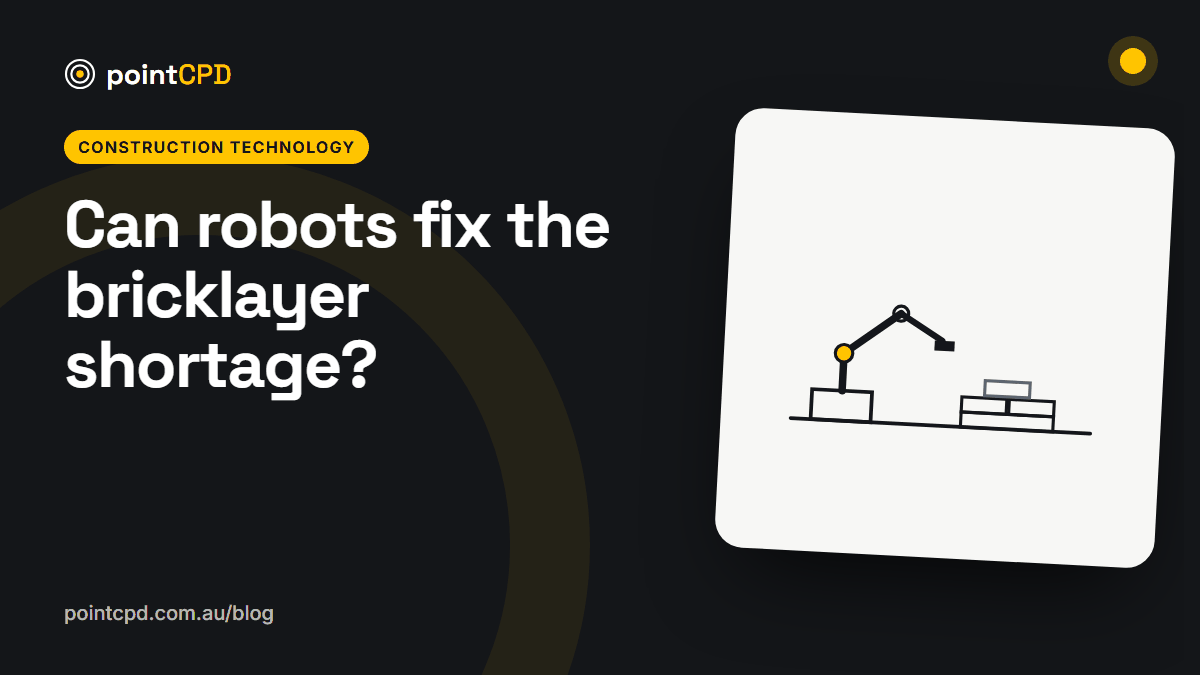
If there is one trade builders complain about more than any other, it is bricklaying. In the Housing Industry Association’s Trades Report for the June quarter 2026, released last month, bricklaying was the scarcest trade in the country, ahead of tiling, roofing and carpentry. A bricklayer shortage delays every stage that follows the brickwork, which is why so many builders have asked whether robots can fill the gap.
Australia happens to be home to one of the best known answers. Perth-based FBR has spent more than a decade developing Hadrian, a truck-mounted robot that lays the walls of a block house. This article looks at how Hadrian and other construction robots work, what they need from builders, and what they realistically mean for the trades.
How Hadrian works
Hadrian is a robotic arm on the end of a long telescopic boom, mounted on a truck. FBR says the boom reaches 32 metres, enough to build walls three storeys high from the roadside. Blocks are fed along the boom by a shuttle system, cut where needed by an on-board saw, glued with adhesive, and placed by a laying head at the end of the boom.
The key technology is what FBR calls Dynamic Stabilisation Technology. A boom that long moves with wind and vibration, and the laying head must place each block precisely. The system measures the movement in real time and corrects for it, which is what allows the robot to lay accurately outdoors.
Hadrian, by the manufacturer’s numbers
Software converts the wall design into block positions. FBR says the robot is designed to lay at up to 360 blocks per hour and could complete the external and internal walls of a standard double brick house in a single day. It operates with a crew of two, a robot operator and a telehandler operator, and FBR publishes operating limits for temperature, light rain and wind gusts.
Not bricks and mortar as we know them
An important detail is what Hadrian lays. It builds with FBR’s own wall system: optimised blocks, which can be much larger than a standard brick, bonded with adhesive rather than mortar. FBR says the system is compatible with render and other finishes. So a Hadrian-built house is a block house designed for the robot, not a conventional face brick house laid by a machine.
That has consequences for builders. The house must be designed around the block system, its sizes, its openings and its structural rules. Lintels, control joints, services and the connections to slab and roof must all be detailed for it. And the certifier needs to be satisfied that the wall system meets the NCC, through the relevant documentation for the system.
Where Hadrian is being used
FBR offers Hadrian through a wall-as-a-service model, where FBR builds the walls for a builder, and has also made the robot available to purchase for selected partners. Industry reports put the number of confirmed deployments in the teens across Australia, the United States and Mexico as of mid-2026, including a pilot with a large US homebuilder in Florida. FBR describes its uses as ranging from single-storey homes and townhouses to commercial projects and childcare centres.
That is real progress for a technology that took many years to reach the field. It is also a small number compared with the scale of the housing industry, which is a reminder that robotic masonry is still in its early commercial phase.
Other construction robots on the way
Construction robots you may meet on a site
| Robot type | What it does | Where it helps most |
|---|---|---|
| Automated block laying | Lays blocks from a digital wall design | Masonry walls on houses and townhouses |
| Bricklaying assistant | Lifts and places bricks while a bricklayer finishes joints | Long straight runs of face brick |
| Layout robot | Prints the floor plan and set-out directly onto the slab | Framing, services set-out, fit-out |
| Rebar-tying robot | Ties reinforcement intersections on large decks | Civil and large slab pours |
| Drilling and installation robot | Drills anchors into ceilings from a design | Commercial services installation |
Automated block laying is only one kind of construction robot. Several others are already in commercial use:
- Bricklaying assistants, used mainly overseas, lift and place bricks while a bricklayer works alongside to tool the joints and handle the details. They reduce the heavy lifting and speed up long runs of face brick.
- Layout robots drive across a slab and print the floor plan, wall positions and service locations directly onto the concrete from the digital design. They are among the most practical robots for builders because they speed up set-out and reduce errors.
- Rebar-tying robots tie reinforcement intersections on large bridge decks and slabs, doing some of the most physically punishing work in civil construction.
- Drilling robots drill anchor holes in ceilings for services on commercial jobs, removing repetitive overhead work.
What these robots have in common is that they take on repetitive, physically demanding tasks in well-defined conditions, using a digital design. They are not general-purpose site workers.
What robots need from builders
What a robot needs from the builder
- A design prepared for the robot’s wall system, block sizes and openings.
- A slab or footings accurate to the tolerances the system specifies.
- Truck access and a stable set-up position within the boom’s reach.
- Weather within the operating limits for wind, rain and temperature.
- Blocks, adhesive and lintels delivered and staged to suit the robot.
- Trades ready for what the robot does not do: services, lintels, finishing and the rest of the house.
Robots are unforgiving of the improvisation that human trades handle every day. A bricklayer can adjust for a slab that is slightly out; a robot needs the base within its tolerances. A carpenter can work around a late design change; a robot laying from a digital design needs the design to be right before it starts. The builders who get the most from robotics are those with accurate set-out, finished designs and well-organised sites.
Design first, robot second. The biggest cost on a robotic job is a design that was not prepared for the robot’s system. Involve the robot provider at design stage, not after the plans are approved.
Planning a robotic masonry job, step by step
For a builder considering a robot-built house, the process looks different from booking a bricklayer.
- Early conversation. Talk to the robot provider before the design is finalised. Confirm the site is suitable: access for the truck, a set-up position within the boom’s reach, overhead lines, slope and neighbours.
- Design for the system. The designer works with the provider’s wall system: block modules, opening sizes, lintels, control joints, wall ties to the frame or roof, and services paths.
- Engineering and approval. The engineer designs to the system’s documentation, and the certifier confirms the compliance pathway for the walls.
- Slab to tolerance. The slab or footings are poured and surveyed to the tolerances the system needs, with any starter details the design requires.
- Logistics. Blocks, adhesive and lintels are delivered and staged; traffic management is arranged if the truck will sit on the road.
- Lay day. The robot lays the walls, with the crew handling blocks and the builder’s supervisor checking set-out, openings and quality as the walls go up.
- Follow-on trades. Roof framing, windows, services and finishes follow, just as they would on a conventional block house.
Quality: where robots help and where they don’t
A robot laying from a digital design places blocks consistently, with accurate heights and openings, and it does not get tired at the end of the day. That consistency is a quality advantage, particularly for wall straightness and opening positions. But the robot is only as accurate as the design and the base it is working from. An error in the design is reproduced faithfully. A slab out of tolerance can stop the robot or produce a wall that has to be corrected.
Details that robots do not handle, such as junctions with windows, control joints, cavity cleanliness where relevant, flashings and the interface with the roof, still depend on people. Builders should inspect those details as carefully on a robot-built wall as on any other.
Questions to ask a robot provider
- What wall system does the robot use, and what documentation supports its compliance with the NCC?
- What site access and set-up conditions does the robot need?
- What tolerances must the slab or footings meet?
- What are the weather limits, and what happens to the programme if weather stops work?
- Who is responsible for defects in the walls, and what warranty applies?
- What does the price include: blocks, adhesive, lintels, cutting, clean-up?
What it means for trades
It is natural for bricklayers to see robots as a threat. The reality over the next decade is more nuanced. The shortage of bricklayers is severe, and demand for masonry homes remains high. Robots are more likely to fill some of the gap than to replace the bricklayers who exist. They also change the skills mix: operating and maintaining robots, setting out accurately, handling the details the robot does not, and finishing work.
For apprentices, the lesson is that masonry skills combined with digital skills, reading a model, setting out accurately and operating equipment, are likely to be more valuable, not less.
Safety and robots on site
A large robot with a long boom is plant, and it brings plant hazards: exclusion zones under the boom, overhead power lines, stability on uneven ground, and interaction with other workers and vehicles. The robot’s own safety systems are part of the answer; the site’s traffic management, exclusion zones and SWMS are the rest. On the positive side, robots take on some of the heaviest manual handling in construction, which is a major source of injury for bricklayers and labourers.
Cost and business model
Few builders will buy a bricklaying robot. The more likely models are service-based: the robot provider builds the walls for an agreed price, as a specialist subcontractor would, or a trade business partners with the provider to operate a robot in a region. For builders, the question is the same as for any subcontractor: price, reliability, quality, programme, and who is responsible for defects.
What to watch
- Deployment numbers. The move from pilots to routine use is the real test of robotic masonry.
- Approval pathways for robot-built wall systems, and how easily certifiers accept them.
- Cost per house compared with conventional masonry, once the novelty premium fades.
- Government support, as states back modern methods of construction to lift housing supply.
The bottom line
Robotic bricklaying is real, Australian-made, and working on actual houses. It will not replace bricklayers overnight, and it requires houses designed for its wall system. But in a market where bricklaying is the scarcest trade, robots that can lay a house’s walls in a day are likely to become part of the answer. Builders who understand what the robots need, accurate slabs, finished designs, organised sites, will be ready to use them.
Questions builders ask
Is there a bricklaying robot in Australia?
Yes. FBR, based in Perth, developed Hadrian, a truck-mounted robot that lays blocks with adhesive from a 32 metre boom. It has been deployed on projects in Australia and overseas.
How fast can Hadrian lay bricks?
FBR says Hadrian is designed to lay up to 360 blocks per hour and could complete the external and internal walls of a standard double brick house in a day.
Does Hadrian use normal bricks and mortar?
No. It uses FBR’s wall system of optimised blocks bonded with adhesive, so the house must be designed for that system.
Will robots replace bricklayers?
Not in the near term. Robots are more likely to fill part of a severe shortage and change the skills mix, with people still needed for operation, set-out, details and finishing.
What other construction robots are in use?
Layout robots that print floor plans onto slabs, rebar-tying robots, drilling robots for ceiling anchors, and bricklaying assistants that lift and place bricks alongside a bricklayer.
Sources
- Hadrian: automated construction robot · FBR
- Tradie shortages remain entrenched despite housing market uncertainty · Housing Industry Association · 2026-07-28
Published 12 August 2026. General information for builders, not legal, financial or engineering advice for a specific job. Check current requirements with the relevant regulator or standard before relying on them.