Key takeaways
- Flying a drone for your business is commercial use under CASA rules, even on your own site. Drones of 2 kg or less can be flown for work without a remote pilot licence, but you need an aviation reference number, operator accreditation and a registered drone.
- The standard operating conditions apply: no higher than 120 metres, at least 30 metres from other people, never over people, within visual line of sight, in daylight, and one drone at a time.
- Anything heavier than 2 kg, or any flight outside the standard conditions, needs a remote pilot licence (RePL) and a remote operator certificate (ReOC).
- The biggest payoffs on residential jobs are roof and gutter inspections without a ladder, dated progress records, and survey-grade site models from photogrammetry.
- Treat workers on site as other people for the 30 metre rule unless they are part of the flight, and plan flights for before or after trades are working.
Five years ago a drone on a house site was a novelty, usually the real estate agent’s. Today a small drone sits in plenty of builders’ utes next to the laser level. It does three jobs better than anything else a residential builder owns: it gets eyes on a roof without a ladder, it records the job from above on a schedule, and it can turn a set of photos into a measurable model of the site.
It also brings rules that many builders do not realise apply to them. The moment a drone is flown for a business purpose, it is commercial use in the eyes of the Civil Aviation Safety Authority (CASA), even if the business is yours, the site is yours and nobody is paying for the footage. This guide covers what the rules require, what drones are actually good for on residential and small commercial jobs, and how to start without a licence.
The CASA numbers every builder flying a drone should know
What a drone actually does on a building job
It is easy to buy a drone and use it for a few pretty photos. The builders who get real value use it for a handful of repeatable tasks.
Roof, gutter and flashing inspections
Most roof defects are visible from above: missing or lifted fixings, damaged or poorly lapped flashings, debris in valleys, sagging gutters, cracked tiles, and penetrations that were never sealed. A drone lets you see all of it in minutes, from the ground, without anybody going up a ladder or onto the roof. On a second-storey roof, that is a real reduction in working-at-heights exposure, and falls from height remain one of the leading causes of death in construction.
For handover and maintenance-period inspections, a drone gives you dated, high-resolution images of the roof in the state you handed it over. That record can be decisive if a leak turns up months later and the question is whether the roof was damaged by another trade or a storm.
Progress records that line up week to week
A weekly flight on the same route, at the same height, from the same take-off point, produces a set of images that show exactly when each stage happened. Slab poured, frame up, roof on, windows in, cladding complete. It is a better record than a phone photo because it shows the whole site, including the parts that later disappear: set-out, drainage runs, trenches, service locations and temporary works.
That record earns its keep in disputes over delays, variations and extensions of time, where the argument is often about what was done when. It is also the simplest client update you can send: an owner living interstate sees their whole house from above every Friday.
Site surveys and measurable models
Photogrammetry software turns an overlapping grid of drone photos into an orthomosaic, a single, scaled plan image of the site, and a 3D model with surface levels. On a knockdown rebuild or a sloping block, that model gives you cut and fill estimates, stockpile volumes and a record of existing levels before work starts. It does not replace a registered surveyor for boundaries, set-out or anything that must be certified, but it is excellent for planning and for recording what was there.
Thermal imaging
Drones with thermal cameras can find missing insulation, air leaks and moisture patterns in roofs and walls. Thermal imaging is easy to misread, because surface temperature depends on sun, wind and time of day, so treat it as a way to find places to investigate, not as proof of a defect on its own.
Marketing
Completed homes photographed from the air sell a builder’s work better than any brochure. It is the use most builders start with, and it is legitimate, but it is also the least valuable use of the drone in terms of time saved on site.
The CASA rules that apply to builders
CASA regulates every drone flight in Australia. For a builder, the key distinction is between flying for fun and flying for work. Flying for work includes inspecting your own roof for a client, recording progress on your own job, and taking photos for your own website. There is no exemption for “my own business on my own site”.
The standard operating conditions
Every commercial flight in the excluded category must stay within CASA’s standard operating conditions. In plain words:
Standard operating conditions, in plain words
- Fly no higher than 120 metres above the ground.
- Keep at least 30 metres from other people.
- Never fly over or above people, including over a crowd or an occupied neighbouring yard.
- Keep the drone within your own visual line of sight, not only on the screen.
- Fly only in daylight and not into cloud or fog.
- Fly one drone at a time.
- Stay out of controlled airspace near airports unless you have approval, and away from emergency operations.
- Do not fly in a way that creates a hazard to another aircraft, person or property.
Source: CASA drone rules. Check the current rules and a CASA-verified drone safety app before every flight.
The 30 metre rule is the one that catches builders. On a busy residential site, the people within 30 metres are your trades, and a neighbour hanging out washing next door. CASA’s rule is about other people, meaning people who are not part of the operation. A carpenter on the frame is not part of your drone flight just because they work for you. The practical solution is to fly before trades arrive or after they leave, or to pause work in the flight area with a clear briefing. Flying directly over workers is not permitted under the standard conditions, and it is a genuine hazard: a small drone falling from height onto a person can cause serious injury.
The excluded category: flying commercially without a licence
If your drone weighs 2 kg or less and you stay within the standard operating conditions, you can fly commercially in what CASA calls the excluded category. You do not need a remote pilot licence or a remote operator certificate. You do need to:
- Get an aviation reference number (ARN). A business may need an organisation ARN rather than a personal one.
- Register the drone with CASA before flying it for business.
- Hold operator accreditation, which is completed online and involves learning the rules and passing a short test.
- Follow the standard operating conditions on every flight.
Most of the drones builders buy for inspections and progress photos fall under the 2 kg limit, which is why the excluded category is the sensible starting point for a small building business.
CASA splits drones into weight classes: micro (250 g or less), very small (over 250 g up to 2 kg), small (over 2 kg up to 25 kg) and medium (over 25 kg up to 150 kg). A micro drone flown for work still needs the ARN, accreditation and registration. There is also a landowner excluded category for heavier drones flown over your own land without payment, which suits farmers but rarely a builder, because a building site is normally the client’s land and the flight is part of a paid job.
It is worth reading CASA’s plain English guide to micro and excluded category operations once, end to end. It is short, and it answers most of the questions builders ask about what is and is not allowed. Penalties apply for flying for work without accreditation or with an unregistered drone, and CASA does act on complaints from the public.
When you need a licence and certificate
Flying a heavier drone commercially, or flying outside the standard operating conditions, requires a remote pilot licence (RePL) for the person at the controls and a remote operator certificate (ReOC) for the business, or engaging someone who holds them. That is the path for survey-grade mapping with larger drones, flights near controlled aerodromes, or work that needs approval to operate closer to people.
Two legal ways to fly for your business
| Excluded category (sub-2 kg) | RePL + ReOC | |
|---|---|---|
| Drone weight | Up to 2 kg | Heavier drones allowed within your certificate |
| Pilot licence | Not required | Remote pilot licence required |
| Operator certificate | Not required | Remote operator certificate required |
| Registration and accreditation | Drone registration and operator accreditation | Registration, plus the conditions of the ReOC |
| Flight envelope | Standard operating conditions only | Can apply for approvals outside them |
| Typical builder use | Progress photos, roof checks, marketing | Survey work, larger sensors, complex sites |
Source: CASA drone rules for commercial operators.
Airports are closer than you think. Many suburban building sites sit within 5.5 kilometres of a controlled aerodrome, including smaller general aviation airports. Check a CASA-verified drone safety app for your exact site before the first flight, not after you have unpacked the drone.
Privacy, neighbours and the client
Aviation rules are not the only rules. A drone with a camera records whatever it sees, including neighbouring yards, windows and people. State surveillance and privacy laws differ, and the safe practice is the same everywhere:
- Keep the camera pointed at your site and frame shots so neighbouring properties are not the subject.
- Tell neighbours when you will be flying if the flights are regular. A quick note in the letterbox prevents most complaints.
- Do not publish images that show identifiable people or other people’s property without thinking about consent.
- Put drone photography in your contract or client communication, so the owner knows the job will be recorded from the air and how the images will be used.
Drone flights and WHS on site
A drone flight is an activity on a construction site and belongs in your safety system like any other. The hazards are straightforward: the drone striking a person, a structure or a power line; a flyaway; a battery fire; and distraction of workers at height who look up at the drone.
Controls that work:
- A short written procedure for drone flights, covering pre-flight checks, the exclusion zone, weather limits and what to do if the drone loses signal.
- A site briefing or toolbox mention before regular flights, so nobody is surprised.
- No flights while anyone is working at height in the flight area.
- Battery storage and charging away from combustibles, with damaged batteries removed from service.
- A log of every flight: date, time, pilot, drone, purpose and any incident.
The same risk assessment template you use for other site activities works for drone flights. It also gives you a record that you considered the risks if anything ever goes wrong.
A repeatable site flight, start to finish
- 1Check the airspaceOpen a CASA-verified app and confirm you are clear of controlled airspace and restrictions.
- 2Walk the siteLook for cranes, power lines, trees, overhead services and people. Decide your take-off spot and exclusion zone.
- 3Brief the siteTell anyone on site when you will fly. Pause work in the flight area or fly before trades arrive.
- 4Fly the same routeUse a saved flight plan so each week’s photos line up and can be compared.
- 5Log itRecord date, time, pilot, drone and what was captured. File images to the job, not a phone.
What to buy, and what it takes to run
For most residential builders, a compact camera drone under 2 kg with obstacle sensing, a good 1-inch-class or similar sensor, and at least 30 minutes of flight per battery covers inspections, progress and marketing. A spare battery or two matters more than any other accessory: a roof inspection and a progress flight on the same visit can use more than one battery.
Budget for the things that are easy to forget:
- Insurance. Check whether your public liability policy covers drone operations. Many general policies exclude aircraft, and drones can fall into that exclusion. Drone-specific liability cover is widely available.
- Software. Flight planning apps that repeat a route, and photogrammetry software if you want models and measurements. Some are subscription-based.
- Storage. Drone images are large. File them to the job in your project system or cloud storage, not on a phone or the drone’s memory card.
- Time. The first few flights take longer than you expect. Once the routine is set, a progress flight takes minutes.
How to start in a week
- Choose the task first. Decide whether you want roof inspections, progress records, surveys or marketing. That decides the drone and software.
- Complete operator accreditation and register the drone with CASA before the first work flight.
- Practise on an empty site or open field until take-off, hovering, returning home and landing are routine.
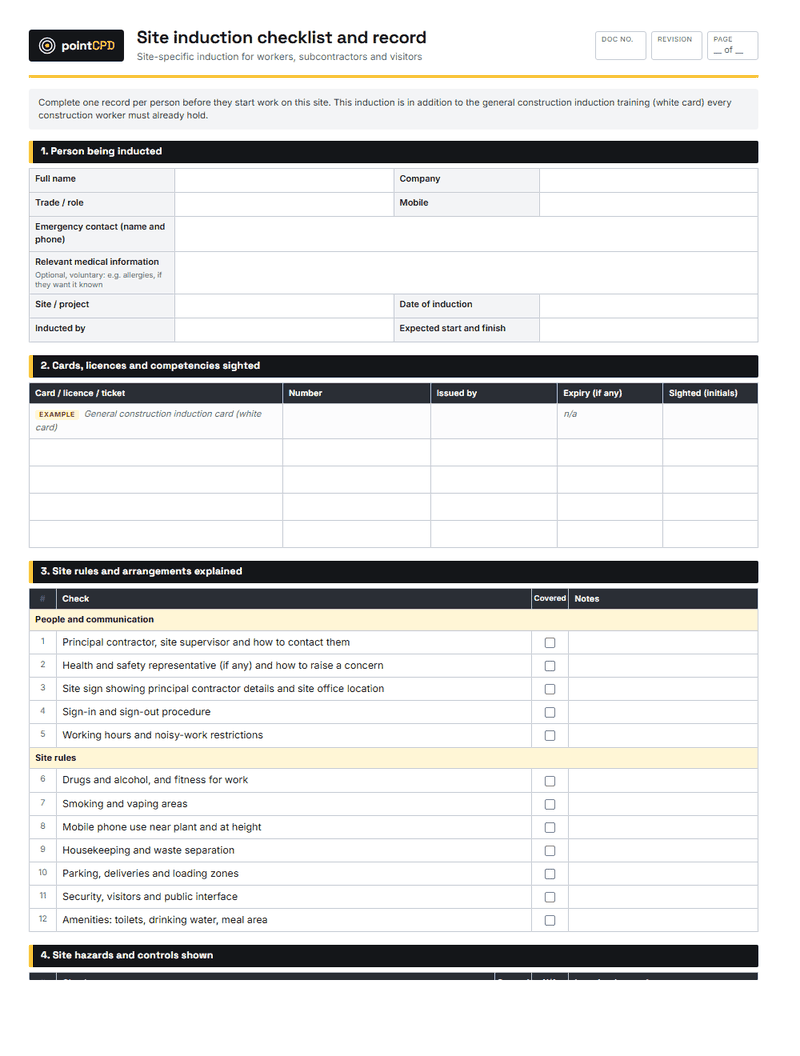
- Write a one-page procedure and add drone flights to your site induction, so trades know what to expect.
- Pick one live job and fly it every week on the same route. Send the images to the client. You will know within a month whether it is worth rolling out.
Where drones are heading on building sites
The direction is towards automation and integration. Drones that fly a saved mission without a pilot touching the sticks already exist, and the images increasingly flow straight into project software, where they are compared with the design model to flag differences. For larger builders, that means progress reporting that runs itself. For small builders, the gains are simpler: fewer ladders, better records and happier clients.
The rules will keep evolving too, particularly around flying beyond visual line of sight and automated operations. The safe assumption is that CASA will continue to treat any work flight as commercial, and that builders who set up properly from the start will be the ones able to take advantage of what comes next.
Questions builders ask
Do I need a licence to fly a drone on my own building site?
Not if the drone weighs 2 kg or less and you stay within CASA’s standard operating conditions. Flying for your business is still commercial use, so you must register the drone and hold operator accreditation. Heavier drones, or flights outside the standard conditions, need a remote pilot licence and a remote operator certificate.
Can I fly a drone over workers on my site?
Not under the standard operating conditions. You must not fly over people and must stay at least 30 metres from other people. Plan flights for before or after work, or pause work in the flight area.
How high can a drone fly for a roof inspection?
The standard operating conditions allow up to 120 metres above ground level, far more than a roof inspection needs. Most roof checks are flown at a few metres above the roof line.
Can a drone survey replace a registered surveyor?
No. Drone photogrammetry is useful for planning, volumes and records of existing conditions, but boundary identification, set-out and any survey that must be certified still need a registered surveyor.
Does my insurance cover drone use?
Check your policy. Many general liability policies exclude aircraft, and drones can fall within that exclusion. Drone-specific liability cover is widely available.
Sources
- Drone rules · Civil Aviation Safety Authority
- Drone weight categories and requirements · Civil Aviation Safety Authority
- Key WHS statistics Australia · Safe Work Australia
Published 31 July 2026. General information for builders, not legal, financial or engineering advice for a specific job. Check current requirements with the relevant regulator or standard before relying on them.