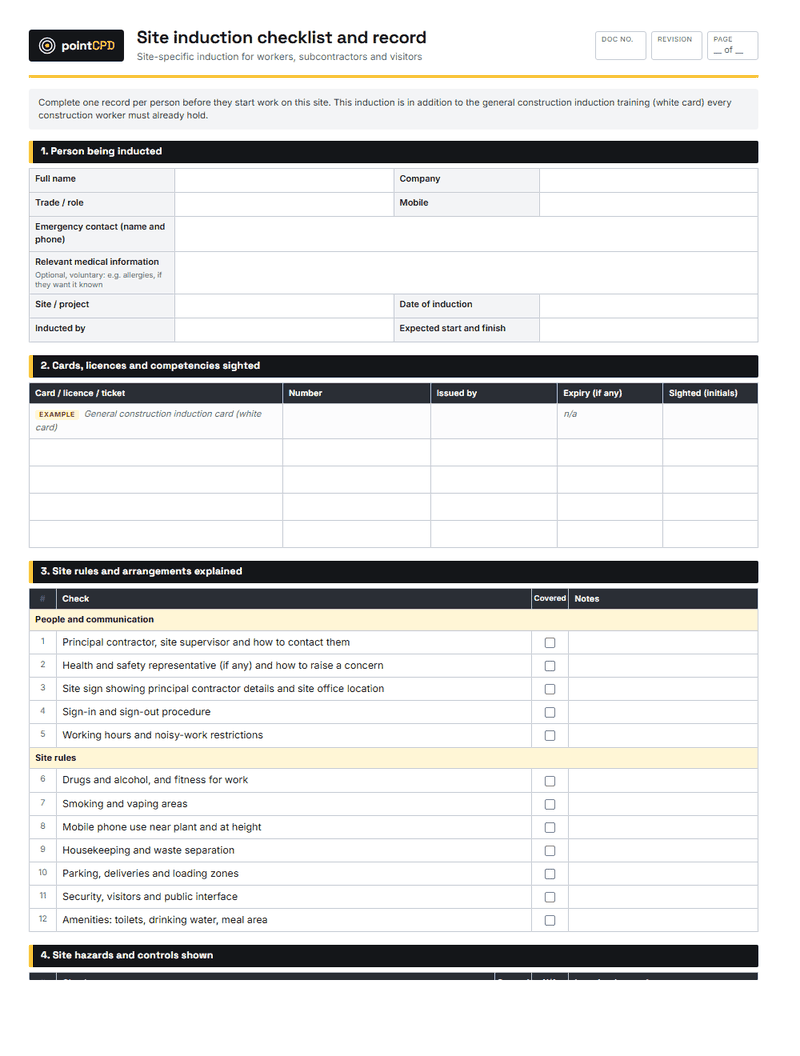
A site induction is the first real safety conversation a worker has on your job, and the one you will be asked to prove happened if anything goes wrong. This template turns it into a checklist the supervisor can run in the same order every time, with the card and licence checks and a signed record at the end.
White card and site induction are two different things
Every person who does construction work must first complete general construction induction training, recognised nationally by the card most builders still call the white card. It is a one-off course about construction safety in general. It says nothing about your site.
A site-specific induction covers what is different about this job: who is in charge, the site rules, the hazards on this block, the emergency arrangements, the amenities, and the SWMS for the person’s work. It is done before the person starts on site, every time they start on a new one.
The template checks both. Section 2 records the white card and any licences, such as a high risk work licence for the plant they will operate. The rest is the site-specific induction.
What the law expects
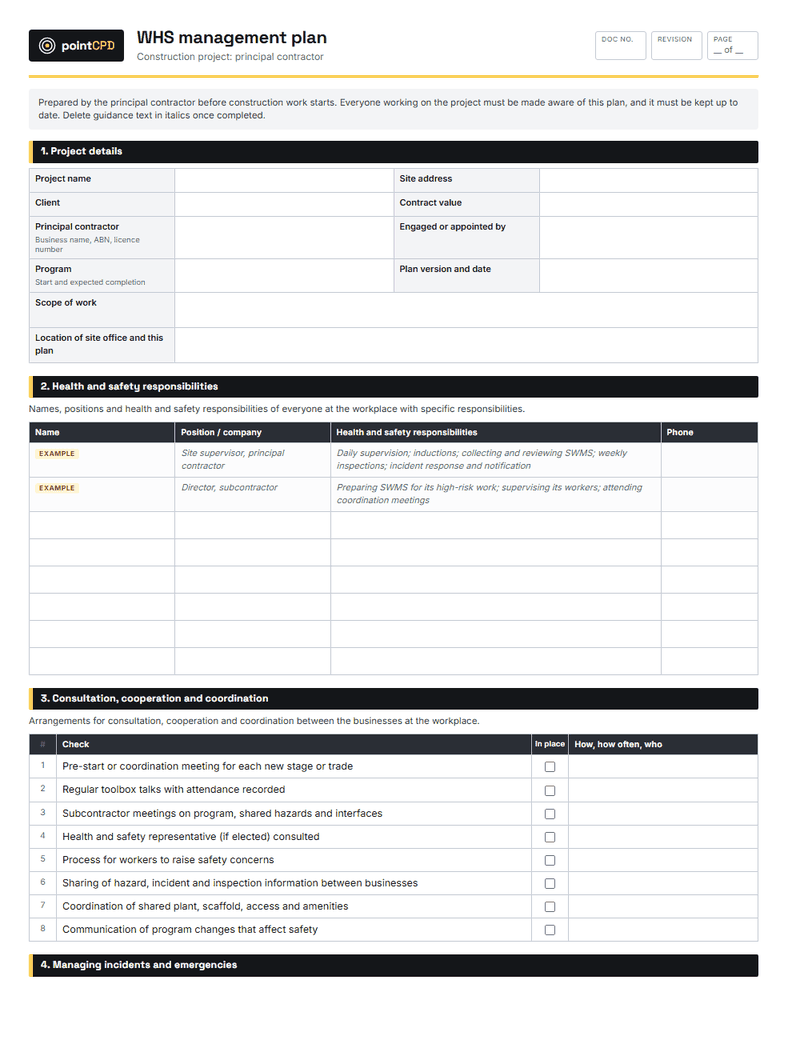
WHS laws require every business to provide the information, training, instruction and supervision people need to work safely. On a construction project, meaning construction work costing $250,000 or more, the principal contractor has extra duties: to prepare a WHS management plan, to make sure people working on the project are aware of it, and to put up signage identifying the principal contractor and how to contact them.
No regulation prescribes an induction form. What matters is being able to show that each person was told what they needed to know before they started, by someone who knew the site. A signed checklist is the simplest evidence there is.
What to cover, and why each part is there
| Section | Why it matters |
|---|---|
| Cards and licences | A worker without the white card must not do construction work. A licence check is the only way to know an operator is qualified for the plant. |
| Site rules | Sign-in, drugs and alcohol, phones, housekeeping and deliveries are where disputes start. Explaining them up front makes them enforceable. |
| Site hazards | Generic training cannot tell a worker where the unprotected edge or the buried service is on this site. |
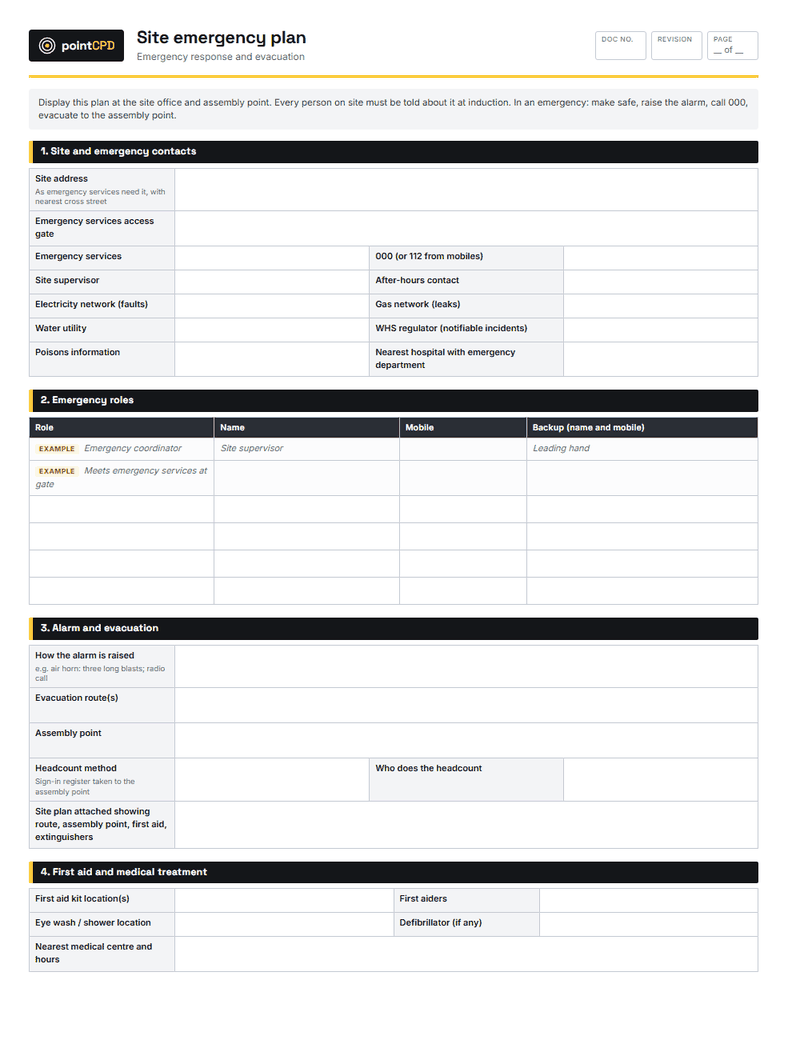
| Emergencies | People need to know the alarm, the assembly point and the first aid kit before an emergency, not during one. |
| SWMS and PPE | The principal contractor must obtain SWMS for high-risk work before it starts. Induction is the natural checkpoint. |
Walk the site, do not just talk
An induction delivered from a clipboard in the site shed is better than none. An induction delivered while walking the site is far better. Point at the scaffold tag and explain the system. Stand at the edge of the excavation and show the exclusion zone. Show where the assembly point actually is. People remember what they have seen.
Check understanding, do not ask if they understood
“Any questions?” produces a shake of the head. Instead ask two or three direct questions at the end: where is the assembly point, who do you tell if you see a hazard, what do you do if your SWMS cannot be followed? If the answers are right, sign off. If not, go over it again. For workers with limited English, use pictures, a translated sheet, or a colleague who can interpret, because the duty is to make sure they understand.
Subcontractors, labour hire and visitors
Everyone who does work on the site is inducted, regardless of who employs them. Subcontractors often assume their own company induction covers them; it does not cover your site. Labour hire workers are owed the same induction as your own staff. Visitors who are escorted at all times can have a shorter visitor induction, but still need the emergency procedure and the hazards they will pass.
When to re-induct
- When the site changes significantly: a new stage, a crane arriving, scaffold going up, a change in access.
- When someone returns after a long break from the site.
- When the induction content itself changes, for example after an incident.
Smaller changes can go into a toolbox talk, recorded on the attendance sheet.
Keeping the records
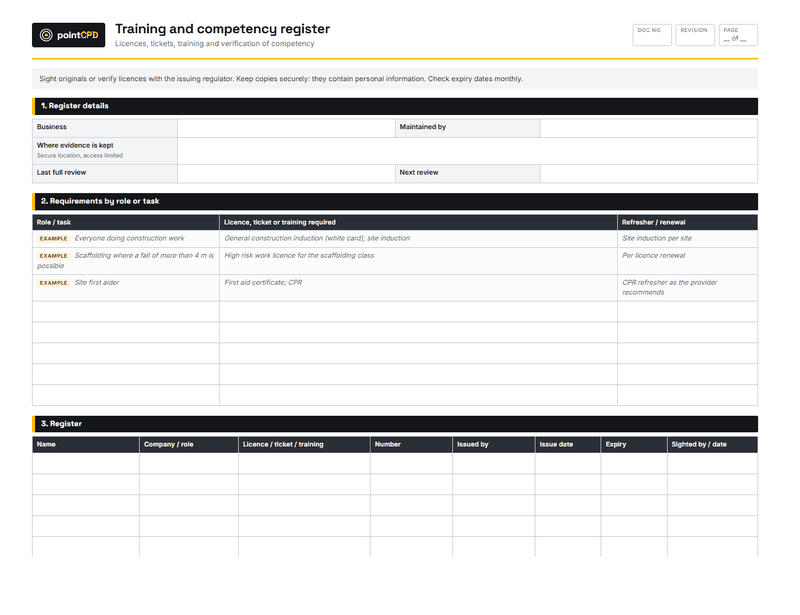
Keep induction records with the project WHS records. Together with the training and competency register, they show who was on site, what they were told, and what they were qualified to do. If a regulator, insurer or court asks how a worker was prepared for the job, this is the first document they will want.
Visitors, delivery drivers and the client
Not everyone who enters a site needs the full induction, but everyone needs enough to stay safe while they are there.
| Person | Practical approach |
|---|---|
| Delivery drivers | Brief set-down rules at the gate: where to park, where to unload, no entry beyond the set-down area, spotter for reversing. Record them in the sign-in register. |
| Client and family | Visits by appointment, always escorted, PPE provided, children kept out of active work areas. A short visitor induction and the emergency procedure. |
| Consultants and certifiers | A visitor induction covering current hazards and PPE. Most will be familiar with sites but not with yours. |
| Short-duration trades | A full site induction, even for a half-day task. The hazard does not know how long they are staying. |
Keep the visitor induction to one page: hazards they will pass, the PPE rule, the assembly point and the escort requirement. Record it in the same way as a full induction.
Inductions for workers with limited English
A large share of the construction workforce speaks English as a second language, and the duty is to make sure people understand the information, not just to deliver it. Practical options include a translated one-page summary of the site rules, pictures and signs rather than text, a walk-around where hazards are pointed at rather than described, and a bilingual worker from the same crew helping to explain. Check understanding with simple questions and by watching the first few hours of work. Record how the induction was delivered, for example “inducted with interpreting by crew leader”, so the record shows the effort made.
Online pre-inductions, where workers watch a short video and answer questions before arriving, can save time on larger jobs. They should add to the on-site induction rather than replace it, because the walk-around is where people see this site’s hazards.