Key takeaways
- Fatigue is a hazard with a control hierarchy, not a judgement about someone’s stamina, and the person who sets the programme and the hours carries most of the control.
- Programme pressure converts into fatigue through compressed trades, extended shifts, early starts and travel time that never appears on a programme.
- Fatigue shows up first in tasks with no margin for a slow reaction — mobile plant, concrete pumping, electrical work, work near excavations and anything at height.
- Hours, start times, travel arrangements and the sequence of trades are commercial decisions a builder already makes, so they can be made with fatigue in mind.
- The conversation before someone drives home is a site control, not a courtesy, and it needs to happen while the person is still fit to take part in it.
Ask a supervisor why a worker made a mistake at the end of a long week and you will usually get a character answer. He was tired. He should have known better. He has done that task a hundred times. The character answer is comfortable because it puts the problem in the worker and the solution nowhere in particular.
Work health and safety law does not work that way. Fatigue is a hazard, and hazards are controlled by whoever has the capacity to control them. On a residential build, the person who sets the programme, books the trades, decides the start time and accepts the delivery window has most of that capacity. That is the builder or the site supervisor, not the apprentice who has been on site since first light.
This article is about fatigue as a duty. It covers how programme pressure manufactures it, which tasks fail first when people are tired, what a builder can actually control about hours and travel, and how to have the conversation before someone gets in a ute and drives home.
Fatigue is a hazard, not a personality trait
Safe Work Australia treats psychosocial hazards as hazards like any other, and fatigue sits inside that family. It arises from the way work is designed, organised and managed, not from a worker’s private shortcomings. The model code of practice on managing psychosocial hazards at work is built on that premise: you identify the hazard, you assess the risk, you apply controls, and you review whether they worked.
The practical consequence is that “he should have gone home” is not a control. It is a description of a control that failed. If the only thing standing between a tired worker and a serious incident is that worker’s own judgement at the end of a long shift, you have no control at all, because the judgement you are relying on is the thing fatigue degrades first.
Treat fatigue the way you treat falls from height. You do not tell a roofer to be careful. You provide edge protection, you sequence the work so the roof is done before the scaffolding comes down, and you check the protection is still in place. Fatigue responds to the same logic: design the work, then verify.
How programme pressure converts into fatigue
Fatigue on a residential site rarely arrives as a single dramatic event. It accumulates through ordinary commercial decisions that each look reasonable in isolation.
Compressed trades
When a frame is late, the trades that follow do not get more time. They get the same time in a shorter window, which means more people in the same space, longer days, and overlapping work that would normally be sequential. Compression is a scheduling decision, and its cost is paid in attention.
Extended shifts to catch up
Saturday work, early starts before a concrete pour, and late finishes to get a roof on before weather arrives are all normal. Each one is defensible. A run of them is a fatigue exposure, and nobody writes it down because each individual decision was made for a good reason.
Travel that never appears on the programme
A worker living an hour from the site, on a job that starts at first light, has a working day that begins well before the shift. Travel time is real time and it does not show on any programme. It is also invisible to the supervisor, who sees the worker arrive and assumes the day started then.
The second job
Subbies and labour hire often move between sites. A person who finished late on another job and started early on yours has a cumulative exposure you did not create but are now responsible for managing, because they are working under your arrangements.
The tasks where fatigue shows up first
Fatigue does not degrade all work equally. It hits hardest where the task has no margin for a slow reaction, a missed cue or a lapse in sequencing. On residential work, four areas stand out.
Mobile plant and concrete pumping
Concrete pumping is a high-consequence activity with plant, pressure and people in proximity. Safe Work Australia’s guidance on concrete pumping deals with the plant, the exclusion zone and the people involved, and every one of those controls assumes an operator who is alert. A pump operator who has been on site since before dawn and is running the boom on the last load of the day is the classic fatigue exposure, and the consequence is not a rework cost.
Electrical work
Electrical safety guidance is built around isolation, testing and verification. Each of those steps depends on a person following a sequence without skipping it. Fatigue produces skipped steps, and a skipped step in electrical work is the one you do not get to correct. The same logic applies to testing and tagging, to temporary supply, and to anything involving live work.
Excavations and work near them
Trench collapses and struck services cluster around the end of the day, when the digging is nearly done and the attention has moved to packing up. Fatigue affects the person spotting, the person operating and the person checking the services plan.
Anything at height, and anything with a fall consequence
Roof work, scaffolding, edge protection and ladder work all punish a lapse. So does the ordinary task of carrying materials up a scaffold at the end of a shift when the lift is booked elsewhere.
Lead in. The mistake that costs the most is treating fatigue as a conversation you have after an incident instead of a control you build into the programme. If the first time fatigue is named on your site is in a statement to a regulator, you have already lost the argument about whether you managed the hazard.
What a builder can actually control
The useful question is not whether workers get tired. They will. The useful question is which parts of the working day are yours to set. On a residential build, the list is longer than most builders assume.
- Start times. A first-light start is a choice. If it exists to beat traffic or a delivery window, that is a trade-off you can state and manage, not a natural fact.
- Shift length and the run of shifts. One long day is not the problem. Five of them in a row, on the same crew, is.
- Sequence and access. Spreading the trades so two of them are not fighting over the same scaffold at the end of the day reduces both frustration and hours.
- Travel and accommodation. Where a crew is travelling a long distance, the arrangement is a commercial decision. So is putting them up locally for the final push.
- Who is on site at the end of the day. The last hour is the highest-risk hour. Staffing it deliberately is a control.
- The pre-start. A pre-start is the cheapest fatigue control available, and it is the one most often run as a formality.
These are the same decisions a builder already makes for cost and programme reasons. The shift is to make them with fatigue as one of the inputs, and to write down what you decided. A programme note that says the pour was moved to avoid a late finish is evidence of a control. A memory of a conversation is not.
It is worth linking this back to how you document risk generally. The same discipline that sits behind a workable SWMS for residential building work applies here: identify the hazard, name the control, and make it something a new supervisor could pick up and follow.
Fatigue controls: reactive versus planned
| Reactive approach | Planned approach |
|---|---|
| Hours are set by whoever is on site longest | Hours are set when the programme is written |
| Travel is the worker’s problem | Travel and start times are part of the engagement |
| Fatigue is raised after an incident | Fatigue is raised at the pre-start |
| A tired worker is sent home mid-shift | Task allocation accounts for the shift ahead |
| Sequence is driven by trade pressure | Sequence is driven by risk and access |
Hours and travel are commercial decisions
Builders push back on fatigue management because it sounds like a cost with no return. In practice, the costs of unmanaged fatigue are already on the job, just recorded under other headings.
Rework from a mistake made at the end of a shift is a direct cost. So is a damaged service, a failed inspection, a delivery that has to be re-booked, or a variation caused by work that has to be pulled out. So is the labour of the crew that has to come back to fix it. None of these appear as fatigue costs, which is exactly why the hazard stays invisible on the balance sheet.
The bigger exposure is the one that does not have a price until it does. A serious incident on a site where the programme shows a run of extended shifts, and where no fatigue control is documented, is a difficult position to explain. The regulator will ask what you knew about the hours being worked and what you did about them. “The subbie chose to work those hours” is a weaker answer than builders expect, particularly where the hours were needed to meet a date the builder set.
Travel sits in the same bucket. Where you have chosen a site, a start time and a crew, you have created a travel exposure. The control might be as simple as a later start on the day after a late pour, or a roster that keeps the same people off the early shift on consecutive days. It does not need to be elaborate. It needs to exist and be recorded.
The conversation before someone drives home
The highest-consequence moment in a fatigued worker’s day is often the drive home. It is unsupervised, it involves a public road, and the person doing it is the least equipped to judge their own fitness. This is where a builder’s duty extends past the site fence in a practical sense, and where the conversation has to happen early enough to matter.
There are three things to get right.
Have it before the person is unfit to take part
A conversation at the gate at the end of a long day is too late. The person is already in the ute, already deciding, and already impaired in their judgement. The conversation belongs at the pre-start, or at the point where the day is being planned, when the person can still make an arrangement.
Make it about the arrangement, not the person
“Are you right to drive?” invites a yes. It also makes the answer a statement about the worker’s toughness, which is exactly the frame you are trying to break. Better to ask about the plan: who is travelling with whom, who is staying locally, who is not on the early shift tomorrow. The question is about logistics, and the answer is not a confession.
Give the person somewhere to land
A control that depends on the worker finding their own solution is not a control. If the answer to a long drive is a motel room, someone has to be able to authorise it. If it is a later start, someone has to be able to change the programme. If it is a lift with a workmate, the workmate needs to know before the end of the shift.
This is the same principle that applies in the tighter, more obviously dangerous corners of a residential site. The controls for confined space work in residential plumbing pits work because they are arranged before anyone enters, not improvised at the opening. Fatigue is less dramatic but the structure is identical.
A worked example: the final week before handover
A builder in western Sydney is finishing a two-storey project with a fixed handover date. The frame was delayed by weather, the brickwork started late, and the internal trades are now stacked on top of each other. To hold the date, the builder puts on Saturday work for three consecutive weekends, starts the renderers at first light to beat the heat, and asks the electrician to come back after the other trades have left so the two do not conflict.
Nothing in that plan is unusual. Each decision has a reason. What the builder has not done is write any of it down as a fatigue exposure, and the effects are already visible. The renderers are travelling from outside the area and leaving home well before dawn. The electrician is working a second job on another site in the afternoons. The leading hand is running the crew all day and then doing the site diary and the material orders at night.
On the second Saturday, the electrician is roughing in on the first floor while the renderers are still working below. Nothing happens. On the third Saturday, the leading hand reverses a ute into a stack of tiles that had been moved to a different position the day before. The cost is a pallet of tiles and a day of lost time, and the immediate explanation is that he did not see them.
The builder’s response is the part that matters. Rather than treating it as a moment of carelessness, the builder maps the last three weeks: who started when, who travelled how far, who was on a second job, who was doing admin after hours. The pattern is obvious. The controls that follow are modest and cheap. The renderers start later on the days after a long pour. The electrician is booked for a full day rather than an evening return. The leading hand’s admin moves to a daytime slot with the supervisor covering the floor. The handover date holds, and the near-miss is recorded as what it was.
The value of the example is not the specific fix. It is that the builder had the information to make the fix because someone finally wrote the hours down.
Pre-start fatigue checks a supervisor can actually run
- Ask each person what they did before they arrived on site, not just how they feel now.
- Check whether anyone has come from another job or a second employer that day.
- Look at the task list against who is on site and what plant is running.
- Confirm travel arrangements for anyone on a long drive home.
- Note anyone on medication or returning from leave and adjust the task, not the person.
- Record the conversation and the control you applied in the site diary.
- Re-check after lunch, because the afternoon is where the errors cluster.
Making it a system rather than a good intention
A fatigue conversation that depends on a supervisor noticing is fragile. It disappears when the supervisor changes, when the programme tightens, or when the person who cares is on leave. The way to make it durable is to attach it to things that already happen on the job.
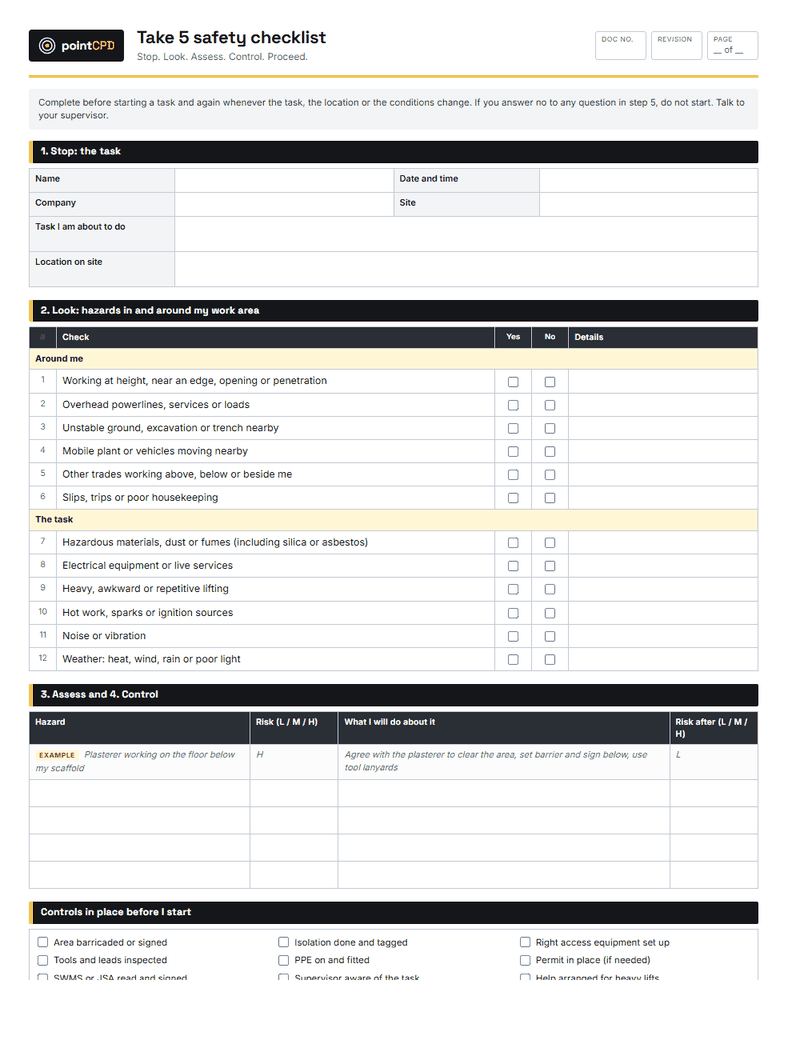
Put fatigue on the pre-start. Not as a lecture, but as two questions: what did you do before you got here, and what is the drive home. Record the answer when it changes something. Use the take-five process you already run for task-level hazards to catch the fatigue element of a task, particularly where plant, electrical work or height is involved. A take-5 checklist template is a reasonable place to add a fatigue prompt, because it is already in the crew’s hands.
Then review it. If the same crew is on extended shifts for a month and nothing has been adjusted, your control is not working, whether or not anything has gone wrong. The absence of an incident is not evidence that a hazard is managed, particularly with fatigue, where the near-misses are quiet and the serious events are rare and severe.
For builders working through their continuing professional development, this is squarely within the safety and risk material that the scheme expects you to keep current, and the guide to how NSW builder CPD works sets out how the requirements are structured. If you want to build the documentation side properly, the course catalogue covers the relevant safety and compliance topics.
Frequently asked questions
Is fatigue actually a WHS issue or just a management problem?
It is a work health and safety matter. Fatigue is a psychosocial hazard arising from how work is designed, organised and managed, and the model code of practice on psychosocial hazards treats it as one of the hazards a person conducting a business or undertaking must identify and control.
Whose responsibility is it when a subbie works long hours on another job?
The subbie’s employer has duties, and so do you as the principal contractor for the work under your arrangements. You control the start time, the sequence, the access and the site rules. If your programme requires the hours, the exposure is partly yours regardless of who employs the person.
Can I just tell workers to speak up if they are too tired?
You can, but it is weak as a control on its own. Fatigue degrades the judgement a person needs to recognise their own impairment, and the culture of a building site punishes that admission. Design the control so it does not depend on the tired person making the call.
What are the first tasks I should look at on my site?
Start with mobile plant and concrete pumping, electrical work, work in or near excavations, and anything at height. These are the tasks where a lapse in attention has a consequence that cannot be corrected afterwards.
Do I need to document fatigue controls, or is a verbal approach enough?
Document them. A note in the programme or the site diary showing that a pour was moved to avoid a late finish is evidence that you identified the hazard and applied a control. A memory of a conversation is not evidence of anything.
How do I raise fatigue without it sounding like an accusation?
Frame it around logistics rather than the person. Ask who is travelling with whom, who is not on the early shift tomorrow, and who needs accommodation for the final push. The answer becomes a planning decision, not a statement about someone’s stamina.
Fatigue will not be eliminated from a residential build, and no builder should pretend otherwise. What can be eliminated is the pretence that it is somebody else’s problem. The hours, the sequence, the start times and the travel arrangements are all decisions made at the builder’s level, and they are the levers that matter. Pull them deliberately, write down what you did, and the hazard stops hiding behind a long week.
Questions builders ask
Is fatigue actually a WHS issue or just a management problem?
It is a work health and safety matter. Fatigue is a psychosocial hazard arising from how work is designed, organised and managed, and the model code of practice on psychosocial hazards treats it as one of the hazards a person conducting a business or undertaking must identify and control.
Whose responsibility is it when a subbie works long hours on another job?
The subbie’s employer has duties, and so do you as the principal contractor for the work under your arrangements. You control the start time, the sequence, the access and the site rules. If your programme requires the hours, the exposure is partly yours regardless of who employs the person.
Can I just tell workers to speak up if they are too tired?
You can, but it is weak as a control on its own. Fatigue degrades the judgement a person needs to recognise their own impairment, and the culture of a building site punishes that admission. Design the control so it does not depend on the tired person making the call.
What are the first tasks I should look at on my site?
Start with mobile plant and concrete pumping, electrical work, work in or near excavations, and anything at height. These are the tasks where a lapse in attention has a consequence that cannot be corrected afterwards.
Do I need to document fatigue controls, or is a verbal approach enough?
Document them. A note in the programme or the site diary showing that a pour was moved to avoid a late finish is evidence that you identified the hazard and applied a control. A memory of a conversation is not evidence of anything.
How do I raise fatigue without it sounding like an accusation?
Frame it around logistics rather than the person. Ask who is travelling with whom, who is not on the early shift tomorrow, and who needs accommodation for the final push. The answer becomes a planning decision, not a statement about someone’s stamina.
Sources
- Psychosocial hazards · Safe Work Australia
- Model Code of Practice: Managing psychosocial hazards at work · Safe Work Australia
- Concrete pumping · Safe Work Australia
- Electrical safety · Safe Work Australia
Published 22 July 2026. General information for builders, not legal, financial or engineering advice for a specific job. Check current requirements with the relevant regulator or standard before relying on them.