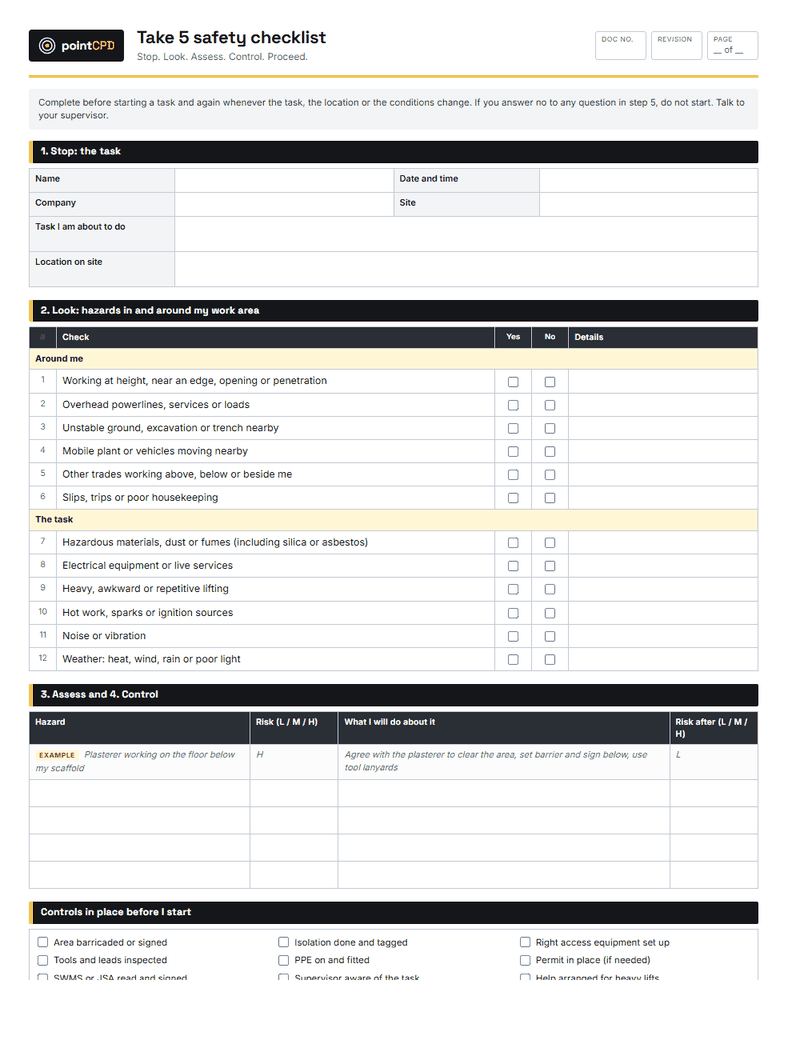
The Take 5 is the shortest piece of safety paperwork on a site and, used properly, one of the most effective. It asks each worker to stop for a few minutes before starting a task, look at what is actually around them, and fix anything that could hurt them before they begin. This template is a single page, designed to be printed as a pad or kept on a phone.
What a Take 5 is
A Take 5 is a personal pre-task check. The name comes from taking five minutes, or five steps, to think before acting. On this template the five steps are:
- Stop. Pause before starting, and be clear about the task.
- Look. Scan the work area for hazards: up, down and around.
- Assess. Judge how likely each hazard is to hurt someone, and how badly.
- Control. Put controls in place before starting.
- Proceed. Start only when every final-check answer is yes.
Why it works when it is done properly
Most site injuries do not come from hazards nobody knew about. They come from a hazard everyone knew about that nobody looked at on the day: the edge protection taken down for a delivery, the extension lead run through water, the trade working directly below. A Take 5 is a prompt to look at the conditions as they are now, rather than as they were when the SWMS was written.
It also changes who owns the check. A SWMS is written by the business; a Take 5 is done by the person about to do the work. That matters, because the person with the tool in their hand is the last one who can stop the job before something goes wrong.
Is a Take 5 required?
No law names the Take 5. WHS laws place a duty on every worker to take reasonable care for their own health and safety and not to harm others, and on every business to manage risks. A Take 5 is a practical way for workers to meet their duty, and for a business to show that risk checks happen at the work face.
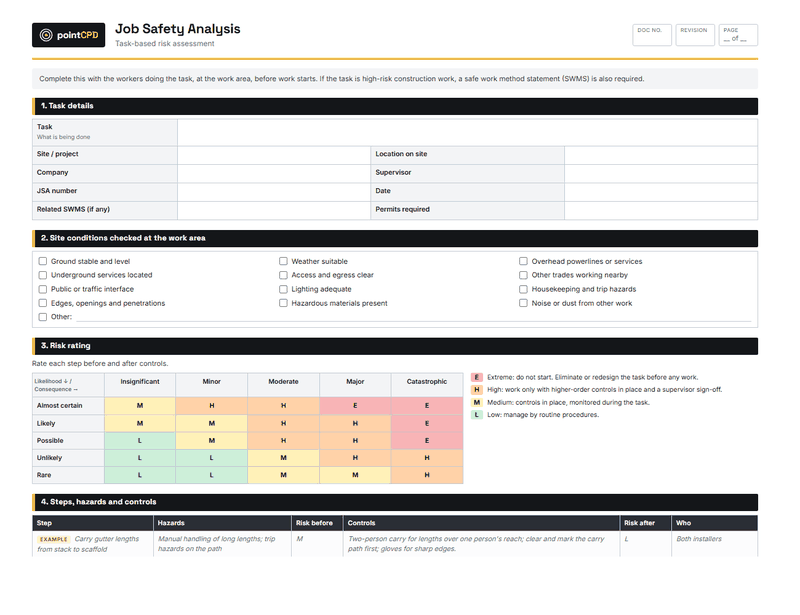
It does not replace other documents. If the task is on the high-risk construction work list, a SWMS is still required. If the crew is planning a multi-step task, a JSA is the better tool. The Take 5 sits underneath both, every time a worker starts or changes a task.
How to stop a Take 5 becoming a tick-and-flick
The biggest risk with a Take 5 is that it becomes a form people fill in from memory. A pad of forms all ticked “yes” with identical handwriting is not a safety system. A few habits keep it honest:
- Do it at the work area, not in the lunch room. The point is to look.
- Make “no” a normal answer. Supervisors should thank the worker who stops a job, not question them.
- Read them. A supervisor who reads a sample each week will see patterns worth a toolbox talk.
- Redo it when things change. Weather, a new trade, a different access method: new Take 5.
- Keep it short. If the Take 5 takes longer than five minutes, the task needs a JSA instead.
What to look for: the hazards that catch builders
The checklist groups hazards into the work area and the task itself. On residential sites the ones that recur are working near unprotected edges and penetrations, overhead powerlines near scaffolds and tipper trucks, unstable ground near trenches, plant reversing on tight sites, dust from cutting fibre cement or masonry, and heat. Each of these is on the checklist so the worker is prompted to look, not left to remember.
The final check
Step 5 asks five direct questions. The last one is deliberately personal: would you be comfortable if your supervisor watched you do this task now? It is the quickest test of whether a worker has cut a corner. Any “no” means stop and talk to the supervisor before starting.
Using the template on your site
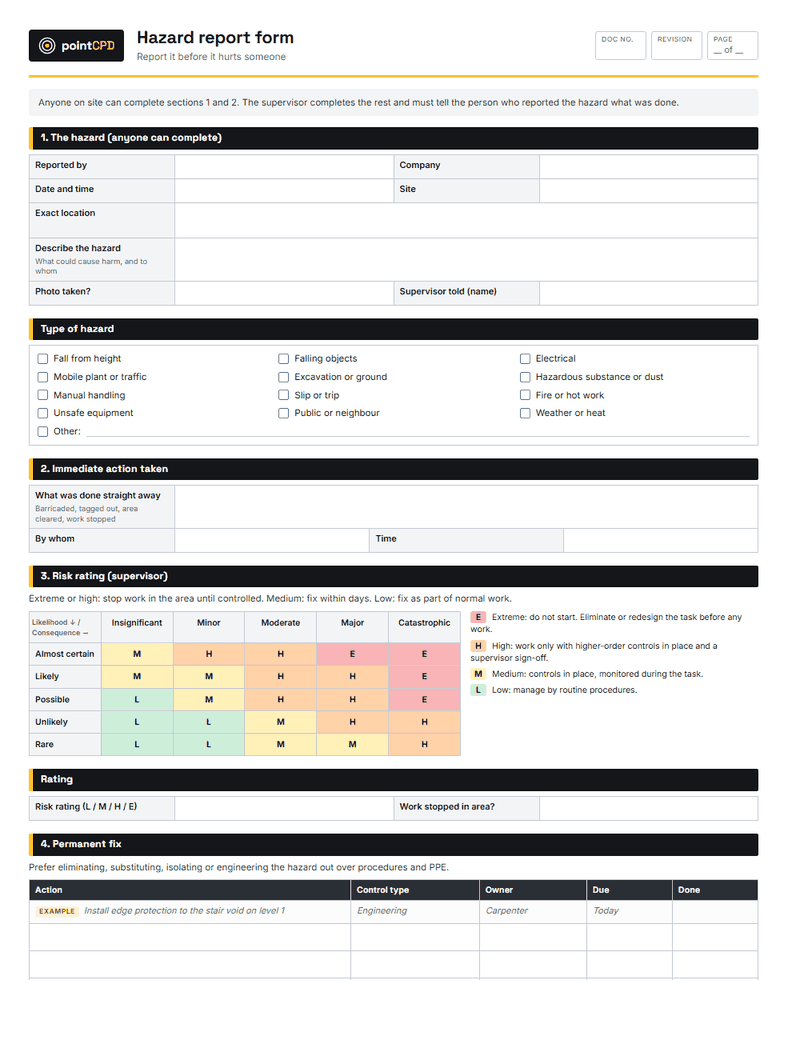
Print the PDF as a pad for the ute, or use the Word version to add your logo and site-specific hazards. Collect completed forms with the job records. If a Take 5 identifies a hazard that cannot be fixed on the spot, record it on a hazard report form so it gets fixed properly.
An example: a Take 5 before ladder work
A carpenter is about to fix a missing section of fascia using an extension ladder. A proper Take 5 takes three minutes and might record:
- Task: fix fascia board, rear south corner, from an extension ladder.
- Hazards found: ground at the base is freshly backfilled and soft; the overhead service line to the house runs within reach of the ladder’s swing path; the plumber is working on the stormwater directly below.
- Controls: move the job to the mobile scaffold already on site rather than the ladder; agree with the plumber to work elsewhere for twenty minutes; keep all materials away from the service line.
- Final check: all yes once the scaffold is in place.
The value was not the form. It was noticing, before starting, that the ladder was the wrong access for that corner. That is the whole point of stopping to look.
Take 5 for apprentices and new workers
For experienced workers a Take 5 is a quick habit. For apprentices and workers new to the site or the trade, it is also a teaching tool. Walking an apprentice through their first few Take 5s, asking what they see and why it matters, builds the hazard awareness that keeps them safe for the rest of their career. Supervisors should read apprentices’ Take 5s and talk them through, rather than just collecting them.
New workers are also more likely to feel they cannot say no. Make it explicit during the site induction that a “no” answer on a Take 5 is expected and welcomed, and that the supervisor would rather stop a job than have someone start one they are not sure about.
Finally, keep the pad where people actually are. A Take 5 pad in the site shed gets used at smoko. A pad on the ute dashboard, or a form on the phone, gets used at the work face.