Key takeaways
- Insurance requirements usually enter a job through the contract, so the cover you must hold depends on the work you have agreed to do, not on what you have always carried.
- A certificate of currency proves cover exists on the day it is issued; it does not prove the cover responds to the loss that has actually occurred.
- Cover for contract works, public liability, workers, vehicles, tools and professional advice sits in different policies, and a gap in any one of them is paid for by the business.
- Under-insuring contract works is one of the most common and most expensive mistakes, because the shortfall is deducted from every progress claim after the loss.
- Reviewing cover when you take on new work types, subcontractors or higher-value projects is cheaper than discovering the gap during a claim.
Most building businesses buy insurance the same way they buy a ute: they get one, they keep renewing it, and they only find out what it does not cover when something goes wrong. The policies that matter are not chosen by habit. They are chosen by the work the business takes on, the contracts it signs and the people it puts on site.
The trigger is usually a contract. When a homeowner or a head contractor engages you for residential building work in NSW, the contract will name the insurance they expect you to hold, and it will usually require you to hand over a certificate of currency before you start. That is a contractual requirement, not a legal one, but it has the same effect: if you cannot produce the certificate, you do not get on site.
This article is a cover checklist, not a legal or financial advice piece. It is about the practical question: which policies does a residential building business actually need, and where do the gaps hide?
Start with the contract, not the broker
The insurance clause in a residential building contract is the document that defines what you must carry for that job. Read it before you price the work. The clause will usually name the types of cover, the minimum sums insured and the evidence you must provide. If you have not read it, you are guessing at the cost of the job.
If the contract is silent on insurance, the obligation still exists in practice, because the owner will expect you to be insured and because your own exposure does not disappear just because the paperwork did not mention it. A contract that says nothing about insurance is not permission to work uninsured; it is simply a contract that has left the risk where it falls, which is on you.
The same logic applies when you are the head contractor engaging subbies. Your contract with the owner will require you to hold cover, and your subcontracts should require your subbies to hold theirs. If a subbie is uninsured and causes damage, the claim will come back to you, because you are the one with the contract and the assets.
The core policies and what each one is actually responding to
Insurance is not one product. It is a set of products, each built for a different kind of loss. The most common mistake is assuming that one policy covers everything, or that a policy with a familiar name covers the thing that actually happened.
What each policy is actually responding to
| Policy type | The loss it is built for |
|---|---|
| Contract works | Damage to the work under construction and materials on site before handover. |
| Public and products liability | Injury to a person or damage to property that is not the work itself. |
| Workers compensation | Injury to your own employees, however the injury happened. |
| Motor and mobile plant | Registered vehicles and plant travelling between or working on sites. |
| Tools and equipment | Theft or damage to the gear you own and take to site. |
| Professional indemnity or design | Claims arising from advice, design or certification you provided. |
Contract works insurance covers the work under construction and the materials on site against damage before handover. If a storm damages a partly built frame, or materials are stolen from a locked site, this is the policy that responds. It is usually written for a specific project and a specific sum insured, which means it has to be updated as the job progresses or as variations increase the contract value.
Public and products liability covers injury to a person or damage to property that is not the work itself. A tile falling from a scaffold onto a parked car, or a visitor tripping over a lead on site, sits here. It does not cover the cost of fixing your own defective work, which is a common misunderstanding.
Workers compensation covers injury to your own employees. In NSW this is not optional for most employers, and the requirement is set by the workers compensation scheme, not by the contract. The practical trap is treating a regular subcontractor as a subbie when the relationship looks like employment; if the insurer or the regulator disagrees with your classification, the claim can land on you.
Motor and mobile plant covers registered vehicles and plant. A ute that is registered and driven on the road needs its own cover. Mobile plant that travels between sites may need a separate policy or an extension, and the boundary between the two is worth checking before a machine is moved.
Tools and equipment covers the gear you own and take to site. Most trades underestimate how much they have and how quickly it adds up. Theft from a ute or a site container is a common claim, and the sum insured needs to reflect replacement cost, not what you paid years ago.
Professional indemnity or design cover responds to claims arising from advice, design or certification you provided. If you design, specify or certify, this is the policy that responds when someone says your advice was wrong. If you only build to someone else’s design, you may not need it, but you should confirm that in writing rather than assume it.
The Home Building Compensation Fund is a separate obligation
The Home Building Compensation Fund is not a general business policy and it does not sit in the same checklist as the others. It is a statutory requirement that attaches to residential building work over a threshold value, and it is covered in detail in our how many jobs you can run at once. What matters here is that holding Home Building Compensation Fund cover does not reduce your need for contract works, public liability or workers compensation. They cover different things, and one does not substitute for another.
The practical consequence is that a builder can be fully compliant with the home warranty requirement and still be exposed on a job, because the warranty covers the owner for defects and incomplete work, not the builder for damage to the work during construction or injury to a person on site.
Where the gaps usually hide
Most uncovered losses are not caused by having no insurance. They are caused by having insurance that does not respond to the specific event. The gaps tend to cluster in a few predictable places.
- Under-insured contract works. The sum insured is set at the start of the job and never updated when variations increase the contract value. After a loss, the shortfall is deducted from every progress claim, and the builder funds the difference.
- Flood and storm exclusions. Many policies exclude or limit flood, and the definition of flood is not always what a builder assumes. The NSW flood risk management manual is the reference point for how flood risk is assessed in this state, and it is worth understanding before you assume a site is not exposed.
- Uninsured subcontractors. A subbie who lets their policy lapse creates a gap that lands on the head contractor. Certificates of currency should be collected before every job, not once at the start of the relationship.
- Tools and plant that are not listed. A policy that covers tools up to a limit may not cover the item that was actually stolen, particularly if it is high-value or specialised.
- Defective work versus damage caused by defective work. Many liability policies cover the damage a defect causes but not the cost of fixing the defect itself. That distinction decides who pays for the rectification.
The mistake that costs the most is under-insuring contract works. A builder sets the sum insured at contract signing, variations push the value up, a loss occurs, and the insurer pays only the proportion the sum insured bears to the true value. The shortfall comes out of the builder’s margin on every remaining progress claim, and it is usually discovered at the worst possible time.
Subcontractors, labour hire and the classification question
The insurance obligation you carry depends on who is on site and how they are engaged. An employee is covered by workers compensation. A genuine subcontractor is expected to carry their own cover. The problem is that the label in the contract does not always match the reality of the relationship.
If a subbie works only for you, uses your equipment, works set hours and is paid like an employee, a regulator or an insurer may treat them as an employee for insurance purposes. If that happens after an injury, the claim can fall back on your policy. The safe approach is to look at the actual arrangement, not the paperwork, and to take advice before relying on a subcontractor’s own cover to protect your business.
Labour hire introduces a third arrangement. The labour hire company typically carries the workers compensation cover for the people it supplies, but you still need to confirm that in writing and check that the cover is current. A certificate of currency from the labour hire company is the evidence you need.
Vehicles, tools and plant: the everyday claims
The claims that happen most often are not the dramatic ones. They are the ute broken into overnight, the dropped tool, the stolen gear from a site container. These are small enough to be annoying and frequent enough to matter over a year.
Tools and equipment cover is usually the easiest to get wrong because the sum insured is often set years ago and never reviewed. Replacement cost is the number that matters, and it changes. The same applies to mobile plant: a machine that is not registered but travels between sites may need a specific extension, and the boundary between motor cover and plant cover is worth confirming before the machine is moved.
For vehicles, the registered vehicle needs its own policy. The practical question is whether the vehicle is used for business, because that affects both the cover and the premium. A ute used to carry materials and tools is a business vehicle, and the policy should reflect that.
A worked example: the variation that was never insured
A builder in western Sydney takes on a renovation and extension for a homeowner. The contract value is set at signing, and the builder arranges contract works insurance for that amount. The job starts, and over the following months the owner adds a new bathroom, upgrades the kitchen and changes the roof. Each change is documented as a variation.
The variations increase the contract value, but the sum insured is never updated. Near the end of the job, a storm damages the partly completed extension. The insurer assesses the loss against the sum insured on the policy, not against the true value of the work at the time of the loss. The builder receives a partial payment and funds the rest from the remaining progress claims.
The loss was not caused by a lack of insurance. It was caused by a policy that was not maintained as the job changed. The fix is administrative, not expensive: a review of the sum insured whenever variations push the contract value materially, and a conversation with the broker about how the policy handles variations.
How to review your cover without overbuying it
The goal is not to buy every policy on the market. It is to match the cover to the work, and to know where the boundaries are. A builder who does small renovations and never designs or certifies has a different set of needs from a builder who does design-and-construct work or takes on multi-unit projects.
The cover review to run at least once a year
- Read the contract clause that names the insurance required and note the exact wording.
- Check the sum insured for contract works against the highest-value job you expect to run.
- Confirm every subcontractor has provided a current certificate of currency before they start.
- Check whether your policy excludes or limits cover for flood, storm or water damage.
- List every tool, item of plant and vehicle and check each one is actually named or covered.
- Confirm the policy responds to defective work as well as damage caused by it.
- Diarise the renewal date and the review date, and put both in the business calendar.
Run the review at least once a year, and again whenever the business changes shape: a new type of work, a new state, a new subcontractor arrangement, a materially larger project. The review is a conversation with your broker, but the builder has to lead it, because the broker does not know what jobs you are pricing next month.
Two documents make the review much easier. The first is a current list of every job in progress and its contract value, so the sum insured can be checked against reality. The second is a folder of current certificates of currency for every subcontractor and labour hire supplier. If either document is out of date, the review is not finished.
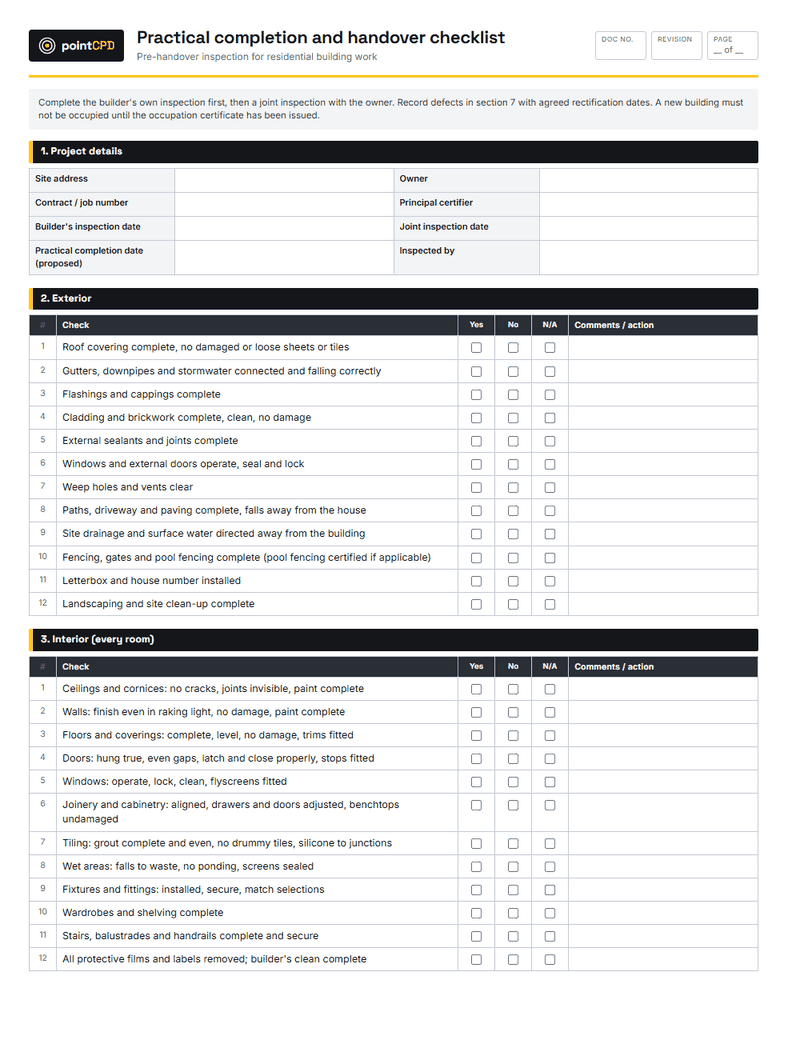
It also helps to think about insurance as part of the business system, not as a separate purchase. The same discipline that keeps your practical completion checklist current should keep your insurance schedule current. The builders who get caught are usually the ones who treat insurance as a renewal date rather than a live record.
What good looks like at the end of the review
At the end of a proper review, you should be able to answer a small set of questions without looking anything up. Which policy responds if the work is damaged before handover? Which policy responds if a visitor is injured? Which policy responds if a subbie causes damage? Which policy responds if your advice is wrong? If any of those answers is unclear, the cover is not yet matched to the business.
The other marker of good practice is evidence. A certificate of currency for every policy, a current schedule of subcontractor certificates, and a note of the last review date. When a contract requires proof of cover, or when a claim arises, the evidence is what decides how quickly the matter is resolved.
None of this replaces advice on the specific policies and limits that suit your business. It is a checklist to run before you speak to the broker, so the conversation is about your actual risk rather than a generic product. For builders working through their CPD obligations, the business and risk material sits alongside the technical content; the guide to how NSW builder CPD works explains how the categories fit together, and the course catalogue lists the business-focused options.
When to revisit the cover during a job
Insurance is not a set-and-forget purchase. A few events during a job should trigger a check, even if the annual review is months away.
- A variation that materially increases the contract value.
- A change in the scope that brings new risks onto the site, such as demolition or work near a boundary.
- A new subcontractor starting on site, or a change in how an existing subbie is engaged.
- A new item of plant or a high-value tool arriving on site.
- Any event that makes you unsure whether the policy responds, which is the moment to ask the broker rather than after the loss.
The cost of asking is a phone call. The cost of not asking is a claim that is declined or partially paid, and a margin that absorbs the difference. That is the commercial reality behind the checklist, and it is why the review belongs in the business calendar rather than in a drawer.
Questions builders ask
What insurance does a building business in NSW actually need?
At a minimum, a residential building business needs workers compensation for its employees, public and products liability, and cover for the work under construction. If it runs vehicles or plant, those need their own cover, and tools and equipment should be insured for replacement cost. The Home Building Compensation Fund is a separate statutory obligation that attaches to residential building work over a threshold value.
Is Home Building Compensation Fund cover the same as contract works insurance?
No. The Home Building Compensation Fund protects the homeowner against defects and incomplete work, and it is required by statute for certain residential work. Contract works insurance protects the work under construction and materials on site against damage before handover. They cover different losses and one does not substitute for the other.
What is a certificate of currency and what does it prove?
A certificate of currency is evidence that a policy was in force on the date it was issued. It does not prove that the policy will respond to a particular loss, and it does not prove the cover is adequate. When you collect certificates from subcontractors, check the dates and the policy type, not just the fact that a document was supplied.
Does public liability cover defective work?
Generally, public liability responds to injury to people or damage to property that is not the work itself. It usually does not cover the cost of rectifying your own defective work. Some policies cover damage caused by defective work while excluding the cost of fixing the defect, and the distinction decides who pays.
What happens if a subcontractor lets their insurance lapse?
If an uninsured subcontractor causes damage or injury on your site, the claim can come back to you as the head contractor, because you hold the contract with the owner. This is why certificates of currency should be collected before every job, not once at the start of the relationship.
How often should a building business review its insurance cover?
At least once a year, and again whenever the business changes shape. Triggers include a new type of work, a materially larger project, a new subcontractor arrangement or a significant variation to a job in progress. The review should compare the sums insured with the work you are actually pricing and running.
Sources
- Contracts for home building work · NSW Government · 2026-04-29
- Rising fuel costs: what trades need to know about contracts, insurance and compliance · Building Commission NSW · 2026-04-28
- Safe work method statement for high risk construction work · Safe Work Australia
- Flood risk management manual · NSW Government
Published 20 July 2026. General information for builders, not legal, financial or engineering advice for a specific job. Check current requirements with the relevant regulator or standard before relying on them.