Skip to content
  • NSW-first CPD, built by a practising builder
  • Instant PDF certificates
  • Unlimited assessment attempts
  • 12 points a year, sorted
  • 15% off your first order — get your code
  • Content aligned to the NCC 2022

Free template Inspections and quality

Free practical completion and pre-handover inspection checklist

Everything to check and collect before handing over a home: room-by-room finishes, services testing, compliance certificates, occupation certificate, keys, manuals and warranties.

The short version

Before handover, inspect every room and the exterior for incomplete work and defects, test every service, and collect the compliance certificates and the occupation certificate: a new home in NSW cannot be occupied without one. Walk it with the owner, record any agreed minor items on a defects list with dates, and hand over keys, manuals and warranties. Handover also marks the start of the statutory warranty periods.

  • No sign-up
  • Free for commercial use
  • Add your own logo
  • Updated 14 Sep 2026

Reviewed by Daniel Betros, Licensed Building Practitioner

Animated walkthrough · 7 steps

How to run a practical completion inspection

Seven steps. Do your own inspection first, fix what you find, then walk it with the owner.

1 / 7
  1. A builder's own inspection a week before handover finds most of what the owner would, and gives time to fix it. Book trades for the fix-up.

  2. Roof, gutters, cladding, sealants, windows and doors, paths, driveway, drainage, fencing and landscaping. Check water flows away from the house.

  3. Ceilings, walls, paint, floors, doors, joinery, tiles, fittings. Operate every door, window, drawer and tap. Look at surfaces in raking light.

  4. Power points, lights, smoke alarms, hot water, taps and drainage, exhaust fans, air conditioning, appliances, gas, solar and batteries. Run the water until it is hot.

  5. Electrical, plumbing, gas, waterproofing, termite, glazing and other certificates, BASIX evidence, and the occupation certificate from the principal certifier.

  6. Record anything the owner raises, agree what is a defect, and set dates for rectification. Both sign. Minor items do not usually stop practical completion, but they must be fixed.

  7. Keys, remotes, manuals, warranties, certificates, maintenance information and emergency contacts. Record what was handed over and when.

Handover is where months of good building are either confirmed or undone. An owner who finds twenty small defects on their first walk-through remembers the defects, not the build. A builder who has already found and fixed them, and hands over a complete pack of certificates, gets a referral. This checklist is built for the builder’s own inspection first, then the joint inspection with the owner.

What practical completion means

Practical completion is defined by your building contract, but it generally means the work is finished apart from minor omissions or defects that do not stop the home being used as intended. It usually triggers the final progress payment and the start of warranty and defects periods, which is why both sides care about getting the date and the list right.

The occupation certificate comes first

In NSW a new building must not be occupied or used until the principal certifier has issued an occupation certificate. The certifier will need the final inspection completed and the relevant certificates, and in NSW evidence that the BASIX commitments were met. Start collecting certificates well before the final inspection; chasing an electrical or waterproofing certificate in the last week is the most common cause of a delayed handover. Never hand over keys for occupation before the certificate is issued.

Do your own inspection first

A thorough builder’s inspection a week before the joint inspection finds most of what the owner would, and leaves time to fix it. Look at walls and ceilings in raking light, with a torch held flat to the surface, the way owners do on their first night. Operate every door, window, drawer and tap. Run the hot water until it is hot. Stand in the shower and check the falls. Test every smoke alarm.

Items that most often appear on owner lists

AreaCommon items
Paint and plasterVisible joints and screw heads in raking light; paint touch-ups; cornice cracks
Doors and joineryUneven gaps; doors that swing open or will not latch; misaligned drawers
TilingUneven grout; drummy tiles; missing silicone at junctions
Wet areasPonding in showers; shower screens that leak or rub
ExteriorPaths falling towards the house; sealant gaps; damaged cladding or roof sheets
CleanProtective films left on windows and appliances; dust in tracks and cupboards

The joint inspection

Walk the home with the owner, in daylight, and record everything they raise in section 7, even if you disagree it is a defect. Discuss each item, agree what will be done and by when, and both sign. Items that are genuinely minor do not usually stop practical completion, but they must be fixed on time; the defects list template tracks them through to sign-off.

Warranties start here

In NSW, the Home Building Act gives owners statutory warranties on residential building work: six years for major defects and two years for all other defects, generally running from completion of the work. They apply whatever the contract says. A clean handover, with every certificate and a clear record of what was inspected and agreed, is the builder’s best protection for the years that follow.

The handover pack

Hand over keys, remotes, manuals, product warranties, certificates, the selection schedule, maintenance information and warranty contacts in one organised pack, and record what was given. Owners who know how to maintain their home, from cleaning weep holes to servicing the hot water system, cause fewer warranty calls. Record the handover date and the meter readings in the site diary.

When the owner will not accept practical completion

Sometimes an owner disputes that the work has reached practical completion, often because they are worried that final payment will remove their leverage over outstanding items. Handle it by the contract, not by argument:

  • check your contract’s definition of practical completion and its notice process;
  • give written notice of practical completion with the date and the evidence, including the occupation certificate;
  • list genuinely minor outstanding items with dates to complete them, so the owner can see they will be dealt with;
  • keep communicating in writing, and record the joint inspection outcome.

If it cannot be resolved, NSW Fair Trading offers a free dispute resolution service for home building disputes, and NCAT can hear claims. A clear record of the inspection, the certificates and the agreed defects list is what those processes rely on.

Final payment and retention

Many residential contracts make the final progress payment due at practical completion, and some commercial and larger residential contracts hold back a retention sum until the end of the defects period. Know what your contract says before the final inspection: what triggers the final claim, what must be provided with it, and when retention is released. Issue the final claim promptly with the handover documents. Holding the handover pack back to pressure payment rarely helps and can breach the contract; providing it promptly, with a clear defects list, usually speeds payment.
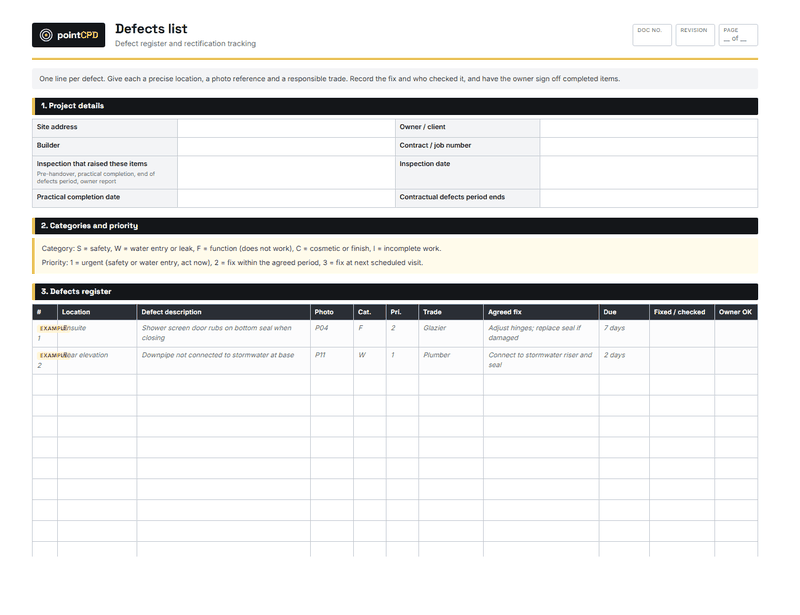
Preview the full Practical completion and handover checklist template

Every section, field and check in the download, exactly as it prints. Edit the Word version to add your logo, delete what does not apply and add your own site-specific items.

pointCPD

Practical completion and handover checklist

Pre-handover inspection for residential building work

Doc no.
Revision
Page
__ of __

Complete the builder's own inspection first, then a joint inspection with the owner. Record defects in section 7 with agreed rectification dates. A new building must not be occupied until the occupation certificate has been issued.

1. Project details

Site addressOwner
Contract / job numberPrincipal certifier
Builder's inspection dateJoint inspection date
Practical completion date (proposed)Inspected by

2. Exterior

#CheckYesNoN/AComments / action
1Roof covering complete, no damaged or loose sheets or tiles
2Gutters, downpipes and stormwater connected and falling correctly
3Flashings and cappings complete
4Cladding and brickwork complete, clean, no damage
5External sealants and joints complete
6Windows and external doors operate, seal and lock
7Weep holes and vents clear
8Paths, driveway and paving complete, falls away from the house
9Site drainage and surface water directed away from the building
10Fencing, gates and pool fencing complete (pool fencing certified if applicable)
11Letterbox and house number installed
12Landscaping and site clean-up complete

3. Interior (every room)

#CheckYesNoN/AComments / action
1Ceilings and cornices: no cracks, joints invisible, paint complete
2Walls: finish even in raking light, no damage, paint complete
3Floors and coverings: complete, level, no damage, trims fitted
4Doors: hung true, even gaps, latch and close properly, stops fitted
5Windows: operate, lock, clean, flyscreens fitted
6Joinery and cabinetry: aligned, drawers and doors adjusted, benchtops undamaged
7Tiling: grout complete and even, no drummy tiles, silicone to junctions
8Wet areas: falls to waste, no ponding, screens sealed
9Fixtures and fittings: installed, secure, match selections
10Wardrobes and shelving complete
11Stairs, balustrades and handrails complete and secure
12All protective films and labels removed; builder's clean complete

4. Services testing

#CheckYesNoN/AComments / action
1Every power point and light switch tested
2Smoke alarms installed, interconnected where required, tested
3Safety switches (RCDs) tested
4Hot water system working and set correctly
5All taps, showers and toilets working, no leaks
6Drainage flows freely, no smells
7Exhaust fans working and ducted to outside
8Air conditioning and heating commissioned
9Appliances installed and working
10Gas appliances commissioned
11Solar, battery and EV charger commissioned (if installed)
12Data, TV and intercom working
13Garage door and remotes working
14Water, electricity and gas meters read and recorded

5. Certificates and approvals

#CheckReceivedN/AReference / date
1Occupation certificate from the principal certifier
2Electrical compliance certificate
3Plumbing and drainage compliance certificate
4Gas compliance certificate
5Waterproofing certificate(s)
6Termite management certificate and durable notice
7Glazing certificate
8Smoke alarm compliance
9BASIX or energy commitments evidence
10Pool fence or pool compliance (if applicable)
11Structural engineer certification (if required)
12Home warranty insurance certificate (where required)

6. Handover pack

#CheckGivenDetails
1All keys, including window keys, counted
2Remotes and access fobs
3Appliance manuals and warranties
4Product warranties (roofing, waterproofing, hot water, tapware)
5Copies of certificates and the occupation certificate
6Maintenance guide for the home
7Paint, tile and product selection schedule
8Emergency and warranty contact details
9Statutory warranty and defects information

7. Items raised at the inspection

#LocationItemAgreed actionDueDone
Example1EnsuiteShower screen door rubs on seal when closingAdjust hinges, replace seal if damaged7 days

8. Acknowledgement

The parties have inspected the work together. Items listed in section 7 will be completed by the dates shown.

BuilderSignature and date
OwnerSignature and date
Template by PointCPD · pointcpd.com.au/resources/templates/practical-completion-checklist/Free to use, copy and adapt, including commercially (CC BY 4.0). Keep this credit line.v1.0

Download Word Download PDF

Questions builders ask

What is practical completion?

The stage when the work is complete except for minor omissions or defects that do not stop the home being used for its intended purpose, as defined in the building contract. It usually triggers the final payment and the start of the warranty periods.

Can a new home be occupied before the occupation certificate?

No. In NSW a new building must not be occupied or used until an occupation certificate has been issued by the principal certifier. Handing over keys for occupation before then exposes the builder and the owner.

What are the statutory warranty periods in NSW?

Under the Home Building Act, residential building work carries statutory warranties: six years for major defects and two years for all other defects, generally from completion of the work. These apply regardless of what the contract says.

Do minor defects stop practical completion?

Usually not, if they are minor and do not prevent the home being used. They should be listed, agreed and fixed by set dates. Check how your contract defines practical completion.

Should the owner get an independent inspection?

Many do, and builders should welcome it. An independent report that finds little is a strong endorsement. Allow access and deal with genuine items promptly.

What certificates should be handed over?

Typically the occupation certificate and compliance certificates for electrical, plumbing, gas, waterproofing, termite management, glazing and smoke alarms, plus warranties, manuals and home warranty insurance where required.

Free to use, adapt and share, including commercially

This template is licensed under Creative Commons Attribution 4.0. Copy it, rebrand it, edit it for your jobs, hand it to clients and subcontractors, or republish it. The one condition: keep the small PointCPD credit line on the document. If you publish it online, credit it like this:

<a href="https://pointcpd.com.au/resources/templates/practical-completion-checklist/">Practical completion and handover checklist template</a> by PointCPD, CC BY 4.0

Last reviewed 14 September 2026. A template is a starting point: it becomes a compliant document only once it is completed for the actual job by people who understand the work, and kept current as the work changes. General information, not legal advice. Check the requirements of your state regulator and your contract.

Sources: Home Building Act 1989 (NSW) (statutory warranties). Environmental Planning and Assessment Act 1979 (NSW) (occupation certificates). NSW Fair Trading guidance on practical completion and defects. Your building contract defines practical completion.