Key takeaways
- A hazardous chemicals register is required for the substances you hold on site, and the part-used tins and cans count just as much as full containers.
- The safety data sheet is the source for storage, decanting and first-aid requirements, and it must be current and accessible to the workers using the product.
- Decanting a solvent or fuel into an unmarked container removes the hazard information a worker needs and is one of the most common and most preventable site failures.
- Solvent vapours and fuel accumulate in low or enclosed spaces, so ventilation and ignition control are the controls that matter most when working inside a sealed house.
- Getting chemical storage wrong shows up as a regulator visit, a fire or a worker injury, and the cost lands on the principal contractor rather than on the individual trade.
A house site holds fewer chemicals than a factory, but it holds them in worse conditions. A part-used tin of solvent sits on a window sill in a room with no ventilation. A fuel can is left beside a drop saw. An adhesive tube rolls under a sheet of flooring. None of these look like a chemical hazard, which is exactly why they cause trouble.
The obligation on you as principal contractor does not scale with the volume you hold. It scales with the risk the substance creates in the place you are keeping it and the way your subbies are using it. A litre of flammable solvent in a sealed room next to a hot works trade is a more serious problem than a drum stored properly in the open.
This article is about the small-volume chemicals that actually turn up on a residential job — solvents, adhesives, sealants, fuels and the cleaning products that come with them — and what to do about them on a working site.
What counts as a hazardous chemical on a house site
A hazardous chemical is one that meets the classification criteria for a physical or health hazard. You do not need to work that out yourself. The classification is on the label and in the safety data sheet, and if a product carries a hazard pictogram and a signal word, it is in scope.
On a residential job the list is longer than most builders assume. It includes:
- Solvents and thinners used for cleaning tools, wiping down surfaces and thinning coatings.
- Adhesives and sealants, including the solvent-based contact adhesives used for benchtops and cladding.
- Paints, varnishes and the two-pack products used for floors and joinery.
- Fuels — petrol and diesel in cans and in the tanks of plant left on site.
- LPG cylinders for heaters, forklifts and temporary cooking.
- Cleaning products, mould treatments and acid washes used on brick, tile and concrete.
- Waterproofing membranes and the primers that go with them.
The mistake is to treat this as the painter’s problem or the concreter’s problem. As principal contractor you control the site, and the register, the storage and the emergency arrangements are yours to run. If you want the underlying framework for how duties sit on a residential job, the guide to how NSW builder CPD works covers the context you are being assessed against.
The register is the control that everything else hangs off
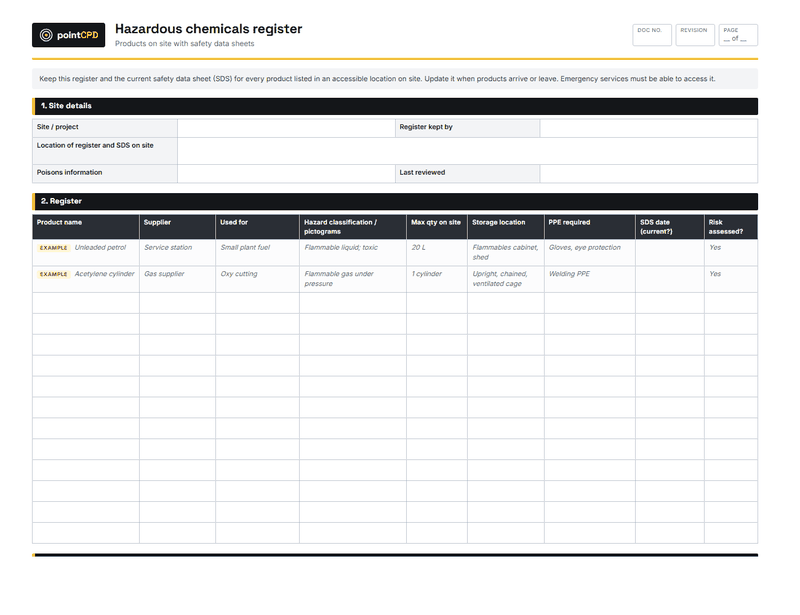
A hazardous chemicals register is a list of the hazardous chemicals you hold, with the current safety data sheet for each one. It exists so that a worker, a subbie or an emergency responder can find out what a substance is, what it does and what to do about it, without opening the container.
Two things make registers fail on house sites. The first is that they are built once at the start of the job and never updated, so by frame stage they bear no relationship to what is actually in the shed. The second is that they only list the bulk products and miss the part-used tins and tubes, which are the ones most likely to be decanted, spilled or left in a bad spot.
Build the register by walking the site, not by copying a list from another job. Then keep it where the chemicals are, not in the ute. A register locked in the site office that nobody can reach is not a control.
There is a free hazardous chemicals register template you can use as the starting point, then adapt it to the products your trades actually bring.
Setting up chemical control on a house site
- 1List what is actually on siteWalk the site and record every solvent, adhesive, fuel, sealant, paint and cleaning product, including part-used containers.
- 2Pull the current safety data sheetGet the sheet that matches the product and version on site, not a generic sheet from a different supplier.
- 3Enter it in the registerRecord the product, the SDS reference and where it is kept, then keep the register where workers can reach it.
- 4Set the storage locationChoose a spot that is ventilated, away from ignition sources and out of the weather.
- 5Label and control decantsAny product transferred out of its original container gets a label that names the product and the hazard.
- 6Review when products changeAdd or remove entries whenever a trade brings a new product onto the site or takes one away.
Safety data sheets: what you need and what you do with them
The safety data sheet is the manufacturer’s statement of what the product is, how it should be stored and handled, what personal protective equipment is required, what to do if it is spilled, and what to do if someone is exposed. It is not a formality. It is the source document that tells you how to run the site controls.
Three practical rules apply.
Get the sheet that matches the product. Suppliers update formulations and reissue sheets. A sheet for an older version of the same brand is not the right document. If you cannot get a current sheet from the supplier, ask again before the product comes onto the site.
Keep it accessible. Workers using the product must be able to get to the sheet without asking you and without leaving the immediate work area. On a house site that usually means a folder in the site shed plus a digital copy the leading hand can pull up on a phone.
Read the storage and spill sections before you choose where to put the container. The sheet will tell you whether the product needs to be kept away from oxidisers, whether it must be kept out of direct sunlight, and what to use to absorb a spill. Those are the details that decide whether a storage spot is acceptable.
Storage: the part that goes wrong most often
Storage on a house site is a compromise between what the safety data sheet requires and what the site layout allows. The compromise has to be a real one, not an excuse.
The working requirements are consistent across most of the products you will hold:
- Keep chemicals in a dedicated area, not scattered around the work face.
- Keep them out of the weather and out of direct sun, because heat raises vapour pressure and degrades some products.
- Keep flammable liquids away from ignition sources, including leads, temporary power boards, hot works and plant exhausts.
- Keep incompatible products apart. The safety data sheet tells you which ones these are; the classic residential example is keeping oxidisers away from solvents and fuels.
- Keep containers closed when they are not in use, and keep them upright.
- Keep the storage area ventilated so vapour cannot accumulate.
- Keep spills contained. Bunding or a tray under the storage area means a leaking tin is a clean-up, not a contamination issue.
Where builders come unstuck is on a small site with no dedicated shed. The chemicals end up in the garage, which is also where the hot water unit, the switchboard and the gas meter sit. That is a storage decision made by default, and it is the one that causes fires. If the garage is the only covered space, control what else is in it.
If your job involves a pool and the chemicals that go with it, the NSW builder CPD courses we run cover the site controls around residential work, and the pool safety requirements sit alongside the chemical controls rather than replacing them.
Site check before the next trade starts
- Every container on site is labelled and legible.
- No solvent or fuel sits in an unmarked drink bottle or bucket.
- Safety data sheets are current and reachable without asking the supervisor.
- Fuels and solvents are stored away from the ignition sources of the trades working nearby.
- The register matches what is physically on site, including part-used tins.
- Spills are cleaned up with the material the safety data sheet specifies.
- Waste containers are closed and separated from the storage area.
Decanting and labelling
Decanting is transferring a product out of its original container into something smaller or more convenient. It happens constantly on house sites: solvent into a squeeze bottle, fuel into a jerry can, adhesive into a small pot.
The moment a product leaves its original container, the label goes with it. Everything the worker needs to know about the hazard, the PPE and the first aid was on that label. An unmarked container is a container that has lost its safety information, and a worker who picks it up has no way of knowing what is in it.
The rule is simple and non-negotiable: any container holding a decanted hazardous chemical must be labelled with the product name and the hazard information. If it cannot be labelled, do not decant into it. Do not use drink bottles, do not use food containers, and do not leave a decant sitting on a bench at the end of the day.
There is a second decanting risk that gets less attention: the decant itself. Pouring a flammable solvent in a room with a running compressor or a hot works trade nearby is the moment of ignition, not the storage. Do the decant outside, or in a ventilated area, away from ignition sources, and put the container away when you are done.
Ventilation, ignition and the trades working around you
Most of the small-volume chemical risk on a house site is a vapour risk, not a skin-contact risk. Solvent vapour is heavier than air and collects in low spots: floor level, pits, the bottom of a stairwell, the inside of a sealed room. On a new build, the house itself is a low spot with no ventilation until the windows are in and the doors are hung.
That creates a specific hazard at fit-out and finishing stage. The painter is using solvent-based products in a room with no cross-flow. The electrician is working in the same room with a drill that sparks. The plumber is soldering in the adjacent space. None of them is doing anything unusual; the combination is the problem.
What to do about it is mostly sequencing and communication:
- Stagger solvent-intensive work away from hot works in the same space, or separate the spaces with a physical barrier.
- Open the space up where the building allows, and use mechanical ventilation where it does not.
- Tell the trades what is being used and where, at the daily pre-start, not after the incident.
- Keep ignition sources out of the immediate area while solvent work is under way.
The same logic applies to fuel. Refuelling a generator or a plate compactor inside a partially enclosed structure, or next to a running engine, is the classic residential fuel incident. Refuel outside, with the equipment off and cool.
Lead in. The mistake that costs the most is an unlabelled decant left in a work area overnight. It is a cheap fix at the time and an expensive one after a fire, a poisoning or a regulator inspection, because the principal contractor carries the consequence, not the individual who poured it.
Spills, waste and the clean-up that gets skipped
Every product on your register can be spilled, and the safety data sheet tells you how to deal with it. The site failure is not the spill itself; it is the improvised clean-up.
Three things need to be decided before a spill happens:
- What absorbs the product. The safety data sheet specifies it; sawdust is not a universal answer and is wrong for some products.
- Where the spill kit is kept, and whether it is actually stocked.
- Who is told, and at what point the spill becomes a reportable event rather than a mop-up.
Waste is the other half of this. Part-used containers, contaminated rags and absorbent material are all waste that carries the hazard of the original product. Rags soaked in solvent or oil are a genuine fire risk because they can self-heat. Keep them in a closed metal container, separate from the storage area, and get them off site rather than letting them accumulate in a corner of the garage.
Do not pour leftover product down a stormwater drain or onto the ground. On a residential site that is both an environmental offence and, on some jobs, a contamination issue that surfaces later at handover.
Training, supervision and the subbie problem
The people using these products are usually not your employees. They are subbies who brought their own chemicals, have their own habits and may have worked this way for years. You cannot change their habits by putting a folder in the shed.
What works is making the correct behaviour the easy behaviour:
- Provide the labelled containers so nobody has a reason to decant into an unmarked one.
- Set up one storage area and make it the obvious place to put things.
- Put the register and the safety data sheets where the products are.
- Cover chemical storage and decanting in the site induction, and again at pre-start when the relevant trade starts.
- Check compliance as part of your normal site walk, not as a special inspection.
If a subbie brings a product onto site that is not on your register, the register is out of date from that moment. Add it, get the sheet, and check the storage location still works. For jobs where the work itself triggers a higher-risk category, the article on working alone on site explains how the paperwork escalates with the risk.
Worked example: a fit-out in western Sydney
A builder in western Sydney is running a knockdown-rebuild. At fit-out stage the painter is using solvent-based products in the rear bedrooms, the electrician is roughing in the same area, and the tiler is cutting in the adjacent bathroom. The builder has a chemical register in the site shed, built at the start of the job, listing the bulk products: two-pack floor coating, waterproofing membrane and primer.
What is actually on site includes the painter’s thinners in a part-used tin, a squeeze bottle of solvent on a window sill, a jerry can of petrol for the compactor parked in the garage next to the switchboard, and an adhesive tube and a tin of contact adhesive the cabinetmaker left behind. None of these are on the register, and none of them are labelled.
Nothing goes wrong on the Tuesday. On the Thursday the electrician drills into a stud in the room where the painter has been working with the door closed, and the solvent vapour in the room ignites. The fire is small and gets put out, but the room is damaged, the painter is treated for burns, and the incident gets reported.
The investigation does not focus on the electrician’s drill, because drilling into a stud is the job. It focuses on why a flammable solvent was being used in a sealed room with no ventilation, with another trade working in the same space, and why the container was unlabelled and not on the register. The builder carries that. The rectification cost is the smaller part of the total: the delay, the lost trade days, the insurer’s questions and the regulator’s interest all land on the principal contractor.
The controls that would have prevented it are not expensive. A labelled container instead of a squeeze bottle. A storage spot for the jerry can away from the switchboard. A pre-start that told the electrician the painter was working solvent in the rear rooms. A register that reflected what was actually on site. None of these require a consultant, and all of them are the builder’s job.
Where this fits in your CPD
Chemical management on residential sites sits inside the safety and compliance strand of your CPD, and it connects to the SWMS you already run, the site induction and your emergency arrangements. Our article on the SWMS template for residential builders in NSW covers how to document the controls you have just read about, and our course catalogue lists the modules that go deeper on site safety and compliance.
The short version for a working site: know what is on site, keep the sheet for each product, store it where the sheet says, label every decant, ventilate the space and control the ignition sources. Do that and the small-volume chemicals stop being a source of surprise.
Questions builders ask
Do I need a hazardous chemicals register on a residential house site?
Yes. If you hold hazardous chemicals on site, you need a register that lists them with a current safety data sheet for each. The requirement does not exempt small volumes, so part-used tins of solvent, adhesive tubes and fuel cans all belong on it. Build the register by walking the site and update it whenever a trade brings a new product on.
Does a part-used tin of solvent still need to be on the register?
Yes. The register records the hazardous chemicals you hold, and a part-used container is still a hazardous chemical on site. Part-used containers are the ones most likely to be decanted, spilled or stored badly, so leaving them off the register removes control exactly where you need it.
Can I decant solvent or fuel into an unmarked container?
No. Once a product leaves its original container it loses the label that carries the hazard, PPE and first aid information. Any container holding a decanted hazardous chemical must be labelled with the product name and hazard information. If you cannot label it, do not decant into it, and never use drink bottles or food containers.
How should I store fuels and solvents on a house site?
Keep them in a dedicated, ventilated area, out of the weather and direct sun, away from ignition sources and separated from incompatible products. Keep containers closed and upright, and contain spills with a tray or bunding. The safety data sheet for each product gives the specific storage requirements, so read that before choosing the spot.
What is the biggest risk with solvents during fit-out?
Vapour accumulation in sealed rooms, combined with ignition sources from other trades. Solvent vapour is heavier than air and collects at floor level in spaces that are not yet ventilated. Stagger solvent work away from hot works, open the space up or use mechanical ventilation, and tell the other trades what is being used and where.
What do I do with solvent-soaked rags and waste containers?
Keep them in a closed metal container, separate from the storage area, and get them off site rather than letting them accumulate. Solvent-soaked rags can self-heat and are a genuine fire risk. Follow the safety data sheet for the product, and never pour leftover product down a stormwater drain or onto the ground.
Sources
- Electrical safety · Safe Work Australia
- Pools and pool safety · NSW Government
- Asbestos in the home · Asbestos and Silica Safety and Eradication Agency
- Bans and safety notices for building products · NSW Government
Published 9 July 2026. General information for builders, not legal, financial or engineering advice for a specific job. Check current requirements with the relevant regulator or standard before relying on them.