Skip to content
  • NSW-first CPD, built by a practising builder
  • Instant PDF certificates
  • Unlimited assessment attempts
  • 12 points a year, sorted
  • 15% off your first order — get your code
  • Content aligned to the NCC 2022

Free template Safety and WHS

Free WHS management plan template for construction projects

The site-specific safety plan a principal contractor needs on a construction project, laid out around every element the WHS Regulations require, with site rules and review record.

The short version

A WHS management plan is required on every construction project, meaning construction work costing $250,000 or more, and the principal contractor must prepare it before work starts. It must set out who has safety responsibilities, how businesses on site will consult and coordinate, how incidents will be managed, the site rules and how people learn them, and how SWMS will be collected, checked, monitored and reviewed.

  • No sign-up
  • Free for commercial use
  • Add your own logo
  • Updated 14 Sep 2026

Reviewed by Daniel Betros, Licensed Building Practitioner

Animated walkthrough · 8 steps

How to write a construction WHS management plan

Eight steps. Write it for this project, keep it short enough to use, and keep it up to date.

1 / 8
  1. Project name, address, client, value, program and the principal contractor. Confirm the project meets the construction project threshold and who has been engaged or appointed as principal contractor.

  2. List everyone with specific health and safety responsibilities, by name and position: project manager, site supervisor, first aiders, HSR, and each subcontractor's contact.

  3. How the businesses on site will consult, cooperate and coordinate: pre-start meetings, toolbox talks, subcontractor meetings, how programs and shared hazards are managed.

  4. First aid, emergency response, reporting, notifying the regulator for notifiable incidents, preserving the site, investigation and follow-up.

  5. The site-specific health and safety rules, and how everyone will be told them: the induction, signage and toolbox talks.

  6. How SWMS are collected before work starts, who assesses them, how compliance is monitored on site, and how they are reviewed. No SWMS, no start.

  7. The significant hazards for this project and the controls that apply across the site, linked to your risk register.

  8. Brief everyone on it at induction, keep it available on site, review it as the project changes and record each revision.

On a construction project, the WHS management plan is the principal contractor’s rulebook for the site: who is responsible for what, how the businesses on site work together, what happens when something goes wrong, and how SWMS are handled. This template is laid out around each element the regulations require, so nothing is left out and nothing unnecessary is added.

When you need one

Under the model WHS Regulations, a construction project is construction work where the cost of the construction work is $250,000 or more. Every construction project must have a principal contractor, and the principal contractor must prepare a WHS management plan before work on the project starts.

The principal contractor is the business commissioning the project, or a business it engages or appoints and authorises to manage or control the workplace. On most residential builds under a head contract, that is the builder. There is only one principal contractor per project.

Below the threshold, no WHS management plan is required, but the general duties still apply: manage risks, consult, cooperate and coordinate with other businesses, and obtain SWMS for high-risk construction work. Many builders use a cut-down version of this plan on smaller jobs anyway, because it is the simplest way to show those duties were met.

What the plan must contain

The regulations requireTemplate section
Names, positions and health and safety responsibilities of people with specific responsibilities2. Health and safety responsibilities
Arrangements for consultation, cooperation and coordination between businesses at the workplace3. Consultation, cooperation and coordination
Arrangements for managing work health and safety incidents4. Managing incidents and emergencies
Site-specific health and safety rules, and how people are informed of them5. Site-specific rules
Arrangements for collecting, assessing, monitoring and reviewing SWMS6. SWMS arrangements

Sections 7 to 10 are not listed in the regulations but make the plan usable: the significant project hazards and site-wide controls, the supporting documents, a revision record and approval.

The principal contractor’s other duties

Preparing the plan is not the end of it. The principal contractor must also make sure everyone working on the project is made aware of the plan and can access it, keep it up to date, and put up signage showing the principal contractor’s name, a contact number available at any time, and the location of the site office. The site induction is the natural place to brief people on the plan.

SWMS: the section inspectors look at first

The plan must say how SWMS will be collected, assessed, monitored and reviewed. The strongest arrangement is also the simplest: no contractor starts high-risk construction work until their SWMS has been received and checked, it is written into the subcontract, and supervisors check work against the SWMS during their inspections. Checking means reading it, not filing it: a SWMS full of generic statements should be sent back.

Write it for this project

A WHS management plan copied from the last job with the address changed is easy to spot and of little use. The people change, the site rules change, the hazards change. The sections most worth tailoring are the responsibilities table (real names and phone numbers), the site rules (what is actually different about this site), and the significant hazards (the three or four that could kill someone on this job).

Keeping it alive

  • Review it at each stage. Earthworks, frame, lock-up and fit-out bring different trades and hazards.
  • Update it when arrangements change: a new site supervisor, a change of first aider, a different access route.
  • Update it after incidents. If the incident showed a gap in the arrangements, fix the plan.
  • Record every revision in section 9, and tell people when something that affects them changes.

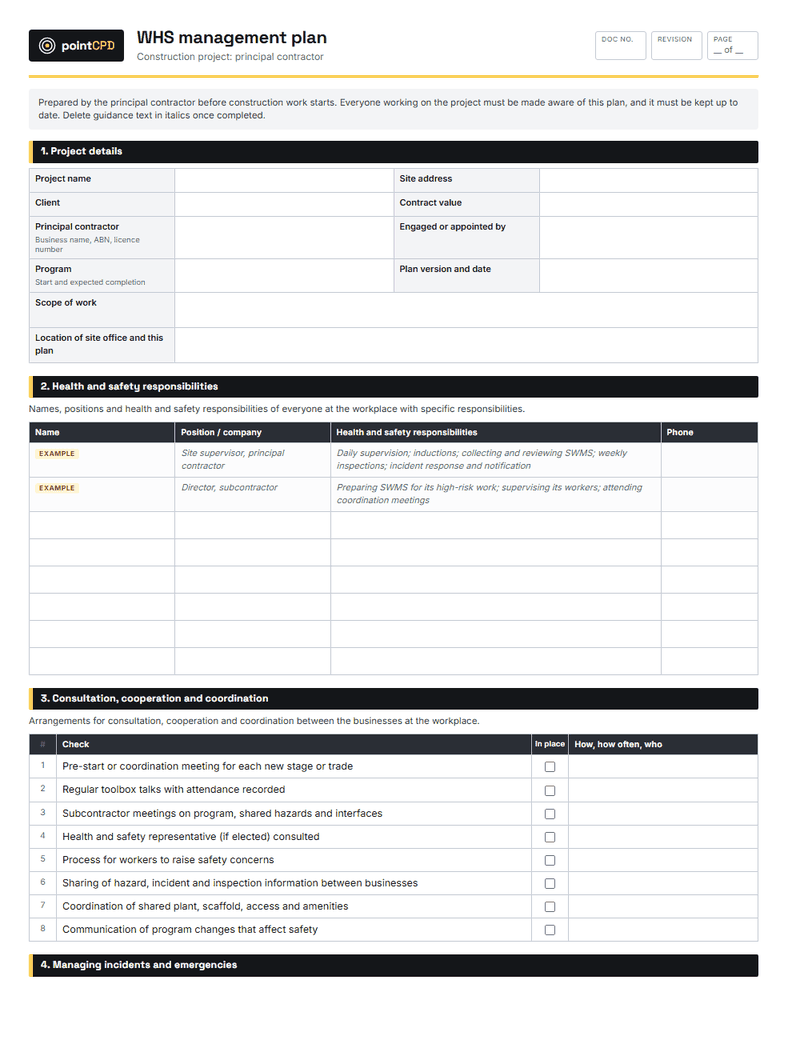
The plan works alongside the project risk register and the site emergency plan, which carry the detail the plan refers to.

Example: a two-storey home over the threshold

A builder contracted to build a two-storey home for $750,000 is the principal contractor for a construction project. A practical WHS management plan for that job might be eight or ten pages, not eighty:

  • Responsibilities: the director, the site supervisor, the leading hand as backup, a named first aider, and a contact for each of the main subcontractors.
  • Consultation and coordination: a pre-start meeting with each trade before they begin, a weekly toolbox talk open to all trades, and a group message for program changes.
  • Incidents: the site emergency plan, the incident report form, and who notifies the regulator.
  • Site rules: one page, covering sign-in, PPE, scaffold alterations, housekeeping, drugs and alcohol, and phones near plant.
  • SWMS: required before start, checked by the supervisor, filed in the site box, and spot-checked during weekly inspections.
  • Significant hazards: falls, excavation, plant and deliveries, silica dust, and the overhead service line.

That plan is short enough that every trade can be walked through it at induction, which is the point.

Sharing the plan with subcontractors

A WHS management plan only works if the people on site know what is in it. Send the relevant parts to each subcontractor with the subcontract or work order: the site rules, the SWMS requirement, the emergency arrangements and the coordination meetings. Cover it at the site induction. Keep a copy in the site box, and tell people when it changes. Subcontractors who have seen the plan before they arrive start work faster and argue less about rules they did not know existed.

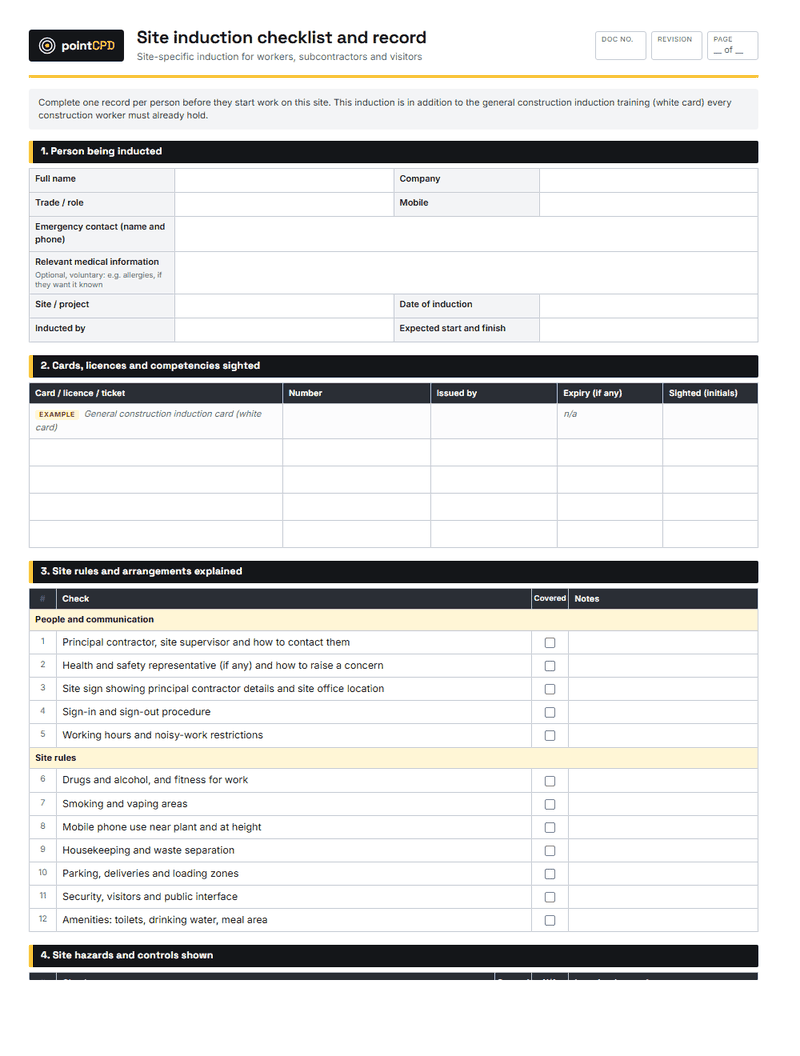
Preview the full Construction WHS management plan template

Every section, field and check in the download, exactly as it prints. Edit the Word version to add your logo, delete what does not apply and add your own site-specific items.

pointCPD

WHS management plan

Construction project: principal contractor

Doc no.
Revision
Page
__ of __

Prepared by the principal contractor before construction work starts. Everyone working on the project must be made aware of this plan, and it must be kept up to date. Delete guidance text in italics once completed.

1. Project details

Project nameSite address
ClientContract value
Principal contractorBusiness name, ABN, licence numberEngaged or appointed by
ProgramStart and expected completionPlan version and date
Scope of work
Location of site office and this plan

2. Health and safety responsibilities

Names, positions and health and safety responsibilities of everyone at the workplace with specific responsibilities.

NamePosition / companyHealth and safety responsibilitiesPhone
ExampleSite supervisor, principal contractorDaily supervision; inductions; collecting and reviewing SWMS; weekly inspections; incident response and notification
ExampleDirector, subcontractorPreparing SWMS for its high-risk work; supervising its workers; attending coordination meetings

3. Consultation, cooperation and coordination

Arrangements for consultation, cooperation and coordination between the businesses at the workplace.

#CheckIn placeHow, how often, who
1Pre-start or coordination meeting for each new stage or trade
2Regular toolbox talks with attendance recorded
3Subcontractor meetings on program, shared hazards and interfaces
4Health and safety representative (if elected) consulted
5Process for workers to raise safety concerns
6Sharing of hazard, incident and inspection information between businesses
7Coordination of shared plant, scaffold, access and amenities
8Communication of program changes that affect safety

4. Managing incidents and emergencies

#CheckIn placeDetails
1Site emergency plan prepared, displayed and tested
2First aid kits, first aiders and facilities
3Emergency services access to site
4Incident and near-miss reporting procedure
5Notifying the regulator of notifiable incidents immediately
6Preserving the incident site until released
7Investigation and corrective action
8Informing the client and insurer

5. Site-specific health and safety rules

The site rules, and how everyone will be informed of them.

RuleHow people are informed
ExampleEveryone signs in and completes a site induction before starting workInduction; gate signage
ExampleHard hat, hi-vis and safety boots at all times beyond the site officeInduction; signage at entry
ExampleNo alteration of scaffold except by the scaffolding contractorInduction; scaffold tags; toolbox talk

6. SWMS arrangements

Arrangements for collecting, assessing, monitoring and reviewing safe work method statements.

#CheckIn placeWho / how
1SWMS required from each contractor before its high-risk construction work starts
2SWMS checked for site-specific content and specific controls before acceptance
3Register of SWMS received, with version and date
4Monitoring that work follows the SWMS (supervision, inspections)
5Work stopped where it does not follow the SWMS
6Revised SWMS obtained when methods or controls change
7Workers briefed and signed on to SWMS

7. Significant project hazards and site-wide controls

HazardSite-wide controlsResponsible
ExampleFalls from heightEdge protection to all slab edges and roofs before work; scaffold by licensed scaffolder, tagged and inspected; voids coveredSite supervisor
ExampleMobile plant and deliveriesTraffic management plan; set-down area; spotters; pedestrian separationSite supervisor

8. Supporting documents

  • Risk register
  • Site emergency plan
  • Traffic management plan
  • Asbestos register (existing buildings)
  • Hazardous chemicals register
  • Training and competency register
  • Inspection checklists
  • Incident and hazard reports
  • Other:

9. Review and revision record

Keep this plan up to date. Review at each new stage, when the work or arrangements change, and after incidents.

VersionDateChangesApproved by

10. Approval

Prepared byDate
Approved (principal contractor)Signature
Template by PointCPD · pointcpd.com.au/resources/templates/whs-management-plan-template/Free to use, copy and adapt, including commercially (CC BY 4.0). Keep this credit line.v1.0

Download Word Download PDF

Questions builders ask

When is a WHS management plan required?

Under the model WHS Regulations, for every construction project, which is construction work where the cost is $250,000 or more. The principal contractor must prepare it before work on the project starts.

Who is the principal contractor?

The business commissioning the project, or a business it engages or appoints as principal contractor and authorises to manage or control the workplace. On most residential builds with a head contract, it is the builder. There can only be one principal contractor for a project.

What must a WHS management plan contain?

The names, positions and health and safety responsibilities of people with specific responsibilities; arrangements for consultation, cooperation and coordination between businesses; arrangements for managing incidents; site-specific rules and how people are told about them; and arrangements for collecting, assessing, monitoring and reviewing SWMS.

Is a WHS management plan the same as a SWMS?

No. The WHS management plan covers the whole project and the principal contractor's arrangements. A SWMS covers a specific high-risk construction activity and is prepared by the business doing that work. The plan must say how SWMS will be handled.

Does a small residential job need one?

Not if the construction work costs less than $250,000, because it is not a construction project under the regulations. You still have the general duties to manage risks, consult and coordinate, and SWMS are still required for high-risk construction work.

How long must the plan be kept?

Keep it up to date throughout the project. The regulations also set how long it must be kept after the project, including a longer period if a notifiable incident occurs; check the current rule with your regulator.

Free to use, adapt and share, including commercially

This template is licensed under Creative Commons Attribution 4.0. Copy it, rebrand it, edit it for your jobs, hand it to clients and subcontractors, or republish it. The one condition: keep the small PointCPD credit line on the document. If you publish it online, credit it like this:

<a href="https://pointcpd.com.au/resources/templates/whs-management-plan-template/">Construction WHS management plan template</a> by PointCPD, CC BY 4.0

Last reviewed 14 September 2026. A template is a starting point: it becomes a compliant document only once it is completed for the actual job by people who understand the work, and kept current as the work changes. General information, not legal advice. Check the requirements of your state regulator and your contract.

Sources: Model Work Health and Safety Regulations, construction project and principal contractor provisions (WHS management plans). Safe Work Australia, Code of Practice: Construction work. WorkSafe ACT, Guidance note: Work health and safety management plans.