Key takeaways
- Disruption to oil supply through the Strait of Hormuz drove diesel, plastic pipe, bitumen and asphalt prices sharply higher from February 2026.
- Rider Levett Bucknall reported diesel and plastic pipe up 25–40% between February and June, bitumen and asphalt up 20–40%, and estimated the shock added 1.5–3.5% to total project costs.
- The Cotality Cordell Construction Cost Index rose 1.0% in the June quarter 2026, up from 0.2% in March, taking annual growth to 2.8%.
- In NSW, a price rise that takes a residential contract above $20,000 including GST may trigger Home Building Compensation Fund cover, and variations must include any extra premium.
- Substituting cheaper products to absorb costs carries compliance risk. The builder remains responsible for work matching the approved plans and standards.
Builders felt it before the indices showed it. Supplier emails announcing fuel levies. Plumbers re-pricing drainage because PVC had jumped. Civil contractors warning that asphalt quotes would not hold. The Middle East conflict that disrupted oil shipping through the Strait of Hormuz early in 2026 flowed straight into the cost of building in Australia.
The good news is that the worst of the direct shock appears to have passed. The less good news is that cost growth was already picking up before the conflict, and the indices now show it clearly. This article sets out what happened, what it did to building costs, and how builders can protect their margins on work being priced now.
Cotality Cordell Construction Cost Index, June quarter 2026
Source: Cotality, 22 July 2026; HIA Trades Report, 28 July 2026
What happened to prices
Australia imports most of its refined fuel, and many building products are made from oil or depend on it. When shipping through the Strait of Hormuz was severely disrupted, crude and refined fuel prices rose sharply, and the effect spread through the supply chain.
Quantity surveyors Rider Levett Bucknall documented the impact. Between February and June 2026, diesel and plastic pipe prices rose by 25–40%. Bitumen and asphalt rose by 20–40%. Polyethylene resin, the raw material for many pipes and fittings, was priced on the spot market for April delivery at around 40% above March. Suppliers applied emergency fuel levies to deliveries. Taken together, RLB estimated the shock added 1.5–3.5% to total project costs.
Where the 2026 price shock hit
| Item | Reported movement | Why |
|---|---|---|
| Diesel | Up 25–40% between February and June | Crude oil supply disruption through the Strait of Hormuz |
| Plastic pipe (PVC, PE) | Up 25–40% between February and June | Petrochemical feedstock prices; PE resin spot for April delivery about 40% above March |
| Bitumen and asphalt | Up 20–40% | Oil-derived products |
| Freight and delivery | Emergency fuel levies applied by suppliers | Diesel costs passed through |
| Whole projects | An estimated 1.5–3.5% added to total costs | The combined effect across materials and transport |
Source: Rider Levett Bucknall; The Urban Developer, June 2026.
Those numbers are averages across the industry. The effect on an individual job depends on its mix. A house on a sloping block with long drainage runs, a big driveway and a lot of plant time felt it more than a compact single-storey home on a flat lot. Civil and infrastructure work, heavy in bitumen, diesel and plant, felt it most.
What the cost indices show
The Cotality Cordell Construction Cost Index, which tracks residential building costs, rose 1.0% in the June quarter 2026, up from 0.2% in the March quarter. Annual growth lifted to 2.8%, from 2.3%. That is not a return to the extreme cost growth of 2021 and 2022, but it is a clear re-acceleration after a period of relative calm.
Labour is the other half of the story. The Housing Industry Association’s Trades Report, released on 28 July, found trades prices rose 5.1% in the first half of 2026, the fastest six-monthly rise since 2022, with shortages still entrenched. So even as fuel-driven materials prices ease, labour costs are still climbing.
Is the shock over?
Some of it. By mid-year, RLB reported that diesel had come off its peak and shipping had stabilised. RLB expects the direct effect on tender prices to fade from 2027. But three things suggest builders should not assume costs will fall back:
- Price rises are sticky. Suppliers who raised prices on fuel and freight rarely lower them at the same speed when fuel falls. Emergency levies tend to become part of the base price.
- Labour is still rising. Trade shortages are structural, and trades prices are growing faster than materials.
- Demand is strong. Governments are pushing to build more homes and more infrastructure at the same time. Demand for materials and trades will stay high.
A prudent working assumption for pricing is that costs will keep rising at a moderate pace, with the risk of another shock if global supply is disrupted again.
Fixed-price contracts: who wears the cost?
Most residential building work in Australia is done on fixed-price contracts. That means the builder carries the risk of cost increases after the contract is signed, except to the extent the contract allows the price to be adjusted. For builders who signed contracts late in 2025 and early 2026, before the shock, the price rises came straight out of margin.
Whether any of that cost can be recovered depends entirely on the contract. Some contracts include rise and fall provisions, others limit adjustments to specific items such as provisional sums, and many allow no adjustment at all. In NSW, the Building Commission reminded consumers in April that in most cases they cannot be charged more unless there is a genuine change in scope or another valid reason allowed under the contract or the law.
A cost increase is not a variation. A variation is a change to the work. Rising prices for the same work are a pricing risk, and whether any of that risk can be passed on depends on what your contract says. Trying to dress up a cost increase as a variation is a fast way to a dispute, and in NSW a variation must show how its price was calculated.
NSW rules when a contract price changes
The Building Commission NSW issued guidance for licence holders in April 2026 on rising fuel costs. It covers contract price changes, insurance and compliance, and it applies to any price increase, whatever the cause.
NSW rules that bite when a contract price rises
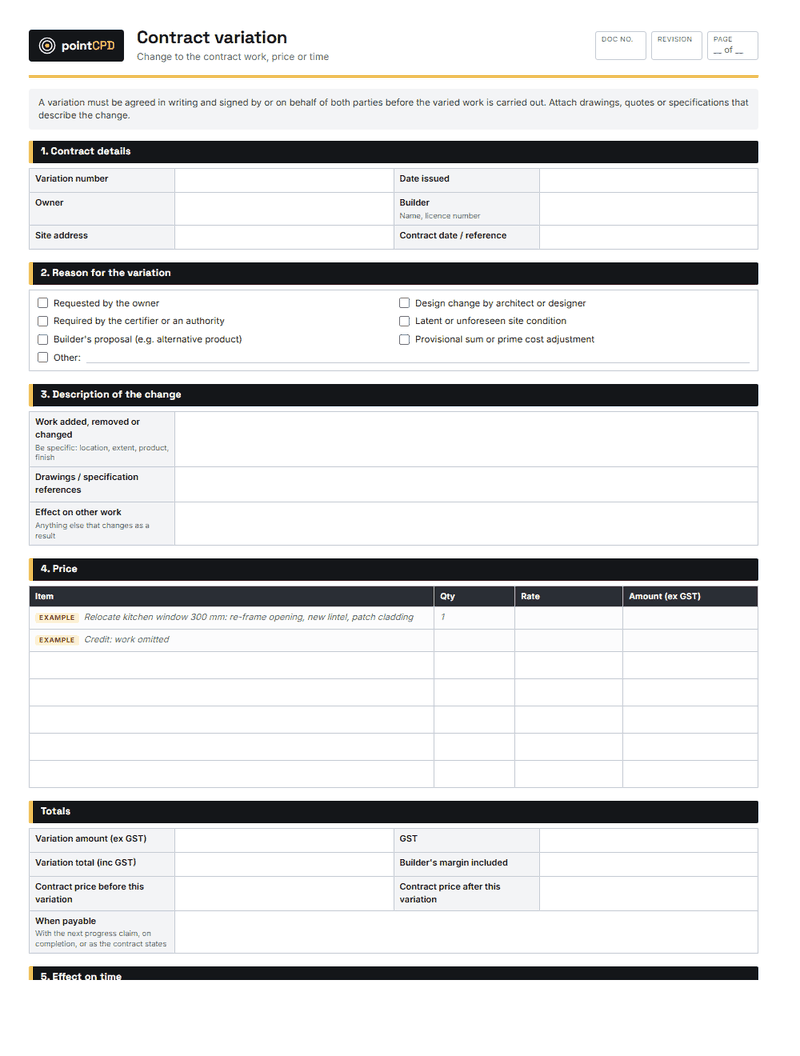
- Contracts for residential work over $5,000 must be in writing, and variations must be agreed in writing before the work is done.
- A variation must explain its cost and its effect on the contract price, with the calculation shown, not just a dollar figure.
- If a price increase takes a contract over $20,000 including GST, HBCF insurance may be required before work continues.
- HBCF premiums are based on the value of the work, so a price increase can mean an extra premium, which the variation must include.
- Most residential work over $5,000 must be done by a licensed contractor, so check licensing if the price moves across that line.
The insurance point catches builders out. A small job contracted just under $20,000 including GST may not need Home Building Compensation Fund cover. If a legitimate price increase takes it over that figure, cover may be required before the work continues, and the builder is responsible for making sure the right cover is in place. Because HBCF premiums are based on the value of the work, a price increase on a larger job can also mean an additional premium, and the Commission’s guidance is that variations must include that premium cost.
The temptation to substitute
When prices rise, the easiest way to protect margin is to buy something cheaper. The Building Commission’s guidance warns about exactly that. Substituting products or materials because of cost or supply can mean the work no longer matches the approved plans or required standards, which can breach both the building rules and the contract with the client.
The builder remains responsible for ensuring all work complies with approved specifications, regulatory requirements and industry standards, regardless of cost pressures. In practice, that means:
- Checking whether a substitute product is genuinely equivalent, including its standards compliance, certification and warranty, not just its price.
- Checking whether the substitution affects an approval document, such as an engineer’s design, a BASIX certificate or a fire-rated system.
- Getting written agreement from the client, and from the certifier or designer where needed, before the substitution is made.
- Checking the product against any building product bans or safety notices.
A cheaper pipe, membrane or window that fails is not a saving. It is a defect claim with the builder’s name on it.
Pricing new work in a volatile market
Protecting the margin on the next contract
- 1Price it freshGet current supplier and trade prices for the job, not last quarter’s price list.
- 2Shorten validityLimit how long a quote stays open. A 90-day quote in a volatile market is a gift to the client.
- 3Use the contract properlyUnderstand what your contract allows for price movement, provisional sums and prime cost items, and use them honestly.
- 4Order earlyLock in prices for long-lead and volatile items once the contract is signed.
- 5Talk earlyTell clients about cost pressure before it becomes a claim. Surprises cause disputes.
A few habits separate builders who came through 2026 with their margins intact from those who did not:
- Current prices, from the people doing the work. Estimating from a rate book or last year’s job is dangerous when prices are moving. Get current quotes from suppliers and trades for the specific job.
- Short quote validity. A quote that stays open for months lets a client lock in yesterday’s price for a job you will build next year.
- Honest provisional sums. Where an item genuinely cannot be priced yet, a realistic provisional sum is better than a guess in the fixed price. Set it at a realistic level, not a low one to make the headline number look good.
- Buy early on volatile items. Once the contract is signed, lock in prices for items most exposed to fuel and petrochemical costs, such as pipe, drainage and membranes, where storage and cash flow allow.
- Talk to clients before the claim. Clients handle bad news better as information than as an invoice. Explain early what is moving and what the contract allows.
Provisional sums and prime cost items, used properly
Two contract tools exist precisely for items that cannot be priced exactly at signing, and they are often misused.
A provisional sum is an allowance for work that cannot be accurately priced when the contract is signed, such as rock excavation of unknown extent or a retaining wall that depends on a later engineering design. The contract price includes the allowance, and the final cost is adjusted up or down to the actual cost of the work, usually with the builder’s agreed margin on any increase.
A prime cost item is an allowance for supplying an item that has not yet been selected, such as tapware, appliances or tiles. The price adjusts to the cost of the item the client actually chooses.
Both are legitimate. Both are also a source of disputes when they are set unrealistically low to make a quote look competitive. In a rising market, a low provisional sum does not protect the builder from cost risk; it simply defers the argument to the middle of the job. Many state laws, including in NSW, set requirements for how these allowances are described in residential contracts, including stating the basis on which they were estimated. Use them for genuine unknowns, price them realistically, and explain them clearly to the client.
A worked example: what 3% does to a fixed-price job
Take a new home contracted at $600,000 in late 2025. The builder’s estimate put direct costs at $552,000, leaving a gross margin of $48,000, or 8%, to cover overheads and profit.
By mid-2026, drainage and plumbing materials, concrete deliveries, plant hire and several trades have risen. Across the job, direct costs finish 3% higher than estimated: $568,560. The contract price has not changed. The margin is now $31,440, down by more than a third.
If the builder has several jobs like this running at once, and overheads have also risen, the business can go from comfortably profitable to barely breaking even without a single thing going wrong on site. That is the quiet way cost shocks damage building businesses, and it is why pricing discipline matters more than ever.
Questions to ask your suppliers now
- Which of my regular items are still carrying fuel or freight levies, and when will they be reviewed?
- How long will you hold a price once I place an order, and can I lock in pricing for a specific job?
- Which products have been hardest to supply this year, and what are the equivalent alternatives if supply fails?
- Are any price increases already announced for the coming months?
Suppliers know what is coming before the indices do. A builder who asks regularly prices with better information than one who waits for the next price list.
Cash flow: the hidden cost
A 1.5–3.5% rise in project costs sounds manageable. For a builder operating on thin margins, it is not. If the margin on a job was 8% and costs rose 3% after the contract was signed, more than a third of the profit is gone. Across several jobs at once, that can turn a profitable business into one struggling to pay its trades.
Builders under that pressure should look at cash flow job by job: what has been claimed, what is owed to trades and suppliers, and what remains to be done at what cost. Catching a margin problem early, while there is still time to adjust the program or have a conversation with the client, is far better than discovering it at practical completion.
What to watch
- The next cost index releases, which will show whether the June quarter lift continues.
- Fuel prices, which are the fastest channel for global shocks into Australian building costs.
- Interest rates: the Reserve Bank meets on 11 August. Rates affect demand, which affects how much pricing power builders have.
- Trade prices, which are likely to keep rising regardless of what happens to fuel.
The 2026 cost shock is a reminder that a builder’s price is only as good as the assumptions behind it. The businesses that thrive in this market are the ones that price for when the work will actually happen, use their contracts properly, and refuse to protect margin with substitutions that create defects.
Questions builders ask
Why did building costs rise in 2026?
Disruption to oil supply through the Strait of Hormuz pushed up diesel, plastic pipe, bitumen and asphalt prices, and suppliers added fuel levies. At the same time, trade labour costs kept rising because of skills shortages.
How much did the Middle East conflict add to construction costs?
Rider Levett Bucknall estimated it added 1.5–3.5% to total project costs, with diesel and plastic pipe up 25–40% and bitumen and asphalt up 20–40% between February and June 2026.
Can I pass cost increases on to a client on a fixed-price contract?
Only to the extent the contract allows. A cost increase for the same work is not a variation. In NSW, variations must be agreed in writing and show how the price change was calculated.
Does a price increase affect HBCF insurance in NSW?
It can. If an increase takes a residential contract over $20,000 including GST, HBCF cover may be required before work continues, and a higher contract value can mean an extra premium that the variation must include.
Can I substitute cheaper materials to offset rising costs?
Only with care. Substitutions can mean the work no longer matches approved plans, standards or the contract. The builder remains responsible for compliance, so check equivalence and get the necessary agreement before substituting.
Sources
- What the Middle East conflict means for Australian construction costs · Rider Levett Bucknall
- Rider Levett Bucknall construction market update: Middle East conflict costs · The Urban Developer
- Construction costs rebound to steady growth · Cotality · 2026-07-22
- Rising fuel costs: what trades need to know about contracts, insurance and compliance · Building Commission NSW · 2026-04-28
- Tradie shortages remain entrenched despite housing market uncertainty · Housing Industry Association · 2026-07-28
Published 4 August 2026. General information for builders, not legal, financial or engineering advice for a specific job. Check current requirements with the relevant regulator or standard before relying on them.