Skip to content
  • NSW-first CPD, built by a practising builder
  • Instant PDF certificates
  • Unlimited assessment attempts
  • 12 points a year, sorted
  • 15% off your first order — get your code
  • Content aligned to the NCC 2022

Free template Contracts and site admin

Free building variation form template for builders

Record a change to the contract work before it is done: who asked for it, what changes, the price, the effect on completion time, and signatures from both parties.

The short version

A variation is any change to the contracted work: an owner request, a design change, or something required by the certifier or site conditions. Record what changes, why, the price, the effect on completion time, and signatures from both parties, before the varied work is done. In NSW, residential building contracts require variations to be in writing and signed by or on behalf of both parties.

  • No sign-up
  • Free for commercial use
  • Add your own logo
  • Updated 14 Sep 2026

Reviewed by Daniel Betros, Licensed Building Practitioner

Animated walkthrough · 6 steps

How to complete a variation form

Six steps. The golden rule: signed before the work is done.

1 / 6
  1. Contract, owner, site, and a sequential variation number. A numbered register makes the final account simple.

  2. Owner request, design change, certifier or authority requirement, latent condition, or builder's proposal. The reason affects who pays and how it is handled under the contract.

  3. What is added, removed or changed, with drawing references, specifications and selections. Vague descriptions cause the disputes.

  4. Labour, materials, subcontractors, credits for work omitted, margin and GST, in a way the owner can follow. Show the new contract price.

  5. How many days the change adds to completion, or state that it adds none. Leaving it blank gives up an extension you may need.

  6. Owner and builder sign and date. Keep a copy each and record it in the variation register.

Variations are where good jobs go bad. The owner asks for a small change on site, it gets done, and the invoice arrives weeks later as a surprise. By then nobody remembers the conversation the same way. A signed variation form, done before the work, prevents almost all of it. This template covers the change, the price, the time impact and the signatures, with a running register.

What counts as a variation

A variation is any change to the work described in the contract. Common sources on residential jobs:

  • Owner requests: move a window, upgrade tapware, add a power point.
  • Design changes: revised drawings from the architect or engineer.
  • Certifier or authority requirements: changes needed to comply.
  • Site conditions: rock, fill or services not anticipated in the contract.
  • Provisional sums and prime cost items: adjustments when the actual cost is known.

The NSW rule: in writing, signed by both

For residential building work in NSW, contracts must require variations to be in writing and signed by or on behalf of both parties. The practical meaning is simple: if the variation is not written and signed, the builder may struggle to be paid for it. Do not start varied work on a handshake, however friendly the owner. If a change is genuinely urgent, get a signed note of the instruction on the day and issue the full variation straight after. Check your own contract’s variation clause too: most set out how variations are requested, priced and paid.

Describe it so it cannot be misunderstood

“Kitchen changes” is not a variation description. “Relocate kitchen window W3 300 mm to the left as shown on sketch SK-04, including re-framing, new lintel and cladding patch” is. Reference drawings, specifications and product selections, and note anything else the change affects, such as the splashback, the rangehood position or a power point.

Price it transparently

Owners dispute prices they cannot follow. Break the variation into labour, materials, subcontract costs and credits for work omitted, show the margin and GST, and state the new contract price. Say when it is payable: with the next progress claim, on completion of the varied work, or as the contract says.

Never leave the time box blank

A change that adds work usually adds time. If the variation affects the completion date, state how many days and why. Many builders leave this blank to keep the owner happy, then find they cannot claim the time later and face delay damages. If there is no time impact, write zero. Where the time effect cannot be known yet, say so and follow up with an extension of time claim.

Keep a register

Section 7 is a running register of every variation: number, date, description, amount, days and whether it is signed. It makes the final account straightforward and shows at a glance which variations are still unsigned. Tie each one back to the site diary entry where the instruction was given, and claim approved variations in your progress claims.

Questions before variations

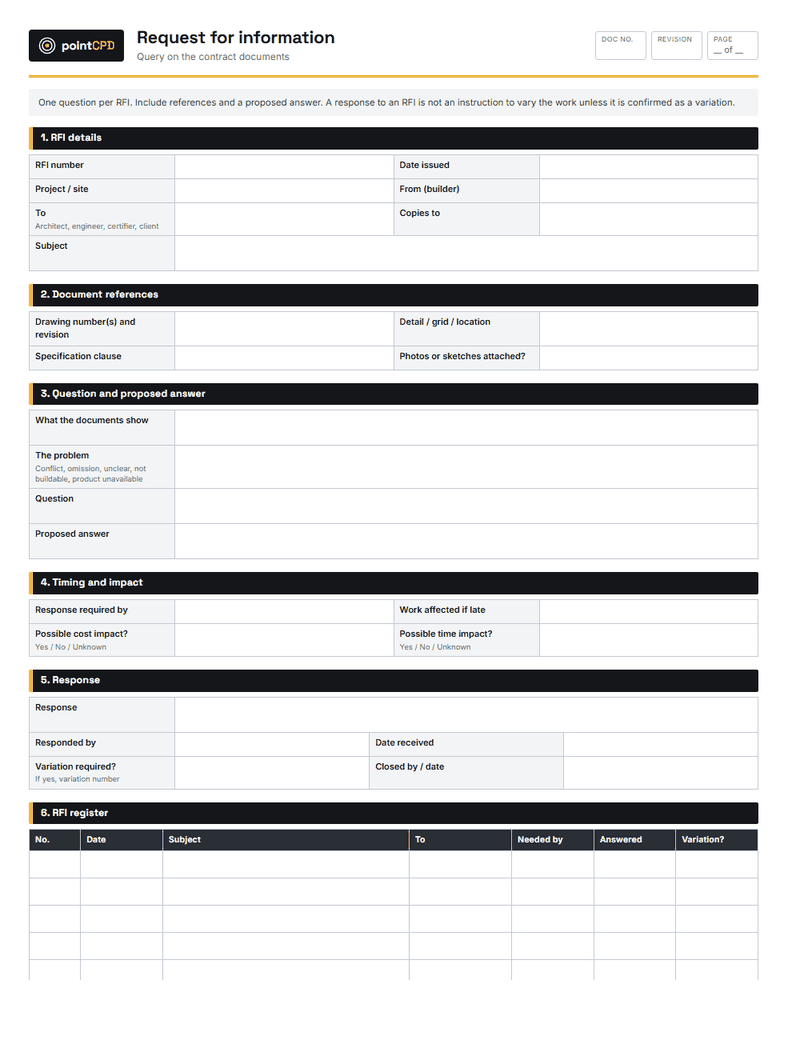
Not every query is a variation. If something on the drawings is unclear or conflicting, issue an RFI first. The answer may turn out to be a variation, but the RFI records the question, the date and the response, which is the evidence you need either way.

Pricing variations fairly

Most variation disputes are about price, not scope. A few habits reduce them:

  • Use the contract’s method. Many contracts set how variations are valued: agreed price, rates in the contract, or cost plus a stated margin. Follow it.
  • Show credits. If the change removes work, show the credit alongside the added cost, so the owner sees the net effect.
  • Include the knock-on costs. Re-inspection, extra scaffold time, disposal and supervision are real costs; list them rather than hiding them in a lump sum.
  • Price before the work. A price agreed in advance is rarely disputed. A price presented afterwards often is.

Provisional sums and prime cost items

Many residential contracts include provisional sums (allowances for work that cannot be fully priced at signing, such as rock excavation) and prime cost items (allowances for items the owner will select, such as tapware or appliances). When the actual cost is known, the difference is adjusted, usually with the builder’s margin on any increase as the contract provides. Treat each adjustment like a variation: record the allowance, the actual cost, the margin and the adjustment, and have it acknowledged. Owners are often surprised by prime cost adjustments at the end of a job; recording each one as it happens avoids that surprise.
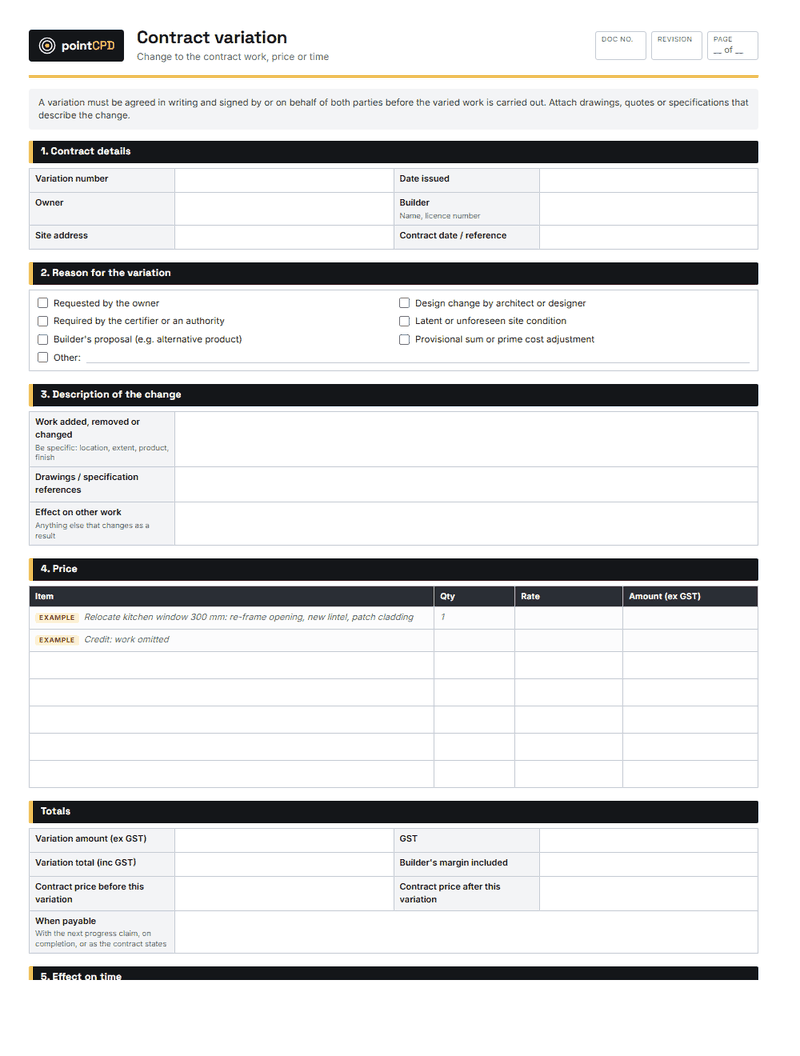
Preview the full Contract variation form template

Every section, field and check in the download, exactly as it prints. Edit the Word version to add your logo, delete what does not apply and add your own site-specific items.

pointCPD

Contract variation

Change to the contract work, price or time

Doc no.
Revision
Page
__ of __

A variation must be agreed in writing and signed by or on behalf of both parties before the varied work is carried out. Attach drawings, quotes or specifications that describe the change.

1. Contract details

Variation numberDate issued
OwnerBuilderName, licence number
Site addressContract date / reference

2. Reason for the variation

  • Requested by the owner
  • Design change by architect or designer
  • Required by the certifier or an authority
  • Latent or unforeseen site condition
  • Builder's proposal (e.g. alternative product)
  • Provisional sum or prime cost adjustment
  • Other:

3. Description of the change

Work added, removed or changedBe specific: location, extent, product, finish
Drawings / specification references
Effect on other workAnything else that changes as a result

4. Price

ItemQtyRateAmount (ex GST)
ExampleRelocate kitchen window 300 mm: re-frame opening, new lintel, patch cladding1
ExampleCredit: work omitted

Totals

Variation amount (ex GST)GST
Variation total (inc GST)Builder's margin included
Contract price before this variationContract price after this variation
When payableWith the next progress claim, on completion, or as the contract states

5. Effect on time

Extension to the completion date (days)Write 0 if noneRevised completion date
Reason for the time impact

6. Agreement

The parties agree to vary the contract as described. All other terms of the contract continue to apply.

Owner nameOwner signature and date
Builder nameBuilder signature and date

7. Variation register (running total)

No.DateDescriptionAmount (inc GST)DaysSigned?
Template by PointCPD · pointcpd.com.au/resources/templates/variation-form-template/Free to use, copy and adapt, including commercially (CC BY 4.0). Keep this credit line.v1.0

Download Word Download PDF

Questions builders ask

What is a variation in a building contract?

Any change to the work described in the contract: something added, removed or changed, whether requested by the owner, needed because of a design change, required by the certifier, or caused by site conditions.

Do variations have to be in writing in NSW?

Yes. NSW residential building contracts must require variations to be in writing and signed by or on behalf of both parties. Doing varied work on a verbal agreement puts the builder's payment at risk.

What if the owner asks for a change on site?

Record it in the site diary, then issue a written variation with the price and time impact, and get it signed before doing the work. If the change is urgent, get at least a signed note of the instruction on the day.

Should a variation include time as well as price?

Yes. If a change delays completion, say so on the variation. Otherwise you may lose the ability to claim that extra time later and face delay damages.

What about changes required by the certifier?

They are still variations if they change the contract work, but how they are priced and who bears the cost depends on the contract and the cause. Record them the same way.

Can a builder refuse a variation?

Depending on the contract, a builder may be able to decline a variation that is outside the scope of the work or not reasonably practicable. Check your contract's variation clause.

Free to use, adapt and share, including commercially

This template is licensed under Creative Commons Attribution 4.0. Copy it, rebrand it, edit it for your jobs, hand it to clients and subcontractors, or republish it. The one condition: keep the small PointCPD credit line on the document. If you publish it online, credit it like this:

<a href="https://pointcpd.com.au/resources/templates/variation-form-template/">Contract variation form template</a> by PointCPD, CC BY 4.0

Last reviewed 14 September 2026. A template is a starting point: it becomes a compliant document only once it is completed for the actual job by people who understand the work, and kept current as the work changes. General information, not legal advice. Check the requirements of your state regulator and your contract.

Sources: Home Building Act 1989 (NSW) and Home Building Regulation (contract requirements for residential building work). NSW Fair Trading guidance on contract variations. Your building contract's variation clause governs pricing, time and procedure.