Key takeaways
- In NSW, variations to a residential building contract must be in writing, and agreed before the work is carried out.
- Building Commission NSW says the variation must explain its cost implications and effect on the contract price, with the calculation shown rather than just a dollar amount.
- If the variation is needed because of the builder’s or trade’s own fault, the owner does not have to pay for it.
- A price increase can change insurance and licensing obligations: HBCF cover applies to most residential work over $20,000 including GST, and extra premium must be included in a variation.
- Most variation disputes are paperwork disputes. Describe the change, price it with workings, state the time impact, and get it signed before you start.
Ask any experienced builder where jobs go wrong and most will say the same thing: variations. Not because variations are unusual, since almost every residential job has them, but because they are so often handled badly. A change agreed on site, a price mentioned in passing, a bill at the end of the job that the owner does not remember agreeing to. That is how a good relationship becomes a dispute.
The fix is not complicated. It is discipline: every change written down, priced with workings, signed before the work starts. This guide explains what a variation is, what NSW requires, and how to write variations that get signed and paid.
What a variation is, and what it is not
A variation is a change to the work described in the contract. The owner wants a different window, an extra power point, a moved wall, an upgraded finish. The certifier or an authority requires a change. A condition on site, such as rock or an unknown service, means the work must be done differently.
A variation is not:
- A correction of the builder’s own mistake. If the work has to be changed because it was built wrong, that is the builder’s cost.
- A general price increase. If materials or labour cost more for the same work, that is a pricing risk. Whether any of it can be passed on depends on the contract, not on the variation clause.
- Something already included. If the contract and plans already require it, charging for it as a variation is not legitimate.
Getting that distinction right matters. Trying to recover a mistake or a cost increase through a variation is one of the fastest ways to lose an owner’s trust, and it will not survive scrutiny in a dispute.
What NSW requires
In NSW, residential building work is governed by the Home Building Act 1989. Building Commission NSW summarises the key points for variations in its consumer guidance:
- In writing. All contracts for work valued above $5,000 must be in writing, and variations to that contract must also be agreed in writing before the work is carried out.
- Signed and attached. The variation should be signed by both the owner and the contracting builder or tradesperson (or their nominated supervisor or agent), and attached to the contract.
- Cost implications explained. Documents authorising variations must contain a statement explaining the cost implications of the variation and its impact on the overall contract price. The calculation of the price change should be shown, rather than just a simple dollar amount.
- Builder’s fault. If the reason for a variation is the builder’s or tradesperson’s fault, the owner does not have to pay for the extra work to fix the problem.
The Commission also advises owners to agree all work in writing regardless of value, to review any variation carefully, and to agree only if the work itself is changing. Builders should assume that owners are reading that advice.
Price changes can trigger insurance and licensing obligations. Most NSW residential work over $20,000 including GST must be covered by the Home Building Compensation Fund. If variations push a contract over that line, cover may be required before work continues. HBCF premiums are based on the value of the work, so a variation that increases the price may need an additional premium, which the variation must include. Similarly, most residential work over $5,000 must be done by a licensed contractor.
The anatomy of a good variation
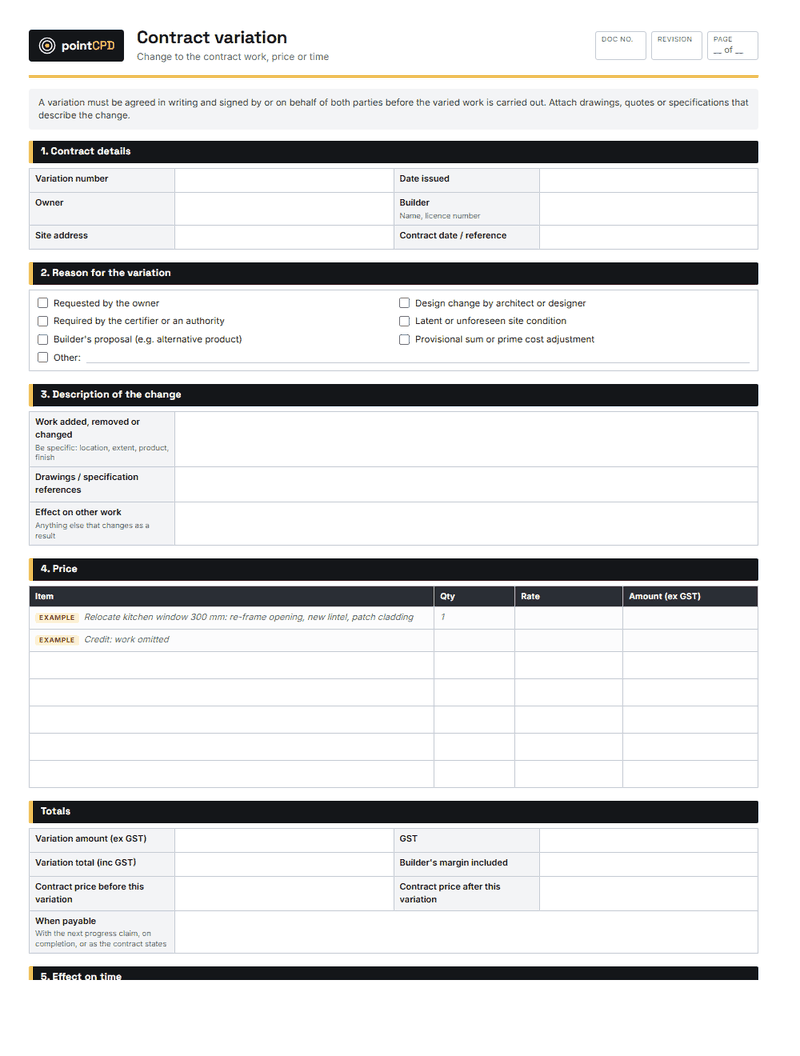
What a good variation contains
- Job, contract and variation number, and the date.
- Who requested the change: owner, builder, certifier, authority or an unforeseen condition.
- A plain-English description of exactly what is changing, with drawing references.
- The cost, with the calculation shown: labour, materials, subcontractors, margin, GST.
- The effect on the contract price: previous price, this variation, new price.
- The effect on time: days added to the programme, if any.
- Any change to insurance premium, approvals or specifications caused by the change.
- Signatures of the owner and the builder (or their nominated agent) before the work starts.
The description is where most variations fail. “Extra electrical work” is not a description. “Supply and install four additional double power points on the north wall of the living room, as marked on drawing A-102 revision C” is. The test is whether a stranger, reading the variation a year later, would know exactly what was changed.
The price is the second failure point. A single dollar figure invites the question “how did you get that?”. Showing labour hours and rate, materials, subcontractor quotes, margin and GST answers the question before it is asked, and in NSW it is what the regulator expects.
The third is time. Many variations add days to the programme, and those days matter if the contract has a completion date and liquidated damages. If a variation adds time, say so in the variation, and have the owner sign it. A variation that is silent on time can leave the builder carrying the delay.
The process
The variation process that prevents disputes
- 1Stop and writeWhen a change comes up, record it the same day. Do not start the work on a verbal agreement.
- 2Price with workingsShow how the price was calculated. A number with no workings invites an argument.
- 3State the timeSay how many days the change adds, and why. Time is where disputes hide.
- 4Get it signedOwner and builder sign before the work is done. Attach it to the contract.
- 5Track itKeep a variation register: number, description, price, time, status, date signed, date invoiced.
The single most important habit is not starting the work until the variation is signed. It is tempting, on a busy site with an owner standing next to you asking for a change, to just do it and sort out the paperwork later. Later is when the owner does not remember agreeing, disputes the price, or refuses to pay because the variation was never signed. A two-day delay to get a signature is always cheaper than a dispute.
Where the owner is hard to reach, a variation can often be signed electronically. Many builders now send variations from their project management software or a simple PDF form for e-signature, which removes the excuse that the paperwork was too hard to get signed.
Who pays for which changes
Who pays for the change?
| Cause of the change | Usually paid by | Watch out for |
|---|---|---|
| Owner asks for something different | Owner, through a signed variation | Get it signed before the work, however small |
| Builder or trade got it wrong | Builder, not the owner | Do not dress a correction up as a variation |
| Certifier or authority requires a change | Depends on the contract and the cause | Check whether the requirement was foreseeable at tender |
| Latent condition such as rock or services | Depends on the contract’s latent conditions clause | Notify promptly as the contract requires |
| Prime cost or provisional sum adjustment | Adjusted under the contract’s PC and PS clauses | Show the actual cost and the agreed margin |
Source: General guide only; the contract and the Home Building Act decide each case.
Certifier and authority requirements are a common grey area. If a certifier requires a change because the design did not comply, the question is whether that was the builder’s responsibility under the contract (for example, in a design and construct arrangement) or the owner’s designer’s. If an authority introduces a new requirement after the contract was signed, the contract may treat that differently again. The answer is in the contract, so read it before you write the variation.
Latent conditions, such as rock in an excavation, contaminated soil or an unmapped service, are usually dealt with by a specific clause that sets out how and when the builder must notify the owner. Missing the notice requirement can cost the builder the right to claim, so notify promptly and in writing, then follow with a variation.
Keep a register
On a job with more than a couple of variations, a simple register prevents confusion. It shows every variation, its status, its price and time effect, and whether it has been invoiced. It also makes progress claims and the final account easier, and it is the first thing anyone will ask for in a dispute.
A simple variation register
| No. | Description | Price (inc GST) | Days | Signed | Invoiced |
|---|---|---|---|---|---|
| V01 | Relocate kitchen window 600 mm east | $1,870 | 1 | 12 Mar | 14 Mar |
| V02 | Upgrade ensuite tapware (PC adjustment) | $640 | 0 | 20 Mar | 28 Mar |
| V03 | Additional power points, living room ×4 | $720 | 0 | Pending | — |
Illustrative example only.
Pricing variations fairly
Variations are often priced at a premium, and owners know it. There are legitimate reasons a variation costs more than the same work would have cost at tender: small quantities, disruption to the programme, re-ordering, and work done out of sequence. But a variation priced far above the value of the work damages trust and invites challenge.
A fair variation price is the real cost of the change, including disruption, plus the margin the contract allows. If you show the calculation, a fair price is easy to defend. If the price cannot be defended with workings, it is probably not fair.
Credits for deleted work
Variations are not always additions. When the owner removes something from the scope, the contract price should reduce by a fair credit. Owners are understandably sensitive when additions are priced generously and deletions are credited meanly. Treat credits the same way as additions: show the calculation, including any costs already incurred, such as materials ordered or work done that cannot be reversed.
Common variation disputes, and how to avoid them
- “I never agreed to that.” Avoided by a signed variation before the work.
- “That price is outrageous.” Avoided by showing the calculation and pricing fairly.
- “Why is the job late?” Avoided by stating the time effect in each variation.
- “That was already included.” Avoided by checking the contract, plans and specification before issuing the variation.
- “You made that mistake, why am I paying?” Avoided by not issuing variations for your own errors.
- “I didn’t know it would affect the insurance.” Avoided by including any HBCF premium change in the variation.
Variations and progress claims
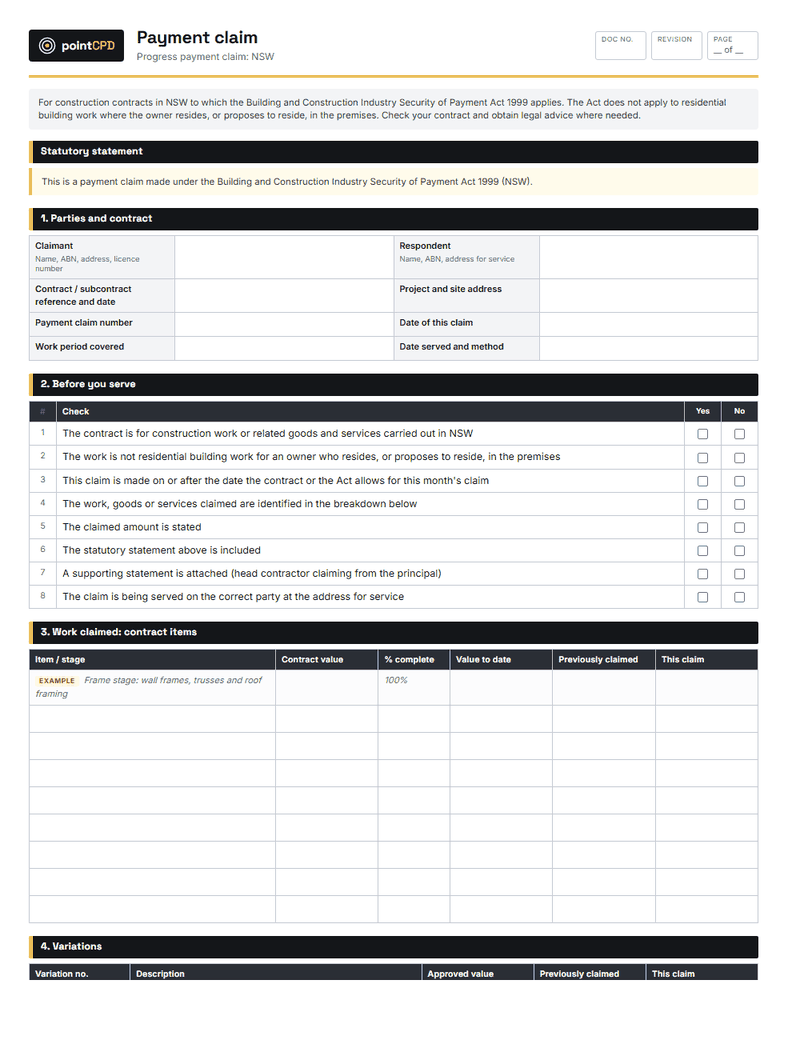
Variations are usually claimed with the next progress payment after the work is done, or as the contract specifies. Include each variation separately on the claim, with its number, so the owner can match it to what they signed. Unsigned variations should not be claimed as if they were agreed. If there is a dispute about a variation, deal with it separately rather than letting it hold up the whole progress claim.
Variations and extensions of time
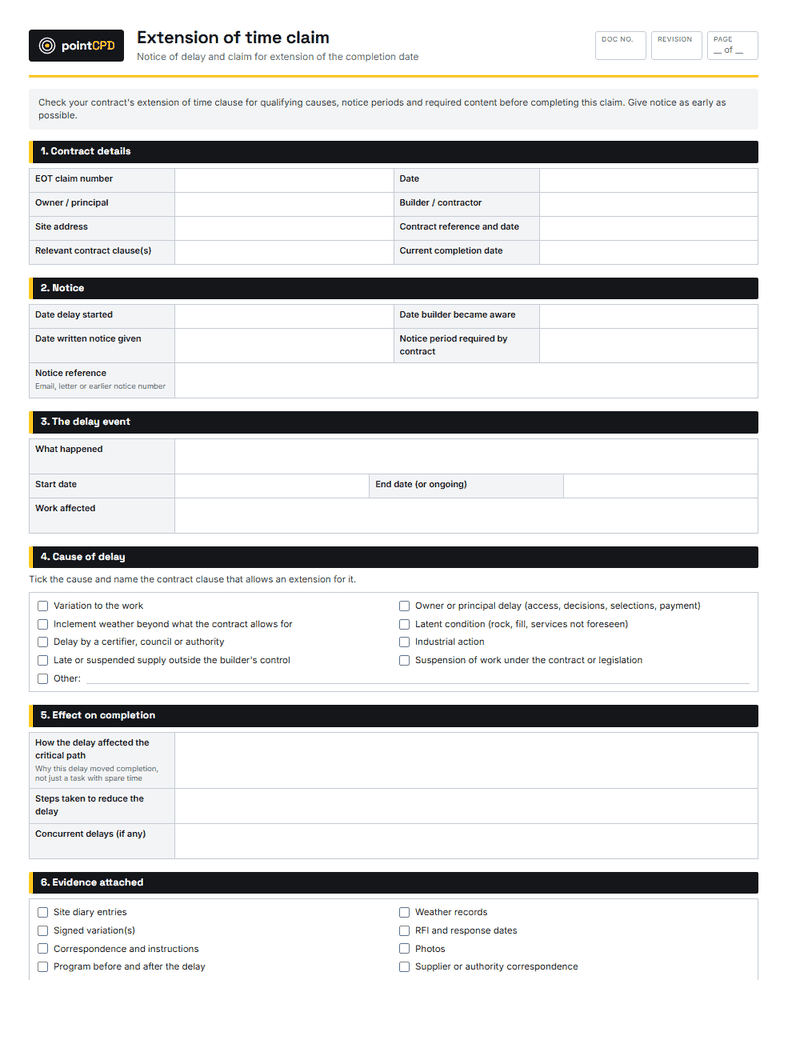
A variation changes the work. An extension of time changes the completion date. They often go together, but they are separate contractual mechanisms with their own rules. Most residential contracts allow the builder to claim an extension of time for delays caused by variations, among other causes, but many require the claim to be made in writing within a set period after the builder becomes aware of the delay.
The simplest approach is to deal with time in the variation itself, as described above, so the owner signs off on the time and the cost together. Where the delay only becomes clear later, lodge a separate extension of time claim promptly, as the contract requires. Missing the notice period can leave the builder liable for delay damages even though the delay was caused by the owner’s own changes.
When the owner will not sign
Sometimes an owner wants the change but will not sign the variation, usually because they dispute the price. Doing the work anyway is the worst option: it leaves the builder with no signed agreement and a disputed claim. Better options, depending on the contract and the situation, include:
- Explaining the calculation in person and offering to review it line by line.
- Offering to proceed without the change, as the contract originally required.
- Getting an independent quote for the varied work to show the price is fair.
- Using the contract’s dispute resolution process, or the free services available through NSW Fair Trading and Building Commission NSW, if a genuine disagreement cannot be resolved.
If the change is required, for example by the certifier or an authority, and the work cannot wait, record the instruction and your notice to the owner in writing, and seek advice on your contractual position before proceeding.
Records that make variations stick
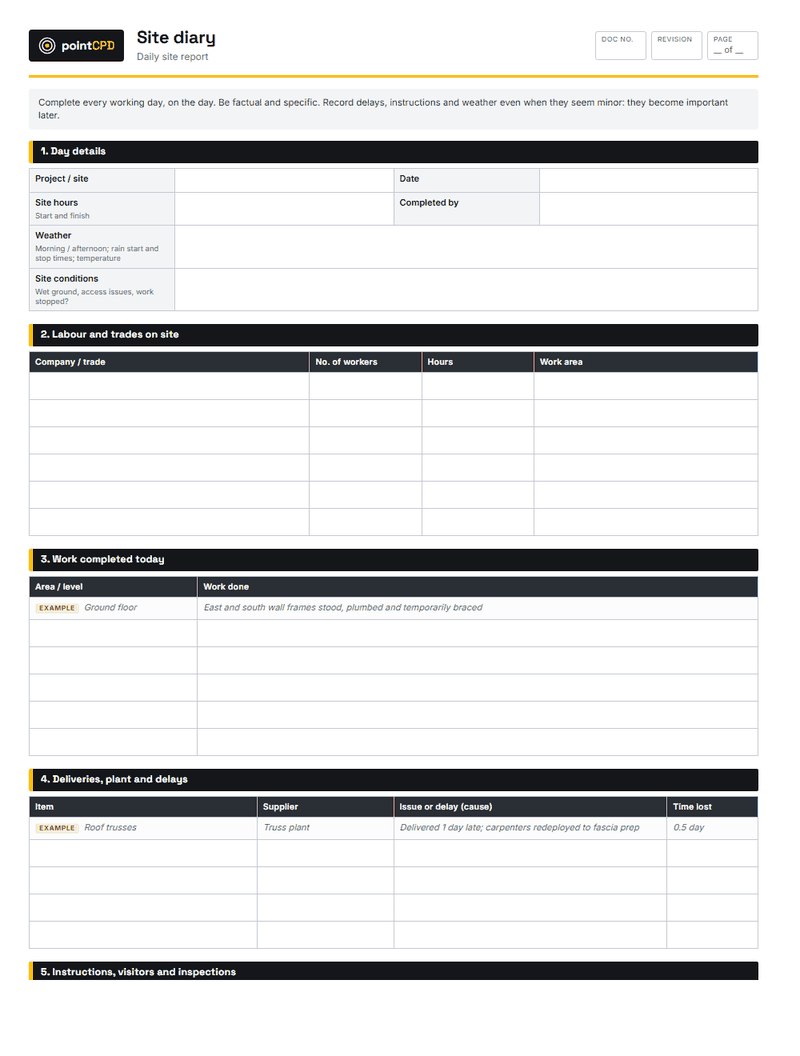
A signed variation is strongest when it is supported by other records: the site diary entry noting the owner’s request, photos of the work before and after, supplier invoices for materials, and the correspondence where the change was discussed. Stored together in the job file, those records turn a potential argument into a simple matter of evidence.
A note on small jobs
On small jobs, variations are often agreed verbally because the paperwork feels out of proportion. That is exactly where disputes about a few hundred dollars can grow into complaints to the regulator. A short, signed variation on one page takes five minutes and removes the argument. For NSW contracts over $5,000, the written requirement applies regardless.
Train the people who say yes
On many jobs, variations are agreed not by the builder but by a supervisor or a trade standing next to the owner. Make sure everyone on site knows the rule: no change is agreed until it is written, priced and signed. Give supervisors a simple variation form, or an app, and the authority to say “I’ll get that priced for you” rather than “no worries, we’ll do it”.
The bottom line
Variations are not a problem. Unwritten, unpriced, unsigned variations are. Write every change down, show how you priced it, state what it does to the programme, get it signed before you start, and keep a register. It is the cheapest insurance a builder can buy.
Questions builders ask
Do variations have to be in writing in NSW?
Yes. For residential contracts over $5,000, variations must be agreed in writing before the work is carried out, signed by the owner and the builder (or their nominated agent), and attached to the contract.
What must a NSW building variation include?
A description of the change and a statement explaining its cost implications and effect on the contract price. Building Commission NSW says the calculation of the price change should be shown, not just a dollar amount.
Can I charge a variation to fix my own mistake?
No. If the variation is needed because of the builder’s or tradesperson’s fault, the owner does not have to pay for the work to fix it.
Can a variation affect HBCF insurance?
Yes. If variations take a contract over $20,000 including GST, HBCF cover may be required. Premiums are based on the value of the work, so an increase may require extra premium, which must be included in the variation.
Should a variation include the time impact?
Yes. If a variation adds days to the programme, state it in the variation and have it signed. A variation that is silent on time can leave the builder carrying the delay.
Sources
- Concerned about rising fuel costs? Your building contract still protects you · Building Commission NSW · 2026-04-28
- Rising fuel costs: what trades need to know about contracts, insurance and compliance · Building Commission NSW · 2026-04-28
Published 8 August 2026. General information for builders, not legal, financial or engineering advice for a specific job. Check current requirements with the relevant regulator or standard before relying on them.