Skip to content
  • NSW-first CPD, built by a practising builder
  • Instant PDF certificates
  • Unlimited assessment attempts
  • 12 points a year, sorted
  • 15% off your first order — get your code
  • Content aligned to the NCC 2022

Free template Contracts and site admin

Free extension of time claim template for builders

Claim more time properly: the delay event, its cause, why it is a qualifying cause under the contract, the effect on completion, the notice given, the evidence and the days claimed.

The short version

An extension of time claim asks for the completion date to be moved because of a delay the contract allows for, such as wet weather, variations, owner delays or latent conditions. It must show the delay event, that it is a qualifying cause under the contract, how it delayed completion, and the days claimed, supported by records. Most contracts require written notice within a set time, and a late notice can cost the entitlement.

  • No sign-up
  • Free for commercial use
  • Add your own logo
  • Updated 14 Sep 2026

Reviewed by Daniel Betros, Licensed Building Practitioner

Animated walkthrough · 7 steps

How to claim an extension of time

Seven steps. Read the contract clause first: notice periods decide most EOT disputes.

1 / 7
  1. Find what counts as a qualifying cause, the notice period, the form of notice, and what the claim must contain. Different contracts, different rules.

  2. Notify the owner in writing as soon as you know a delay is happening, within the contract's time, even if you cannot yet say how long it will be. Late notice is the most common reason EOT claims fail.

  3. What happened, when it started and ended, and what work it stopped or slowed. Be specific and factual.

  4. Link the event to the contract clause that allows time for it: variation, owner delay, weather beyond the usual, latent condition, authority delay.

  5. Explain how the delay affected work on the critical path, so that completion itself moved. A delay to work with spare time may not extend completion.

  6. Site diary entries, weather records, the variation, the RFI and its late answer, photos, the program before and after.

  7. State the days claimed, the new completion date, and ask for a written response. Keep a copy and diarise any response deadline.

Builders lose more money to lost extension of time claims than to almost any other contract issue. Not because the delays were not real, but because the notice was late, the cause was not linked to the contract, or there was no record of the days lost. This template walks through what an EOT claim needs, in the order an owner or their adviser will test it.

Why extensions of time matter

Most building contracts set a date for completion and a rate of liquidated or delay damages if the builder finishes late. An extension of time moves the completion date for delays the contract allows, so the builder is not charged damages for time that was not their fault. Without a properly claimed extension, a builder can end up paying damages for a delay the owner caused.

Start with the contract clause

Every contract handles EOTs differently. Before writing a claim, find the clause and note:

  • Qualifying causes: what kinds of delay entitle the builder to more time.
  • Notice: how soon after becoming aware of a delay the builder must give written notice, and in what form.
  • Content: what the claim must include, such as the cause, the effect and the days claimed.
  • Response: how and when the owner or superintendent must respond, and what happens if they do not.

The template deliberately states no notice periods, because they vary by contract. The one universal rule is: give notice early, even before you know how long the delay will be.

The four things a claim has to prove

ElementWhat it meansEvidence
A delay eventSomething happened that stopped or slowed workSite diary, photos, correspondence
A qualifying causeThe contract allows time for that kind of eventThe clause; the variation, instruction or weather record
An effect on completionThe delay moved the completion date, not just one taskProgram before and after; critical path explanation
Proper noticeNotice given within the contract’s time and formDated notice email or letter

Weather claims

Wet weather is the most common EOT cause on residential jobs, and the most commonly disputed. Many contracts allow an extension only for weather beyond what could reasonably be expected, or only for days when work actually could not proceed. The evidence is the daily site diary: rain start and stop times, the trades that could not work, and ground conditions afterwards. A claim for “about ten wet days in June” will fail against a diary that shows which days work stopped and why.

Variations and owner delays

When an owner asks for a change, the time impact belongs on the variation form at the time it is signed. When a decision, selection or answer to an RFI is late, record the date it was needed and the date it arrived. Both are strong EOT causes, but only if the timeline is documented.

Critical path and concurrency

A delay only extends completion if it affects the critical path: the chain of work that decides when the job finishes. If the painter is delayed but painting had weeks of float, completion may not move. Where the builder’s own delays overlap with a qualifying delay, the contract’s approach to concurrent delay matters. Explain both honestly in section 5; overstated claims damage the credibility of the ones that are sound.

Keep the claim and the response together

Ask for a written response by a set date, record the outcome in section 8, and keep every EOT claim with the variations and diary it relies on. If the extension is refused and you disagree, the claim file is the starting point for any dispute. This template is general information; for significant or disputed claims, get advice early.

A worked example: a wet weather claim

A builder is framing a two-storey home in a very wet month. The contract allows an extension for inclement weather that prevents work on the critical path. The claim might set out:

  • Delay event: rain on eight working days between specific dates, with start and stop times from the site diary.
  • Qualifying cause: the inclement weather clause, noting which days work could not proceed at all and which were partial.
  • Effect: framing was the critical activity, so each lost day delayed completion; days when only non-critical work stopped are excluded.
  • Notice: written notice given on the first affected day, with an update at the end of the month.
  • Evidence: diary entries, weather observations for the nearest station, photos of site conditions, and the program.
  • Claim: six working days, with the revised completion date.

Excluding the days that did not affect completion makes the claim more credible, not less.

Liquidated damages and delay damages

Many contracts set an amount per day the builder must pay if completion is late, known as liquidated damages or, in some residential contracts, delay damages. The rate is set in the contract. An extension of time moves the date from which those damages run, which is why EOT claims matter financially even on small jobs. If the owner causes delay and the contract has no proper mechanism to extend time for it, the position can become complicated; get advice. The simplest protection is to claim every qualifying delay promptly and properly, so the completion date always reflects what actually happened.
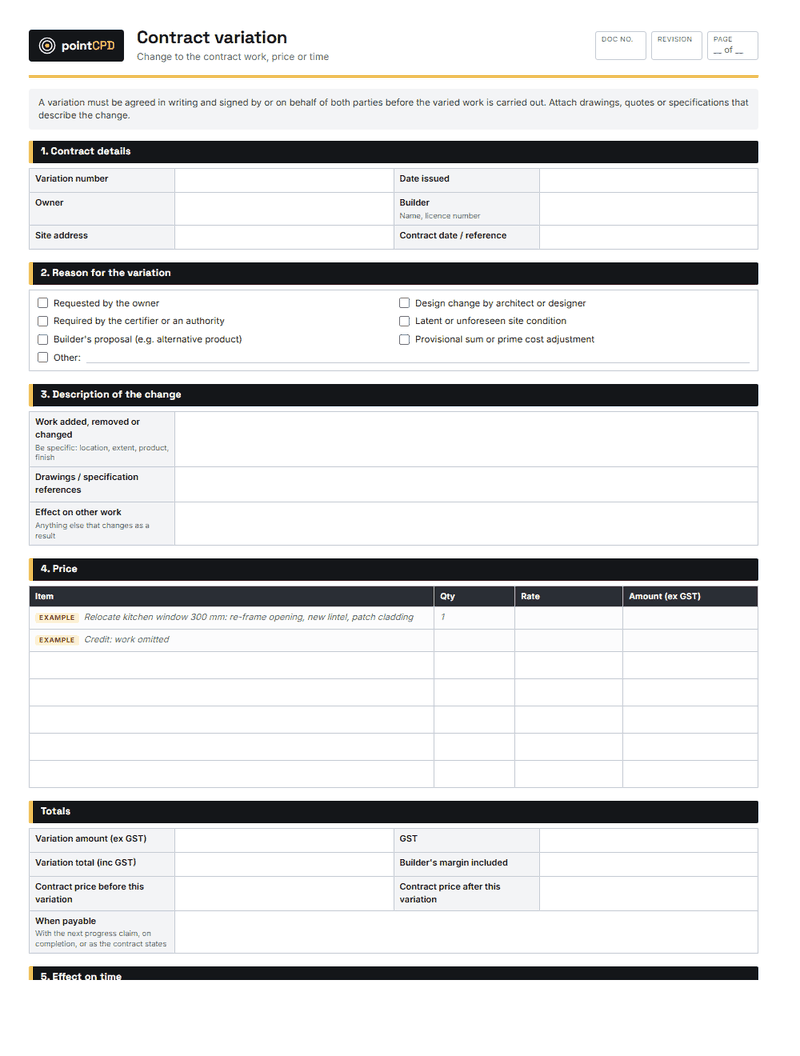
Preview the full Extension of time claim template

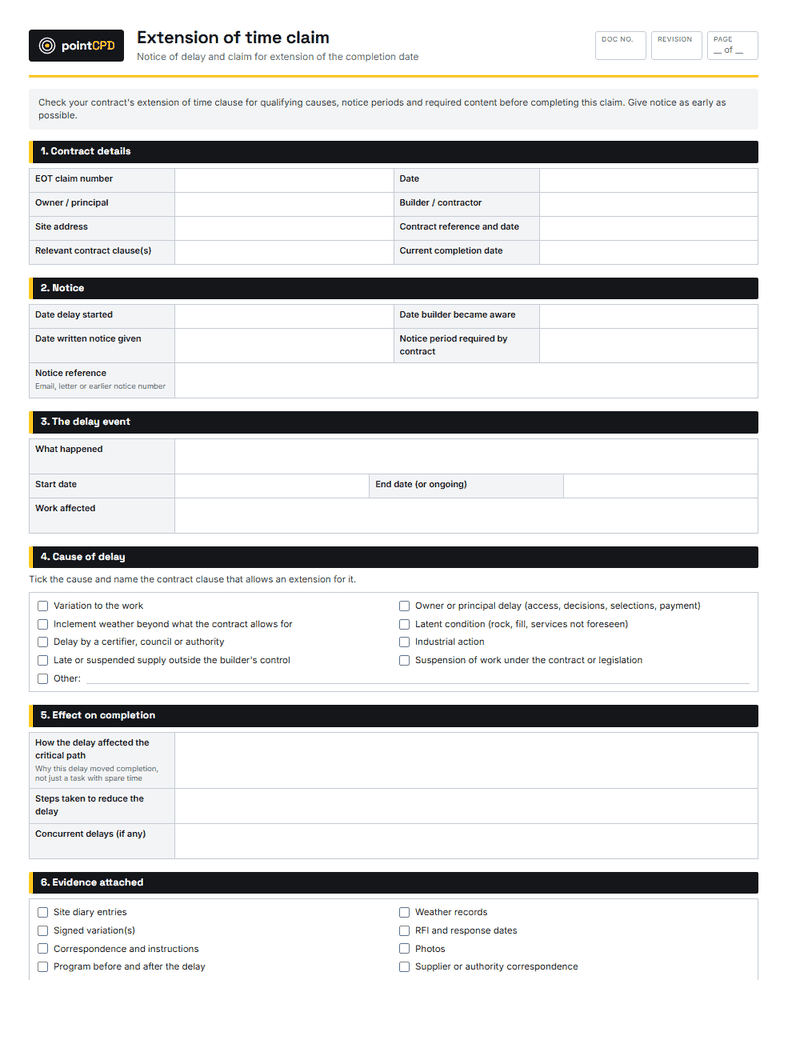
Every section, field and check in the download, exactly as it prints. Edit the Word version to add your logo, delete what does not apply and add your own site-specific items.

pointCPD

Extension of time claim

Notice of delay and claim for extension of the completion date

Doc no.
Revision
Page
__ of __

Check your contract's extension of time clause for qualifying causes, notice periods and required content before completing this claim. Give notice as early as possible.

1. Contract details

EOT claim numberDate
Owner / principalBuilder / contractor
Site addressContract reference and date
Relevant contract clause(s)Current completion date

2. Notice

Date delay startedDate builder became aware
Date written notice givenNotice period required by contract
Notice referenceEmail, letter or earlier notice number

3. The delay event

What happened
Start dateEnd date (or ongoing)
Work affected

4. Cause of delay

Tick the cause and name the contract clause that allows an extension for it.

  • Variation to the work
  • Owner or principal delay (access, decisions, selections, payment)
  • Inclement weather beyond what the contract allows for
  • Latent condition (rock, fill, services not foreseen)
  • Delay by a certifier, council or authority
  • Industrial action
  • Late or suspended supply outside the builder's control
  • Suspension of work under the contract or legislation
  • Other:

5. Effect on completion

How the delay affected the critical pathWhy this delay moved completion, not just a task with spare time
Steps taken to reduce the delay
Concurrent delays (if any)

6. Evidence attached

  • Site diary entries
  • Weather records
  • Signed variation(s)
  • RFI and response dates
  • Correspondence and instructions
  • Photos
  • Program before and after the delay
  • Supplier or authority correspondence
  • Other:

7. Claim

Extension claimed (days)State working or calendar days as the contract requiresProposed new completion date
Costs claimed (if the contract allows delay costs)Response requested by
Builder signatureDate

8. Owner response

Extension granted (days)Revised completion date
Reasons (if refused or reduced)
Owner signatureDate
Template by PointCPD · pointcpd.com.au/resources/templates/extension-of-time-claim/Free to use, copy and adapt, including commercially (CC BY 4.0). Keep this credit line.v1.0

Download Word Download PDF

Questions builders ask

What is an extension of time in a building contract?

An agreed or assessed extension of the date for completion because of a delay the contract allows for. It protects the builder from liquidated damages or delay damages for the period of the extension.

What delays qualify for an extension of time?

It depends on the contract. Common qualifying causes are variations, owner or principal delays, inclement weather beyond what the contract allows, latent conditions, and delays by authorities. Delays caused by the builder usually do not qualify.

Is there a time limit for claiming an extension of time?

Most contracts require written notice within a set period of the builder becoming aware of the delay, and some make that notice a condition of the entitlement. Read your contract's clause and give notice early.

Does every delay extend completion?

No. Only a delay that affects the critical path, the sequence of work that determines the completion date, extends completion. A delay to work with spare time may not.

What evidence supports an EOT claim?

Daily site diary entries, weather records, signed variations, RFIs and response dates, correspondence, photos, and the program before and after the delay.

Can I claim costs as well as time?

Some contracts allow delay costs for certain causes, such as owner-caused delays; others give time only. Check your contract.

Free to use, adapt and share, including commercially

This template is licensed under Creative Commons Attribution 4.0. Copy it, rebrand it, edit it for your jobs, hand it to clients and subcontractors, or republish it. The one condition: keep the small PointCPD credit line on the document. If you publish it online, credit it like this:

<a href="https://pointcpd.com.au/resources/templates/extension-of-time-claim/">Extension of time claim template</a> by PointCPD, CC BY 4.0

Last reviewed 14 September 2026. A template is a starting point: it becomes a compliant document only once it is completed for the actual job by people who understand the work, and kept current as the work changes. General information, not legal advice. Check the requirements of your state regulator and your contract.

Sources: Standard residential and commercial building contracts (including industry association contracts) set extension of time procedures, qualifying causes and notice periods. Home Building Act 1989 (NSW) for residential contract requirements. This template is general information, not legal advice.