Key takeaways
- Profit and cash are different. A building business can be profitable on paper and still run out of cash between progress payments.
- Progress claims should be made promptly at each stage, for realistic stage values tied to work done, and followed up the day they fall due.
- A rolling 13-week cash flow forecast, updated weekly, shows problems while there is still time to act.
- GST, PAYG withholding and super are not the business’s money. Set them aside as they are collected or incurred.
- Using deposits from new jobs to pay for old ones is the classic warning sign of a builder in trouble, and a path to insolvency.
Ask an insolvency practitioner why building businesses fail and the answer is rarely a lack of work. It is cash. Money goes out every week, for wages, super, subcontractors, suppliers, vehicles and tax, while money comes in at stages, weeks apart, and sometimes late. When costs rise, jobs run over, or a client delays a payment, the gap can swallow a business that looked profitable on paper.
The collapse of Sydney developer Bathla Group last week, and a long list of builder failures over the past few years, have put cash flow back at the top of every builder’s mind. This guide covers the practical habits that keep a building business solvent: progress claims, forecasting, job costing, tax provisions, and knowing the warning signs.
Profit is not cash
A job can be profitable and still create a cash problem. If the business pays for materials and labour in weeks one to four, and the client pays the stage claim in week six, the business has funded that gap. Run several jobs at once, with deposits capped and stages spread out, and the business is constantly funding work in advance. Add a late payment, a cost overrun or a quiet month for new sales, and the bank balance can go negative even while the books show a profit.
That is why cash flow needs its own management, separate from the profit and loss.
Progress payments: the main source of cash
For residential builders, progress payments are the lifeblood of the business. In NSW, the rules shape how they can be structured: the deposit is capped at 10% of the contract price, and for large jobs, progress payments must be tied to stages of work described in plain language, or to work performed and costs incurred supported by documentation. Payments should reflect work actually done, not time on the job.
Within those rules, builders control a lot.
Progress claims that get paid, and claims that don’t
| Good practice | Common problem |
|---|---|
| Claim the day the stage is complete | Claim when someone gets around to it |
| Stage values reflect the work done | Front-loaded stages that invite dispute |
| Signed variations claimed with the next stage | Variations never invoiced |
| Clear claim with contract clause and stage description | A bare invoice with no reference |
| Follow up on the due date | Wait and hope |
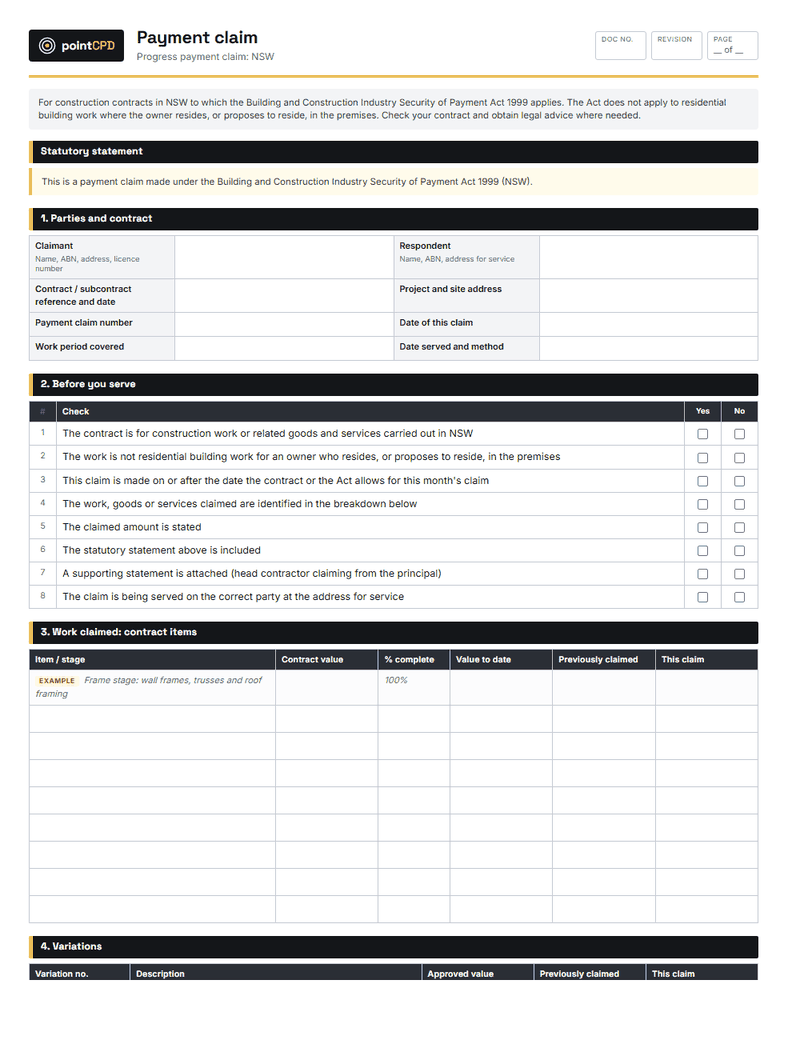
- Claim promptly. The day a stage is complete, send the claim. Every day of delay is a day the business funds the job.
- Price stages realistically. Honest stage values reduce disputes and protect clients. Front-loading can help cash briefly but invites trouble, and regulators look closely at it when builders fail.
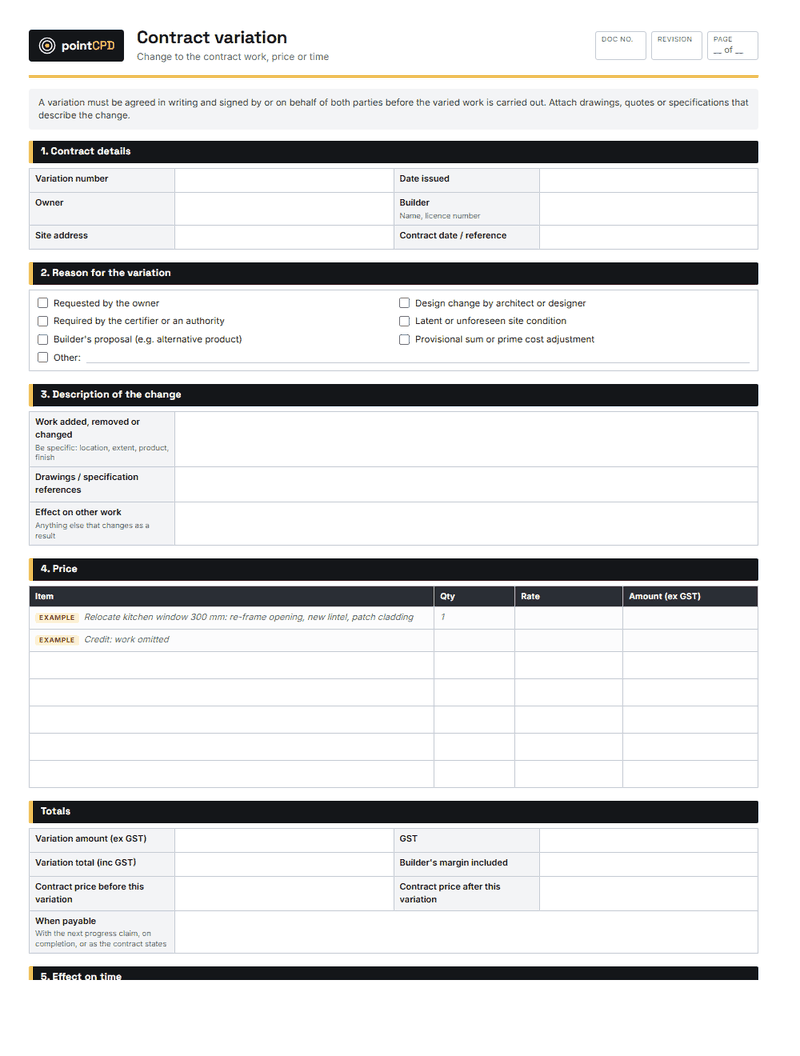
- Bill variations. Signed variations should be claimed with the next progress payment, not left until the end.
- Make claims easy to pay. Reference the contract clause and stage, attach any required evidence, and state the due date.
- Follow up on the due date. A polite call on the day a payment is due is normal business, not rudeness.
For payments owed by head contractors on commercial or multi-unit jobs, security of payment laws give builders and subcontractors a statutory right to progress payments and a fast process to resolve disputes. Know how the process works in your state.
A 13-week cash flow forecast
The most useful cash flow tool for a small building business is a simple rolling forecast covering the next 13 weeks. It does not need special software; a spreadsheet works.
Building a 13-week cash flow forecast
- 1Start with cash todayThe actual bank balance, not the accounting profit.
- 2List money inProgress claims by expected payment date, job by job, conservatively.
- 3List money outWages and super each pay run, subcontractors, suppliers, rent, vehicles, insurance, tax.
- 4Find the low pointThe week the balance is lowest is the week to plan for.
- 5Update weeklyReplace forecasts with actuals, roll forward a week, and act on what you see.
The forecast answers the question that matters: in which week will cash be tightest, and is it enough? If the low point is below what the business needs, there is time to act: bring forward a claim, negotiate supplier terms, delay a discretionary purchase, arrange finance, or talk to a client about timing. Discovering the same problem on the Tuesday before payroll leaves no options.
Tax, super and other money that isn’t yours
A building business collects and holds money that belongs to others: GST collected on progress claims, PAYG withheld from wages, and superannuation owed to employees. Treating that money as available cash is one of the most common routes to trouble. When the BAS falls due, the money needs to be there.
Many builders transfer GST, PAYG withholding and a provision for income tax into a separate account as payments come in. With Payday Super now requiring super to be paid with every pay run, super is no longer a quarterly lump that can be deferred; it leaves the account each payday.
Unpaid tax debts grow teeth. Directors can become personally liable for certain unpaid company tax debts, including PAYG withholding and super guarantee charge, in some circumstances. Late BAS and super payments are also a red flag to the ATO. If cash is tight, talk to your accountant and the ATO early.
Job costing: knowing which jobs make money
Cash problems often start with jobs that lose money without anyone noticing until the end. Job costing, tracking actual costs against the budget for each job as it progresses, shows which jobs are on track and which are drifting. A job that is over budget at frame stage will not recover by itself.
Construction software and accounting systems can track costs by job if bills are coded to the right job as they are entered. Review each job’s costs against its budget at every stage, and investigate overruns immediately.
Warning signs
Warning signs a building business is in cash trouble
- Deposits from new jobs are needed to pay for work on old ones.
- Subcontractors and suppliers are paid later and later.
- BAS, PAYG withholding or super are paid late or not at all.
- Progress claims are made before the stage is complete to cover bills.
- The owner does not know the business’s cash position next month.
- Variations are done but never billed.
- Several jobs are running at a loss and nobody knows exactly why.
The most dangerous sign is using deposits and early progress payments from new jobs to pay for work on older jobs. It feels like a short-term fix, and it can go on for a long time while sales are strong. When sales slow, as they are now in parts of the market, the gap is exposed all at once. Many builder collapses follow exactly this pattern.
Directors also have a legal duty not to allow a company to incur debts when it is insolvent or would become insolvent by incurring them. If the business cannot pay its debts as they fall due, seek advice from an accountant or insolvency adviser early. Options are much wider before a crisis than during one.
Managing suppliers and subcontractors
Good relationships with suppliers and trades are a cash flow asset. Paying on time, every time, earns trust and sometimes better terms. Negotiating trade credit terms that match your progress payment cycle, and knowing exactly what you owe and when, avoids surprises. If you cannot pay on time, a phone call before the due date preserves the relationship far better than silence.
Overheads and drawings
Cash flow is not only about jobs. Office rent, vehicles, insurance, software, marketing and the owner’s own drawings all leave the account every month, whether jobs are paying or not. Many small builders underestimate overheads when pricing, and take drawings based on how busy they are rather than what the business can afford. Knowing the monthly cost of running the business, and pricing jobs to cover it, is as important as costing materials and labour.
Finance options
An overdraft or business line of credit can smooth predictable timing gaps between outgoings and progress payments. Equipment finance spreads the cost of vehicles and plant. These are tools for timing, not for funding losses. Borrowing to cover jobs that lose money only delays the problem and makes it bigger. Talk to your accountant about the right structure before you need it.
In a turning market
The market in late 2026 is mixed: busy sites working through a large pipeline, but slowing new sales, higher interest rates, rising costs and policy changes affecting investors. That combination is when cash flow discipline matters most. Builders who price for current costs, claim promptly, forecast weekly and keep tax money separate are the ones who come through a slowdown intact.
Industry reports based on ASIC data suggest construction insolvencies eased slightly in 2025–26 compared with the year before, but construction remains the industry with the most companies entering external administration, and the pressures behind recent collapses have not gone away.
A worked example: the four-job builder
A builder has four houses under construction, each around $600,000. On paper, the business is profitable. But two clients are slow to pay stage claims, one job has blown its budget on rock excavation that was not properly provided for, and new sales have slowed, so fewer deposits are arriving.
The builder starts a 13-week forecast and finds that in week seven, after a large supplier payment, a BAS and two pay runs, the account will be short. Because it is seven weeks away, there is time. The builder claims two completed stages that had not been invoiced, follows up the slow payers with reference to the contract’s payment terms, negotiates a variation for the rock excavation under the contract’s latent conditions clause, and arranges a modest overdraft for the timing gap. Week seven passes without drama. Without the forecast, the builder would have found out on the Monday.
The bottom line
Cash, not work, decides whether a building business survives. Claim every stage promptly for realistic values, bill variations, forecast 13 weeks ahead and update weekly, cost every job as it goes, set aside GST, PAYG and super, and treat the use of new deposits to fund old jobs as an alarm, not a strategy. If the numbers look bad, get advice early.
Questions builders ask
Why do profitable builders run out of cash?
Because costs are paid weekly while progress payments arrive at stages, sometimes late. Several jobs at once, cost overruns or slower sales can create a cash gap even when the business is profitable on paper.
What is a 13-week cash flow forecast?
A rolling week-by-week forecast of money in and out over the next 13 weeks, starting from the actual bank balance, updated weekly to show when cash will be tightest.
How much deposit can a NSW builder take?
No more than 10% of the contract price. For work over $20,000, Home Building Compensation Fund cover must be in place, and owners are advised not to pay until they have the certificate.
Should I keep GST and PAYG in a separate account?
Many builders do. GST collected, PAYG withheld and super owed are not the business’s money, and setting them aside avoids a shortfall when payments fall due.
What is the biggest cash flow warning sign for a builder?
Needing deposits from new jobs to pay for work on existing ones. It can hide losses while sales are strong and cause a sudden crisis when they slow.
Sources
- Contracts for home building work · NSW Government · 2026-04-29
- Payday Super for employers · Australian Taxation Office
- Construction insolvencies just fell for the first time in five years · The Good Builder
- Sydney builder Bathla Group enters administration with more than 7,000 homes in its pipeline · SmartCompany (AAP) · 2026-08-26
Published 31 August 2026. General information for builders, not legal, financial or engineering advice for a specific job. Check current requirements with the relevant regulator or standard before relying on them.