Key takeaways
- A handover pack should be built around the questions an owner will ask, and it should open with an index that links to every document.
- Consistent file names that put the property first and the item second let an owner or a future builder understand the folder without you.
- Records of concealed work must be captured during the build, because a pack assembled from memory after completion cannot defend a later defect claim.
- Storage and sharing should sit in a business-owned account with an independent copy, so the pack survives staff changes and closed services.
- A maintenance schedule the owner can follow and keep records against is evidence of care, and it turns the handover into an ongoing relationship.
Most builders hand over a job with a box of paper, a folder of emailed PDFs and a verbal walk-through of the switchboard. Within a year the owner has lost half of it, cannot find the warranty for the hot water system, and rings the office to ask which tile was used in the bathroom. The handover is the point where the job stops being yours to manage and starts being the owner’s to maintain, and a poorly organised record makes every later question a call back to the builder.
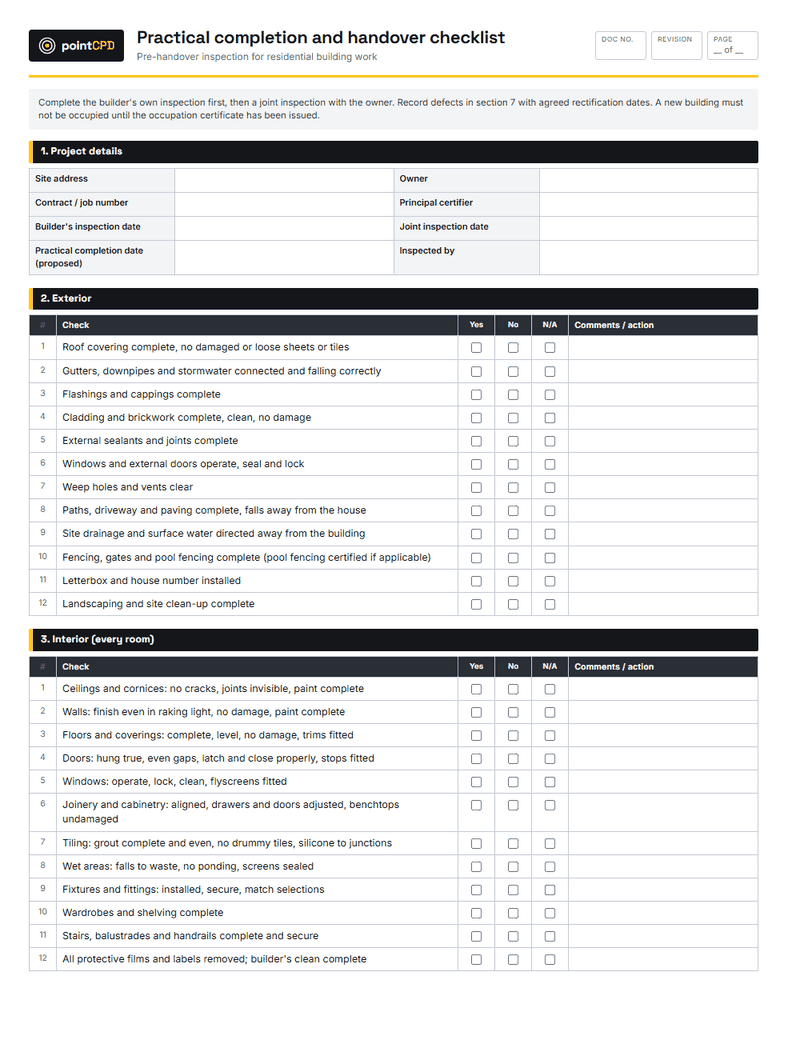
A digital handover pack is a structured, searchable set of records that the owner can keep, find and pass on. It is not the practical completion process itself. The checklist that confirms the works are finished is a separate document, covered by the free template linked later in this article. This article is about how to organise the records that come out of the job, how to name the files, where to keep them and how to make sure the links still work when the owner needs them.
The commercial reason to get this right is simple. A builder who can produce the as-built details for a wall that was closed in during the job answers a defect question in a morning. A builder who has to reconstruct those details from memory, or from a site diary that does not mention them, spends weeks on the phone and may still lose the argument. The pack is also the first thing a new owner shows a buyer, a valuer or a second contractor, and it carries the business name every time.
What an owner actually needs from a handover
Start from the owner’s position. They will open the pack in three situations: when something breaks, when they want to change or extend the building, and when they sell. In each case they need to find a document quickly, understand what it is, and know whom to call. An owner does not need every site email or every delivery docket. They need the records that describe what was built, how it was built where it cannot be seen, and how to look after it.
That distinction shapes everything else. The pack should hold the approvals, the certificates, the product information, the as-built records of concealed work, the maintenance schedule and the contacts for the trades who did the work. The job file that sits in your office can hold the rest. Keeping the two separate stops the owner drowning in material they will never open, and it protects the business from handing over documents that were never meant to leave the office, such as internal costings or staff records.
Think, too, about who will take over the pack. Owners sell, die, move interstate or hand the house to children. A pack that depends on the original builder explaining it is only half a pack. Write each section so that a stranger with no background can follow it, because that is the test the pack will eventually face.
Structure the pack in the order the owner will use it
The structure should be built around questions the owner will ask, not around the sequence in which your office filed things. A sensible top level has five sections: the building and approvals, the as-built and concealed works, the products and warranties, the maintenance schedule, and the contacts and trades. Each section gets a plain index page that lists what is inside and what each document is for, one sentence per item.
Put the index first and make it the front page of the pack. A reader who opens the folder should see the index before any PDF, and the index should link to each document rather than repeat its name in words. If the pack is a shared folder, the index is a document at the top of it. If it is a single PDF with bookmarks, the bookmarks should match the index exactly. The point is that the owner should be able to find the hot water warranty in the time it takes to read one sentence, without calling you.
Resist the urge to bury the important documents in a catch-all folder called Miscellaneous. Every item in that folder is a document the owner has to open to find out what it is, and the items that matter most, such as the certificate for the wet area waterproofing or the electrical certificate of compliance, get lost among the delivery dockets. If an item does not fit a section, it probably does not belong in the pack.
File naming that still makes sense in five years
File names are the cheapest part of the pack to get right and the most expensive to fix later. A consistent convention means the owner, or the next builder, can sort the folder by name and understand it at a glance. The convention should put the property first, then the section, then the item, then the date of issue, and finally a version marker where a document has been revised. Keep the words plain and the order identical across every job, so the pattern becomes familiar.
Avoid names that only make sense inside your own office. A file called “final revised plan.pdf” tells the owner nothing, and “SS_rev_B” means nothing to anyone who was not on the job. Do not use the client’s first name or a nickname in the file name, because the pack will outlive the relationship. Use the street address or the lot description, which will still be recognisable when the property changes hands. Avoid spaces and special characters where the file system or the owner’s device might not handle them well.
Keep the originals and the superseded versions out of the owner’s folder. The owner needs the current document, and a folder that holds three versions of the same drawing invites the wrong one to be used. Keep the earlier versions in your job file, where they remain available for audit. This matters most for as-built drawings, where a superseded plan that shows a different pipe route can send a plumber into the wrong wall.
Durable links and where the files actually live
A digital pack is only as durable as the place it is stored. A link to a file in a personal email account, on a laptop that will be replaced, or in a free file-sharing service with an uncertain future is not a handover. The business should own the storage, the account should be a business account rather than an individual’s, and the folder should have a structure that survives a change of staff. When the person who set it up leaves, the pack must still open.
Share the pack with the owner by granting access to the folder rather than sending a link to individual files. Individual links break when a file is moved or renamed, and a link sent in an email from three years ago is a common cause of a dead end. Where the platform allows, make the owner the owner of the folder, or at least give them a copy they control. Confirm that the sharing works from the owner’s own device before you close the job, because a pack that cannot be opened on the phone is not much use on a Sunday morning.
Keep a second copy outside the shared storage. A USB drive or a read-only export, handed to the owner with the index printed on the cover, protects against an account lockout or a service that closes. The business should also keep its own backup of every completed pack, which is the same discipline described in the guide to backing up job files for a small builder. Losing your copy of the pack is a business problem. Losing the owner’s copy is a client problem, and the second one is the one that generates complaints.
What belongs in the pack, and what does not
The pack should contain the building contract and the variations the owner agreed, the approvals and certificates issued for the work, the certificate of insurance evidence for the work, and the as-built records. The Home Building Act sets out insurance that must be in place for certain residential building work and the evidence the owner must be given, so the insurance documents belong in the pack and the exact requirement should be confirmed against the Act. Keep the building contract and the warranty documents easy to find, because they are the first things an owner needs when a dispute starts.
The as-built section is where most packs fail. Record what is behind the lining before it is closed: the position of pipes and cables, the type and depth of insulation, the flashing details at openings, the framing where the owner might later want to fix a shelf or a handrail. Photographs with a note on each are better than a drawing that was never updated. The practical completion checklist is the document that confirms the works are complete, and it is covered in the free practical completion template; the as-built records are what the owner will need for the rest of the building’s life.
Leave out anything that is internal, private or not the owner’s business. Internal costings, margin calculations, subcontractor bank details, staff time records and disputes with other trades do not belong in a handover pack. Your own licence records stay in the business as well, which is the subject of the guide to how NSW builder CPD works. Include contact names and numbers for the trades who did the work, because the owner may need them for a warranty call.
Before the pack goes to the owner
- Every document in the index opens from the owner’s own device.
- File names follow the convention, with the property first and the version marker last.
- Superseded versions are removed from the owner’s folder and kept in the job file.
- Photographs of concealed work are attached to the stage they belong to, with a short note.
- The insurance evidence, certificates and approvals are in the pack.
- Internal costings, staff records and subcontractor bank details are not in the pack.
- A second copy has been handed over or saved outside the shared storage.
The costliest mistake. Assembling the pack from memory after practical completion, and leaving out the photographs of concealed work taken during the build. When a defect appears in a wall that was closed in months earlier, the missing record is the one thing the builder cannot reconstruct, and the defence turns into an argument about what was probably there.
Building the pack during the job, not after it
A pack built at the end of a job is always incomplete, because the details that matter most were recorded at the moment they happened and have since been covered over. The discipline is to add to the pack as the job goes, at each stage where something becomes hidden or certified. The owner does not see any of this until handover, but the business gets a complete record without a last-week scramble.
The sequence below is one way to organise that work. Each stage has a clear owner in the business and a defined output, so nothing depends on someone remembering to do it at the end.
Building the pack as the job goes
- Contract stageThe signed contract, the approvals and the insurance evidence are filed under the property name.
- Before cover-upPhotographs and notes of pipes, cables, insulation and flashing are attached to the stage they belong to.
- During the worksVariations, product sheets and warranties are saved as they are received, not collected later.
- Practical completionThe index is finished, the superseded versions are removed and the owner’s access is tested.
- After handoverThe maintenance schedule is sent, and the owner is asked to keep the service records alongside it.
Photographs are the most useful part of that process and the easiest to skip. Take them at the hold points where the work is about to be covered, and name them with the same convention as the documents. Attach each photograph to the stage it belongs to in the job file, so the link between the record and the stage is kept. Digital records made on site are only useful if they are made on site, and the discipline of recording attendance and inspections as they happen is covered in digital timesheets and site attendance records.
Worked example: a renovation in a western Sydney suburb
A builder in western Sydney finishes a rear extension and internal renovation to a family home. The job had a variation for an extra window, a change to the bathroom waterproofing and a late decision about the kitchen benchtop. The builder had been photographing concealed work at each stage, but the bathroom photographs were on a phone that the site supervisor had since replaced.
At handover the builder assembles the pack from three sources: the signed contract and variations, the approvals and certificates saved to the business folder as the job progressed, and the site photographs from the phone that was still available, with the bathroom gap noted honestly in the as-built section. The index names each section and says in one sentence what each document is. The kitchen benchtop product warranty and care sheet are saved under the property name, with the supplier and install date in the file name.
Three months later the owner notices a hairline crack at the junction of the new and old walls. The builder can locate the framing and flashing photographs for that area in the folder within minutes, and can show the owner exactly what was installed. The discussion moves from who is to blame to what the next step is. The owner is still unhappy about the bathroom gap, and the builder says so plainly, which is more useful than a pack that looks complete and is not.
Keeping the maintenance record current for the owner
A maintenance schedule is the part of the pack the owner is most likely to use and least likely to keep up to date. Set it out as a short list of recurring tasks, each with a plain description of how often it is due, who should do it and what the product manual says. Use the manufacturer’s intervals wherever they exist, and describe the interval in words, such as every few months or once a year, so the schedule does not go stale when a supplier changes the recommendation.
Ask the owner to record when they complete each task, and make that record part of the pack. A record of regular servicing of the air conditioning, the roof gutters or the waterproofing is evidence that the property has been cared for, and it is the document that answers a later question about whether a defect was caused by neglect. A digital pack makes that easy, because the record can sit beside the schedule rather than in a drawer.
- Keep the schedule short enough that the owner will read it, and put the detail in the attached manuals.
- Name the trade or supplier for each task, with a contact that will still work next year.
- Explain what the owner must do themselves and what needs a licensed tradesperson.
- Note any warranty condition that depends on the owner having the work serviced.
The schedule is the owner’s document, but it reflects your build. A builder who writes it clearly, and who follows up at the end of the first year to ask whether the owner needs anything, turns a handover into a relationship that produces referrals rather than complaints.
Questions builders ask
What should a digital handover pack contain?
It should hold the contract and agreed variations, the approvals and certificates for the work, the insurance evidence, the as-built records of concealed work, the product warranties and manuals, and the maintenance schedule. Keep internal business records out of it, and open it with an index that links to each document.
How should I name the files in a handover pack?
Put the property first, then the section, then the item, then the date of issue and any version marker, and keep the same order on every job. Avoid client first names and office shorthand, because the pack must still make sense when the property has changed hands.
Should I share the pack by email link or by folder?
Share the folder rather than individual files, because links to single files break when they are moved or renamed. Test that the owner can open the folder from their own phone before you close the job. Keep a second copy outside the shared storage as well.
Where should the pack be stored?
In a business-owned account rather than an individual’s personal email or laptop, with a folder structure that survives a change of staff. The business should also keep its own backup of every completed pack. Losing the owner’s copy is a client problem, so the independent copy matters.
What happens if I did not take photographs of concealed work?
The gap has to be disclosed honestly in the as-built section, with whatever records do exist. A pack that looks complete but is not will not hold up when a defect appears. Make photographs of concealed work a fixed step at each hold point on future jobs.
Does a maintenance schedule belong in the handover pack?
Yes. Write it in plain words, using the manufacturer’s intervals and describing how often each task is due. Ask the owner to keep service records alongside it, because those records answer later questions about neglect.
Sources
- Continuing professional development for builders and swimming pool builders · NSW Government
- General building work licensing · NSW Government
- Home Building Act 1989 (NSW) · NSW Legislation
Published 25 October 2026. General information for builders, not legal, financial or engineering advice for a specific job. Check current requirements with the relevant regulator or standard before relying on them.