Key takeaways
- A business system is a document set that is controlled, so every job uses the same current version of each template rather than whatever is on the office computer.
- Document control means a single register, one owner per document, a version marker and a defined review trigger, which prevents the most expensive failures where an old contract or an unapproved variation is used.
- The core template set is small: a quote schedule with inclusions and exclusions, a variation form, a site diary, a WHS management plan, a certificate and approval register, and a bookkeeping reconciliation routine.
- Privacy, cyber and scheme obligations attach to the records a builder already holds, so the controls that protect those records belong in the same system as the templates, not in a separate project.
- Systems fail when they are written for an audit rather than for the person doing the work, so each template must be short enough to complete on site and must capture the information the business actually needs later.
A small building company rarely fails because the trade knowledge is missing. It fails because the paperwork that supports the trade is different on every job, and no one can tell which version is current. The quote sent on Tuesday does not match the contract signed on Friday, the variation agreed on site was never written down, and the WHS plan on the site shed belongs to a different project.
That is a document-control problem, not a software problem. You can fix it with a template set, a register and a rule about who owns each document. The technology can stay exactly as it is.
This article sets out a template and control approach that works for a builder running a handful of jobs at a time with a small office team, and explains why each control exists so you can reason about a job the article never anticipated.
What a business system actually is
A business system is a document set that is controlled. That means every document in the set has an owner, a current version, and a defined trigger for review. The purpose is not to create bureaucracy; it is to make sure the version of the document being used on site is the version the business intends to stand behind.
Think about what happens without that control. A supervisor downloads a quote template from a job two years ago because it is faster than finding the current one. The inclusions and exclusions are out of date. A price goes out with an assumption that the client will supply the footing excavation, and the assumption was removed from the current template because it caused a dispute. The builder is now bound by a document the business no longer uses.
The cost of that failure is not the cost of the template. It is the cost of the dispute, the rework, or the margin that disappears when an exclusion is missing. It surfaces weeks later, when the work is already in the ground and the client is holding a signed document that says something different from what the builder intended.
The core template set for a residential builder
You do not need dozens of templates. A small building company can run on a set of six or seven documents that cover quoting, delivery, safety and money. The test for each one is whether it captures information you will need later, when the job is finished and someone is asking a question about it.
The core set is:
- A quote schedule that states the inclusions, the exclusions, and the assumptions the price depends on.
- A contract document set that matches what was quoted.
- A variation form that can be completed on site and signed before the work proceeds.
- A site diary that records weather, labour, deliveries, instructions and visitors.
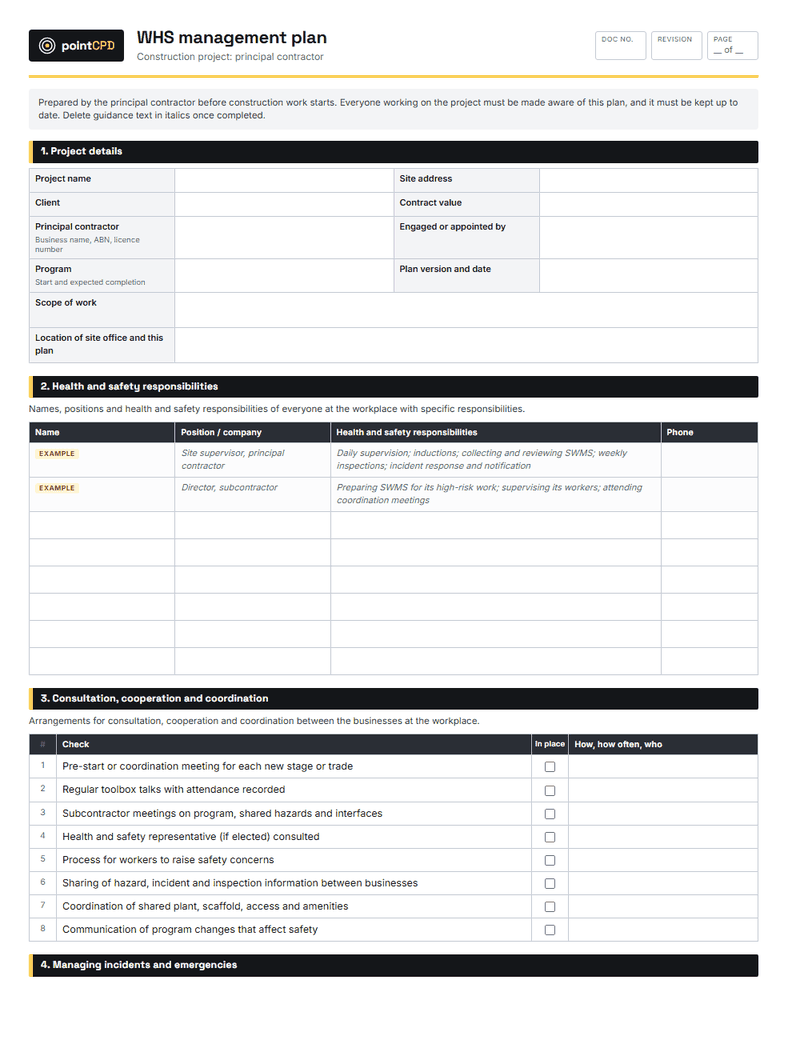
- A WHS management plan that reflects the actual site and the actual trades.
- A certificate and approval register that lists what is required and what has been received.
- A bookkeeping routine that reconciles the job against the quote as the job runs.
Each of these documents has a job to do. The quote schedule exists so that a later argument about scope can be resolved by reading what was agreed, not by remembering a conversation. The variation form exists because work done without a written variation is work that is difficult to charge for. The site diary exists because the record of what happened on a given day is the builder’s best evidence when a delay or a defect is disputed.
The WHS management plan is a good example of a template that must be adapted rather than copied. A free template such as the WHS management plan template gives you the structure, but the content has to reflect the site, the trades, the plant and the hazards that are actually present. A plan that describes a different site is worse than no plan, because it shows the business knew a plan was required and produced one that does not apply.
Building the core template set
- 1Choose the documents you use every weekList the quote, contract, variation, diary and WHS documents you already produce, because the template set is a formal version of what you already do.
- 2Write the template for the person completing itKeep each template to the fields needed to price, deliver or defend the job, and delete anything that exists only to look thorough.
- 3Name and version every fileUse a consistent file name with a version marker and a date, so the current version is obvious without opening the file.
- 4Register the documentsRecord each document, its owner, its current version and its review trigger on one register that the office and the site can both see.
- 5Retire old versionsMove superseded files to an archive folder the same day a new version is issued, so no one can quote from a withdrawn document.
Document control in practice: the register
Document control sounds like an office term, but the mechanic is simple. You keep one register. The register lists every document in the business system, who owns it, what the current version is, and what triggers a review. Nothing is in use unless it is on the register.
The owner is a named person, not a role. If the WHS management plan is owned by the person who runs the sites, that person is responsible for updating it when the work changes. If the quote schedule is owned by the person who prices, that person is responsible for the inclusions and exclusions. Ownership is what stops the register from becoming a list of documents nobody maintains.
The version marker matters more than it sounds. A file named “quote template” tells you nothing about whether it is current. A file with a version marker and a date tells you at a glance. When a new version is issued, the old one moves to an archive folder the same day. If both versions sit in the same folder, someone will use the wrong one, and the mistake will not be obvious until the job is priced or built.
The review trigger is the part most builders skip. A document should be reviewed when something changes that affects it: a new contract, a change in the work the business does, a new obligation, or an incident that shows the document did not work. A register without review triggers is a snapshot, not a system.
Quoting and variation control
The quoting system and the variation system are two halves of the same control. The quote defines the scope; the variation records the change to it. If either half is missing, the builder carries the risk of the gap.
A quote schedule should make the assumptions explicit. If the price assumes a level site, say so. If it excludes rock excavation, say so. If it assumes the client will obtain an approval by a certain stage, say so. The purpose is not to protect the builder from every argument; it is to make the scope clear enough that a reasonable client can see what is and is not included. A quote that is silent on a significant assumption is a quote that will be read as including it.
The variation form should be short enough to complete on site. If it takes twenty minutes and a laptop, it will not be used. If it is a single page that records the change, the reason, the price and the signature, it will be used. The commercial reality is that an unwritten variation is usually not recovered. The builder either absorbs the cost or damages the relationship by trying to raise it later.
This is where the systems connect to money. A bookkeeping system that reconciles each job against its quote will show a margin problem while there is still time to act. The bookkeeping systems article covers the routines in detail; the point here is that the variation form is the source document the bookkeeping routine depends on. If variations are not written, the reconciliation cannot be accurate.
Safety, certificates and the records that prove the job
The WHS management plan, the certificate and approval register, and the site diary are the records that prove what happened on a job. They matter for two reasons: they keep the work safe, and they answer questions later.
The certificate and approval register is a simple control that prevents a common and expensive failure. It lists each approval, certificate or inspection the job requires, who is responsible for obtaining it, and whether it has been received. Without it, the builder relies on memory and email. With it, the gap is visible before it becomes a delay or a compliance problem.
The site diary is the record that supports everything else. It is not a formal document; it is a daily note of what happened. Weather, labour on site, deliveries, instructions given and received, visitors, and any event that might matter later. A diary written at the end of the day takes a few minutes. A diary reconstructed a month later is unreliable and often useless in a dispute.
The WHS management plan needs the same discipline. It must be the current version, it must reflect the actual site, and the people on site must have signed on to it. A plan that is current but not communicated is not a control. A plan that is communicated but out of date is a liability.
Document control checks before every job starts
- The quote schedule states inclusions, exclusions and the assumptions the price depends on.
- The contract documents on site match the version recorded in the register.
- The WHS management plan is the current version and is signed on by the people on site.
- The certificate and approval register lists what is required and what has been received.
- The variation form is available on site and every change is written before the work proceeds.
- Client records are stored where only the people who need them can reach them.
- The bookkeeping routine for the job is scheduled, not left to the end of the quarter.
Privacy, cyber and scheme records in the same system
A small building company holds records that attract obligations beyond the build itself. Client contact details, financial information, contracts and photographs are personal information, and the OAIC guidance for small business explains how privacy obligations apply to small operations. The controls that protect those records belong in the same document system as everything else, because a builder who stores client records on a personal device without a routine is one lost phone away from a problem.
Cyber security is part of the same picture. The Australian Signals Directorate small business hub sets out the basics: know what you hold, restrict who can reach it, and have a way to recover it. For a builder, that usually means the business records are separate from personal accounts, access is limited to the people who need it, and there is a backup that has been tested. None of that requires a new platform; it requires a decision about where records live and who can open them.
If the business installs renewable energy systems, the records connected to small-scale technology certificates are part of the job file and should be controlled in the same way as the certificate register. If the business works in flood-affected areas, flood risk information from the NSW flood risk management manual may inform the design and approval records the job depends on. The principle is the same: the document set is the business system, and every obligation that attaches to a record is handled by the same control.
Making the system survive a busy month
Systems fail when they are written for an audit rather than for the person doing the work. A template that takes an hour to complete will not be completed when the job is under pressure. A register that is updated monthly will be out of date when it matters. The design rule is to make each control short enough to use on its busiest day.
There are three practical habits that keep a small system alive. The first is a weekly review of the register: what changed, what needs a new version, what is due. The second is a job startup routine: before work begins, the current document set is confirmed and the register is updated. The third is a job closeout routine: the records are filed, the variations are reconciled against the quote, and anything that did not work is noted for the next review.
None of these habits require software. They require a decision that the document set is the system, and that the system is worth ten minutes a week. The related article on getting your team to use the software you paid for covers what to look for if you do decide to move to a platform, but the template and register come first. Software applied to an uncontrolled document set just makes the wrong version easier to find.
A worked example: a builder in western Sydney
Consider a builder in western Sydney running three jobs at once with an office administrator and two supervisors. The business has been growing, and the paperwork has grown with it. Quotes are prepared from a template that has been edited by three different people. The WHS management plan is a document from a previous project with the site address changed. Variations are agreed verbally and sometimes written on the back of a delivery docket.
Nothing has gone badly wrong yet, but the signs are there. A client disputes an exclusion that was in an older version of the quote template but not the current one. A supervisor cannot find the current WHS plan when a SafeWork NSW inspector arrives. A bookkeeping reconciliation shows a job running below margin, but no one can tell whether the cause is a pricing error or an unwritten variation.
The fix is not a new platform. The builder starts with a register. Six documents go on it, each with a named owner, a version marker and a review trigger. The quote schedule is rewritten so the inclusions and exclusions are explicit. The variation form is reduced to a single page that can be completed on site. The WHS management plan is rewritten for the actual site and signed on by the people working there. The certificate register is started for each job. The bookkeeping routine is scheduled weekly rather than quarterly.
Within a month, the disputes are easier to resolve because the documents agree with each other. The margin problem on the third job turns out to be an unwritten variation, now recovered because the form was used. The inspector’s visit produces the current plan without a search. The system did not make the business larger; it made the existing business predictable.
The mistake that costs the most. Running a job on a document set that is not controlled — where the quote, the contract, the variation and the WHS plan can each be a different version — is the failure that produces disputes, unrecovered variations and margin loss that surfaces long after the work is finished. The register and the version marker are the cheapest controls you will ever put in place.
Where this fits with your CPD
Business systems are part of the knowledge a licensed builder is expected to maintain, and the way NSW builder CPD works is set out in the PointCPD guide to NSW builder CPD. If you are working through your hours, the PointCPD course catalogue includes business and project management content that covers quoting, contracts, WHS and record keeping. The point of the article is not the course; it is the template set and the register. Do that first, and the rest of the business becomes easier to run.
Frequently asked questions
What is a business system for a small builder?
A business system is a controlled document set that covers how the business quotes, delivers, records and reconciles its work. It includes the templates used on every job and the register that says which version is current. The control is what makes it a system rather than a folder of files.
How many templates does a small building company need?
Most small builders can run on a core set covering quoting, contracts, variations, site records, WHS, certificates and bookkeeping. The number matters less than the control: each template needs an owner, a current version and a review trigger. Adding templates that nobody maintains makes the system worse, not better.
Who should own each document?
Each document should be owned by a named person, not a role or a committee. The owner is responsible for keeping the document current and for reviewing it when something changes. If no single person owns a document, it will drift out of date and be used in the wrong form.
Do I need software to run document control?
No. A register, consistent file names and a version marker will control a small document set without any platform. Software can help once the system is defined, but it cannot substitute for the control. Applying software to an uncontrolled set of documents makes the wrong version easier to find, not harder.
How do privacy and cyber obligations fit into the system?
Client records, contracts and photographs are personal information, and the obligations that apply to them attach to records the business already holds. The practical control is to decide where those records live, who can reach them, and how they are backed up. That decision belongs in the same system as the templates, because the records and the templates are used by the same people.
What is the first step if the business has no system at all?
Start with the register. List the documents you already use, name an owner for each, and mark the current version. Then rewrite the quote schedule so the inclusions and exclusions are explicit, and introduce a single-page variation form. Those three steps address the failures that cost the most money, and they can be done without changing any software.
Questions builders ask
What is a business system for a small builder?
A business system is a controlled document set that covers how the business quotes, delivers, records and reconciles its work. It includes the templates used on every job and the register that says which version is current. The control is what makes it a system rather than a folder of files.
How many templates does a small building company need?
Most small builders can run on a core set covering quoting, contracts, variations, site records, WHS, certificates and bookkeeping. The number matters less than the control: each template needs an owner, a current version and a review trigger. Adding templates that nobody maintains makes the system worse, not better.
Who should own each document?
Each document should be owned by a named person, not a role or a committee. The owner is responsible for keeping the document current and for reviewing it when something changes. If no single person owns a document, it will drift out of date and be used in the wrong form.
Do I need software to run document control?
No. A register, consistent file names and a version marker will control a small document set without any platform. Software can help once the system is defined, but it cannot substitute for the control. Applying software to an uncontrolled set of documents makes the wrong version easier to find, not harder.
How do privacy and cyber obligations fit into the system?
Client records, contracts and photographs are personal information, and the obligations that apply to them attach to records the business already holds. The practical control is to decide where those records live, who can reach them, and how they are backed up. That decision belongs in the same system as the templates, because the records and the templates are used by the same people.
What is the first step if the business has no system at all?
Start with the register. List the documents you already use, name an owner for each, and mark the current version. Then rewrite the quote schedule so the inclusions and exclusions are explicit, and introduce a single-page variation form. Those three steps address the failures that cost the most money, and they can be done without changing any software.
Sources
- Small business cyber security · Australian Signals Directorate
- Privacy for small business · Office of the Australian Information Commissioner
- Small-scale technology certificates · Clean Energy Regulator
- Flood risk management manual · NSW Government
Published 25 August 2026. General information for builders, not legal, financial or engineering advice for a specific job. Check current requirements with the relevant regulator or standard before relying on them.