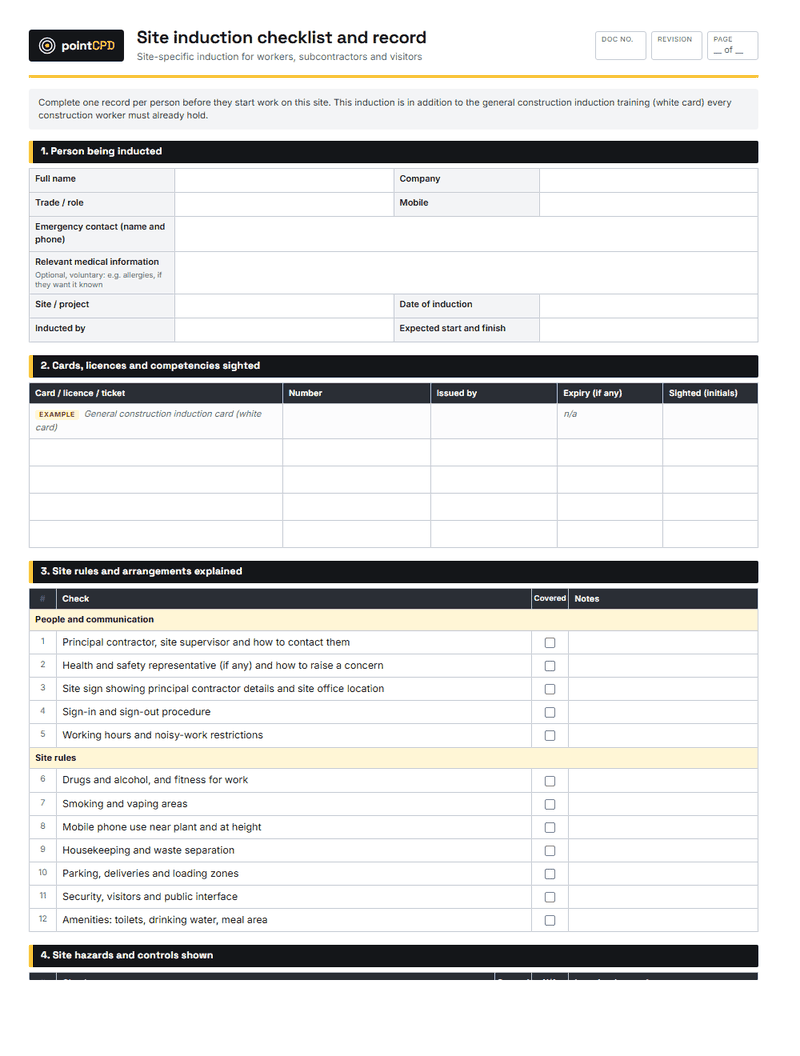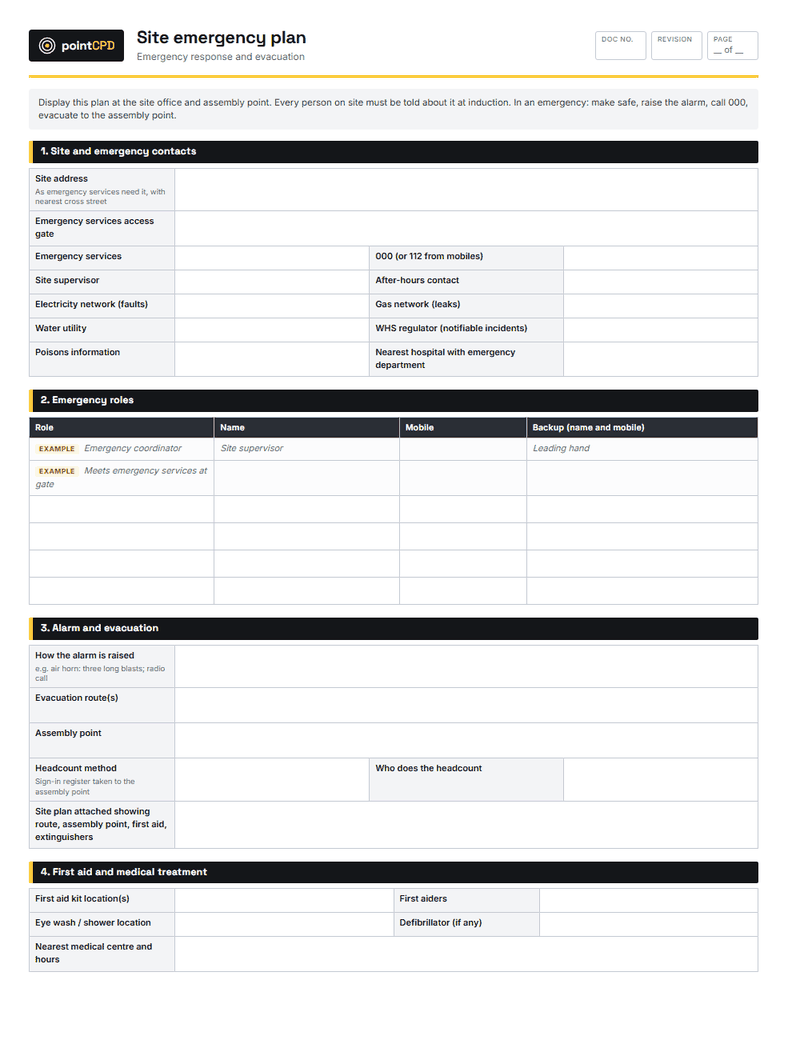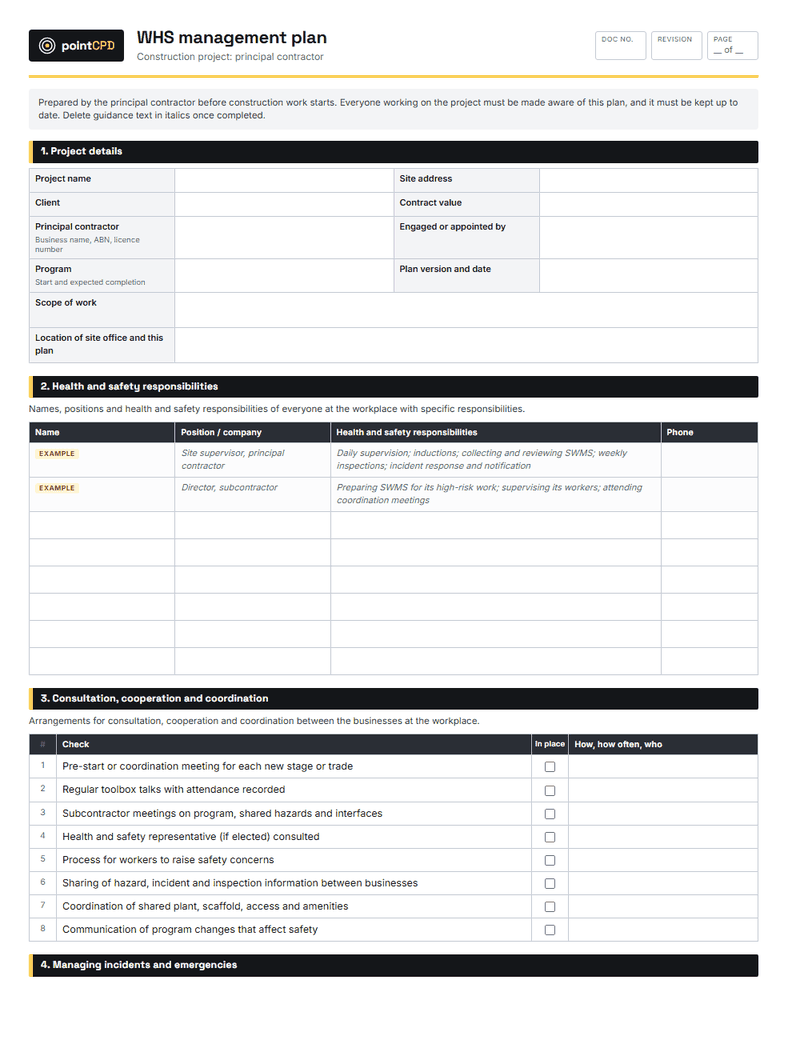
On a construction project, the WHS management plan is the principal contractor’s rulebook for the site: who is responsible for what, how the businesses on site work together, what happens when something goes wrong, and how SWMS are handled. This template is laid out around each element the regulations require, so nothing is left out and nothing unnecessary is added.
When you need one
Under the model WHS Regulations, a construction project is construction work where the cost of the construction work is $250,000 or more. Every construction project must have a principal contractor, and the principal contractor must prepare a WHS management plan before work on the project starts.
The principal contractor is the business commissioning the project, or a business it engages or appoints and authorises to manage or control the workplace. On most residential builds under a head contract, that is the builder. There is only one principal contractor per project.
Below the threshold, no WHS management plan is required, but the general duties still apply: manage risks, consult, cooperate and coordinate with other businesses, and obtain SWMS for high-risk construction work. Many builders use a cut-down version of this plan on smaller jobs anyway, because it is the simplest way to show those duties were met.
What the plan must contain
| The regulations require | Template section |
|---|---|
| Names, positions and health and safety responsibilities of people with specific responsibilities | 2. Health and safety responsibilities |
| Arrangements for consultation, cooperation and coordination between businesses at the workplace | 3. Consultation, cooperation and coordination |
| Arrangements for managing work health and safety incidents | 4. Managing incidents and emergencies |
| Site-specific health and safety rules, and how people are informed of them | 5. Site-specific rules |
| Arrangements for collecting, assessing, monitoring and reviewing SWMS | 6. SWMS arrangements |
Sections 7 to 10 are not listed in the regulations but make the plan usable: the significant project hazards and site-wide controls, the supporting documents, a revision record and approval.
The principal contractor’s other duties
Preparing the plan is not the end of it. The principal contractor must also make sure everyone working on the project is made aware of the plan and can access it, keep it up to date, and put up signage showing the principal contractor’s name, a contact number available at any time, and the location of the site office. The site induction is the natural place to brief people on the plan.
SWMS: the section inspectors look at first
The plan must say how SWMS will be collected, assessed, monitored and reviewed. The strongest arrangement is also the simplest: no contractor starts high-risk construction work until their SWMS has been received and checked, it is written into the subcontract, and supervisors check work against the SWMS during their inspections. Checking means reading it, not filing it: a SWMS full of generic statements should be sent back.
Write it for this project
A WHS management plan copied from the last job with the address changed is easy to spot and of little use. The people change, the site rules change, the hazards change. The sections most worth tailoring are the responsibilities table (real names and phone numbers), the site rules (what is actually different about this site), and the significant hazards (the three or four that could kill someone on this job).
Keeping it alive
- Review it at each stage. Earthworks, frame, lock-up and fit-out bring different trades and hazards.
- Update it when arrangements change: a new site supervisor, a change of first aider, a different access route.
- Update it after incidents. If the incident showed a gap in the arrangements, fix the plan.
- Record every revision in section 9, and tell people when something that affects them changes.
The plan works alongside the project risk register and the site emergency plan, which carry the detail the plan refers to.
Example: a two-storey home over the threshold
A builder contracted to build a two-storey home for $750,000 is the principal contractor for a construction project. A practical WHS management plan for that job might be eight or ten pages, not eighty:
- Responsibilities: the director, the site supervisor, the leading hand as backup, a named first aider, and a contact for each of the main subcontractors.
- Consultation and coordination: a pre-start meeting with each trade before they begin, a weekly toolbox talk open to all trades, and a group message for program changes.
- Incidents: the site emergency plan, the incident report form, and who notifies the regulator.
- Site rules: one page, covering sign-in, PPE, scaffold alterations, housekeeping, drugs and alcohol, and phones near plant.
- SWMS: required before start, checked by the supervisor, filed in the site box, and spot-checked during weekly inspections.
- Significant hazards: falls, excavation, plant and deliveries, silica dust, and the overhead service line.
That plan is short enough that every trade can be walked through it at induction, which is the point.
Sharing the plan with subcontractors
A WHS management plan only works if the people on site know what is in it. Send the relevant parts to each subcontractor with the subcontract or work order: the site rules, the SWMS requirement, the emergency arrangements and the coordination meetings. Cover it at the site induction. Keep a copy in the site box, and tell people when it changes. Subcontractors who have seen the plan before they arrive start work faster and argue less about rules they did not know existed.