Key takeaways
- An extension of time is a contractual right that depends on giving notice within the period the contract sets, so the clock on the claim starts running before the builder has worked out the full cost.
- Delay must be tied to the critical path of the programme; work that has float around it can usually be absorbed without moving practical completion.
- A notice that asserts delay without records is an assertion, not a claim, and the evidence needs to be created on site at the time rather than reconstructed at the end of the job.
- Costs and time are separate entitlements, and a builder who has claimed time may still need a further notice to recover the money the delay cost.
- The client relationship is usually damaged more by silence during a delay than by the delay itself, so a written notice with a clear revised date is the better commercial move.
A delay on a residential job is rarely the hard part. The hard part is the paperwork that has to exist before the delay becomes someone else’s problem. An extension of time is not a favour the client grants because the story sounds reasonable; it is a contractual right that only operates if the builder follows the procedure in the contract, and the procedure almost always starts with a notice within a stated period.
That is why so many otherwise strong claims fail. The builder knows the truth of the delay, the site diary shows it, the client watched it happen — and the claim still gets knocked back because the notice went in after the period had closed, or because nothing in the file ties the lost days to the critical path of the programme. The cost lands on the builder, and it usually surfaces late, at practical completion, when there is no time left to recover the position.
This article deals with the notice and evidence process specifically. It assumes you already know how to build and maintain a programme, and that variations are being handled through their own track. The question here is narrower and more mechanical: what has to be written down, when, and how it connects to the money.
Why the notice clause exists and who it protects
Builders tend to read a notice clause as a trap set by the client’s lawyer. It is better understood as the mechanism that keeps the contract’s end date meaningful. The contract states a date for practical completion, and both sides plan around it. If delays could be raised at any time, in any form, the stated date would mean nothing and the client could never plan finance, moving dates or a rental gap.
So the contract creates a trade: the builder gets the right to more time, and in exchange the builder has to tell the client promptly that the date is at risk. The client then has the chance to make decisions — resequence, bring in another trade, extend a rental arrangement — while those decisions still have value. A notice that arrives months later has taken that opportunity away, which is exactly the argument a client will run when a claim is disputed.
The NSW Government’s guidance on contracts for home building work is written for homeowners, but it is worth reading as a builder because it shows what your client has been told to expect: a written contract, clear terms, and a process for changes and delays. If your notice practice does not match what the client believes they signed up to, the conversation becomes a dispute about conduct rather than about days.
Notice periods are contractual, not statutory
There is no single notice period that applies to every job. The period is whatever the contract says, and it can differ between a delay event caused by the client, a delay caused by weather, and a delay caused by a supplier. Before you draft anything, read the clause and the definitions. Where a contract sets a period and you are unsure how it interacts with the work you are doing, check the current requirement in the contract itself and, if the position is unclear, get advice before the period closes rather than after.
What actually counts as a delay event
Not every lost day is a delay event. A delay event is something the contract identifies as giving rise to an extension of time, and it typically falls into a few families: acts or omissions of the client, including late decisions and late selections; variations and instructions that change the scope; delays in obtaining approvals or information from others; and events outside either party’s control, such as severe weather or a supplier failure.
The distinction matters because it determines who carries the risk. A builder who has under-resourced a job and falls behind has a delay, but not an extension of time. A builder who is waiting on a client’s colour selection for a wet area has a delay event, provided the contract makes the client responsible for that selection and provided the notice goes in.
Approval delays are a common grey area. BASIX is a good example: it imposes sustainability requirements on new dwellings and some alterations, and it is assessed as part of the development and planning approval process. The NSW Planning Portal explains how BASIX interacts with planning approvals, and the practical point for a builder is that a certificate that is not in place when the programme expects it will hold up the start of work. Whether that is your risk or the client’s depends on who was responsible for obtaining it under the contract, and that is a question to answer before you sign, not after the excavator is sitting idle.
Weather is a delay event with a test attached
Most contracts do not give an extension for any rain day. They give it for weather that is severe enough, measured against a stated benchmark, to prevent work proceeding. That means the record has to show not just that it rained, but that the specific activity planned for that day could not proceed. A site diary entry saying “wet” is not evidence of that. An entry that names the activity, the reason it could not proceed, and what was done with the crew instead is.
The notice itself: what has to be in it
A valid notice does not need to be long. It needs to be in writing, sent by a method the contract recognises, and it needs to do three things. It must identify the delay event and its cause. It must state that the event is likely to cause delay to practical completion. And it must say that the builder intends to claim an extension of time, with particulars to follow.
What it does not need to do is quantify the whole claim. This is the single most common self-inflicted failure on residential jobs. Builders delay sending a notice because they cannot yet say how many days are involved. By the time they can, the notice period has closed. The correct approach is to send the notice as soon as the event is known, state that the impact is still being assessed, and reserve the right to provide particulars later. A notice that says the impact is unknown is still a notice. A notice that is never sent is not.
Running a delay claim from the first day of the event
- 1Identify the eventName the cause precisely, whether it is a client instruction, a late selection, a certifier query or weather, rather than describing it as a hold-up.
- 2Check the contractRead the notice clause, the definition of a delay event and the period allowed for notice before drafting anything.
- 3Notify in writingSend the notice inside the period the contract sets, stating the cause and that time is affected, even if the full impact is not yet known.
- 4Record the impactUpdate the programme, photograph the affected area, log labour and plant on site and note the date work would otherwise have started.
- 5Quantify and submitFollow the notice with the particulars the contract requires, tying the delay to the critical path and stating the revised completion date.
- 6Confirm the outcomeGet the extension in writing, adjust the programme and tell the client and subbies what the new sequence looks like.
Send it to the right place, in the right way
Contracts usually nominate an address and a method for notices. Email to the site contact may be how the job actually runs, but if the contract requires notice to a nominated address, an email to the supervisor may not satisfy it. Send it the way the contract requires and, if you also want the practical benefit of the client reading it immediately, send a copy the way you normally communicate. Do both, and keep the sent record.
Keep a schedule of notices issued. When a claim is disputed later, the first thing anyone asks for is the sequence: what was sent, when, and what came back. If that schedule lives in your head or across three email threads, you will spend a day rebuilding it and you will still miss something.
Evidence: the part that decides the claim
Notice preserves the right. Evidence proves the entitlement. The two are separate, and a builder who is disciplined about notices but sloppy about records will still lose the argument about how many days the delay actually cost.
Delay evidence does one job: it shows that the event pushed the critical path, and by how much. The critical path is the sequence of activities where any lost day moves practical completion. Work with float around it can absorb a delay without moving the end date, and a client’s adviser will look for exactly that. If the delayed activity had float, the delay may not entitle the builder to anything beyond the days that consumed it.
In practice, that means the programme as it stood before the event is the most important document in the file. Without a baseline programme that was issued to the client, there is nothing to compare against, and the claim becomes a story about lost days with no structure. The second most important is the site diary, because it records what actually happened on the ground on the days in question.
What a delay file should contain before you need it
- A copy of the signed contract with the notice clause highlighted.
- The programme as approved, plus every revision issued to the client.
- Site diaries for every working day, signed and dated.
- Photographs of the affected area before, during and after the event.
- Delivery dockets, plant hire records and labour allocation for the affected period.
- Correspondence with the client, certifier and suppliers on the cause of the delay.
- A running schedule of notices issued, with the date each one was sent.
Records you should be creating anyway
The useful discipline is to treat delay evidence as a by-product of running the job rather than a task you start when something goes wrong. Daily diaries signed and dated, photographs of the affected area before and after, delivery dockets, plant hire records and labour allocation for the affected period — all of these are things a well-run site produces regardless. The builder who has them can assemble a claim in an afternoon. The builder who does not is reconstructing events from memory months later, which is both slow and unconvincing.
Correspondence is evidence too. If the client was told in writing that a selection was needed by a certain point in the programme to avoid impacting the start of a trade, that letter does a great deal of work later. If the warning was given verbally on site, it does almost none.
Subcontractor delay is your problem first
When a subbie fails to turn up, the builder still owes the client the end date. The claim against the client, if any, depends on whether the cause is a delay event under the head contract; the claim against the subbie depends on the subcontract. These are separate documents and separate notice regimes, and the periods are often shorter under the subcontract. If a subbie is drifting, issue the notice under the subcontract on time even while you are still working out whether the head contract gives you relief. Missing the subcontract period because you were focused on the client is an expensive way to absorb a delay twice.
Costs are a separate claim from time
An extension of time moves the date. It does not automatically move money. If the delay has cost you — extended site establishment, extra supervision, plant standing, preliminaries running longer — that is a separate entitlement, and it usually has its own notice requirement under the contract. Builders routinely win the days and then discover they have no route to the cost because the money claim was never notified.
Read the contract for what it says about delay costs. Some contracts provide for them when the delay is caused by the client, some exclude them for certain events, and some are silent. Where the contract is silent or unclear, do not assume; check the current requirement and take advice before the notice period for the cost claim expires. The distinction between time and money also matters in the conversation with the client, because a client who understands that an extension of time is not a payment demand is far easier to deal with.
Prolongation is not the same as a variation
A variation is a change to the scope, priced through the variation mechanism. Prolongation is the cost of being on site longer because of a delay. They can arise from the same instruction, but they are claimed through different routes and often on different notice periods. If a client instruction both changes the work and pushes the programme, deal with both tracks explicitly rather than bundling them into one letter and hoping the contract’s process is satisfied by the combination.
Worked example: a builder in western Sydney
A builder is running a knock-down rebuild for a client. The slab is poured and frames are scheduled to start. Two weeks before frames, the client decides to change the kitchen layout, which moves a wall and requires the structural design to be revised and re-checked. The builder’s supervisor mentions the change on site and starts chasing the designer.
Three weeks pass. The frames are not up, the frame crew has been moved to another job, and the designer’s revised drawings have only just arrived. The builder sends the client an email saying the job is now behind because of the kitchen change and that the completion date will need to move. The client replies that they were told the change would be handled and that no one said the date was at risk.
What went wrong is procedural, not technical. The change was a delay event from the day it was instructed, and the notice should have gone in then, stating the cause and that time was affected, with particulars to follow. The email three weeks later is a description of a problem, not a notice, and it may well fall outside the period the contract allows. The builder also has no revised programme showing the frame start moving, and no record of the frame crew’s availability being lost, so even the days are hard to substantiate.
Handled properly, the sequence looks different. The instruction is acknowledged in writing on the day. A notice goes out inside the contract period identifying the client instruction as a delay event and stating that the impact on practical completion is being assessed. The programme is revised and issued, showing the frame start moving and naming the new critical path. The supervisor’s diary records the crew being stood down and reallocated. A cost claim for the lost crew day and the extended supervision follows through the contract’s own route. The client is unhappy about the change, but not about the process, and when the claim is assessed there is a documentary trail that answers the questions before they are asked.
The commercial difference between the two versions is the whole margin on the job. The first version ends in a dispute about credibility. The second ends in an argument about days, which is a much cheaper argument to have.
What to do when the client refuses to engage
Keep issuing the notices. The obligation is to give notice, not to secure agreement. A client who does not respond has not waived the claim, and a file of unanswered notices sent within the correct periods is strong evidence that the builder did what the contract required. Escalating the tone rarely helps; consistency does. If the position does not move, the NSW Government’s guidance on resolving building disputes sets out the pathways, and it is worth knowing what they are before a matter escalates rather than after.
Communication is part of the process
The notice is a contractual document, but it is also a message to a client who is watching their house and their budget. A notice that arrives with no explanation reads as a threat. The same notice with a short covering line about what it means for the programme, and what the client needs to do next, reads as information. The dealing with neighbours and site access covers the routine side of that; the principle carries straight into delay notices.
Patterns that keep claims alive
Builders who rarely lose delay claims tend to share the same habits. They read the notice clause before the job starts and diarise the periods. They send notices early, in the form the contract requires, and worry about the numbers afterwards. They keep a baseline programme and issue revisions. They write to the client when a decision is needed, with the consequence of delay stated plainly. And they treat the delay file as a live document rather than something assembled at the end.
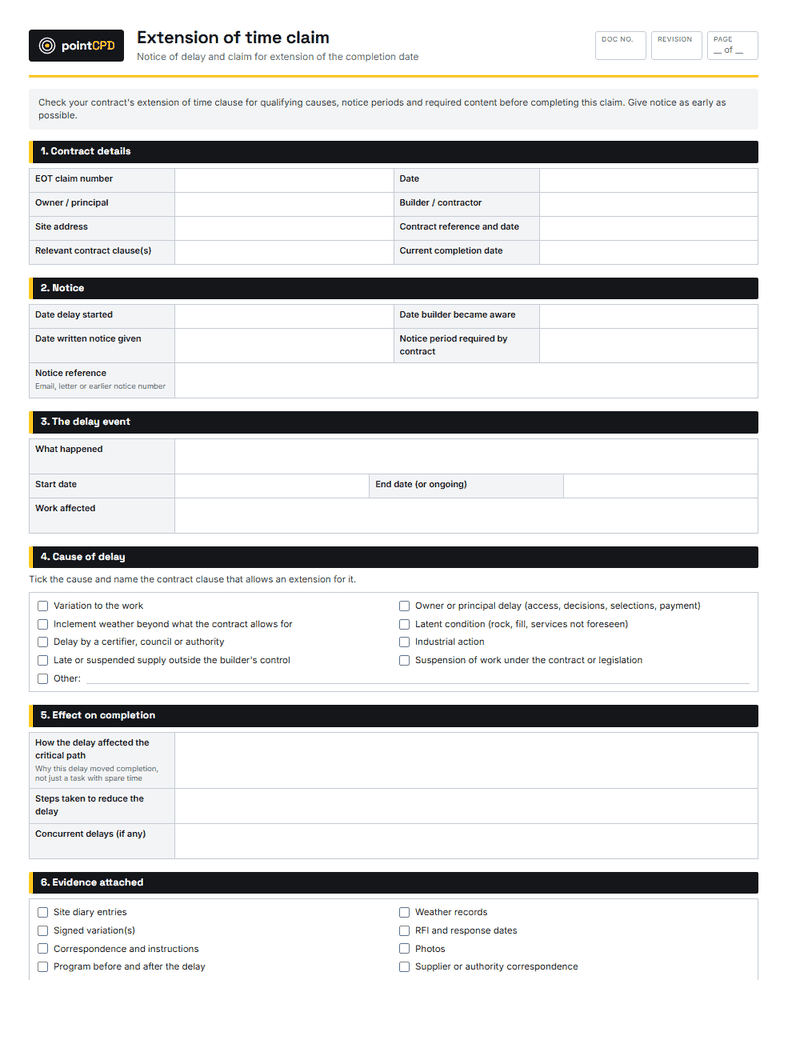
None of that requires legal training. It requires the discipline to send a short letter on the day, which is a habit rather than a skill. If you want the paperwork sitting ready before you need it, the extension of time claim template gives you a starting structure, and the PointCPD course catalogue covers contract administration and dispute avoidance in more depth. Builders working towards their CPD requirements can also review how NSW builder CPD works to see where contract administration sits in the annual cycle.
The mistake that costs the most is waiting until you can quantify the claim. The notice period runs from the delay event, not from the day you work out how many days it cost, so send a short notice immediately and provide the particulars later.
Questions builders ask
What is the notice period for an extension of time on a NSW building contract?
There is no single period that applies to every job. The period is whatever the contract sets, and it can differ between delay events and between delay and cost claims. Read the notice clause and the definitions in your own contract before the job starts, and diarise the date each period closes so you are not calculating it under pressure.
Does a delay caused by weather automatically entitle me to more time?
No, and this is where many claims fail. Most contracts give an extension only where the weather was severe enough, measured against a stated benchmark, to prevent the planned activity from proceeding. The record has to name the activity and explain why it could not go ahead, not simply note that it rained.
Can I claim an extension of time if the delayed activity had float?
Float is the time an activity can slip without moving practical completion, and a client’s adviser will look at it closely. A delay that only consumes float may not entitle you to additional time, though it may still support a cost claim depending on the contract. This is why a baseline programme issued to the client is the most important document in a delay file.
Does an extension of time also cover my additional costs?
No. An extension of time moves the completion date; the money that the delay cost you is a separate entitlement with its own notice requirement under the contract. Builders often secure the days and then find they cannot recover the cost because the money claim was never notified within the period.
What should I do if the client does not respond to my delay notice?
Keep issuing notices in the form and within the periods the contract requires. Your obligation is to give notice, not to obtain agreement, and a file of unanswered notices sent on time is strong evidence that you complied. Escalating the tone rarely helps; consistency does.
Can I recover time lost waiting on a BASIX certificate or another approval?
It depends on who was responsible for obtaining the approval under the contract, and on whether the contract lists that kind of event as a delay event. Sort that out before signing rather than when a certificate is holding up the start of work, because the answer determines whether the risk sits with you or the client.
Sources
- Contracts for home building work · NSW Government · 2026-04-29
- BASIX · NSW Planning Portal
- Resolving building disputes · NSW Government
- BASIX and planning approvals · NSW Planning Portal
Published 18 July 2026. General information for builders, not legal, financial or engineering advice for a specific job. Check current requirements with the relevant regulator or standard before relying on them.