Key takeaways
- The billing meter belongs to the network and the retailer, so the builder’s job is to make sure the connection is complete, accessible and recorded on the day of handover.
- An energy monitor should be tested against a known load and documented on a signed commissioning sheet before the owner is shown the display.
- Monitor app accounts should be recorded with their holder and recovery route, and should never be opened in the owner’s name without consent.
- A short walk-through in which the owner reads the meter and the monitor side by side does more to prevent early complaints than a longer manual.
- Energy performance is assessed for the certifier at design, while monitoring and metering are a handover obligation that the owner depends on after completion.
Most of the energy conversation on a new home happens at the design stage. The energy efficiency provisions of the National Construction Code set the performance the building has to achieve, the design is assessed against them, and the documents are in front of the certifier before the building is occupied. Far less attention goes to what the owner is handed when the keys change hands. A household that cannot read its own meter, or that has an energy monitor nobody set up properly, will never see the performance the builder designed for, and it will blame the builder when the bills do not match what it was told.
This article is about monitoring and metering at handover: the meters, the devices, the data and the instructions the owner receives after practical completion. It is deliberately separate from connected appliances and the smart home cabling that goes into the walls, which is a different conversation with a different set of risks. Here the question is practical. What does the owner need in order to understand how the building uses energy, and what must the builder hand over to make that possible?
The cost of getting this wrong is quiet but real. An owner who cannot find the meter reading, or whose monitor reports figures that do not make sense, rings the builder in the first month. The call takes time nobody invoiced, the owner’s trust is harder to rebuild than it was to earn, and the review that follows often finds that the instructions were never given at all. Handover is the last point at which the builder controls the setup, so it is the cheapest point to get it right.
What the energy provisions ask of the design, and what they do not
The energy efficiency provisions of the National Construction Code are about the performance of the completed building and the systems within it. They are assessed at design and documented for the certifier, and they shape the envelope, the glazing, the insulation, the air sealing, the heating and cooling and the lighting. Lighting controls are covered separately in LED lighting controls in energy efficient homes. A building can meet its energy performance requirement and still have no meter that tells the owner what it uses. Metering and monitoring sit in a different layer of the job.
Where the design includes a specific metering or monitoring element, that element is part of the work and must be built, commissioned and documented like anything else. Where it does not, the owner’s visibility of energy use is a matter of the contract and of good handover practice. The current provisions are published by the Australian Building Codes Board, and the detail is in that document rather than in this summary. Read the version that applies to your job, because the requirements change between editions and the wording matters.
The useful distinction is between the building’s performance, which the certifier checks, and the owner’s information, which the owner uses. The first is a design obligation. The second is a handover obligation, and it is the one that most often gets forgotten in the rush to finish.
The billing meter belongs to someone else
The meter that the energy retailer reads for billing belongs to the network, and the connection is arranged through the network and the retailer rather than by the builder. That means the builder does not decide how the meter is read, what it reports or who sees the data. The builder’s job is narrower and still important. The meter box has to be accessible, labelled clearly, and positioned so that a meter reader or an electrician can reach it without moving the owner’s belongings. The connection has to be complete before the handover is signed, and the owner has to know who to call about it.
Many disputes at the first bill come down to a meter that was never connected, or was connected to the wrong premises, or was read on the day of handover and then never again. Confirm the connection status on the day, photograph the meter and its identifying number, and record the reading. That record costs a few minutes and answers a question that otherwise becomes a long argument.
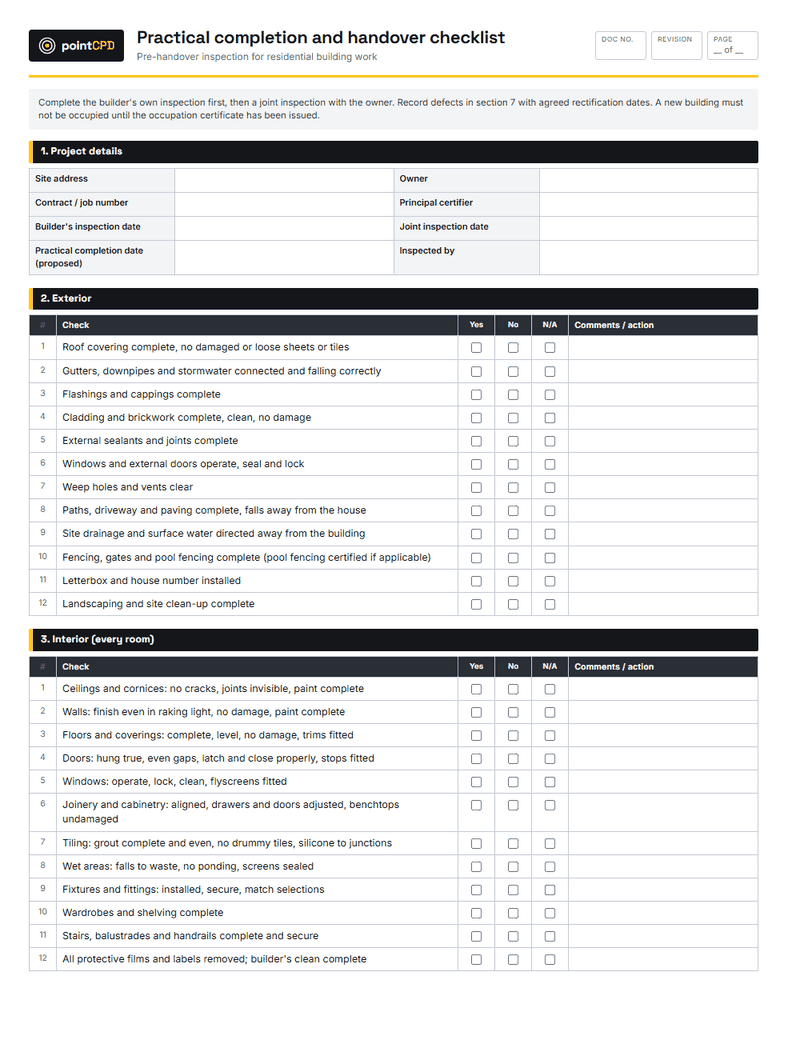
For the reader who wants the wider picture of what goes into a handover pack, the practical completion checklist template is a useful starting point, because the metering items belong alongside the other handover items rather than in a separate envelope.
Monitors, apps and the data nobody has written down
An installed energy monitor usually works by fitting sensors to the switchboard, which measure the load on the circuits they are attached to, and sending the readings to a display or to a phone application. The monitor is a useful tool and a common source of confusion, because the readings are only as meaningful as the setup behind them. A sensor on the wrong circuit gives a confident and wrong picture. A sensor on a circuit that carries nothing tells the owner the house is quiet when it is not.
The app account is the other half of the problem. Accounts are often opened during the commissioning visit, sometimes in the builder’s name, sometimes in the owner’s name with an email address the builder chose, and rarely with a written note of who holds the login. When the owner changes provider, sells the house or forgets the password, nobody knows where the data is or how to get it back. The builder should not create an account in the owner’s name without the owner’s knowledge and consent, and should record in the handover pack which account exists, who holds it and how to recover it.
Privacy follows the same logic. The energy data belongs to the household, and the builder should hold no more of it than the commissioning record requires. If the builder has a login to the owner’s monitor for support, that access should be agreed in writing and removed when the support period ends.
Commissioning the monitor before it goes in the pack
Commissioning means proving the monitor reads correctly before the owner ever looks at it. Start with the sensors. Confirm each one is on the circuit the handover document says it is on, and that the labels on the switchboard match. Then test against a known load. Switch on a single appliance with a known draw, such as a heater or a pump that the owner can identify, and check that the monitor shows the change on the right circuit at the right time. Where the building has any local generation, confirm that the monitor reads the direction of flow correctly, because a monitor that shows the house exporting when it is importing will undermine the owner’s confidence in everything else.
Write the results on a commissioning sheet. It should list each sensor, the circuit it is on, the test load used, the reading observed, the date and the name of the person who tested it. That sheet is the evidence that the monitor was set up correctly, and it is what the builder shows if the owner later says the readings are wrong. Without it, the builder has only a memory of a visit that happened some time ago.
Be clear about the limits. A home energy monitor is an estimate built from sensors on the switchboard. It is not the billing meter, and it will not agree with the bill to the cent. The owner needs to understand that the monitor shows patterns and trends, and that the bill is the legal record. Saying so at handover prevents the first apparent mismatch becoming a complaint.
The mistake that costs the most. Handing over a monitor that was never tested against a known load. The owner’s first readings look plausible, they trust them, and the first real fault shows up as an argument about whether the builder ever checked the sensors at all.
What to put in the handover pack
The pack should be short enough to read and complete enough to answer the questions an owner asks in the first year. It should include the meter identifier and location, the retailer and network details, and a note of who to call for a billing question. It should carry the monitor manual with the pairing and reset steps, the commissioning sheet, and the account details, with the login recorded in a way the owner controls. Include the as-built drawing of the switchboard and the circuit schedule, so that anyone who later works on the house knows which circuit is which.
Add a one-page reading guide written for the owner, not the electrician. It should explain how to read the meter, how to find the monitor’s daily total, what a sudden change might mean, and what to do if the readings look wrong. Plain words work better than technical terms here. An owner who can answer a simple question about the house without ringing anyone is an owner who thinks well of the builder.
Commissioning a monitor before the owner sees it
- 1Check the sensorsConfirm each sensor sits on the circuit the handover document names, and that the switchboard labels match.
- 2Test against a known loadSwitch on an appliance the owner can identify and confirm the change appears on the right circuit.
- 3Record the resultWrite the sensor, circuit, test load, reading and tester on a commissioning sheet and sign it.
- 4Set up the accountOpen the app account with the owner’s knowledge and record who holds the login and how it is recovered.
A short walk-through is worth more than a longer manual
The handover conversation matters more than the paper. Walk the owner to the meter box and the switchboard, point out the monitor display, and show them where the daily total appears. Ask them to read the meter aloud, and read the monitor at the same time, so that they see the two numbers are different and why. Tell them what time of day the readings usually change, and what would be unusual. Then ask them to explain back what they will do if the monitor shows something strange. That last question is the one that tells you whether the handover has worked.
Keep the walk-through short and specific. An owner who has been talked at for an hour will remember none of it, while an owner who has read a number off a meter and seen it match the display will remember the lesson. Record that the walk-through happened, who attended and what was covered, in the same handover record as the commissioning sheet.
Worked example: a builder on the edge of a regional city
A builder on the edge of a regional city handed over a family home with a monitor fitted by a subcontractor. The subcontractor had clamped the sensor to a circuit in the switchboard that was labelled as the main supply, and the app showed the house drawing a steady load all night. The owner, who was careful with money, rang the builder in the second week and asked why the house was using so much power when everyone was asleep.
The builder had no commissioning sheet, because the monitor had been treated as an accessory rather than part of the handover. The builder went back to the site, traced the sensor, and found it on the wrong conductor. Fixing it took less than an hour. Working out what the owner had believed in the meantime took much longer, because the owner had already started to compare the readings with the bill and had decided that something was wrong with the bill.
After that the builder changed the handover. Every monitor is now tested against a known load and recorded on a sheet before the owner is shown the display, and the sheet is signed by the person who did the test. The change added a short step to the handover, and it removed the most common cause of an early complaint on the job.
Where the official sources draw the line
The requirements for energy performance are in the National Construction Code, which is published by the Australian Building Codes Board and is the document to check for the specific provisions that apply to your job. The NSW Government guidance on continuing professional development for builders and on general building work licensing sets out the obligations of the licensee. Neither source is a substitute for reading the current requirement for the building you are handing over.
Where the design or the contract is silent on metering and monitoring, the handover practice described here is a matter of good work rather than a compliance requirement. Agree in writing at the start of the job what the owner will receive, so that the handover is measured against what was promised rather than what the builder remembers promising. The PointCPD guide to how NSW builder CPD works sets out how the wider obligations are kept current.
The billing meter and the home monitor do different jobs
| Billing meter | Home energy monitor |
|---|---|
| Read by the network and retailer for billing | Read by sensors the builder or subcontractor fitted |
| The legal record the bill is based on | An estimate built from circuit readings |
| Owner holds the account with the retailer | Account often opened at commissioning and easily lost |
| Connection confirmed on the day of handover | Accuracy confirmed by a test on a known load |
Making handover the point where the building is explained
Energy efficiency is easy to promise and hard to show. A well-designed building can still disappoint an owner who does not understand what they are looking at, and a monitor that is set up properly is one of the few ways an owner can see the design working. Treat the handover as the moment the building’s energy story is explained, with the meter, the monitor, the documents and the walk-through all pointing the same way.
The builder who does this well will rarely be asked about energy after handover, because the owner already knows the answers. The owner who was left to work it out will ring. The difference is a few hours of planning and a page of clear instructions, and it is one of the cheapest ways to protect the builder’s reputation on a job.
Before the owner signs, check the meter is connected, the monitor is commissioned and tested, the account is recorded, the pack is complete and the walk-through has happened and been written down. If one of those is missing, the handover is not finished, however much the rest of the job looks complete.
Questions builders ask
Does the builder have to install an energy monitor?
Only where the design or the contract requires one. Where it does not, offering a monitor is a choice made for the owner’s benefit, and it creates a responsibility to commission and document it properly. Agree in writing what is being provided before the work starts.
Who is responsible for the electricity meter at handover?
The meter belongs to the network and the retailer, who decide how it is installed and read. The builder’s responsibility is to make sure the connection is complete, the meter box is accessible and labelled, and the owner knows who to call about billing.
What should go into the handover pack for energy?
The meter identifier and location, the retailer and network details, the monitor manual, the commissioning sheet, the switchboard drawing with its circuit schedule, and a one-page reading guide written for the owner. The app account should be recorded with the holder and the recovery route.
Why does the monitor show different figures from the bill?
A home monitor estimates use from sensors on the switchboard, while the bill is based on the billing meter. Trends and patterns are the monitor’s strength. The bill remains the legal record, and the owner should be told this at handover so the first mismatch does not become a dispute.
Can I set up the monitor app for the owner?
You can help, but the account should be opened with the owner’s knowledge and consent, ideally in the owner’s name with their own email address. Record who holds the login and how it can be recovered, and remove any support access you were given once the support period ends.
Where do I check the current energy requirements?
Check the energy efficiency provisions of the National Construction Code published by the Australian Building Codes Board, and the version that applies to your job. The NSW Government guidance on general building work licensing is the reference for your own obligations as the licensee.
Sources
- National Construction Code: energy efficiency provisions · Australian Building Codes Board
- Continuing professional development for builders and swimming pool builders · NSW Government
- General building work licensing · NSW Government
Published 27 October 2026. General information for builders, not legal, financial or engineering advice for a specific job. Check current requirements with the relevant regulator or standard before relying on them.