Key takeaways
- A half-built house has exposed timber, open cavities and loose offcuts, so hot work on it is a fire decision before it is a question of technique.
- Move the work to a workshop or a fabricator wherever the design allows, and treat any welding or cutting that has to stay on site as a planned activity.
- Clearing the zone and covering what cannot be moved matter as much as the permit itself, and both should be checked on the day the work happens.
- A separate fire watch stays in place after the welder has packed up, for the period the permit sets, because smouldering fires often show up long after the sparks have stopped.
- Keep the signed permits and the watch records on the job file, since they are the evidence that the controls were used when something goes wrong.
Welding and cutting are routine on most jobs, which is exactly why they get treated casually. On a half-built house they are not routine at all. The frame is timber or light steel with insulation and sarking going in around it, the floors are covered in offcuts and sawdust, and the cavities behind the linings are full of material that catches easily and keeps smouldering long after the flame has gone. A spark that would be an embarrassment in a workshop can start a loss in a house that already holds weeks of labour and materials.
This article is not about how to weld. A licensed builder or site supervisor already knows the technique, and most of the people holding the torch are qualified tradespeople. The problem sits in the decisions around the work: whether the hot work needs to happen on the house at all, what has to be cleared and protected before it starts, who is watching when the torch goes down, and what gets written down so the next person on the job knows what was done and where.
The cost of getting this wrong is easy to underestimate because it tends to surface late. A small fire in a frame can be put out in minutes, or it can smoulder inside a wall and show up after the trades have gone home. By then the bill is the replacement of whatever burnt, the delay to the completion date, and a conversation with an insurer about whether the loss was caused by a process the insurer would reasonably have expected to see followed.
Why a half-built house carries a different fire risk
A finished house is designed to resist fire in a number of ways. The linings are fixed, the cavities are closed, the services are enclosed and the materials have been chosen with fire behaviour in mind. A house at lock-up stage is the opposite. The linings that would protect the framing are not on yet, so the timber is exposed. The cavities are open, which means a fire can travel through a wall without anyone seeing it. Packaging, paper-faced plasterboard offcuts, rolls of underlay and polystyrene scraps are sitting exactly where a torch is likely to be used, because that is where the work is.
The fire safety framework for the finished building sits in the NSW development certification and fire safety regulation, which deals with the fire safety measures a completed building must have in place before it is occupied. That instrument is about the building as it will be used, not the day-to-day work on it. The daily control on a site is the work health and safety duty every builder carries to keep the people on the job safe, and a hot work permit is the most practical way of meeting that duty when torches, grinders and cutting equipment are in use. Keep the two ideas apart: the certificate protects the occupant later, and the permit protects the house and the people in it now.
Decide whether the work has to happen on the house
The cheapest fire control is not to have hot work inside the building in the first place. A great deal of what gets welded or cut on site could be done in a workshop or at a fabricator: a steel lintel cut to length and drilled, a bracket welded to a plate, a balustrade post finished before it is delivered. Ask the question when the job is programmed, not when the crew arrives with the gas bottles. If the answer is that the work must be done in place, because the connection depends on the existing frame or the dimensions can only be confirmed on the day, then the hot work becomes a permitted activity with the controls that go with it.
Be honest about the reason. A welded connection made in place because the drawings were not finished is a planning failure, and the fire risk is the price of that failure. Build the question into the program so it is asked at the design or ordering stage. A supervisor who is told at the last minute that a steel member needs welding at the slab edge has very little room to do anything except proceed, and that is when a sensible control gets skipped.
Clear the area before the torch comes out
Clearing is the step most often rushed. The rule is simple to say and hard to apply on a busy site: nothing combustible should sit inside the clearance zone the permit sets, and anything that cannot be moved must be covered or protected. That means sawdust and offcuts swept up, timber stacks moved back, packaging removed, paint and solvent cans taken out of the room, and the floor below the work checked for the material that falls through. Where a lining has been fixed and the cavity behind it is still open, the other side of the wall needs a look too, because heat travels along framing and a spark can drop into a space nobody can see.
Cover what stays. Fire blankets or metal shielding over timber that cannot be moved are routine, and wetting down the timber before the work starts is sensible where the material allows it. Think about the people as well as the materials. Anyone working in the room below, or in an adjoining space, needs to know the work is happening, and a door to a neighbouring space should not be left open in the path of sparks. The clearing is part of the job, so it belongs in the program with its own time, not squeezed in before the welder arrives.
Gas cylinders, leads and the kit that travels with the work
Most of the serious equipment faults on site are simple ones. Gas cylinders should be stored upright and secured, kept away from the building, and never left inside a half-built house overnight. Fuel gas and oxygen cylinders are kept apart, hoses and regulators are checked for cracks and leaks before each use, and flashback protection is fitted where the equipment calls for it. A hose with a split in it is a leak, and a leak in a frame is a fire waiting for a torch.
Welding leads and power leads carry the same kind of risk. They should be in good condition, kept off wet timber and out from under foot traffic, and supplied through a residual current device where the supply allows. Safe Work Australia’s guidance on electrical safety is the right reference for the leads, and it applies on a building site as much as it does anywhere else. Keep the extinguishers suited to the materials on the job, have a water supply hose ready, and keep a fire blanket within reach of the work face. Check every item before it is used, and take out of service anything that is damaged.
The hot work permit is the control, not the paperwork
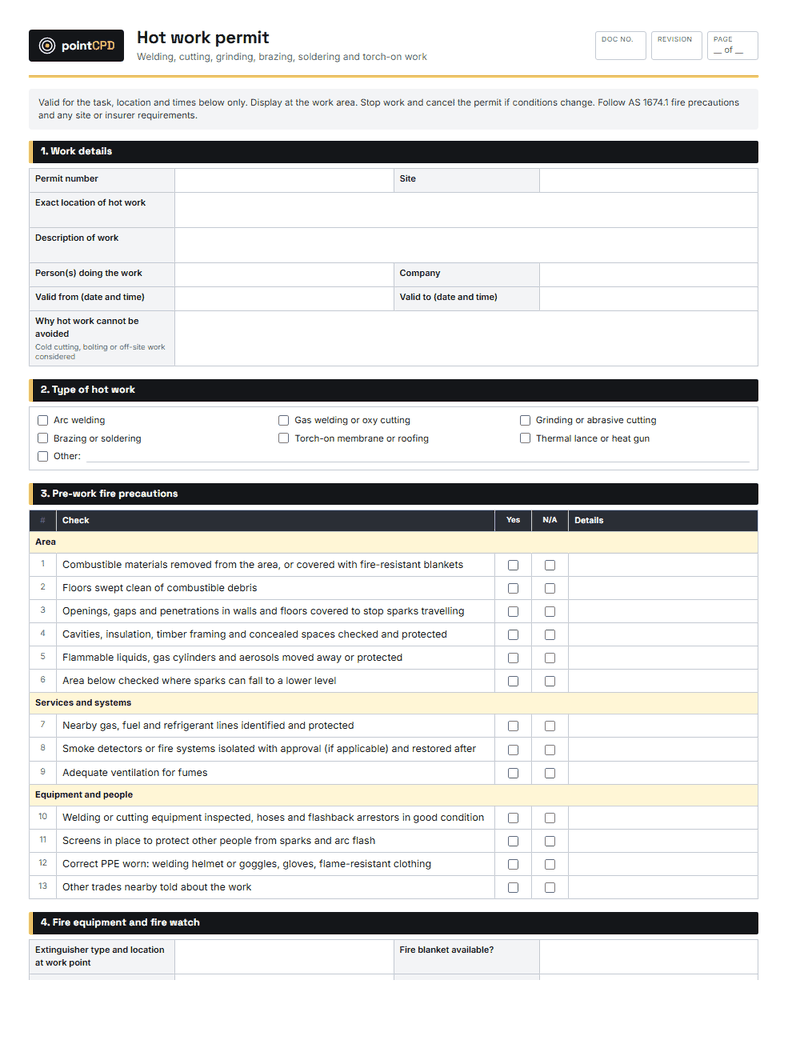
A hot work permit is a short written record that says who is doing the work, who is watching it, where it is happening, when it starts and finishes, what clearing has been done, what controls are in place and who has confirmed that all of it is true. The value is not the form. The value is that someone in charge has to look at the location and say yes before a flame is lit, and that the person doing the work has to acknowledge the controls in writing. A builder who uses a standard form such as the hot work permit template has a starting point that already covers the questions most often forgotten.
The permit is only as good as the check behind it. The person signing it should walk the area, not sign from the office, and the permit should be closed out by the same person once the work and the watch are finished. A permit that is signed in the morning and never closed is a record of intent, not of control. Where a permit is not in place, no work starts, and that rule applies to the subcontractor who says they only need a minute.
How a hot work permit runs on site
- 1Decide whether the work can waitStart from the program and the drawings, and move the work to a workshop if the design allows it.
- 2Clear the zoneRemove or cover everything combustible inside the clearance the permit sets.
- 3Name the peopleThe person doing the work and a separate person watching it both go on the permit.
- 4Check the kitCylinders, hoses, leads and extinguishers are inspected before the first use on the day.
- 5Sign and startThe person in charge of the site signs the permit before the torch is lit.
- 6Close and keepThe watch period ends as the permit states, and the signed record goes on the job file.
Fire watch does not end when the last spark does
A fire watch is a person whose only task is to watch the work area while hot work is under way and for the period afterwards that the permit sets. The reason is that heat and sparks do not stop when the welder packs up. Slag can keep glowing in a gap. Embers can drop into a cavity, a sawdust pile or a roll of insulation and smoulder for hours before anything shows. By the time smoke is visible, the fire is established inside a wall, and the people who could have stopped it have gone home.
The watcher should check the work face, the spaces either side of the work, the cavity behind any lining that was heated, and the roof space above where the heat could travel. They should know where the extinguisher and the water supply are and have a clear way to raise the alarm. If a fire does start, the people on the job need to know exactly where to go and who to call, and that is covered in the way the emergency evacuation plan for a residential site is set up. The watcher is part of that plan, not an extra body on the program.
Fire watch from start to finish
- Before the workThe watcher walks the area, confirms the clearance and knows where the extinguisher and the water supply are.
- During the workThe watcher stays in position with no other task, watching the work face and the spaces around it.
- When the work stopsThe welder packs up, but the watcher stays and checks for glowing slag, smoke and warmth in the framing.
- Through the watch periodThe watcher remains for the period the permit sets, checking adjacent cavities and the roof space.
- Closed outThe watcher records what was seen, signs the permit and the permit goes to the job file.
Bush fire areas and the day the fire danger is high
Where the block is mapped as bush fire prone land, the planning requirements for the building are shaped by Planning for Bush Fire Protection, and the same logic applies to day-to-day hot work. Embers can travel a long way in wind, and the fire danger on the day is the single biggest variable. A job that is safe on a mild morning can be a serious hazard when the forecast turns. Check the fire danger rating for the area before the work is scheduled, and be ready to stop if it rises.
A declared total fire ban can restrict or prohibit work that produces sparks or heat in the open, so check the declaration before the day is planned rather than when the gas bottles are off the ute. Councils and the fire authorities also set their own conditions for some activities. The builder who decides on the morning that the work will go ahead anyway is making a decision that the insurer, the regulator and a coroner would all look at closely.
Records, insurance and who carries the cost
The permits, the watch logs and the equipment checks are the evidence of what was done, and they should live on the job file with the rest of the site records. A permit that cannot be found after a fire is almost as bad as no permit at all, because the first question from the insurer will be whether the controls were used. Keep them in the same place every time, and make sure the supervisor knows where that place is. Your own CPD records are a separate file, and the PointCPD guide to NSW builder CPD sets out how that side of the paperwork works.
The commercial reality is that a fire on a half-built house lands on the builder first. The cost of replacing the framing, the lost time, the delay to the handover and any damage to neighbouring property can all come back to the contract, and the contract will say who is responsible for the works until practical completion. Your insurance is the other half of that picture. Read the conditions of the policy, because many require controls for hot work, and a claim can be reduced or refused where those controls were not in place.
Lead in. The mistake that costs the most is treating the fire watch as optional once the welder has packed up, because that is when the smouldering starts.
Worked example: a steel beam welded into a frame in western Sydney
A builder in western Sydney had a steel beam to fix into a frame that was already lined on one side. The opening had been framed to a site measure that did not match the drawing, so the beam needed a welded plate fixed on the day. The supervisor’s first question was whether the plate could be made off site. The answer from the fabricator was no, because the measure had to be taken from the frame that was already standing, so the work had to happen in place.
The supervisor did three things before anyone lit a torch. The plasterboard offcuts, the insulation roll and a stack of timber were moved out of the room. The timber stud within reach of the work face was covered with a fire blanket and wet down. The permit was written and signed by the supervisor, and it named the welder and a separate labourer as the watcher, with the extinguisher and water hose placed where both could reach them. The welder was given the job and nothing else, and the watcher was given nothing else at all.
The weld took the afternoon. When it finished, the watcher stayed in place, as the permit said he would. Some time later he saw a thin wisp of smoke coming from the bottom of the lower wall cavity, where a piece of offcut had fallen during the cutting. He put it out with the water hose and the fire was contained to a single offcut. The permit was closed, the record went onto the file, and the builder moved on to the next task. Without the controls the same job could have been the house, and the real achievement was nothing more dramatic than having decided the rules applied on the day.
What to take from this on your next job
Hot work on a house under construction is a fire decision before it is a question of skill. Move work out of the building where the design allows, clear what can burn, put a permit in place that someone in charge has checked, and keep a watcher in position for as long as the permit requires. The competent tradesperson does all of this without being asked, and the reason for the rules is that the one time they are skipped is the time the house burns. For the full catalogue of courses, the PointCPD home page sets out what is available.
Questions builders ask
Do I need a hot work permit for a small cutting job on a house under construction?
Yes, if the work produces sparks or heat near anything that can burn. A small job looks harmless, and that is the reason it gets skipped, so treat any cutting or welding in a frame as hot work and control it. The permit can be short, but it should exist.
Who should issue the hot work permit?
The permit should be issued by the person in charge of the site, not by the person holding the torch. That keeps the decision about whether the work goes ahead with someone who has the authority to stop it. The person doing the work signs to say they understand the controls.
How long should a fire watch continue after the welding finishes?
The fire watch should run for the period the permit sets, and it should not end while anything in the work area could still be hot or smouldering. The period is a matter for the permit and the site, so set it in writing before the work starts rather than deciding on the day.
Can the watcher also be doing another job on the site?
No. The watcher’s only task while hot work is under way and during the watch period is to watch. A person who is also running a saw or carrying materials will miss a glow inside a wall, and a fire that starts in a cavity is rarely seen until it is well established.
If a subcontractor brings their own welder, does the permit still apply?
Yes. The principal contractor remains responsible for the safety of the site, so any hot work on the job runs under the site permit system whoever is doing it. A subcontractor’s own procedure can add to the controls, but it does not replace the site permit.
Will my insurer cover a fire caused by hot work on site?
That depends on the conditions of your policy, which can require permits, clearing and a fire watch for hot work. Read the policy wording, ask the insurer or broker what they expect to see, and keep the records that show the controls were followed.
Sources
- Environmental Planning and Assessment (Development Certification and Fire Safety) Regulation 2021 · NSW Legislation
- Planning for Bush Fire Protection · NSW Rural Fire Service
- Electrical safety · Safe Work Australia
- BASIX · NSW Planning Portal
Published 23 September 2026. General information for builders, not legal, financial or engineering advice for a specific job. Check current requirements with the relevant regulator or standard before relying on them.