Key takeaways
- A scaffold handover is a transfer of information and control, not just a verbal all-clear, and the builder as principal contractor needs something in writing that identifies the scaffold, the date and the person handing it over.
- Inspection records only work if they are tied to a specific scaffold, a specific date and a named person, because a generic tick-and-flick sheet proves nothing after an incident.
- The builder should collect the scaffolder’s evidence of competence, the design or engineering documentation where the scaffold is not a standard configuration, and any handover or completion documentation before the scaffold is loaded.
- Records should be held for the life of the project and beyond, because personal injury claims and regulator requests can arrive years after practical completion when the site has been landscaped and the crew has moved on.
- Where the chain breaks down — no handover, no inspection record, an undocumented alteration by another trade — the principal contractor carries the exposure, because the duty to manage the risk sits with whoever controls the site.
A scaffold appears on a house site in a day. A frame, some planks, a tag, and the crew is back on the truck. What often does not appear is a record of who handed that scaffold over to whom, on what date, and what the builder did with it after that.
That gap matters because the builder is usually the principal contractor. The duty to manage risks on the site sits with the person who controls it, and control follows the handover. Once the scaffolder has finished and gone, the builder owns the in-service condition of that scaffold — the inspections, the tagging, the response when a trade decides to cut a plank or remove a brace.
This article is about the paperwork chain between scaffolder and builder. It does not cover how to erect a scaffold, what fall protection system to choose, or how to design a working platform. Those are separate problems. The problem here is the handover: what you collect, what you record, and what it costs when you cannot produce it.
What a scaffold handover actually is
A handover is a transfer of information and control from the scaffolder to the builder. In practice it is often a verbal “she’s right to go” across the driveway, which is fine until something goes wrong and nobody can say who checked what.
The purpose of a documented handover is to close the gap between the scaffolder’s work and the builder’s ongoing duty. The scaffolder is responsible for the scaffold as erected. The builder is responsible for it as used — by carpenters, bricklayers, roofers, electricians, and anyone else who climbs on it in the following weeks. Without a handover record, that boundary is invisible.
A workable handover record does not need to be elaborate. It needs to identify the scaffold, the date, the person handing it over, the person accepting it, and any conditions or exclusions. If the scaffold is not a standard configuration, it also needs to reference the design or engineering documentation that the scaffolder worked to.
Some scaffolders issue a completion certificate or handover tag. Others issue nothing unless asked. Either way, the builder should be asking, in writing, before the scaffold is loaded. An email confirming the details is better than nothing; a signed handover form is better again.
Why the chain breaks on residential sites
On a house site the scaffold is usually erected by a subcontractor the builder has used before, for a fixed price, with the frame going up in a single day. The handover often happens in the same conversation as the invoice. Nobody thinks about records because the scaffold is small, the job is small, and everyone knows each other.
The chain then breaks in predictable places. A carpenter cuts a plank to run a temporary brace. A bricklayer removes a tie to get a lintel in. An electrician runs a cable across a working platform and leaves it there. A roofer drops a sheet on a standard and bends it. In each case the scaffold has changed, and in each case nobody has recorded the change or re-inspected the scaffold afterwards.
Those are the events that matter. A scaffold that has been altered without inspection is no longer the scaffold that was handed over, and the handover documentation no longer describes what is actually standing on site. If an incident follows, the paperwork is the first thing a regulator will ask for, and it will show a scaffold that was signed off and then never looked at again.
The mistake that costs the most. Treating the handover as a verbal event and the inspection record as a formality, then discovering after an incident that no record identifies the scaffold, the date or the person responsible. The scaffold comes down in a day; a personal injury claim does not.
What the builder should collect at handover
The builder does not need to duplicate the scaffolder’s records. The builder needs enough to show that the scaffold was handed over in a known condition, and that its condition has been managed since.
At a minimum, collect:
- Handover or completion documentation identifying the scaffold and the date.
- Evidence that the person who erected or inspected the scaffold is competent to do so, including any licence held.
- Design drawings or engineering certification where the scaffold is not a standard configuration, or where it is loaded in a way that requires design input.
- Any conditions the scaffolder has placed on use — for example, that a bay is not to be loaded, or that ties are not to be removed.
Where the scaffold is a standard configuration and the scaffolder is experienced, this can be a single page. Where the scaffold is unusual — a cantilever over a driveway, a loading platform, a scaffold supporting a temporary roof — the documentation needs to match the complexity.
The handover chain, in order
- 1Pre-start confirmationThe builder confirms in writing what scaffold is being provided, for what tasks, and who is responsible for what.
- 2Erection and self-checkThe scaffolder completes the work and runs its own inspection before offering handover.
- 3HandoverThe scaffolder hands over to the builder with documentation identifying the scaffold and the date.
- 4Builder acceptanceThe builder checks the documentation exists, records acceptance, and tags or registers the scaffold.
- 5In-service inspectionsThe builder or a competent person inspects at the required intervals and after any event that could affect stability.
- 6Alteration and re-handoverAny change by another trade triggers a fresh inspection and, where the change is structural, a fresh handover.
Inspection records that actually hold up
The point of an inspection record is to answer three questions: what was inspected, when, and by whom. A record that cannot answer all three is not evidence of anything.
That rules out the generic sheet with a row of ticks and no scaffold identification. It also rules out the practice of back-filling a week of inspections on a Friday afternoon. If the record does not distinguish one scaffold from another on a site with several, or one week from the next, it will not survive scrutiny.
What the record should capture:
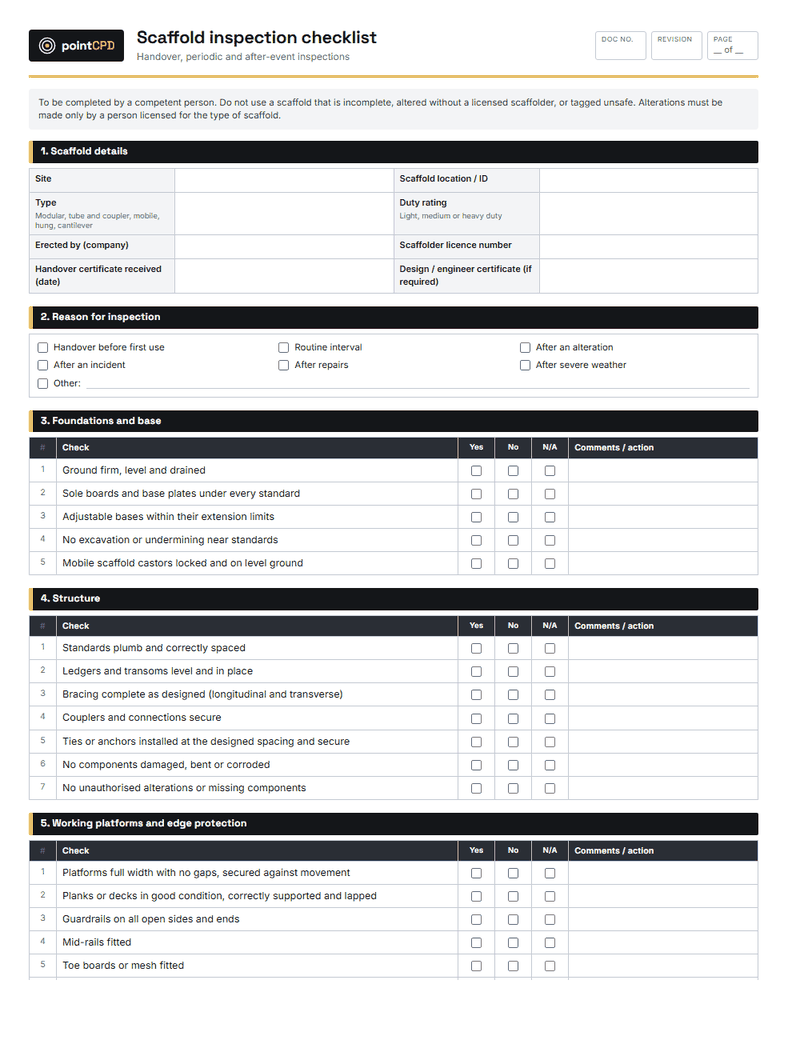
- The scaffold being inspected, identified by location or tag number.
- The date and time of the inspection.
- The name and role of the person who carried it out.
- The condition of the scaffold at the time, including any defects found.
- What was done about any defects, and by when.
- Any event that triggered the inspection — a storm, an alteration, a near miss.
In-service inspections are needed at the intervals the relevant requirements set out, and after any event that could affect the stability of the scaffold. That includes severe weather, impact from plant or materials, and any alteration by another trade. The record should show that the inspection happened, not just that someone intended it to.
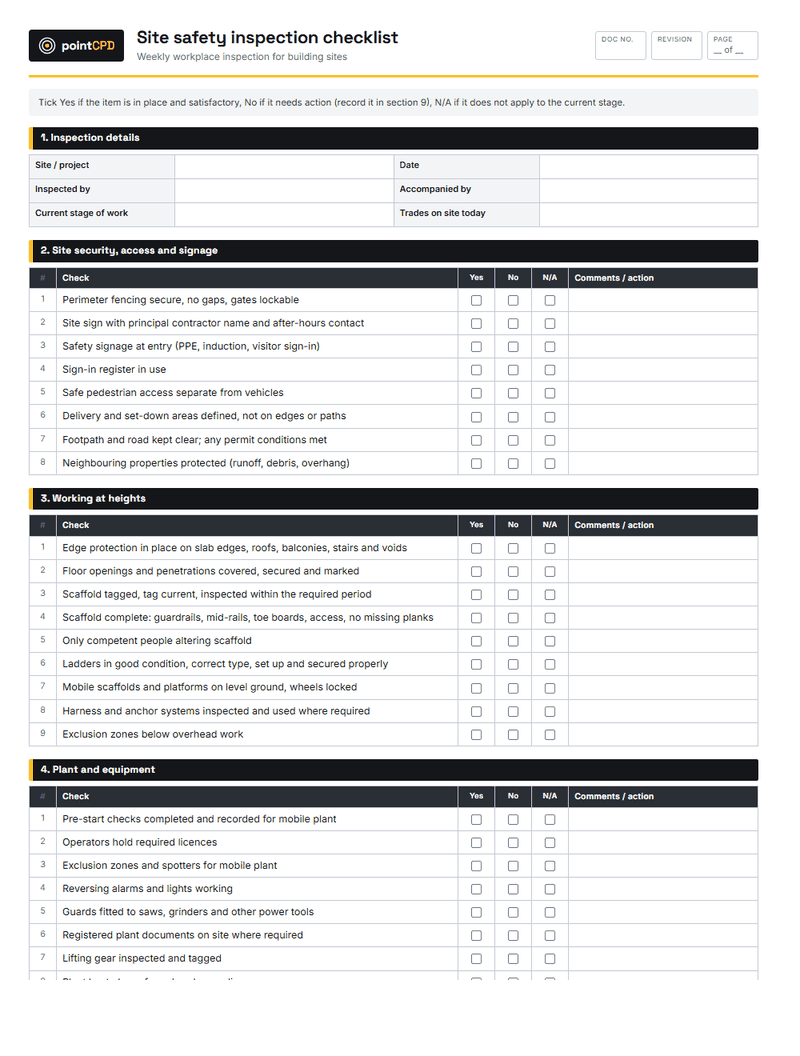
For a template to work from, the scaffold inspection checklist covers the fields a residential site needs. If you are reviewing the broader site safety system at the same time, the site safety inspection checklist is the companion document.
What belongs in the scaffold file
- Handover or completion documentation identifying the scaffold and the date.
- Evidence of the scaffolder’s competence and any licence held by the person doing the work.
- Design drawings or engineering certification where the scaffold is not a standard configuration.
- Inspection records signed and dated by the person who did the inspection.
- Records of any alteration, with who made it and when it was re-inspected.
- Register entry showing where the scaffold is on site and when it was tagged.
- Records of any incident, near miss or event that triggered a re-inspection.
Alterations by other trades are the weak point
Every trade on a house site has a reason to modify the scaffold. The frame is in the way of a beam, the tie is where a window goes, the plank is at the wrong height for the eaves. Most of these changes are small and most of them are made without telling anyone.
The builder’s system needs to make the alteration visible. That means a rule that any change to the scaffold is reported to the site supervisor before it happens, and that the scaffold is re-inspected before it is used again. Where the change is structural — removing a tie, cutting a standard, adding a loading point — the scaffolder should be brought back to do the work and re-hand the scaffold over.
This is where a scaffold register earns its place. A simple register listing each scaffold on site, its location, its handover date and its inspection history gives the supervisor a single place to check before signing off on any change. Without it, the supervisor is relying on memory and on trades volunteering information they have no incentive to volunteer.
The commercial reality is that a re-inspection is cheap and a rebuilt scaffold after an incident is not. The bigger cost is the claim, which can surface years later when the site has been landscaped and the crew has moved on.
Worked example: a two-storey build in western Sydney
A builder in western Sydney is running a two-storey brick veneer with a tiled roof. The scaffold is erected by a regular subcontractor over two days and handed over verbally on the second afternoon. No handover documentation is issued and none is requested. The scaffold tag is fitted but not registered.
Three weeks later the bricklayers remove a tie to install a lintel over a ground-floor opening. The tie is not replaced. A week after that, a carpenter cuts a plank to run a temporary handrail for the upper floor. Nobody records either change.
A storm comes through overnight. The following morning a section of the scaffold is visibly out of plumb. The site supervisor stops work and calls the scaffolder back. The scaffolder inspects, finds the missing tie and the cut plank, and refuses to certify the scaffold until both are rectified. The scaffold is out of service for two days while the work is done and the scaffold re-inspected.
The direct cost is two lost days and the scaffolder’s call-out. The indirect cost is harder: the builder cannot show a handover record, cannot show an inspection record between handover and the storm, and cannot show that the alterations were managed. If the same sequence had led to an injury rather than a delay, that gap in the records would be the builder’s problem, not the scaffolder’s.
The fix is not complicated. A one-page handover record at the start, a register entry, a rule that any alteration is reported and re-inspected, and a signed inspection record at the required intervals. That is the whole system. It takes less time to run than the two-day stoppage it prevents.
How long to keep the records, and where
Scaffold records are project records. They should be held with the rest of the site safety file for the life of the project, and kept after practical completion for as long as the builder’s other project records are kept.
The reason is that claims and regulator requests do not arrive on a convenient timetable. A personal injury claim can be lodged well after the build is finished, and the first thing anyone will ask for is the documentation that shows how the scaffold was managed. If the records were in a folder that went in the skip at handover, the builder has nothing to produce.
Practically, that means:
- Keep the handover record with the project file, not just in an email inbox.
- Keep inspection records in date order, with the scaffold identified.
- Keep alteration records and the associated re-inspections.
- Keep records of any incident or near miss that triggered an inspection.
- Back up digital records so they survive a change of phone, laptop or software.
The same discipline applies to the broader safety documentation. If you are reviewing how your SWMS and site systems fit together, the article on the SWMS template for residential builders in NSW covers the document side, and the piece on working alone on site covers when the higher-level obligations are triggered.
Where the builder carries the risk
The scaffolder is responsible for the scaffold as erected. The builder, as principal contractor, is responsible for the scaffold as used. The handover is the point where that responsibility shifts, and the records are what make the shift visible.
If the scaffolder hands over with proper documentation and the builder files it, the boundary is clear. If the scaffolder hands over verbally and the builder accepts it, the boundary is not clear, and in practice the builder carries the exposure because the builder controls the site and the trades on it.
Three failures recur:
- No handover record, so there is no evidence of the condition of the scaffold at the point the builder took control.
- No inspection record between handover and the incident, so there is no evidence the builder managed the scaffold in service.
- No record of an alteration, so there is no evidence the builder responded to a known change.
Each of these is a documentation failure, not an erection failure. The scaffold may have been perfectly built. The problem is that nobody can prove what happened after the scaffolder left.
That is why the paperwork is worth doing properly, and why it belongs in the builder’s CPD, not just in the scaffolder’s. The guide to how NSW builder CPD works sets out how safety and compliance topics fit into the annual requirement, and the course catalogue lists the options that cover site safety and record-keeping. If you are new to the system, start at the PointCPD home page for NSW builder CPD courses.
What to put in place this week
If your current practice is a verbal handover and an inspection sheet that nobody signs, the fix is a short list of changes you can make on the next job.
First, agree with your scaffolder what the handover record will contain and who will sign it. Second, start a scaffold register for each site, even if it is a single page in the site folder. Third, brief the trades at the pre-start that any alteration to the scaffold must be reported before it happens. Fourth, set a reminder for the in-service inspections at the required intervals. Fifth, file the records where they will survive the project.
None of that is complicated, and none of it requires new software. It requires the builder to treat the handover as an event with a record, rather than a conversation on the driveway. The scaffold is a temporary structure with a short life on site. The records need to outlast it.
Questions builders ask
Does a scaffold handover need to be in writing in NSW?
The obligation is to manage the risk, and a written record is the practical way to show that the handover happened and what condition the scaffold was in. A verbal handover leaves the builder unable to demonstrate the boundary between the scaffolder’s work and the builder’s ongoing control. Most builders find a one-page handover form is enough.
How often should a scaffold be inspected on a house site?
The required intervals are set out in the relevant work health and safety requirements, and inspections are also needed after any event that could affect stability, such as severe weather, impact, or an alteration by another trade. The record should show the date, the scaffold identified, and who carried out the inspection. Check the current requirement for the intervals that apply to your scaffold.
Who is responsible for inspecting a scaffold once it is up?
The scaffolder is responsible for the scaffold as erected, and the builder as principal contractor is responsible for it in service. Once the handover is accepted, the builder needs a system for in-service inspections and for responding to alterations. Where the alteration is structural, the scaffolder should be brought back to do the work and re-hand the scaffold over.
What should I do if another trade alters the scaffold without telling me?
Stop use of the scaffold, get it inspected by a competent person, and record what was found and what was done. If the change is structural, bring the scaffolder back. The important thing is that the alteration and the response are documented, because an undocumented change is the gap that causes trouble after an incident.
How long should scaffold records be kept?
Keep them with the project safety file for the life of the project and after practical completion for as long as your other project records are kept. Claims and regulator requests can arrive well after the build is finished, and the handover and inspection records are the first documents anyone will ask for.
Does a scaffold tag replace a handover record?
No. A tag shows the status of the scaffold at a point in time, but it does not identify who handed it over, who accepted it, or what conditions apply. The handover record and the tag serve different purposes, and a builder should hold both. The tag is the visible signal; the record is the evidence.
Sources
- Electrical safety · Safe Work Australia
- Pools and pool safety · NSW Government
- Asbestos in the home · Asbestos and Silica Safety and Eradication Agency
- Bans and safety notices for building products · NSW Government
Published 29 June 2026. General information for builders, not legal, financial or engineering advice for a specific job. Check current requirements with the relevant regulator or standard before relying on them.