Key takeaways
- In NSW, residential building work over $5,000 including GST needs a written contract. Work between $5,000 and $20,000 needs a small jobs contract; work over $20,000 needs a large jobs contract.
- The deposit must not exceed 10% of the contract price. For work over $20,000, the owner should not pay the deposit until they have a valid Home Building Compensation Fund certificate.
- Large job contracts must include, among other things, the price prominently on the first page, a five-business-day cooling-off statement, a 17-item checklist and a compliant progress payment schedule.
- Progress payments must be tied to stages of work described in plain language, or to work performed and costs incurred supported by documentation, not to time on the job.
- Variations must be in writing and signed by both parties, and the owner must receive a copy of the signed contract within five business days.
In most industries, the contract is a matter of negotiation. In NSW residential building, the Home Building Act 1989 and its regulations decide much of what the contract must say. That protects consumers, and it protects builders who follow the rules, because a compliant contract is much easier to enforce. A builder who uses a non-compliant contract, or no contract at all, can find it very hard to recover money when things go wrong, and faces penalties.
This guide summarises the key requirements, based on the NSW Government’s guidance for home building contracts. It is not legal advice; for your own contract templates, use a sample contract from a reputable source or have a lawyer review them.
When you need a written contract
A written contract is required if the contract price is over $5,000 including GST, or if the price is unknown but the reasonable market cost of the labour and materials is more than $5,000. The rules then split at $20,000.
What the contract value triggers in NSW
| Contract value (inc GST) | Contract required | HBCF insurance |
|---|---|---|
| $5,000 or less | Not required by law, but recommended | Not required |
| Over $5,000 up to $20,000 | Small jobs contract | Not required |
| Over $20,000 | Large jobs contract | Required before deposit or work |
Even below $5,000, a written agreement is strongly recommended. Most disputes on small jobs are about what was agreed, and a one-page written scope and price prevents them.
Small jobs contracts: $5,000 to $20,000
A small jobs contract is simpler, but it still has required content. According to the NSW Government, it must be dated and signed by or on behalf of each party, and it must include:
- the parties’ names, including the name of the licence holder as shown on the contractor licence, and the licence number;
- a description of the work, and any plans or specifications;
- the contract price, if known;
- a quality of construction clause stating the work will comply with the Building Code of Australia (to the extent required), other relevant codes and standards required by law, and the conditions of any development consent or complying development certificate;
- a clause about limiting the contractor’s liability where a non-compliance relates solely to the owner’s own design or specification, or one the owner required after being advised in writing that it breaches the compliance clause;
- where a certifier must be appointed, an information sheet about registered certifiers and a statement of the owner’s freedom to choose the certifier.
A small jobs contract may provide for payment at regular intervals.
Large jobs contracts: over $20,000
For work over $20,000, the contract must be more extensive. The key requirements are summarised below; the NSW Government’s guidance and sample contract set them out in full.
What a NSW large jobs contract must contain (summary)
- Date signed by both parties, and the parties’ names, including the licence holder’s name as shown on the licence.
- A sufficient description of the work, with plans and specifications attached.
- The statutory warranties required by the Home Building Act.
- The contract price prominently on the first page, with a warning and explanation if it may change or is not known.
- A clear statement of the five clear business day cooling-off period.
- The 17-item checklist, with a caution about signing if the owner cannot answer yes to every item.
- A compliant progress payment schedule.
- A termination clause referring to the general law.
- A note about HBCF insurance and the owner’s right to a copy of the signed contract within five business days.
- The owner’s acknowledgment of the Consumer Building Guide.
- Clauses that plans and specifications form part of the contract, variations must be in writing and signed, and the work will comply with the Building Code of Australia, other required standards and the consent conditions.
- An information sheet about registered certifiers where a certifier must be appointed.
Source: NSW Government, home building contracts. See the full list and sample contract for exact requirements.
Two of these requirements trip builders up more than any others. The first is the contract price on the first page, displayed prominently, with a warning if the price may change, for example because of provisional sums or prime cost items. The second is the progress payment schedule, which is tightly controlled.
Deposits and progress payments
Payment rules at a glance
- 1DepositNo more than 10% of the contract price.
- 2Insurance firstOver $20,000, give the owner the HBCF certificate before taking the deposit or starting work.
- 3Stage paymentsFixed amounts or percentages after specified stages, described in clear, plain language.
- 4Cost-plus paymentsAs work is performed and costs incurred, supported by invoices or receipts.
- 5Match the workProgress payments must reflect work actually done, not time on the job.
The 10% deposit cap
The deposit must not exceed 10% of the contract price. For work over $20,000, the builder must have Home Building Compensation Fund cover in place, and the NSW Government advises owners not to pay the deposit until they have seen the insurance certificate and checked that it is valid. Builders should provide the certificate before asking for the deposit.
Progress payment schedules
A large jobs contract’s progress payment schedule may include only certain types of payment:
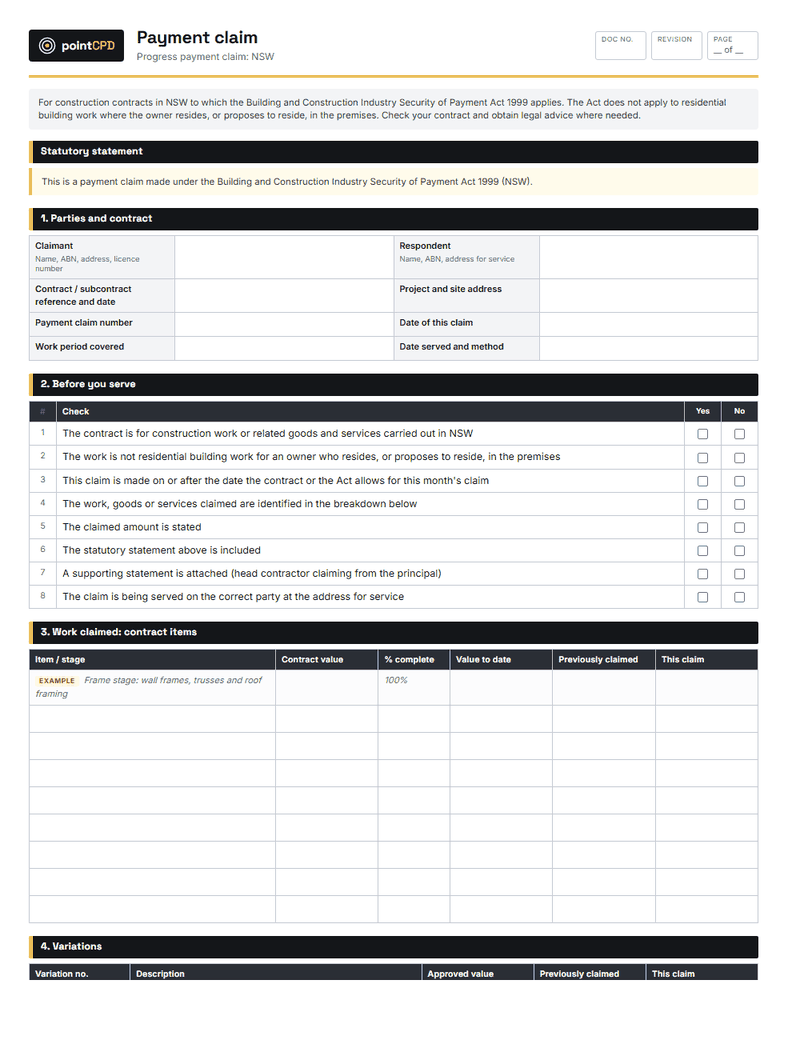
- Stage payments: fixed payments after specified stages of work are completed, as a specified amount or percentage of the contract price, with the stages described in clear, plain language.
- Cost-based payments: payments as work is performed and costs are incurred, which may include a margin, at intervals fixed by the contract or as invoiced, supported by invoices, receipts or other documentation.
- A combination of the two.
The NSW Government also tells owners to make sure progress payments are for work actually done, not time on the job, and that the dollar value placed on each stage is realistic. Front-loaded schedules, where early stages are priced well above the value of the work, are a red flag for regulators and a source of disputes, and they leave the owner exposed if the builder fails.
Price the stages honestly. A progress schedule that claims most of the contract price before the house is at lock-up may help cash flow in the short term, but it breaches the spirit of the rules, alarms informed clients, and is exactly what investigators look at when a builder collapses.
Cooling-off
For contracts over $20,000, the owner has a cooling-off period of five clear business days after being given a copy of the contract. The contract must state this clearly. Builders should not start work or order materials in a way that assumes the cooling-off period has passed.
Variations
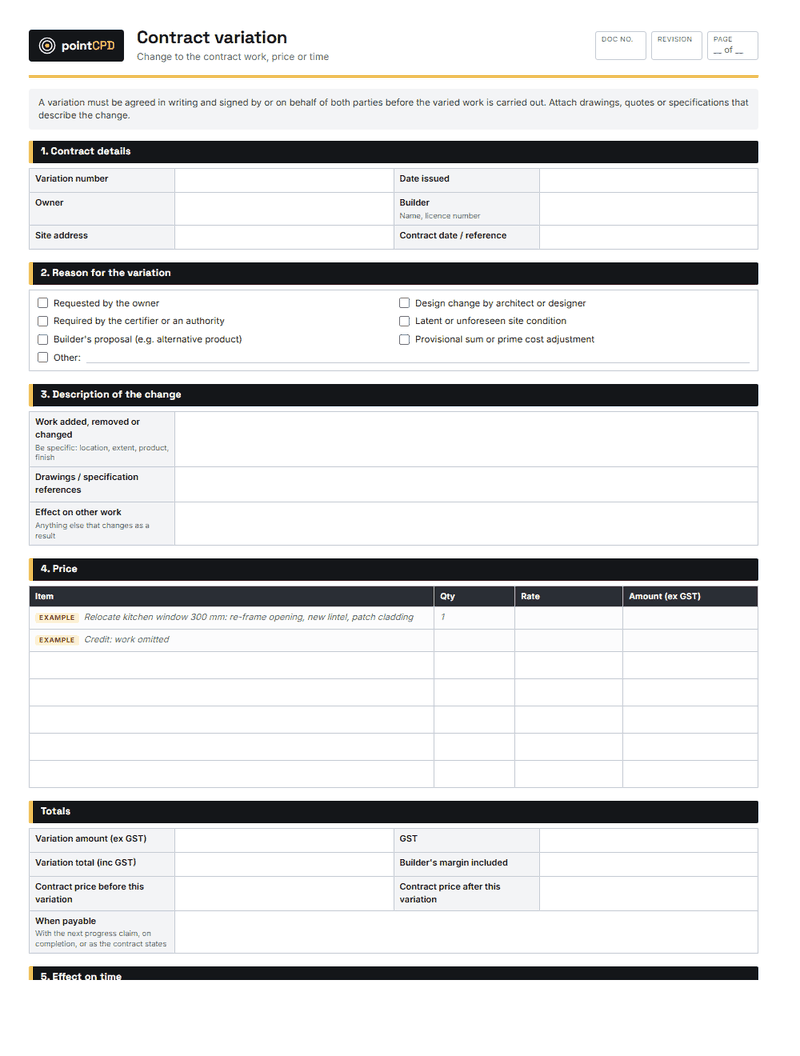
The contract must state that any agreement to vary the contract, or the plans and specifications, must be in writing and signed by both the owner and the contractor. The NSW Government also expects variations to explain their cost implications and effect on the contract price, with the calculation shown. A variation agreed verbally on site is a dispute waiting to happen.
Copies and timing
The builder must give the owner a copy of the signed contract within five business days of signing. Weekends, NSW public holidays and 27 to 31 December do not count. Keep a record of when and how the copy was given.
Statutory warranties
The Home Building Act implies statutory warranties into every contract for residential building work, whether or not they are written in. They include that the work will be done with due care and skill and in accordance with the plans and specifications, that materials will be good and suitable, that the work will comply with the law, and that the work will be done with due diligence and within the time stipulated or a reasonable time. The NSW Government states that a contractor is responsible for the work being free of major defects for six years after completion, and two years for other defects.
Licensing and insurance checks
Most residential work over $5,000 must be done by an appropriately licensed contractor, and the licence holder’s name and number must appear in the contract as they appear on the licence. The NSW Government encourages owners to check licences online, and owners increasingly do. For work over $20,000, owners are also told to check that the HBCF certificate is valid through the insurer or the HBC Check service. Make sure your details match exactly.
Common mistakes
- Using an interstate or generic contract that does not meet NSW requirements.
- Wrong legal name on the contract, such as a trading name instead of the licence holder’s name.
- Deposit above 10%, or a deposit taken before the HBCF certificate is provided.
- Progress stages that are vague or front-loaded, or tied to time rather than work.
- Price not on the first page, or provisional sums not explained.
- Missing checklist, cooling-off statement or Consumer Building Guide acknowledgment.
- Starting work before the contract is signed and the owner has had the cooling-off period.
- Verbal variations never documented.
Provisional sums and prime cost items
Many residential contracts include provisional sums, allowances for work that cannot be priced accurately yet, and prime cost items, allowances for items the owner has not yet selected. They are legitimate, but they must be handled carefully. The contract price on the first page must carry a warning and explanation if the price is subject to change, which provisional sums and prime cost items can cause. Set allowances at realistic levels, explain how they will be adjusted, including any margin on increases, and show the actual costs when they are reconciled. Low allowances used to make a quote look cheaper are one of the most common sources of disputes and complaints.
Owner-supplied items and owner builders
Where the owner supplies items, such as tapware or appliances, the contract should say so clearly and set out who is responsible for their suitability, delivery and installation. Owner builders are covered by different rules again, including their own permit requirements, and a builder contracting to an owner builder for part of the work should check what licensing, contract and insurance obligations apply to that arrangement.
Why it matters to builders
Compliant contracts are not just about avoiding penalties. They are the builder’s main protection when a client refuses to pay, disputes a variation, or makes a defect claim. A contract that meets the statutory requirements, with clear scope, compliant payment terms and signed variations, puts the builder in a strong position. A contract that does not can undermine the builder’s ability to recover money, even for work properly done.
Where to get a compliant contract
The NSW Government publishes sample home building contracts, and industry associations provide member contracts designed for NSW. Many builders use one of these as a base, with legal advice on any changes. If you change a standard contract, get advice first: small edits can have large consequences.
The bottom line
In NSW, the contract value decides the contract: written over $5,000, a small jobs contract to $20,000, a large jobs contract with HBCF cover above that. Cap the deposit at 10%, provide the insurance certificate first, tie progress payments to real work, state the cooling-off period, put the price on the first page, and put every variation in writing. Get those right and the contract works for you rather than against you.
Questions builders ask
When is a written contract required for building work in NSW?
When the contract price is over $5,000 including GST, or the price is unknown but the reasonable market cost of labour and materials is over $5,000.
What is the maximum deposit for building work in NSW?
10% of the contract price. For work over $20,000, the builder must provide a valid Home Building Compensation Fund certificate, and owners are advised not to pay the deposit until they have it.
Is there a cooling-off period for NSW building contracts?
Yes, for contracts over $20,000: five clear business days after the owner is given a copy of the contract.
How must progress payments be structured in NSW?
As fixed payments after specified stages described in plain language, as payments for work performed and costs incurred supported by documentation, or a combination. Payments should match work actually done, not time on the job.
What is the difference between a small jobs and large jobs contract?
A small jobs contract covers work between $5,000 and $20,000 and has basic required content. A large jobs contract covers work over $20,000 and has extensive requirements, including a checklist, cooling-off statement, compliant payment schedule and HBCF insurance.
Sources
- Contracts for home building work · NSW Government · 2026-04-29
- Ensure your new work remains trouble-free (defects and warranties) · NSW Government
Published 18 August 2026. General information for builders, not legal, financial or engineering advice for a specific job. Check current requirements with the relevant regulator or standard before relying on them.