Key takeaways
- A payment claim must identify the construction work or related goods and services, state the amount claimed, and be served on the respondent in the way the Act requires, or it will not start the statutory clock.
- Service is judged on when the claim was actually received, so the method must produce evidence of receipt, not merely evidence of sending.
- A respondent who fails to serve a payment schedule within the required period risks having the full claimed amount treated as owing, with limited grounds to resist later.
- Where the work is residential and the contract is with the homeowner, the claim is served on the homeowner and the dispute may go to the Civil and Administrative Tribunal rather than a court.
- Adjudication is a documents-based process decided on the material served within the statutory periods, so a builder who keeps poor records loses on the paperwork even when the work was done properly.
A progress claim on a residential job is usually the invoice the builder sends at the end of a stage. Under the NSW security of payment legislation, it can also be something more: a statutory payment claim that starts a clock running against the other party. Those are two different documents doing two different jobs, and if you want the protection the Act offers, the claim has to meet the requirements the Act sets out.
The distinction matters commercially because a statutory payment claim changes who carries the risk of delay. If the respondent does not answer it in the way and within the period the Act requires, the amount claimed can become the amount owing, with very limited grounds to resist it later. A builder who sends a well-drafted but non-compliant invoice gets none of that. A builder who sends a compliant payment claim, and can prove when it was received, has a route to enforcement that does not depend on the other party’s goodwill.
This article walks through the practical steps: what makes a claim valid, how to serve it, how the payment schedule works on the other side, and when the sensible move is to escalate to adjudication rather than keep chasing.
What the Security of Payment Act does and does not cover
The Building and Construction Industry Security of Payment Act 1999 (NSW) gives a person who has carried out construction work, or supplied related goods and services, a statutory entitlement to progress payments. That entitlement exists regardless of what the contract says about payment terms. The Act also sets out the process for making a claim, the process for responding to it, and a fast adjudication process for disputes about the amount.
What the Act does not do is decide the price. It does not rewrite your contract’s rates, and it does not create an entitlement to be paid for work you were not contracted to do. It operates on the amount properly attributable to the work under the contract. So a claim for work outside the contract, or for a variation that was never agreed or never documented, is vulnerable even if it is procedurally perfect.
On residential work there is an important structural point. Where the contract is with a homeowner rather than another contractor, the claim is served on the homeowner, and disputes about the amount are dealt with by the NSW Civil and Administrative Tribunal rather than the courts. The steps for making and serving the claim are the same, but the forum for enforcement is different, and builders who are used to commercial subcontract disputes often assume the wrong forum.
What makes a payment claim valid
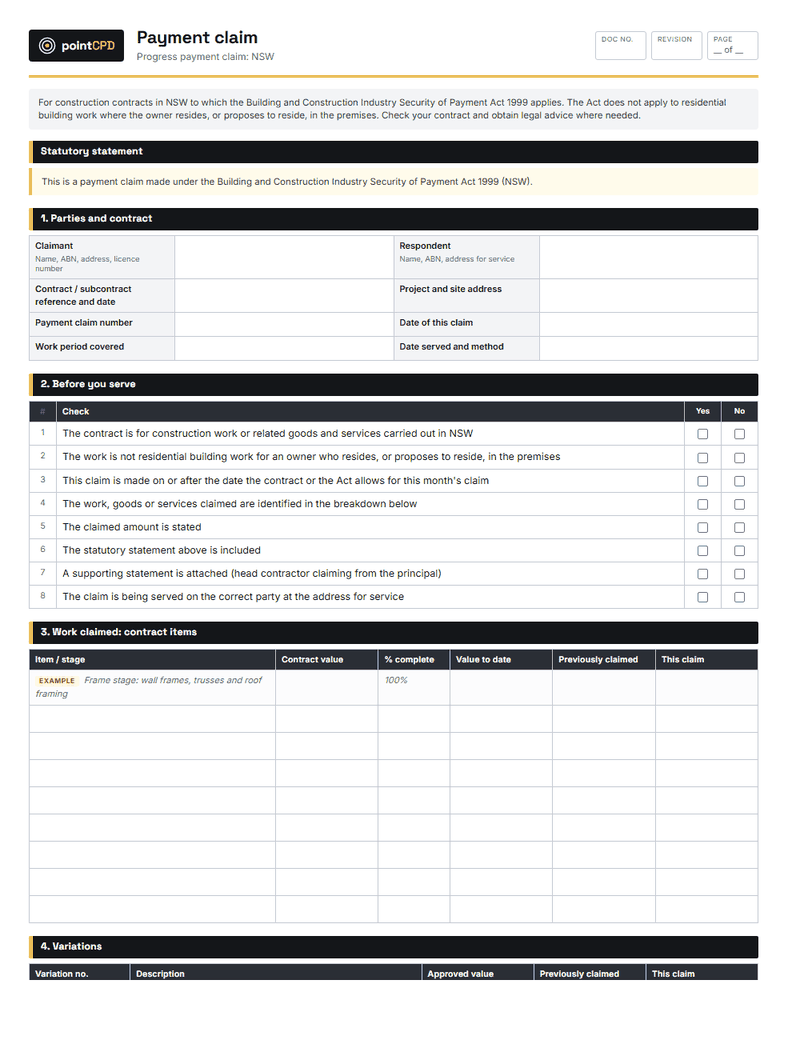
The Act requires a payment claim to identify the construction work or related goods and services to which the claim relates, and to state the amount claimed. It must also indicate the amount is claimed as a payment claim. If there is a written contract, the claim has to be made under that contract. If there is no written contract, it is made under the relevant construction work arrangement.
Those requirements are not decorative. A claim that describes the amount only as “balance outstanding” without identifying the work gives the respondent nothing to assess, and it is open to being treated as invalid. A claim that bundles unrelated jobs into one document, or that spans work under two different contracts, creates the same problem. The respondent has to be able to work out what is being claimed for what.
The reference date is the other technical hinge. A payment claim can only be made on or after the reference date for that claim. The reference date comes from the contract, or from the scheme in the Act where the contract does not set one. If you serve a claim before the reference date for that progress payment, it is not a valid payment claim for that period. Builders who invoice monthly out of habit, without checking what the contract says about when a progress payment falls due, can find that their claim was served too early and does not engage the Act at all.
The claim also has to be served on the right respondent. On a head contract that is the principal or the homeowner. On a subcontract it is the head contractor. Serving the claim on the site supervisor or the project manager personally, when they are not the contracting party, may not be service on the respondent at all.
Calculating the amount claimed
The amount claimed should be the amount properly attributable to the work done and materials supplied as at the reference date, less previous payments. That sounds straightforward, but most disputes that go to adjudication are not really about procedure. They are about what was actually done, what was actually agreed, and what the contract says is payable for it.
Practically, that means the claim should be backed by material you already have on site: the contract and any executed variations, the programme and site records showing progress, delivery dockets and supplier invoices for materials, and any directions from the principal or superintendent. If a variation was done on a verbal instruction, the claim for it is only as strong as the written record you created at the time. A later email reconstructing what was agreed months ago carries much less weight than a contemporaneous site instruction signed by the person who gave it.
Do not inflate the claim to create negotiating room. An adjudicator decides the amount payable on the material served, and a claim that is significantly overstated damages the credibility of the whole document. It also gives the respondent an easy answer on the parts that are exaggerated, which tends to drag down the parts that were solid.
Serving the claim, and why the method is the whole game
The statutory periods run from when the payment claim is served, so service is not an administrative detail — it is the fact that starts everything else. The Act allows service in the way the contract provides for, or in a way permitted by the Act where the contract is silent or the contractual method does not work.
What you need is evidence of receipt, not evidence of sending. A posted letter with no tracking proves you sent something; it does not prove it arrived. A tracked courier delivery with a signature or a delivery confirmation is much stronger. Hand delivery with the recipient signing and dating a copy is stronger again. Email can be effective, but only if you can show the address was the respondent’s and that the message was actually delivered and received — a sent-folder entry alone is weak.
Keep the exact document you served. Not the draft, not the version in your accounting software, but the final document as served, with its attachments. If the validity of the claim is ever challenged, that copy is the evidence.
The mistake that costs the most. Serving a claim by a method that produces no proof of receipt, then assuming the statutory clock has started. If the respondent later says it never received the claim, you have no way to prove the date, no default entitlement, and you are back to an ordinary contractual debt claim — with the delay and cost that involves.
Preparing and serving a statutory payment claim
- 1Confirm the contract positionIdentify the contract or the relevant construction work, the reference date for the claim, and which party is the respondent.
- 2Calculate the amount claimedAssemble the work done, the materials supplied, and any variation you are entitled to claim at that date.
- 3Write the claim so it identifies itself as a payment claimState the construction work or related goods and services, the amount claimed, and any supporting detail the contract or the Act requires.
- 4Serve it on the respondentUse a method that gives you evidence the respondent actually received it, not just that you sent it.
- 5Record the date of receiptThe statutory periods run from receipt, so the date the claim landed is the date that matters.
- 6Diarise the payment schedule deadlineKnow the date by which a payment schedule is due, because what happens after that determines your options.
The payment schedule: what the other side must do
Once a valid payment claim is served, the respondent has a choice. It can pay the claimed amount in full by the due date, or it can serve a payment schedule. A payment schedule must identify the payment claim it responds to and state the amount the respondent proposes to pay, and if that amount is less than the amount claimed, it must say why.
The schedule has to be served within the period set out in the Act, which is measured from receipt of the claim. That period is short, and it is not extended by the respondent being busy, on leave, or waiting on advice. If no payment schedule is served in time, the respondent becomes liable for the full claimed amount, and the builder can move to enforce it. The grounds on which the respondent can resist enforcement at that point are narrow.
This is why the claim itself has to be clean. A vague claim invites a vague schedule, and a vague schedule is often enough to push the dispute into adjudication, where the builder has to prove the amount claimed on the documents. The stronger and more specific the claim, the harder it is to answer with a general denial.
If a payment schedule is served for less than the full amount, the difference is disputed. The respondent must pay the scheduled amount by the due date. The unpaid balance is what can be taken to adjudication.
When to escalate to adjudication, and when not to
Adjudication is a fast, documents-based process. An adjudicator is appointed, the parties exchange submissions within short statutory periods, and the adjudicator determines the amount payable. It is not a court hearing and there is generally no oral evidence. Whoever has the better paper case usually wins, which is a strong argument for keeping site records in a form you can hand over at short notice.
Escalate when the amount in dispute justifies the cost and effort, when your documentation is strong, and when the relationship is already effectively over or the respondent is using delay as a tactic. Adjudication is particularly effective where the respondent has failed to serve a payment schedule at all, because the default position is heavily in the claimant’s favour.
Do not escalate reflexively. If the disputed amount is small relative to the cost of running the process, or if your records for the disputed items are thin, adjudication may produce a determination that is worse than the negotiated outcome you could have reached. It also tends to end the working relationship, which matters if you want more work from that builder or developer.
One point builders regularly get wrong: the statutory entitlement to progress payments sits alongside your contractual rights, it does not replace them. You can still pursue a debt under the contract. What the Act gives you is a faster route to an enforceable determination for the amount properly payable.
Before you serve the claim
- Does the claim clearly identify the construction work or related goods and services it relates to?
- Does it state the amount claimed and how that amount was calculated?
- Does it identify the contract, or if there is no written contract, the arrangement under which the work was done?
- Is it being served on the correct respondent for that contract?
- Is the method of service one that will produce evidence of receipt, such as hand delivery with a signed receipt or a tracked delivery method?
- Have you kept a copy of exactly what was served, not just a draft?
- Have you recorded the date the claim was received, and diarised the date a payment schedule is due?
Record keeping that decides the outcome
Adjudication is decided on documents, so the quality of your records is the quality of your case. The records that matter are the ones that show what was agreed, what was directed, what was done, and when. That means the executed contract and all variations, the programme, daily site records, inspection and compliance documentation, delivery dockets, and correspondence about delays and directions.
Site diaries are the most under-used record in residential work. A short, consistent daily entry recording the trades on site, the work completed, the weather, and any instruction given or received will do more for a disputed claim than a folder of photographs taken at random. If you want a starting point for the safety paperwork that sits alongside this, our article on the SWMS template for residential builders in NSW covers what a site-specific safe work method statement needs to contain.
Keep the records for the period the contract and the Act require. Records that are archived, lost, or held only on a former employee’s laptop are worth nothing when a dispute starts.
Worked example: a stage claim that stalled
A builder in western Sydney was contracted to a homeowner for an alteration and addition. The contract set out progress payments at defined stages. At the frame stage, the builder emailed an invoice to the homeowner, attached a summary of the work, and asked for payment within the contract period. The homeowner did not pay and did not respond.
The builder chased by phone and email for several weeks, then sought advice. The problem was not the work or the amount. The invoice did not identify itself as a payment claim, and the email had gone to an address the homeowner rarely used and which the builder could not prove was monitored. There was no evidence of receipt on a date the builder could point to, so the statutory clock had arguably never started, and the builder had no default entitlement to rely on.
The fix was to prepare a proper payment claim for the frame stage work, identifying the contract, the work, and the amount claimed, and to serve it by a method that produced a signed receipt. Once served, the homeowner had a short period to pay or serve a payment schedule. No schedule came. The builder then had a statutory basis to pursue the amount, which was resolved before it needed to go further.
The lesson is not that the original invoice was dishonest or unreasonable. It is that the builder assumed the paperwork was a formality and lost the statutory protection that would have made the dispute short. The same work, the same amount, and the same contract produced two very different outcomes depending on how the claim was prepared and served.
Where this fits in your business systems
Most builders who get caught do not have a legal problem. They have a systems problem: claims are raised by whoever does the accounts, on a monthly cycle, using a template that was never checked against the Act. The fix is to build the requirements into the process so they are not left to memory under pressure.
Set up a claim template that includes the identifying details, the amount, and the calculation, and that cannot be sent without those fields completed. Set up a service method that always produces proof of receipt. Diarise the payment schedule deadline the moment the claim is served, so a silent respondent is identified early rather than months later. Keep the claim and the service evidence together in the job file.
If you are a licensed builder or site supervisor in NSW, this is the kind of contract and payment material that sits inside your continuing professional development obligations. Our guide to how NSW builder CPD works explains the categories and the record-keeping that applies to your licence, and the course catalogue lists the business and contract units that cover payment and dispute processes in more depth. If you want to start with a working document rather than theory, the free payment claim template gives you the structure to adapt to your own contracts.
None of this replaces advice on a specific dispute. The Act is technical, the periods are short, and the consequences of getting service wrong are severe. Where the amount is significant, get advice before you serve, not after the deadline has passed. For a broader look at how documentation quality affects the rest of a residential job, our article on strip footings and pad footings in residential NSW covers the inspection and record points that come up on the structural side of the same projects.
Questions builders ask
What has to be in a payment claim for it to be valid in NSW?
It must identify the construction work or related goods and services it relates to, state the amount claimed, and indicate that the amount is claimed as a payment claim. It also has to be made under the contract where there is a written contract. If any of those elements are missing, the claim may not engage the Act at all.
How do I serve a payment claim so the clock actually starts?
Use a method the contract allows, or one permitted by the Act, that produces evidence the respondent received the claim. Hand delivery with a signed and dated copy, or a tracked delivery with confirmation, is stronger than an untracked letter or an email you cannot prove was received. The statutory periods run from receipt, so the date of receipt is the fact you need to be able to prove.
What happens if the other party does not serve a payment schedule?
If a valid payment claim is served and no payment schedule is served within the period the Act requires, the respondent becomes liable for the full amount claimed. The builder can then take steps to enforce that amount, and the grounds on which the respondent can resist are narrow. This is why the validity of the claim and proof of service matter so much.
Can I take a residential homeowner to adjudication?
Where the contract is with a homeowner rather than another contractor, the claim is served on the homeowner, but disputes about the amount are dealt with by the NSW Civil and Administrative Tribunal rather than through the same route as commercial disputes. The steps for preparing and serving the claim are the same, but the forum for enforcement differs.
When should I go to adjudication instead of negotiating?
Adjudication suits cases where the disputed amount justifies the cost, your documentation is strong, and the relationship is effectively over or the other party is using delay as a tactic. It is especially effective where no payment schedule was served. Where the amount is small or your records for the disputed items are thin, a negotiated outcome is usually better.
What records do I need if a claim ends up in adjudication?
The process is decided on documents, so you need the executed contract and variations, the programme, daily site records, delivery dockets and supplier invoices, and correspondence about instructions and delays. Consistent site diaries are particularly valuable. Records that are archived or lost are worth nothing once a dispute starts.
Sources
- Making a payment claim under Security of Payment laws · NSW Government
- About Security of Payment for construction contractors · NSW Government
- Building and Construction Industry Security of Payment Act 1999 (NSW) · NSW Legislation
- Contracts for home building work · NSW Government · 2026-04-29
Published 21 June 2026. General information for builders, not legal, financial or engineering advice for a specific job. Check current requirements with the relevant regulator or standard before relying on them.