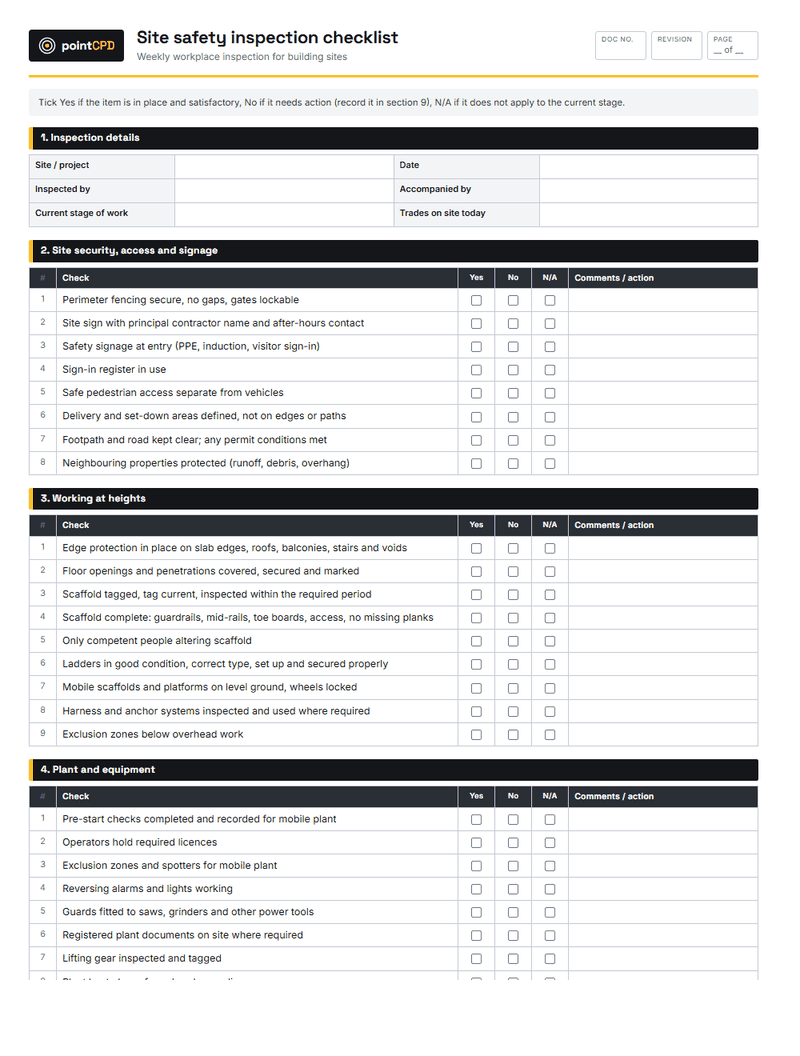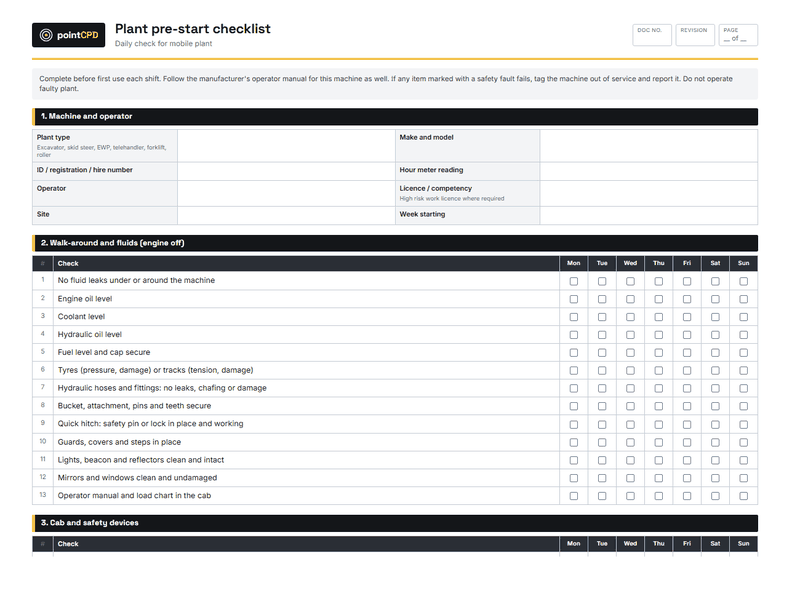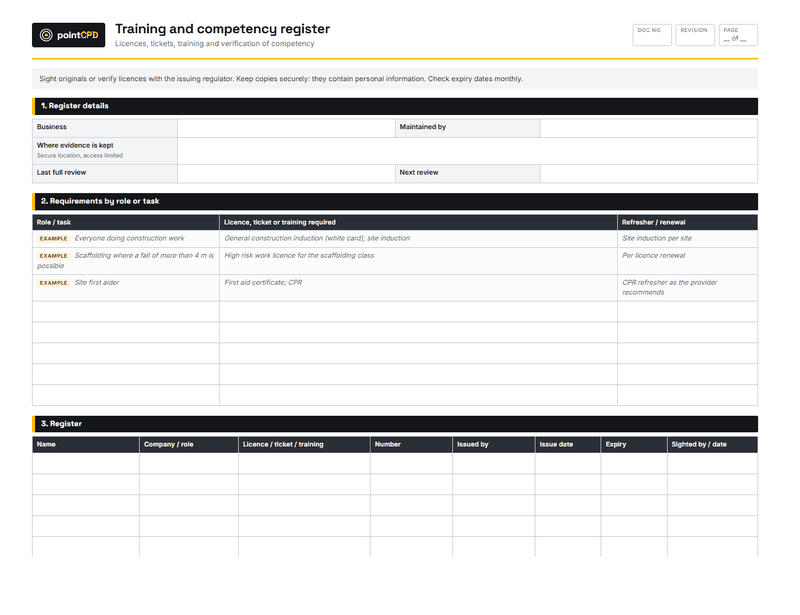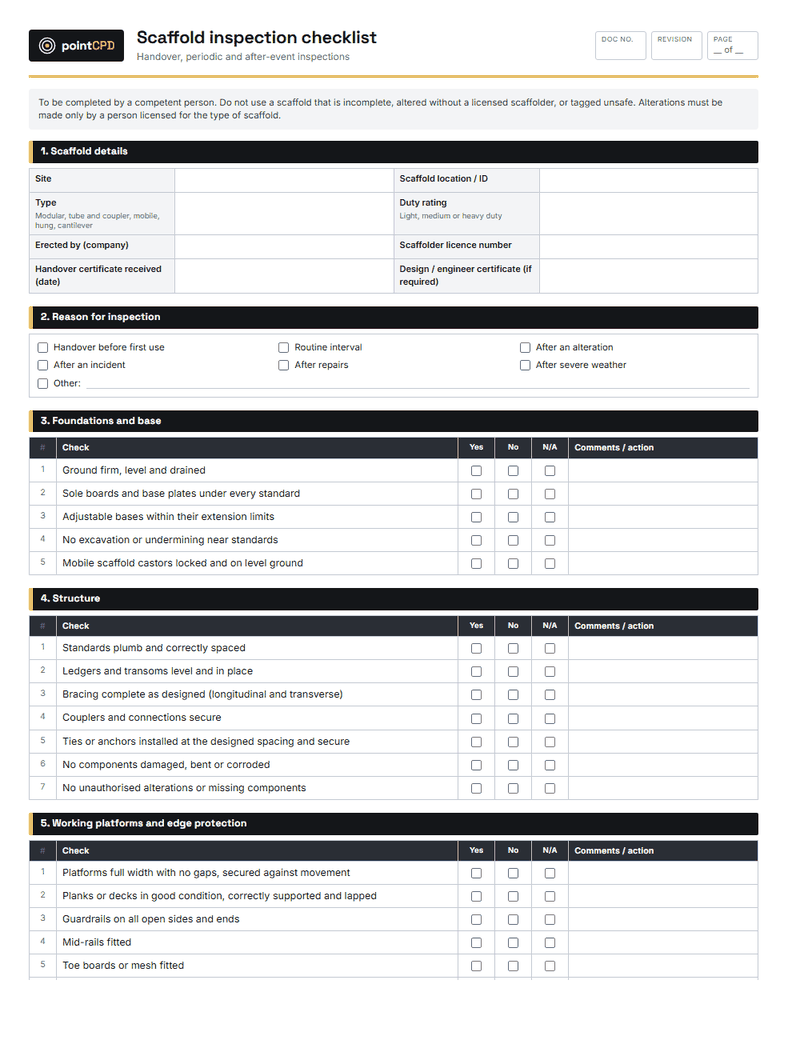
Scaffold falls on residential sites almost never involve a scaffold that was badly erected. They involve a scaffold that was fine at handover and then changed: a plank lifted for a downpipe, a guardrail removed to pass up materials, a tie taken off for the render, the ground washed out after rain. Regular recorded inspections catch those changes. This template covers the handover check, periodic and after-event inspections, and the register.
The rules in plain terms
Under the model WHS Regulations, a scaffold must not be used until a competent person has inspected it and the business receives written confirmation that it is complete. After that, it must be inspected by a competent person:
- before use after an incident that may have affected its stability;
- before use after repairs; and
- at least every 30 days.
If an inspection shows a risk, the scaffold must not be used until it is repaired and re-inspected, and access must be prevented in the meantime. Scaffolding work where a person or object could fall more than 4 metres must be done by a person with the right high risk work licence. Check your state regulator for any local variation.
What competent inspection looks like
The checklist works from the ground up, the way a scaffolder would look at it. The faults that cause serious incidents cluster in a few places:
| Area | Common serious fault |
|---|---|
| Base | Soft or washed-out ground; a trench dug beside the standards after erection |
| Ties | Ties removed by other trades for cladding, render or windows, and never replaced |
| Platforms | Planks lifted or gaps left for services; platforms overloaded with bricks or tiles |
| Edge protection | Guardrails or toe boards removed to pass materials up |
| Surroundings | Scaffold erected or extended near overhead powerlines; no protection for people below |
The tag system
A tag at every access point shows at a glance whether the scaffold can be used, its duty rating, and when and by whom it was last inspected. The inspector updates it every time. Everyone on site should know the rule from the induction: no current tag, no use; and no alterations except by the scaffolder.
After weather and incidents
Strong wind and heavy rain are the most common after-event triggers on a residential site. Wind loads scaffold with containment mesh or shade cloth heavily, and rain undermines base plates on clay or fill. Inspect before anyone goes back up. The same applies after any impact from plant or a delivery truck.
Mobile scaffolds
Mobile scaffolds bring their own hazards: overturning when moved with people or materials on them, being set up on sloping or soft ground, and castors left unlocked. Set up to the manufacturer’s instructions, check the base before each use, and never move them with anyone on the platform.
Keeping the register
The register at the end of the template is the scaffold’s history. It shows the handover, every inspection, every result and who did it. If a regulator asks when a scaffold was last inspected, or an incident happens, the register is the answer. Check it during the weekly site safety inspection, and make sure the SWMS for work from the scaffold refers to it.
Who does what on a residential scaffold
| Party | Responsibility |
|---|---|
| Scaffolding contractor | Design or selection, erection, alteration and dismantling by licensed scaffolders; handover certificate; the tag |
| Builder / principal contractor | Arranging inspections, controlling access, stopping unauthorised alterations, protecting the scaffold from plant and excavation, acting on defects |
| Trades using it | Checking the tag before use, not overloading platforms, not altering anything, reporting damage |
Problems usually start at the boundaries: a trade needs a plank moved for a downpipe, the scaffolder is not due back for a week, and someone decides to do it themselves. Build in a way to get alterations done quickly by the scaffolder, and the temptation goes away.
Hire contracts and handover
Most residential scaffold is hired with erection and dismantling included. Read the hire terms for inspection responsibilities: some include periodic inspections by the scaffolder, others leave them to the builder. Either way, the builder must be satisfied that inspections happen at the required intervals and after any event that could affect the scaffold. At handover, get the written confirmation that the scaffold is complete, check the tag, and walk it before the first trade goes up. When the scaffold is modified for a new stage, such as lifting a level or removing a section for roofing, treat it as a new handover.