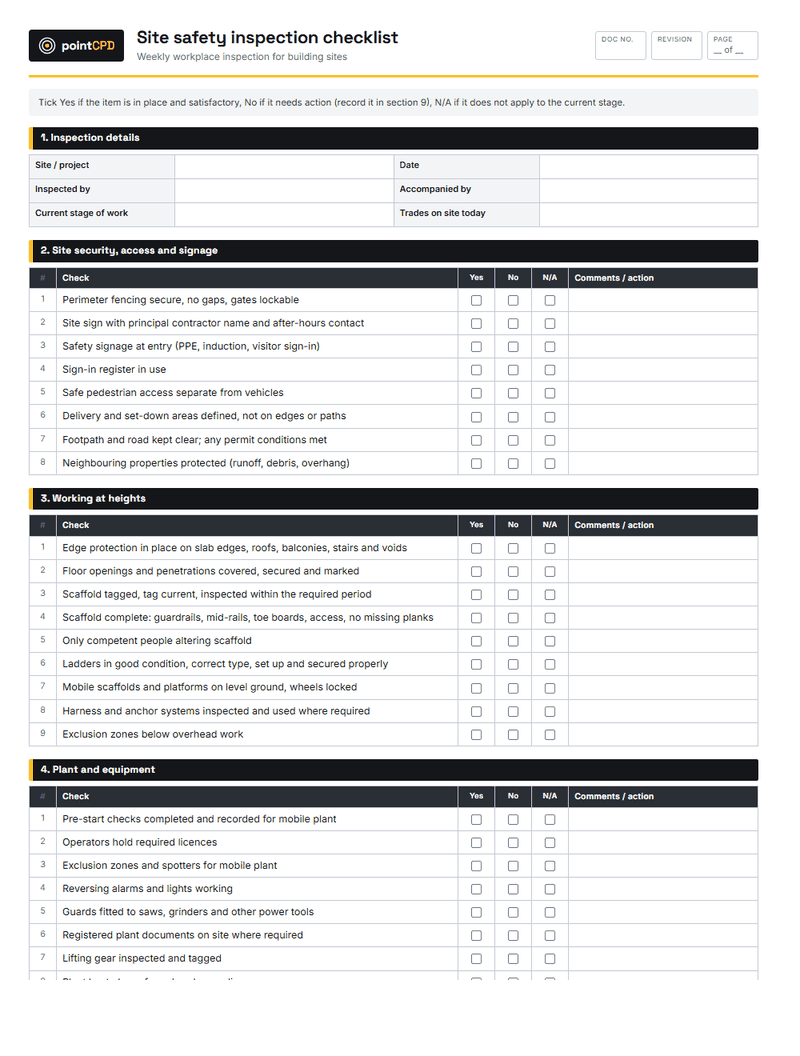
A weekly site inspection is the supervisor’s best defence against the slow drift that turns a safe site into an unsafe one: a guardrail removed for a delivery and never replaced, a lead that has been run through water all week, a trench that has been sitting open since the rain. This checklist walks the site in a fixed order, from the gate to the amenities, so nothing is skipped.
Why a recorded inspection matters
WHS laws require businesses not only to put controls in place but to maintain them and review them when they are not working. Controls on a building site degrade daily: people move barriers, trades change, weather undoes last week’s work. A regular inspection, written down, is how a business shows it is monitoring its controls rather than assuming they are still there.
How to walk a site
- Same order every time. The checklist starts at the gate and works inwards. Habit is what stops you skipping a section on a busy day.
- Look at what is there today. Not what was there last week, and not what the SWMS says should be there.
- Bring someone. The HSR or a leading hand sees things you do not, and it counts as consultation.
- Photograph failed items. It helps the fix and it is evidence of what you found.
- Stop work where you need to. An open void with trades working is not a note for next week.
What the checklist covers
| Section | What you are looking for |
|---|---|
| Security and access | Fencing, signage, pedestrian routes, deliveries, the public and neighbours |
| Working at heights | Edge protection, voids and penetrations, scaffold tags and completeness, ladders and platforms |
| Plant | Pre-starts, licences, exclusion zones, guards, lifting gear, powerlines |
| Electrical | Switchboard, RCDs, test tags, lead management, services |
| Excavations | Services located, shoring or batters, spoil, barriers, access |
| Health and housekeeping | Dust, asbestos, chemicals, noise, heat, clear paths, sharp edges, waste, stacking |
| First aid and amenities | Kit, first aider, emergency plan, extinguishers, toilets, water, SWMS and inductions |
The items that fail most often on residential sites
In practice, the same few items account for most failures: edge protection removed and not replaced, stair voids left open between trades, extension leads on the ground in wet areas, test tags out of date, fibre cement or masonry cut dry in the open, and materials dropped on the slab edge by delivery drivers. If your inspections keep finding the same item, the control is wrong, not just the behaviour. Change the system: a designated set-down area, a lead stand, a cutting station with extraction.
Actions: the part that makes it worthwhile
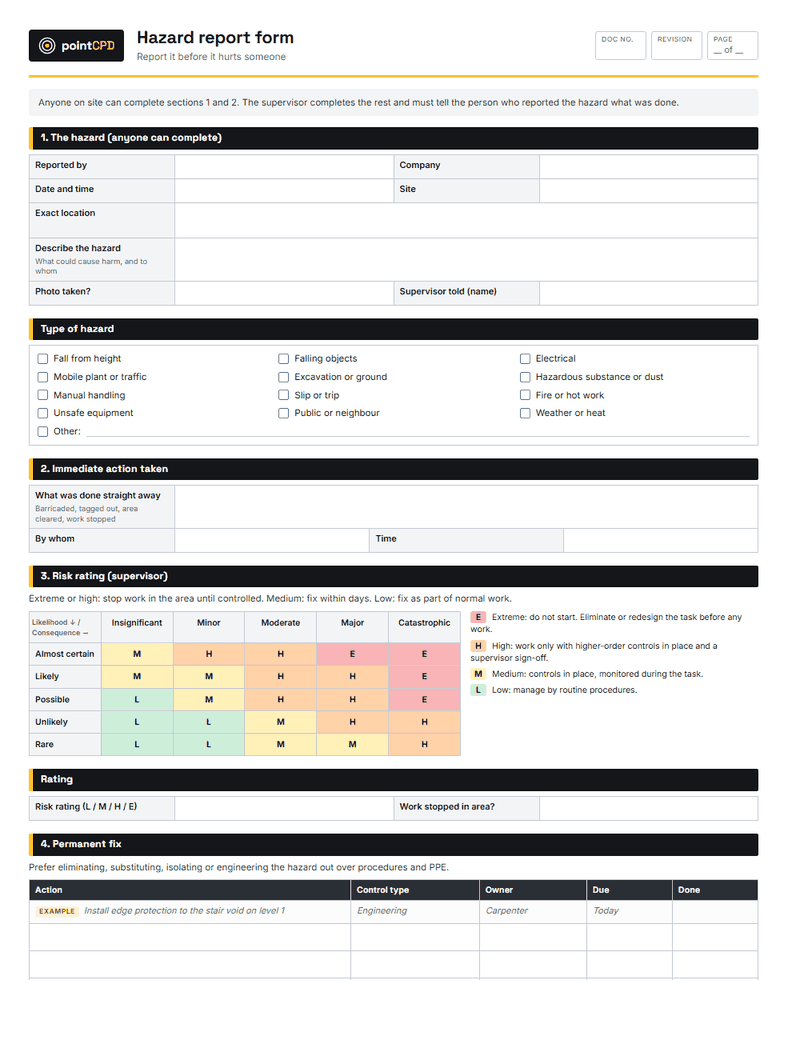
A checklist full of ticks with no actions either means a perfect site or an inspection that was not really done. Section 9 records every failed item with an action, a risk rating, an owner and a date. The sign-off asks whether last week’s actions were closed, so each inspection starts by checking the previous one. Hazards that need more than a quick fix go on a hazard report.
Items with their own inspection rules
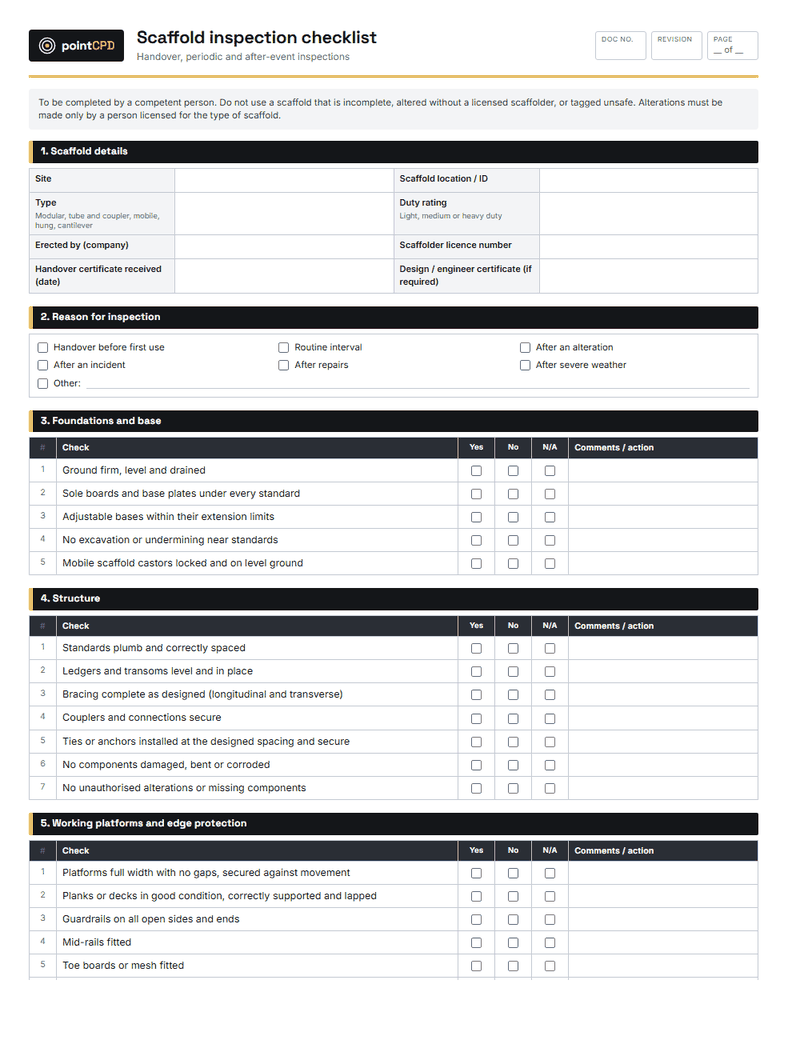
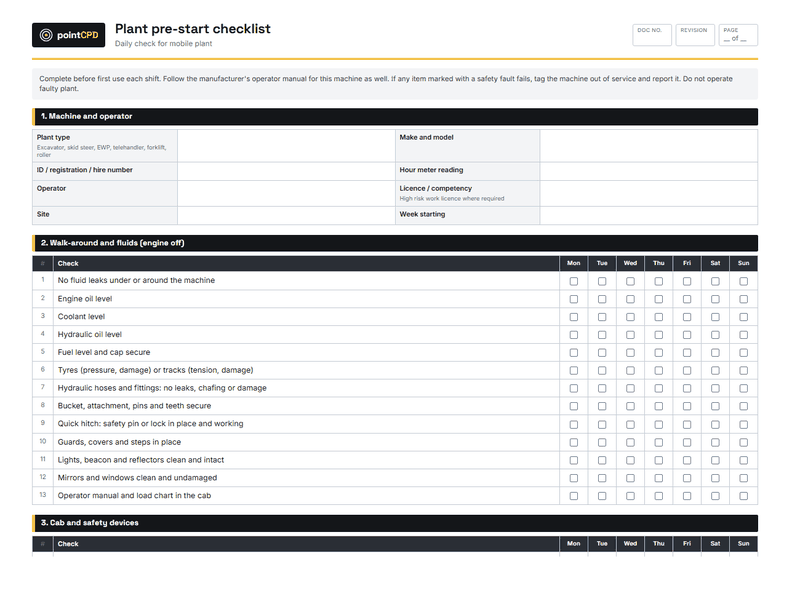
Some things need more than a weekly walk-past. Scaffold must be inspected by a competent person at set intervals and after events that could affect it; use the scaffold inspection checklist for that. Mobile plant needs a pre-start check each shift; use the plant pre-start checklist. The weekly inspection checks those records exist and are current.
Daily checks and weekly inspections
A weekly recorded inspection does not replace the supervisor’s daily look around. The two do different jobs:
| Daily walk-around | Weekly inspection | |
|---|---|---|
| Purpose | Catch today’s changes: removed barriers, new trades, weather damage | Systematic check of every control, with a record and actions |
| Time | Ten minutes at start of day | Thirty to sixty minutes, with a colleague |
| Record | Site diary note; issues fixed on the spot | This checklist, with the actions register |
The daily check is where most problems are fixed. The weekly inspection is where patterns are found and where the business can show it is monitoring controls over time.
Preparing for a regulator visit
Inspectors from the state WHS regulator visit residential sites, sometimes as part of targeted campaigns on falls, silica or electrical safety. A site that runs regular inspections is usually in good shape when they arrive, because the things they look at are the same things on this checklist: edge protection and scaffold, electrical leads and switchboards, dust control, amenities, and whether SWMS exist for high-risk work and match what is happening. They will also ask for records. Being able to show the last few weekly inspections, with actions closed, demonstrates that safety is managed rather than improvised on the day of the visit.
If an inspector issues a notice, comply with it, fix the issue and record what was done. Use the inspection checklist to check the same issue does not reappear on other sites.