Key takeaways
- Site establishment covers the physical setup of the site and the services it needs before construction begins, including access, sediment and erosion control, temporary power and water, amenities and setout.
- Underground service location through Before You Dig Australia should be lodged before any excavation or penetration, because the plans show what is recorded rather than what is actually in the ground.
- Sediment and erosion controls are installed during establishment, before soil is exposed, and the controls need to be maintained and reinstated as the job progresses.
- Temporary services and amenities are cheaper to plan on paper than to retrofit, because relocating a temporary supply or a toilet mid-programme disrupts trades and can breach the contract with the subcontractor.
- Establishment is also the point where the builder confirms who is the principal contractor, what is recorded on the site notice, and what payment reporting obligations apply to subcontractors.
Site establishment is the work you do before the first trade arrives. It covers the physical setup of the site — access, ground protection, sediment and erosion controls, amenities, setout — and the services the site needs to run: temporary power, water, waste collection, communications, and the underground service information that tells you what you are about to dig into.
It is easy to treat establishment as a day of housekeeping. In practice it sets the cost and the programme of everything that follows. A site with a properly formed entry, a stable turning area and services located before excavation runs faster, generates fewer variations, and causes fewer disputes with subbies who turn up to a site that does not work.
This article deals with the physical and services side of establishment. Traffic management plans and inspection stage requirements are dealt with elsewhere; the point here is what you physically put in place, and in what order, before construction starts.
Why establishment is a commercial decision, not just a site task
Every dollar spent on establishment is spent before there is any product to sell, which is why it is the first thing cut when a programme is tight. The saving is usually illusory. If the access route is not protected, the first delivery truck cuts it up and you are repairing the entry while trying to pour a slab. If sediment controls go in after the ground is opened up, the first rain event sends soil into the street and you are cleaning out stormwater pits at your own cost.
Establishment also determines how easily trades can work. A site with a defined entry, a stable hardstand and power where the work is happening will get more productive hours out of every subbie. A site where the electrician has to run a lead from the front fence to the back corner loses time every single day. Those losses do not appear as a line item; they appear as a programme that quietly slips. The scheduling decisions behind that are worth understanding in more depth in our article on construction programme scheduling basics.
There is a compliance side too. Establishment is when the builder confirms who is the principal contractor, what signage is displayed, and how the site will be supervised. It is also when you confirm your payment reporting position: payments to contractors in the building and construction industry may fall within the taxable payments annual report system, so it is worth confirming your obligations through the ATO guidance on building and construction services before the first subcontractor invoice arrives, not after.
Access, entry and ground protection
The entry point is the first decision, because everything else is arranged around it. Decide where vehicles enter and leave, where they turn, where they park, where materials are dropped, and where the skip sits. Then protect that route. A compacted crushed-rock pad over a geotextile layer costs far less than repairing a rutted entry in the middle of a wet week.
Access also determines what can be delivered and when. A crane truck, a concrete agitator and a plasterboard delivery all have different turning requirements, and all of them will arrive at the worst possible moment if the site has not been set up for them. Walk the route yourself before the first delivery.
If the site fronts a busy road, the access arrangement may need to be co-ordinated with the relevant authority, and the requirements can differ from one council area to the next. Confirm what applies to your site rather than assuming a standard arrangement carries across.
Establishment sequence before trades arrive
- 1Confirm access and set the entry pointDecide where vehicles enter, where they turn and where they park, and protect that route before it is cut up.
- 2Locate services undergroundLodge the enquiry through Before You Dig Australia and pothole where the response indicates a conflict before excavating.
- 3Install sediment and erosion controlsPut controls in before soil is exposed, not after the first rain event.
- 4Set up temporary services and amenitiesArrange power, water, amenities and waste collection so they serve the whole build, not just the first stage.
- 5Set out the buildingConfirm boundaries, levels and the position of the structure against the approved documents before excavation.
- 6Establish the site notice and recordsDisplay the required signage and start the site diary and records that will run for the whole job.
Locating services before you dig
The single most expensive establishment mistake is hitting an underground service. Before any excavation or penetration, lodge an enquiry through Before You Dig Australia, which co-ordinates the response from asset owners. The Before You Dig Australia service is free, and the plans it returns are an indicator of what is recorded, not a guarantee of what is in the ground.
That distinction matters. Recorded plans can be inaccurate, incomplete or out of date, and private services on the block — a water line to a garden tap, an old sewer connection, a buried electrical feed to a shed — may not be recorded at all. Where the response shows a conflict with your works, pothole by hand to confirm the actual position before machine excavation. On a knockdown-rebuild, treat every service on the block as live until proven otherwise.
Service location is also a scheduling input. If a service needs to be relocated or protected, that work has a lead time and it sits on the critical path before the excavation crew arrives. Discovering it on the morning of the dig is how a one-day excavation becomes a week of standing around.
Sediment and erosion control from day one
Sediment and erosion controls are installed during establishment, before soil is exposed. The logic is simple: once ground is disturbed, rain will move soil, and soil that leaves the site ends up in the street, the gutter or the stormwater system. Cleaning that up is the builder’s problem, and it can attract attention from the council at exactly the wrong time.
Controls typically include sediment fencing downslope of the disturbed area, a stabilised entry point so trucks do not track mud onto the road, and stockpile management so spoil does not sit in the flow path. They need maintenance, not just installation. A sediment fence that has been driven over by a delivery truck is not a control. Build a weekly check into the site routine and reinstate controls as the job progresses, because the areas of disturbance change as the build moves.
On flood-affected land the picture is more complicated. Where a site sits in a floodplain, the way runoff and floodwater behave is dealt with in the NSW flood risk management framework, and the NSW flood risk management manual sets out the approach used for floodplain management. If your site is in a flood planning area, confirm the conditions that apply to your development before you set up, because they can affect levels, fill and drainage.
Temporary services, amenities and site facilities
Temporary services are where good intentions most often meet reality. Power, water, amenities, waste collection and communications all need to serve the whole build, and all of them are more expensive to move than to position correctly the first time.
Decide where the temporary supply point sits relative to where the work will actually happen, and allow for the fact that the work moves. A temporary distribution board at the front of the block is convenient on day one and useless by the time the fitout trades arrive. Water needs to be available for concrete works, cleaning and dust suppression, which means a tap position that a hose can actually reach.
Amenities are a compliance item, not a convenience. Toilets, washing facilities and a place to sit and eat need to be provided for the workforce, and their position affects how much time is lost walking to them. Getting the position wrong also affects subcontractor relationships: a subbie who has to walk a long way to a facility will find reasons not to be on your site. The practicalities of positioning site facilities are covered in our article on site data plans and toilet location.
Waste collection should be arranged during establishment, with a skip position that a truck can service without blocking the street or the entry. Communications matter more than they used to: an increasing number of site processes depend on a phone signal and a data connection, and a site with no coverage is a site where information moves slowly.
Pre-start site checks
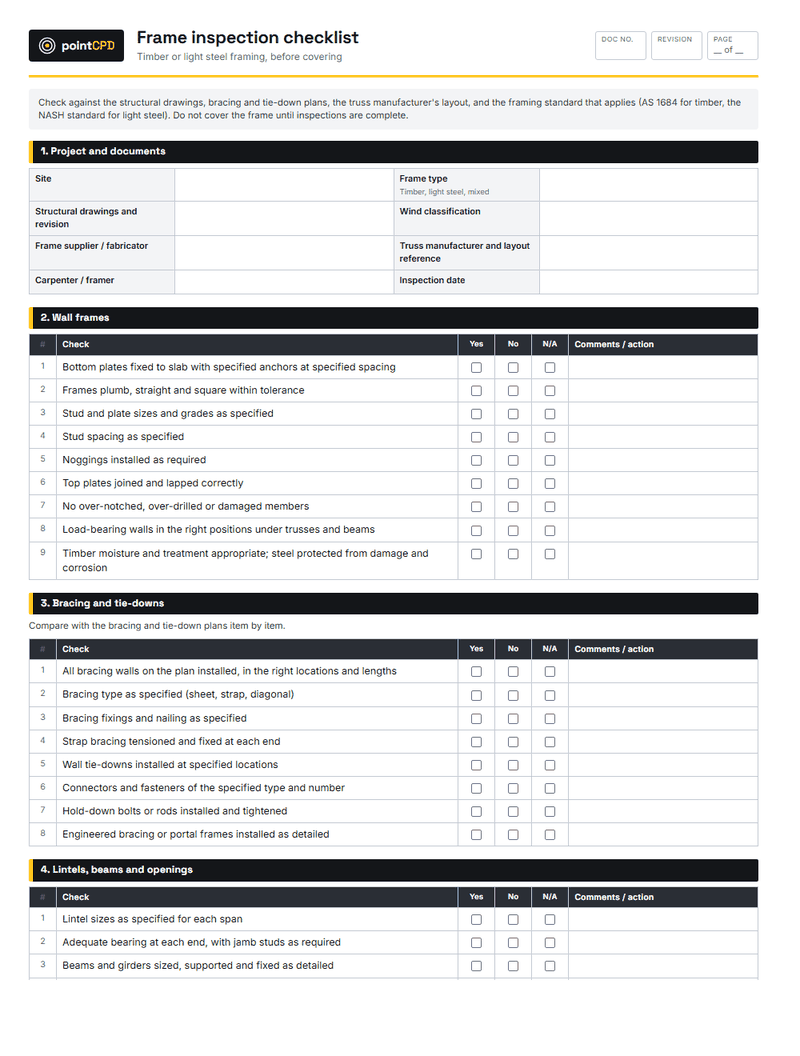
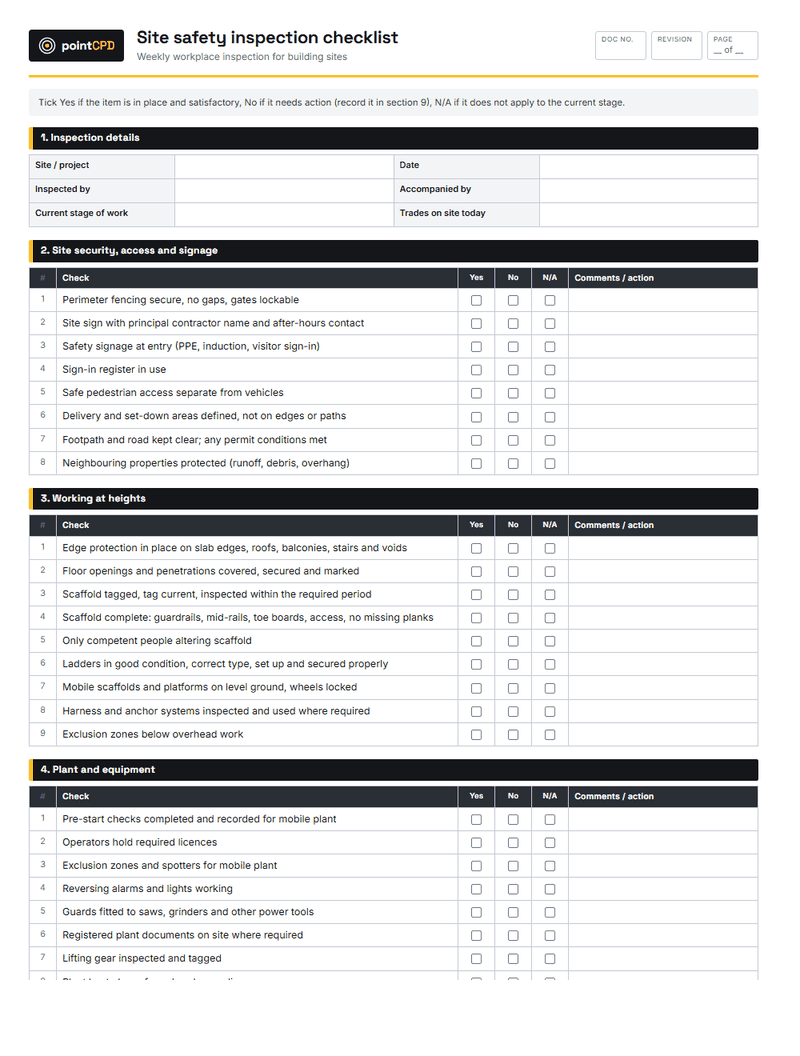
- Access route and turning area confirmed and protected
- Underground service enquiry lodged and responses reviewed
- Sediment and erosion controls installed before ground disturbance
- Temporary power, water and amenities positioned for the whole build
- Site notice and required signage displayed
- Setout confirmed against approved plans and survey information
- Site diary and record-keeping started
Setout, levels and confirming what you are building
Setout happens during establishment and it is the point of no return for the position of the building. Before excavation, confirm the boundaries, the levels and the position of the structure against the approved documents. If a survey is required, arrange it early; surveyors are busy and a delay in setout delays everything downstream.
Boundary identification deserves particular care on tight urban blocks. A fence line is not evidence of a boundary. If there is any doubt about where the boundary sits, resolve it before you set the building out, because moving a structure after excavation is an order of magnitude more expensive than moving it on paper.
Levels need the same treatment. Confirm the relationship between the finished floor level, the existing ground and the street, and check that the drainage strategy actually works at the levels shown. A discrepancy picked up at setout is a variation to a design; the same discrepancy picked up after the slab is poured is a problem with no cheap solution.
Signage, supervision and the records you start now
Establishment is when the site notice goes up and when the record-keeping starts. The site notice identifies the project and the principal contractor, and it is the first thing an inspector looks for. Display the signage your project requires, and keep it legible and current throughout the build.
The site diary starts on day one, not on the day something goes wrong. Record deliveries, weather, visitors, instructions, delays and anything that might later be relevant to an extension of time or a variation. On a residential job, the diary is often the only contemporaneous record of what happened and when, and its value is entirely dependent on it having been kept from the start.
Establishment is also when you set the pattern for how subcontractors are inducted and supervised. The arrangements you put in place now — induction, sign-in, site rules, access to amenities — are the ones that will still be running in six months. Our article on managing subcontractors on site in NSW covers how those arrangements play out once the trades are moving.
The mistake that costs the most. Excavating before you have located underground services and installed sediment controls. Both are cheap to do before ground is disturbed and expensive to deal with afterwards, and both surface at the worst possible time — a struck service stops work immediately, and a sediment discharge attracts the council just as you are trying to pour.
Worked example: a knockdown-rebuild in western Sydney
A builder in western Sydney takes on a knockdown-rebuild on a suburban block. The old house is demolished, and the builder plans to start excavation the following week. The site has a single driveway, a mature street tree near the entry, and an existing shed at the rear with a power feed that is not shown on the plans returned through the dial-before-you-dig process.
The temptation is to start digging. Instead, the builder spends the first two days on establishment. The entry is formed and covered with crushed rock over geotextile, because the driveway crosses a grass verge and the excavator will track mud onto the road. Sediment fencing goes in downslope before any ground is opened. The dial-before-you-dig response is reviewed, and because the shed feed is unrecorded, the area is potholed by hand before the machine arrives — confirming a live cable that would otherwise have been struck on the first bucket.
Temporary power is positioned at the side of the block rather than the front, because that is where the slab, frame and fitout will actually be. A toilet and a crib area are placed near the entry, on the hardstand, so they are serviced without a truck entering the site. The setout is confirmed against the survey, and the levels are checked against the drainage design before excavation begins.
The result is not dramatic. Nothing goes wrong. The excavator starts on schedule, the first concrete pour is not delayed by a service strike, and no one is cleaning soil out of the gutter after the first storm. That is what good establishment looks like: it is invisible in the finished job, and its absence is visible in every variation after it.
Where establishment sits in the programme
Establishment is not a single task; it is a phase with dependencies. The underground service enquiry has a response time. The sediment controls must precede ground disturbance. Setout must precede excavation. Temporary services may have lead times. If you compress establishment, you are not removing the work — you are moving it into the construction phase, where it interferes with trades.
A useful discipline is to write the establishment phase into the programme as explicit tasks with durations, rather than treating it as the day before the excavator arrives. That forces the decisions — where the entry is, where the power goes, when the survey is booked — to be made while they are still cheap to change.
For builders working through their continuing professional development, establishment is a good example of why the business and compliance side of the job deserves as much attention as the technical side. The guide to how NSW builder CPD works explains how the requirements are structured, and the PointCPD course catalogue lists the courses that cover site management and project administration in more detail.
The bottom line
Site establishment is the cheapest part of the job to get right and the most expensive part to get wrong. The physical setup — access, ground protection, sediment and erosion control, amenities, setout — and the services — power, water, waste, communications, and service location — all need to be resolved before the first trade arrives.
None of it is technically difficult. It is a matter of sequence and discipline: locate services before you dig, control sediment before you expose soil, set out before you excavate, and position temporary services where the work will actually be. Do that, and the rest of the build has a site that works.
Questions builders ask
What should be on a site establishment checklist for a residential job?
At a minimum: access and entry protection, underground service location, sediment and erosion controls, temporary power and water, amenities, waste collection, setout, site notice and signage, and the start of the site diary. The order matters as much as the items, because some controls must be in place before ground is disturbed. Write the phase into the programme as explicit tasks rather than treating it as one day.
Do I need to contact Before You Dig Australia before excavating on a residential site?
Yes. Lodge an enquiry before any excavation or penetration so the asset owners can respond with the information they hold. Treat the plans you receive as an indicator of what is recorded rather than a guarantee of what is in the ground, and pothole by hand where a conflict is shown or where private services are likely. On a knockdown-rebuild, assume every service on the block is live until proven otherwise.
When should sediment and erosion controls be installed?
Before soil is exposed, which means during establishment rather than after the first rain. Controls typically include sediment fencing downslope of the disturbed area, a stabilised entry point and stockpile management. They also need maintenance and reinstatement as the areas of disturbance move through the build, so build a regular check into the site routine.
Where should temporary power and amenities be positioned?
Position temporary services where the work will actually happen, not where they are easiest to connect on day one. The work moves from slab to frame to fitout, so a supply at the front of the block becomes useless later in the job. Amenities need to be accessible and serviceable without a truck entering the site, and their position affects how much time the workforce spends walking to them.
What signage and records should be in place before construction starts?
Display the site notice identifying the project and the principal contractor, and keep it legible throughout the build. Start the site diary on day one and record deliveries, weather, instructions and delays as they happen, because it is often the only contemporaneous record of what occurred. If you pay subcontractors in the building and construction industry, confirm your payment reporting position before the first invoice arrives.
How long should site establishment take?
It depends on the site, but the phase should be written into the programme with explicit durations rather than compressed into the day before the excavator arrives. Some items have lead times, such as service enquiries and survey bookings, and some must precede others, such as controls before ground disturbance and setout before excavation. Compressing establishment does not remove the work; it pushes it into the construction phase where it disrupts trades.
Sources
- Construction begins on NSW’s first 3D-printed social housing project · NSW Government · 2024-11-11
- Before You Dig Australia · BYDA
- Building and construction services (TPAR) · Australian Taxation Office
- Flood risk management manual · NSW Government
Published 20 September 2026. General information for builders, not legal, financial or engineering advice for a specific job. Check current requirements with the relevant regulator or standard before relying on them.