Key takeaways
- Concrete maturity sensors, cast into a slab, record temperature over time, and a calibrated maturity curve converts that into an estimate of in-place strength.
- They can support earlier, better-informed decisions on stripping formwork, stressing and loading, but the engineer must agree to the method and calibration.
- Slab moisture is a major cause of flooring failures. Timber, vinyl and some adhesives need the slab to be dry enough, measured by an appropriate test, before installation.
- Humidity and temperature loggers help with curing, drying out a building before finishes, and diagnosing condensation complaints.
- Sensors are data, not decisions. Their value comes from a clear question, correct installation, and someone who reads the results.
Builders make decisions about concrete, moisture and timing every day, often by feel and experience. Is the slab strong enough to stand frames on? Is it dry enough for the timber floor? Is the frame too wet to line? Is the building dry enough for the painter? Get those calls wrong and the result is cracked slabs, cupped floorboards, popped nails, blistered paint and callbacks.
Small, affordable wireless sensors can turn some of those guesses into measurements. This guide explains the main types, where they genuinely help residential and small commercial builders, and where a simple meter and good practice are enough.
Sensors a builder might use, and the question each answers
| Sensor | The question it answers | Typical use |
|---|---|---|
| Concrete maturity (temperature) | Is the concrete strong enough yet? | Stripping, stressing, loading, cold-weather pours |
| Slab relative humidity probe | Is the slab dry enough for the floor covering? | Timber, vinyl, epoxy and adhesive-fixed floors |
| Timber moisture meter or sensor | Is the frame or flooring dry enough to close up? | Before lining, before sanding and coating floors |
| Temperature and humidity logger | What are conditions inside the building? | Curing, drying out, condensation complaints |
| Environmental monitors | Are dust, noise or vibration within limits? | Urban sites, neighbours, demolition |
Concrete maturity sensors
Concrete gains strength as the cement hydrates, and the rate depends heavily on temperature. A slab poured on a warm day gains strength much faster than the same slab poured in winter. Maturity monitoring uses that relationship.
How concrete maturity monitoring works
- 1CalibrateThe mix is tested in a lab to relate its temperature history to its strength.
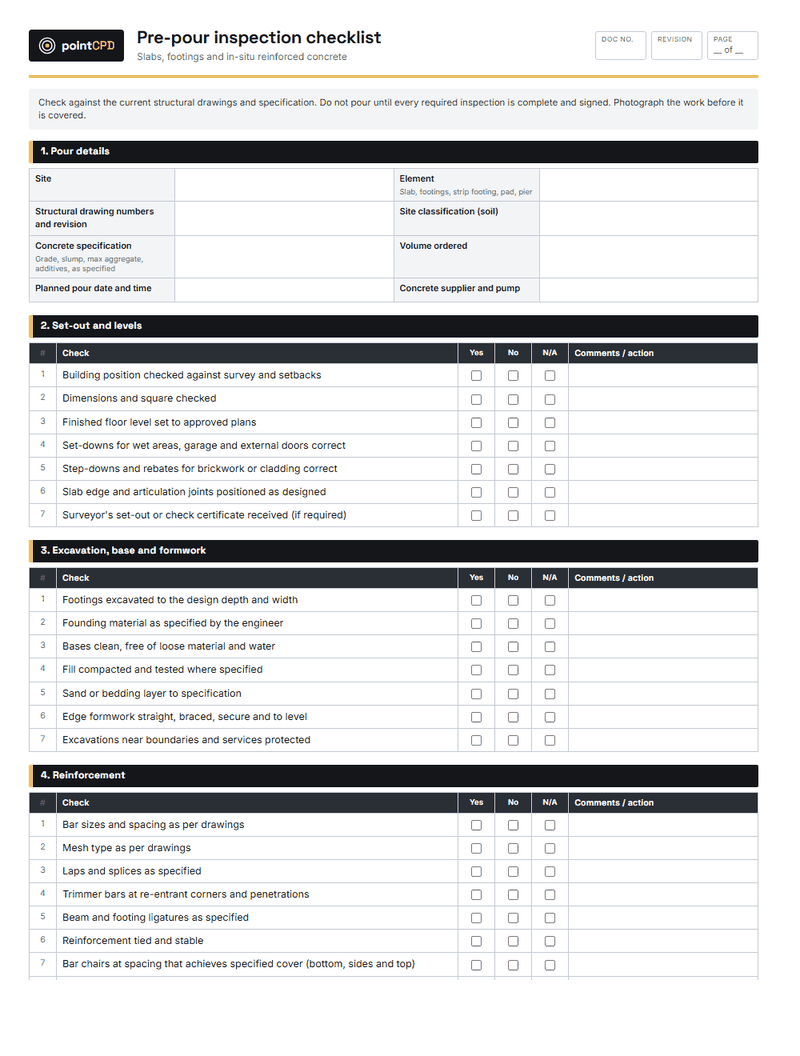
- 2InstallSensors are fixed to the reinforcement at representative locations before the pour.
- 3RecordSensors log concrete temperature over time and send it to a phone or gateway.
- 4EstimateSoftware converts the temperature history into an estimated strength using the calibration.
- 5DecideThe engineer uses the estimate, with any required cylinder tests, to approve stripping or loading.
Wireless maturity sensors are tied to the reinforcement before the pour. From the moment the concrete is placed, they record its temperature. Using a calibration curve for the specific mix, software estimates the strength the concrete has reached at each sensor location, and the results appear on a phone.
Where it helps
- Cold-weather pours, where strength gain is slow and stripping or loading too early risks damage.
- Post-tensioned slabs, where stressing depends on the concrete reaching a specified strength.
- Tight programmes, where knowing the concrete is ready a day earlier saves time on the critical path.
- Low-carbon mixes, which can gain early strength more slowly, making real data more valuable than rules of thumb.
What it does not replace
Maturity monitoring is an estimate based on a calibration. It is only as good as that calibration and the sensor placement. The engineer must agree to its use and decide what evidence is needed before stripping, stressing or loading, which may still include cylinder or core tests. It does not replace the specified compliance testing of the concrete supply.
Slab moisture: the hidden cause of floor failures
A concrete slab contains a lot of water, and it takes a long time to dry. If moisture-sensitive flooring, timber, some vinyls, laminate or adhesive-fixed floors, is laid on a slab that is still too wet, moisture moving up from the slab can cause cupping, lifting, adhesive failure, mould or discolouration. These failures often appear weeks or months after installation, long after the flooring contractor has been paid.
Flooring manufacturers and the relevant standards specify how dry the slab must be and how to test it. Relative humidity probes, inserted into holes drilled to a specified depth in the slab and left to equalise, are a common method. Some sensors can be left in place and read remotely, which helps with programming: you can see when the slab reaches the required level rather than guessing or testing repeatedly.
Before laying flooring on a slab
- Check the flooring manufacturer’s moisture requirement and the test method it specifies.
- Test at the locations and depths the method requires, not just one spot near a window.
- Allow for the building being closed up and at normal living conditions where the test requires it.
- Record results with dates, locations and readings; keep them with the job.
- If the slab is too wet, wait, dehumidify, or use a moisture barrier the manufacturer approves.
Test before the floor goes down, and keep the results. A moisture-related floor failure becomes a dispute about who is responsible: the builder, the flooring contractor or the owner. Dated test results showing the slab met the manufacturer’s requirement are the best protection.
Timber moisture
Timber frames and floors are sensitive to moisture too. A frame that has been rained on and is enclosed while wet will shrink as it dries, causing plaster cracks and nail pops. Timber flooring laid before it has acclimatised, or in a building that is still drying out, can gap or cup.
A handheld moisture meter is the everyday tool. Checking frames before lining, and flooring before installation, against the moisture content the supplier recommends, prevents many movement defects. Fixed sensors are occasionally used on mass timber projects, where moisture management during construction is critical, but for most houses a meter and a routine are enough.
Humidity and temperature loggers
Small loggers that record temperature and humidity inside a building have several uses:
- Curing and cold weather. Tracking conditions around a fresh pour or render in winter.
- Drying out. Showing when a building has dried enough after wet trades for painting, flooring and joinery.
- Condensation complaints. Leaving a logger in a client’s home for a week to see whether indoor humidity stays high, which helps separate a building problem from how the home is used.
- Handover evidence. Recording the conditions under which finishes were applied.
They are inexpensive and easy to use, and for builders dealing with condensation and moisture callbacks, one of the most useful diagnostic tools available.
Environmental monitoring on urban sites
On urban infill and apartment sites, dust, noise and vibration monitors are increasingly required by development consent conditions or used to manage neighbour relations. Vibration monitoring near sensitive neighbouring buildings, for example during excavation or demolition, provides a record that helps if a neighbour claims damage. Dust monitoring supports silica and asbestos controls. These are usually specified by the consent, the engineer or a consultant.
A worked example: the timber floor that didn’t cup
A builder is finishing a single-storey home on a slab poured in late autumn. The client has chosen a glued-down engineered timber floor. The programme has the flooring going in six weeks after the roof went on, and the flooring contractor is keen to start.
The builder checks the flooring manufacturer’s installation guide, which specifies a slab moisture limit and a test method. The flooring contractor drills test holes at several locations, including the middle of the living area and near the bathroom, inserts relative humidity probes and leaves them to equalise as the method requires. The readings near the bathroom and in the thickest part of the slab are above the limit.
The builder has two choices: wait, running dehumidifiers with the house closed up, or use a moisture barrier system the flooring manufacturer approves. The client agrees to a two-week wait rather than the cost of a barrier. The readings drop within limits, the floor goes down, and the test results are filed with the job.
The house down the road, where the same floor was laid on schedule without testing, is the one whose owners call eight months later about boards lifting in the hallway.
Sensors and the programme
The most valuable effect of sensors is often on the programme rather than the building. Knowing exactly when a slab is strong enough, or dry enough, lets the builder book the next trade with confidence instead of padding the schedule or gambling. On cold-weather pours, maturity data can show a slab is ready earlier than a conservative rule of thumb would suggest, or warn that it is not ready when it looks it. For flooring, remote moisture readings mean the flooring contractor arrives when the slab is ready, not when the calendar says so.
Making sensors worth the money
- Start with a question. “When can we strip?” or “Is the slab dry enough for timber?” A sensor without a question produces data nobody uses.
- Install correctly. Placement matters. Maturity sensors should be at representative and critical locations; moisture probes at the depth the method specifies.
- Agree the method. For structural decisions, the engineer must agree to the method and the evidence required.
- Assign someone to read it. Data on an app nobody opens is worthless.
- Keep the records. File readings with the job, like photos and inspection records.
Reading the data sensibly
Sensor readings are only meaningful in context. A single high moisture reading near a bathroom may reflect a local wet spot rather than the whole slab. A maturity estimate from a sensor near the slab edge, where concrete cools faster, will differ from one in the centre. Look at trends over time and across locations, compare with what you can see on site, and when a reading does not make sense, check the sensor and its placement before acting on it.
Costs and practicalities
Wireless maturity sensors are single-use, cast into the concrete, and typically sold with a subscription or reading app. Relative humidity probes and loggers are reusable. Handheld moisture meters are an everyday tool every supervisor should carry. For most residential builders, the realistic starting kit is a good moisture meter, a set of temperature and humidity loggers, and access to slab moisture testing when laying moisture-sensitive floors. Maturity sensors earn their place on cold-weather pours, post-tensioned slabs and jobs where programme time is valuable.
Who owns the data
Sensor platforms store readings in the cloud. As with any construction software, check that you can export the readings and keep them with the job file, because the data may be needed long after the subscription ends.
Where it is heading
Sensors are getting cheaper and more connected, and their data increasingly flows into project software alongside photos and diaries. On larger projects, sensor networks already track curing, drying, temperature and environmental conditions across a whole site. For residential builders, the near-term value is simpler: fewer floor failures, fewer movement cracks, better cold-weather concrete decisions, and evidence when something goes wrong.
The bottom line
Many of the most expensive residential callbacks, cupped floors, cracked slabs, popped plaster and mouldy walls, come down to moisture and timing. Sensors and meters replace guesswork with measurement. Use them to answer specific questions, agree methods with the engineer for structural decisions, follow the flooring manufacturer’s test requirements, and keep the readings. The data is cheap; the callbacks it prevents are not.
Questions builders ask
What is a concrete maturity sensor?
A sensor cast into concrete that records its temperature over time. Using a calibration curve for the mix, software estimates the concrete’s in-place strength, which can inform decisions on stripping, stressing and loading with the engineer’s agreement.
How do I know if a slab is dry enough for flooring?
Test it using the method and limit specified by the flooring manufacturer and relevant standard, commonly relative humidity probes in drilled holes, at the required locations and depth.
Why do timber floors cup on concrete slabs?
Often because moisture moves up from a slab that was not dry enough when the floor was laid, or because the timber had not acclimatised. Testing the slab and timber before installation prevents most failures.
Are humidity loggers useful for condensation complaints?
Yes. A week of readings shows whether indoor humidity stays high, which helps separate building defects from how the home is used.
Can maturity sensors replace cylinder testing?
Not on their own. They are an estimate based on calibration, and the engineer decides what evidence is required, which may still include cylinder or core tests. They do not replace compliance testing of the concrete supply.
Sources
- Condensation in buildings handbook · Australian Building Codes Board
- Cement Concrete and Aggregates Australia · CCAA
Published 18 August 2026. General information for builders, not legal, financial or engineering advice for a specific job. Check current requirements with the relevant regulator or standard before relying on them.