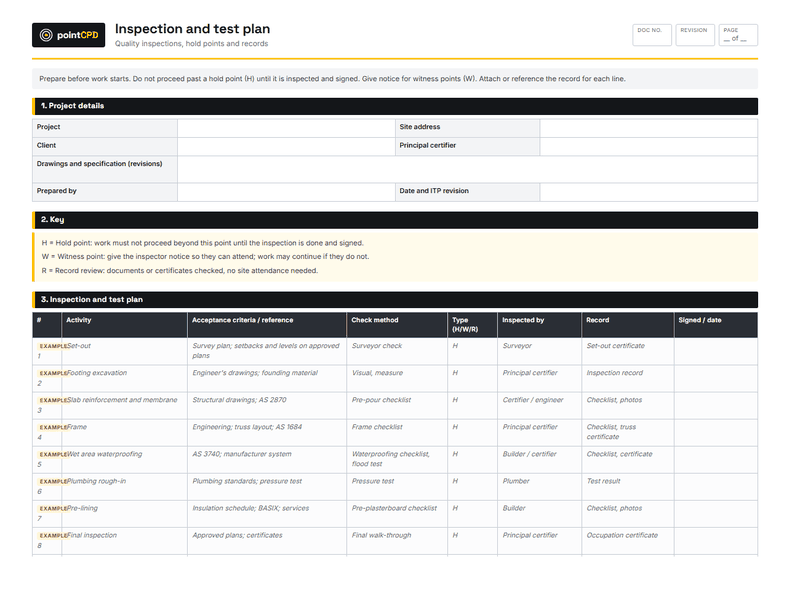
Most quality failures on a build are not failures of skill. They are failures of sequence: the plasterer arrived before anyone checked the insulation, the slab was poured before the engineer saw the reo, the tiler started before the membrane was flood tested. An inspection and test plan fixes the sequence. Every check is scheduled before the job starts, and the hold points physically stop the next trade until the check is signed.
What an ITP is
An ITP is a table of every inspection and test on a job, in build order. Each line says what is being checked, what it must meet (a drawing, a standard, a specification), how it is checked, who checks it, whether it is a hold or witness point, and what record proves it was done. It is standard on commercial and civil work and often required by contract. On residential work it is less common, which is exactly why the builders who use one stand out.
Hold points, witness points and record reviews
| Type | Meaning | Residential examples |
|---|---|---|
| Hold point (H) | Work stops until the inspection is done and signed | Footing excavation, reo before pour, frame before covering, waterproofing before tiling, pressure tests, insulation before lining |
| Witness point (W) | Inspector is notified and may attend; work continues if they do not | Concrete pour, owner walk-throughs, supplier inspections |
| Record review (R) | Documents checked, no site attendance | Truss certificates, product data, compliance certificates |
Build the plan around the cover-ups
The simplest way to find the hold points is to ask what gets covered. Reinforcement is covered by concrete. The frame is covered by linings and cladding. Membranes are covered by tiles. Services are covered by plasterboard. Anything that becomes invisible is a hold point, because after that point it cannot be checked without demolition. Add the principal certifier’s mandatory critical stage inspections, which in NSW for new houses include footings, reinforced concrete before pouring, framework before covering, waterproofing in wet areas for some building classes, stormwater before covering, and the final inspection.
Acceptance criteria: say what “right” means
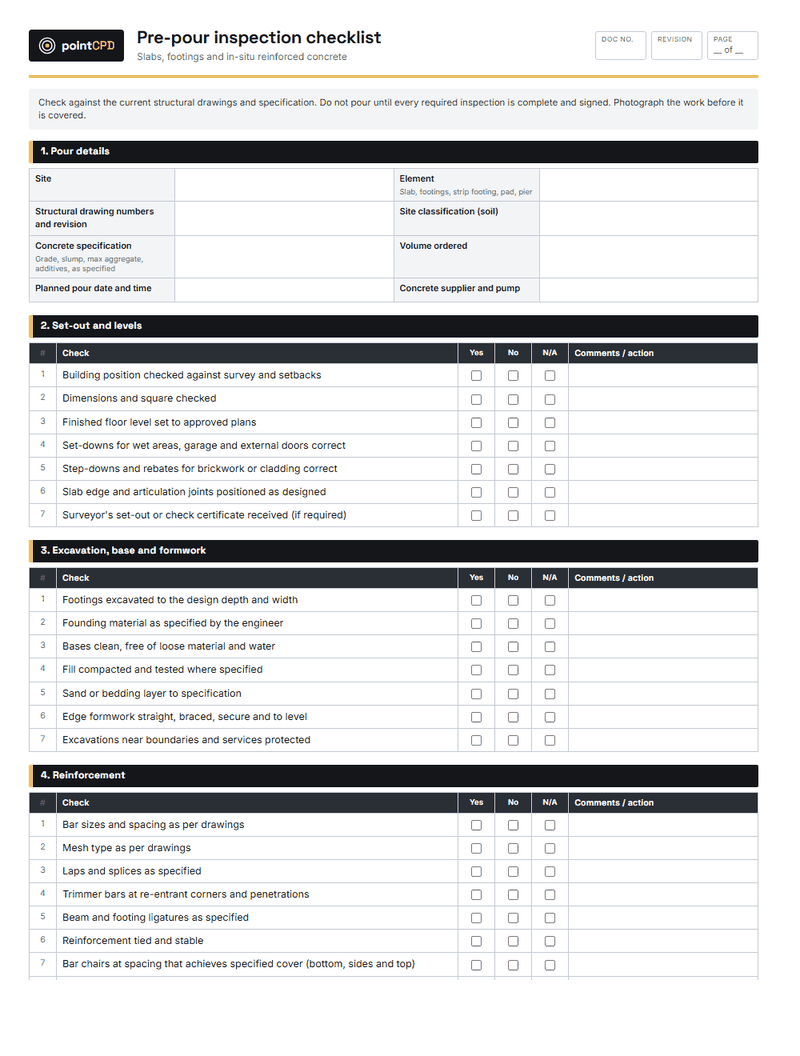
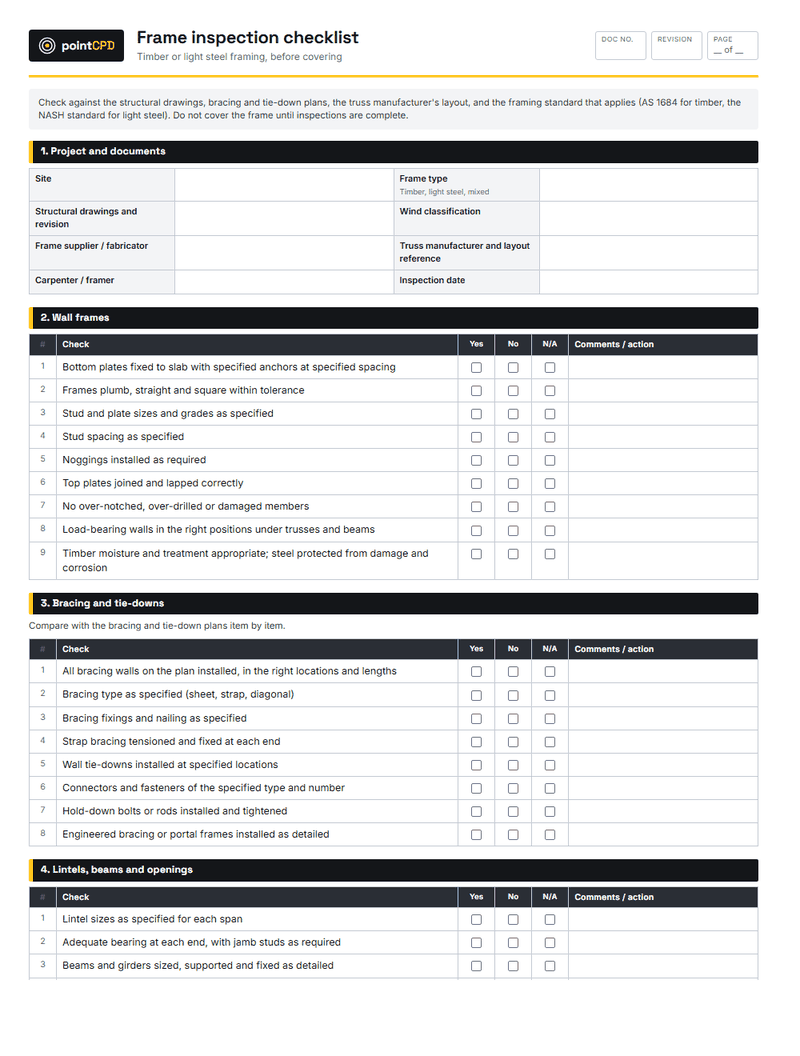
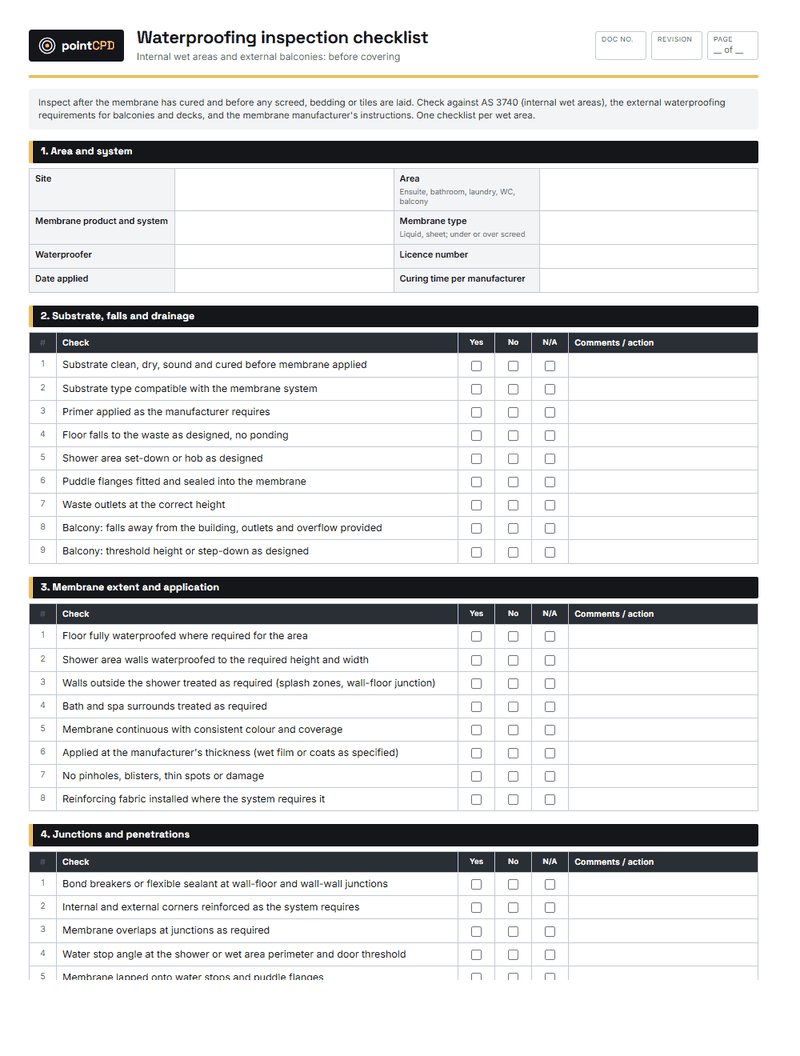
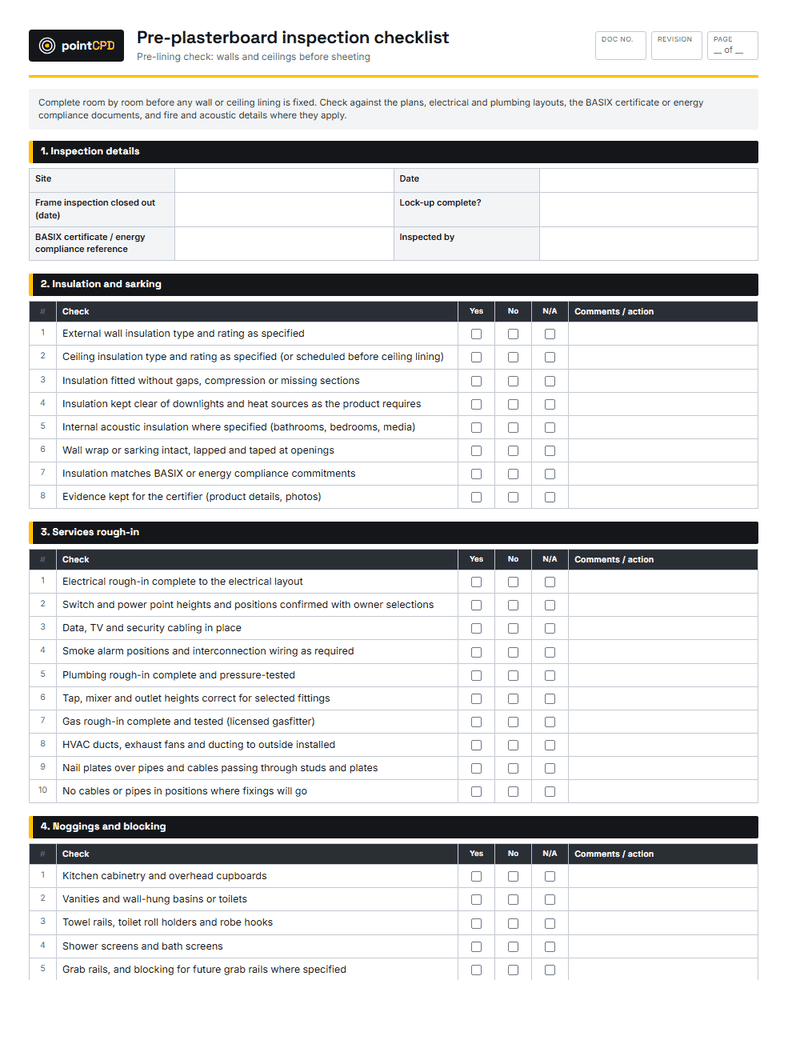
An inspection without criteria is an opinion. Each line in the ITP names what the work must meet: the structural drawing and revision, the relevant standard such as AS 2870 for slabs or AS 3740 for wet areas, the manufacturer’s installation instructions, or the specification. Then the check method: a checklist, a measurement, a pressure test, a flood test. The detailed checklists for the main stages are free on this site: pre-pour, frame, waterproofing and pre-plasterboard.
Non-conformances
When an inspection finds work that does not meet the criteria, record it as a non-conformance: what was wrong, what was done, who re-inspected it and when it was closed. A hold point is released only when its non-conformances are closed. Over several jobs, the non-conformance log shows which trades and stages need attention.
Why it pays for residential builders
- No missed certifier inspections, which can cause serious problems at occupation certificate stage.
- Trades booked in the right order, because the plan shows what must be signed before they start.
- A defensible record if a defect claim arrives years after handover.
- Something to show clients that sets a quality builder apart at tender.
An ITP for a renovation
Renovations benefit from an ITP as much as new builds, with different hold points. A bathroom and kitchen renovation in an existing home might include:
| Hold point | Check |
|---|---|
| After demolition | Existing framing, substrate and services condition; any asbestos found and managed; structural concerns referred to an engineer |
| Services rough-in | Plumbing pressure test; electrical rough-in by licensed electrician; positions against selections |
| Pre-lining | Noggings for cabinetry and fittings; wet area board; insulation if walls are opened |
| Waterproofing | Substrate, falls, membrane, junctions, flood test, certificate |
| Final | Fit-off, testing, compliance certificates, clean, owner walk-through |
Link the ITP to the program
An ITP works best when every hold point also appears on the construction program, with the inspection booked before the following trade. That turns the ITP from a quality document into a scheduling tool: the program shows the frame inspection on Thursday, so the wall wrap and windows are booked for Friday, not Wednesday. Review both at each site meeting. When a hold point slips, the program shows immediately what it affects, and the site diary records why.