Key takeaways
- A written subcontract sets out scope, price, payment, variations, defects, insurance and safety, and it is the builder’s main tool when something goes wrong with a trade.
- In NSW, security of payment laws give subcontractors strong rights to claim payment from the builder, even on houses built for owner-occupiers where the head contract is outside the Act.
- A payment claim under the Act must be answered with a payment schedule within the time set by the Act, or the full amount can become due.
- Unfair contract terms laws now carry penalties and can apply to standard-form subcontracts with small businesses, so one-sided clauses carry real risk.
- Subcontracts should reflect the head contract: defects periods, warranties, variations and time must flow down so the builder is not left carrying risk the trade created.
Most residential builders rely on subcontractors for most of the work on a house: concreters, carpenters, bricklayers, roofers, plumbers, electricians, plasterers, tilers and painters. Yet many of those relationships run on a quote, a phone call and trust. That works well, right up until a defect, a delay, a variation dispute or a payment argument. Then the builder finds that the terms that matter were never agreed.
A written subcontract does not have to be long or adversarial. It is simply the record of what each party agreed. This guide covers the clauses that matter most for residential builders, how security of payment laws apply to subcontractors, and how to keep subcontracts fair and enforceable.
Why a written subcontract matters
The builder carries the head contract risk: the client, the statutory warranties, the programme, the price. When a subcontractor’s work is defective or late, the client looks to the builder. A subcontract is how the builder passes the relevant parts of that risk to the trade who controls the work, and how the trade knows exactly what is expected.
It also protects subcontractors. A clear scope, price and payment timetable reduces the arguments that leave good trades unpaid.
The clauses that matter
The clauses that matter, and why
| Clause | Why it matters | Common mistake |
|---|---|---|
| Scope and documents | Defines exactly what the trade must do and to which drawings | “Supply and install as per plans” with no revision or exclusions |
| Price and payment | Sets how and when the trade is paid | No claim dates; no link to progress or inspections |
| Variations | Controls extra work and extra cost | Verbal instructions on site, argued about later |
| Time and programme | Links the trade to the builder’s programme | No dates, so delay cannot be managed or claimed |
| Defects and warranties | Makes the trade fix its own defects during and after the job | No defects period matching the head contract |
| Insurance and licences | Proves the trade is covered and qualified | Certificates never collected or expired |
| WHS | Sets SWMS, induction and site rules | Generic SWMS accepted without review |
| Disputes and termination | Gives a path when things go wrong | No process, straight to lawyers |
Scope and documents
The most important clause is the scope: exactly what work, to which drawings and specifications, including which revision, with any inclusions and exclusions spelled out. “Supply and install plasterboard as per plans” invites an argument about cornices, set-outs, wet area board and access panels. A scope that lists them does not.
Price and payment
The subcontract should state the price and how it will be paid: stages, progress claims, or cost and margin. It should set out when claims can be made, what they must include, and the timeframe for payment. Linking payment stages to inspections or completed work, and to the builder’s own progress claims, keeps cash flow aligned.
Variations
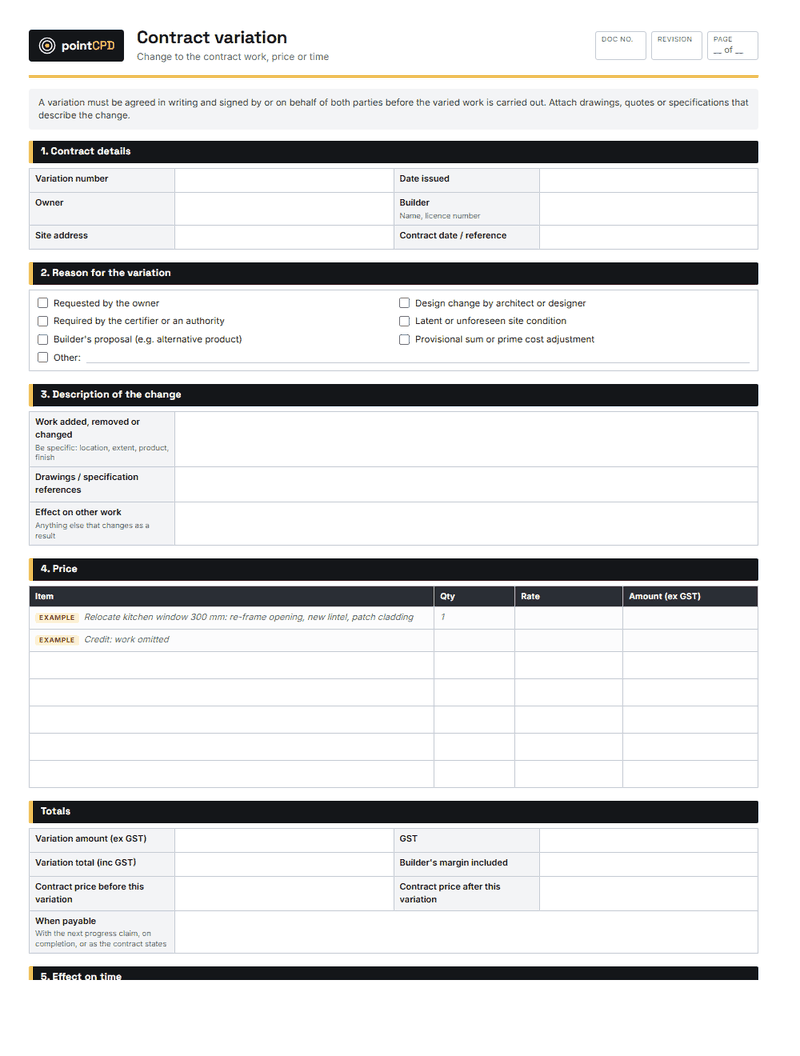
Variations should be instructed and agreed in writing, with price and time effect, before the work is done. This mirrors what the builder must do with the client in NSW. A trade who does extra work on a site instruction and bills for it later is a common source of disputes; a simple variation process prevents it.
Time and programme
Without dates, delay cannot be managed. The subcontract should reference the programme, the start date or notice period, and the time allowed for the work, with a process for extensions of time if the delay is not the subcontractor’s fault.
Defects and warranties
The subcontractor should be responsible for fixing defects in their work, during the job and for a defined period after completion that matches the builder’s obligations to the client. The builder carries statutory warranties for years after completion; a subcontract with no post-completion defects obligation leaves the builder alone with defects the trade created.
Insurance and licences
Require evidence of public liability insurance and appropriate workers compensation or personal accident cover, and check the licence for the work the trade will do. Collect certificates before the trade starts and check they remain current on longer jobs.
Work health and safety
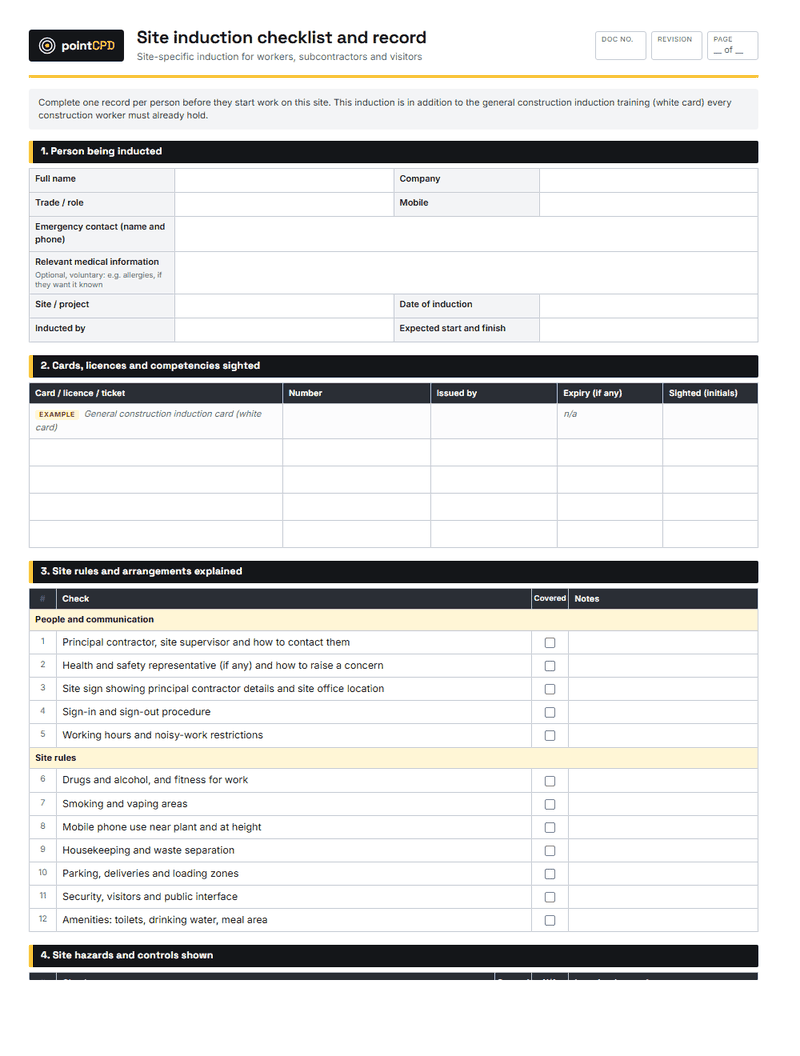
Set out the site rules, induction, SWMS requirements for high-risk construction work, and the trade’s obligations to consult and cooperate with the builder on safety. Review each trade’s SWMS for the actual site rather than filing a generic document.
Disputes and termination
Include a simple dispute process: notice, a meeting, and escalation to mediation or another agreed process before litigation. Set out when either party can terminate, and what happens to payment and materials if they do.
Security of payment: subcontractors’ rights in NSW
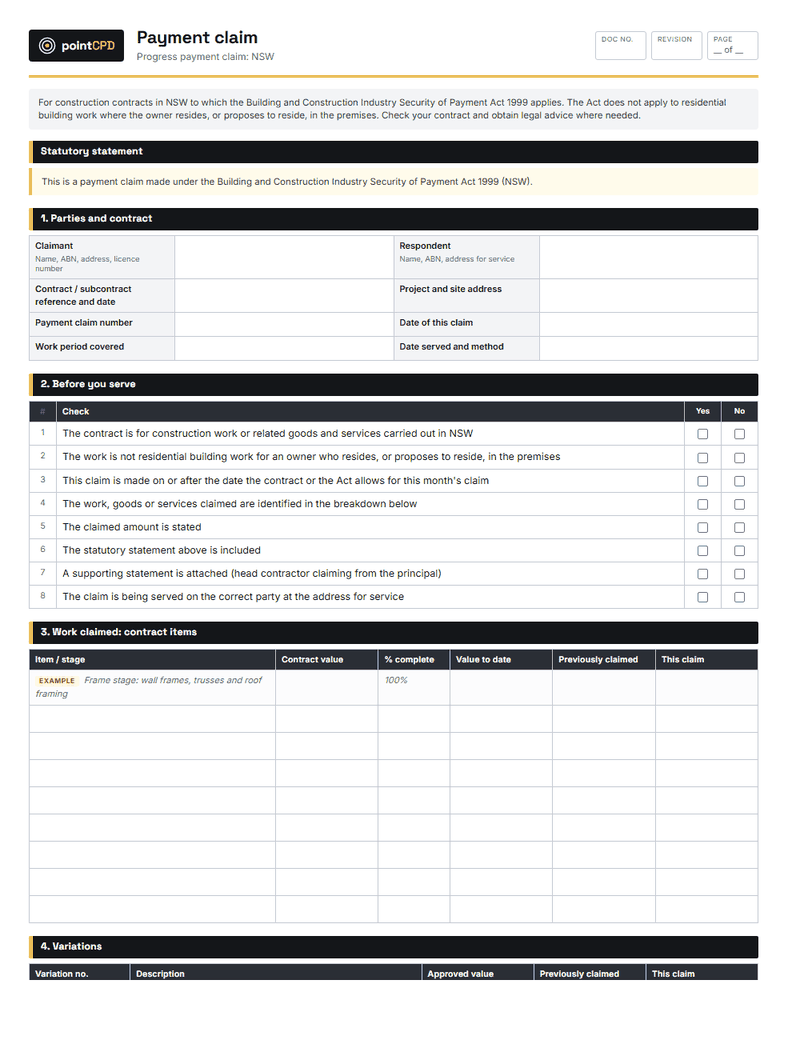
The Building and Construction Industry Security of Payment Act 1999 (NSW) gives people who carry out construction work, including subcontractors, a statutory right to progress payments and a fast process to resolve payment disputes. Builders need to understand it, because it applies to their subcontracts.
A key point for residential builders: the Act does not apply to a head contract for residential building work with an owner who lives in, or intends to live in, the home. But it does apply to the builder’s subcontracts on that same job. So a plumber on a house built for an owner-occupier can use the Act against the builder, even though the builder cannot use it against the owner.
How a NSW security of payment claim works
- 1Payment claimThe subcontractor serves a payment claim for work done, which must meet the Act’s requirements.
- 2Payment scheduleThe builder has a limited number of business days to respond with a payment schedule stating what it will pay and why.
- 3Payment dueThe scheduled amount must be paid by the due date. Missing the schedule can make the full claim due.
- 4AdjudicationIf there is a dispute, the subcontractor can apply for fast-track adjudication.
- 5EnforcementAn adjudicated amount can be enforced as a debt, and the subcontractor may be able to suspend work.
Source: Building and Construction Industry Security of Payment Act 1999 (NSW). General information only.
The most important practical rule is the payment schedule. When a subcontractor serves a valid payment claim under the Act, the builder must respond with a payment schedule within the time the Act allows, stating the amount it will pay and the reasons for paying less than claimed. If the builder does not provide a schedule in time, and does not pay, the full claimed amount can become payable and recoverable as a debt. Many builders have been caught by ignoring a claim that arrived by email.
Never ignore a payment claim. Diary the due date for a payment schedule the day a claim arrives. If you dispute any part of the claim, say so in the schedule with reasons. Silence can cost you the full amount.
Unfair contract terms
Unfair contract terms laws protect small businesses as well as consumers, and since November 2023 using or relying on unfair terms in standard-form contracts can attract significant penalties. A builder’s standard subcontract offered on a take-it-or-leave-it basis to a small trade business may be covered. Clauses that let the builder vary the price or scope unilaterally, impose one-sided termination rights, or shift all risk to the trade regardless of fault can be challenged. A fair, balanced subcontract is not just good relations; it is lower legal risk.
Flowing down the head contract
A good subcontract mirrors the head contract where it matters. If the head contract requires the builder to rectify defects for a period, the subcontract should require the trade to rectify their defects for a matching period. If the head contract has a variation process with the client, the subcontract should have a compatible one. If the builder faces delay damages, the subcontract should address the trade’s responsibility for delays they cause, fairly and proportionately.
Contractors or employees?
A subcontract does not decide whether someone is legally a contractor. Long-term, labour-only workers who work only for you, on your directions, using your equipment may be employees for tax, super and workplace law purposes, whatever the contract says. With Payday Super now in force and the ATO receiving contractor payment data through the taxable payments annual report, it is worth reviewing arrangements that look more like employment than subcontracting.
Before a subcontractor starts
- Signed subcontract with scope, drawings (with revision), price and payment terms.
- Licence checked and recorded for the work they will do.
- Public liability insurance certificate current; workers compensation or equivalent cover confirmed.
- SWMS for any high-risk construction work, reviewed for this site.
- Site induction completed.
- ABN confirmed for TPAR reporting.
- Programme dates agreed and communicated.
A worked example: the leaking shower and the tiler
Eighteen months after handover, a client reports a leaking shower. Investigation finds the membrane was damaged during tiling and not repaired. The builder is liable to the client under the statutory warranties and pays for the rectification.
Builder A had a written subcontract with the tiler requiring them to rectify defects in their work for a period matching the builder’s warranty exposure, with a notice process. The tiler is notified, attends, and contributes to the rectification. Builder B had a quote and a handshake. The tiler says the membrane was the waterproofer’s problem, the waterproofer says it was fine when inspected, and Builder B pays the whole cost. The difference is two pages of paper signed at the start.
Paying subcontractors well
The best subcontract in the world will not keep good trades if they are paid late. In a market where bricklayers, tilers, roofers and carpenters are scarce, reliable payment is one of the strongest reasons a trade chooses one builder’s job over another’s. Pay on the agreed dates, answer claims promptly, and if you dispute part of a claim, pay the undisputed part on time and explain the rest.
Keeping it practical
Subcontracts do not need to be negotiated from scratch for every job. Most builders use a standard subcontract, from an industry association or drafted by a lawyer, with a short schedule for each job setting out the scope, drawings, price, dates and any special conditions. Keep it readable, keep it fair, and make sure both parties sign it before work starts.
The bottom line
A written subcontract is the builder’s link between the promises made to the client and the trades who deliver them. Define the scope precisely, set out price, payment and variations, pass down defects and time obligations, collect insurance and licences, and understand that NSW security of payment laws give subcontractors real rights, including on houses for owner-occupiers. Fair, clear subcontracts keep good trades and prevent expensive arguments.
Questions builders ask
Do I need a written subcontract with my trades?
It is strongly recommended. A written subcontract sets out scope, price, payment, variations, defects, insurance and safety, and it is the builder’s main tool when a trade’s work is defective, late or disputed.
Does the NSW Security of Payment Act apply to house builders?
It does not apply to a head contract for residential work with an owner-occupier, but it does apply to the builder’s subcontracts on that job, so subcontractors can use it against the builder.
What happens if I ignore a subcontractor’s payment claim?
If a valid payment claim under the Act is not answered with a payment schedule within the time allowed, and is not paid, the full claimed amount can become payable and recoverable as a debt.
Do unfair contract terms laws apply to subcontracts?
They can. Unfair contract terms laws protect small businesses, and since November 2023 using unfair terms in standard-form contracts can attract penalties.
How long should a subcontractor be responsible for defects?
Ideally for a period that matches the builder’s own obligations to the client, so the builder is not left carrying defects caused by the trade. Get legal advice on the right terms for your contracts.
Sources
- Building and Construction Industry Security of Payment Act 1999 (NSW) · NSW Legislation
- Unfair contract terms · Australian Competition and Consumer Commission
Published 22 August 2026. General information for builders, not legal, financial or engineering advice for a specific job. Check current requirements with the relevant regulator or standard before relying on them.