Key takeaways
- An apprentice is a worker under WHS law, so the duty to provide supervision, information, training and instruction attaches to you as principal contractor regardless of who employs them.
- Supervision has to be proportionate to the risk and to the competence of the person doing the task, which is why a first-year and a fourth-year cannot be supervised the same way on the same job.
- The person doing the supervising must themselves hold the competency for the task, because a tradesman who has never done the task cannot competently direct an apprentice through it.
- A competency record is the practical evidence that you discharged the duty, and it needs to be contemporaneous, task-specific and signed rather than reconstructed after an incident.
- Records should follow the person rather than the job, so a competency register that travels with an apprentice across sites and employers is worth more than one filed per project.
An apprentice on your site is a worker. That single fact drives everything else in this article. It does not matter that the apprentice is employed by a subcontractor, that they are on a low hourly rate, or that their TAFE teacher signs off on their competencies. Under work health and safety law, the duty to provide supervision, information, training and instruction attaches to the person conducting the business or undertaking — and on a residential site, that is usually you as principal contractor.
The reason the law lands on you rather than on the apprentice is that an apprentice is, by definition, a person who cannot yet see the risk. A fourth-year who has been on tools for years will spot a live circuit or an unpropped excavation. A first-year will walk straight past it, because they have no framework to compare it against. The duty exists because you are the one with the framework.
Where builders get caught is not in the principle. It is in the gap between what they believe happens on site and what they can actually demonstrate. If an apprentice is injured and the regulator asks what supervision was in place, a verbal assurance that the leading hand was keeping an eye on him will not carry much weight. The competency record is what carries the weight, and it is the part most builders treat as paperwork rather than as the evidence of the duty itself.
Who the duty actually attaches to on a residential site
On a house or duplex job you are typically the principal contractor. That role carries specific obligations under the WHS Regulation, and one of them is to make sure the site is supervised in a way that is proportionate to the risks. When an apprentice from a subcontractor is working under your site, you have a duty to them as a worker, and so does their employer. The duties overlap rather than replace each other.
In practice that means three things. You need to know who is on site and what they are doing. You need to have assessed the risk of the tasks they will do. And you need to have put supervision arrangements in place that match that risk. The subcontractor’s duty does not excuse you from any of it, and your duty does not excuse them.
This is also where the host arrangement matters. If you have taken on an apprentice through a group training organisation, the GTO is the employer and you are the host. The GTO will have its own obligations about training and pastoral care, but the day-to-day supervision on your site is yours, because you control the site and the work. Do not assume the GTO has covered the WHS side. Check what they have in place and record what you are doing on top of it.
What supervision actually means, and why it is not a fixed standard
Supervision is not a single thing you either provide or do not. It is a sliding scale, and the level required for any given task depends on two variables: how dangerous the task is, and how competent the person doing it is. A task with serious consequences and a worker with no experience of it needs direct supervision, meaning someone competent is present and watching. A task with low consequences and a worker who has done it many times under supervision can sit at general supervision.
The trap is treating the apprentice’s year level as a proxy for competence. A third-year who has spent their whole time on framing may never have touched a live electrical connection or worked at height on a pitched roof. Conversely, an apprentice who has grown up on a farm may be far more comfortable around machinery than their year level suggests. Competence is task-specific, not person-wide.
There is a second trap, which is that the supervisor has to be competent in the task themselves. A tradesman who has never set up a temporary supply cannot competently direct an apprentice through it, and cannot recognise when the apprentice is about to do something dangerous. If you are assigning supervision, you are also certifying that the supervisor knows the work. That is a real check, not a formality.
Direct supervision compared with general supervision
| Direct supervision | General supervision |
|---|---|
| Supervisor is present and watching the task as it is done | Supervisor is on site, contactable and checking in at intervals |
| Appropriate for high-risk work and for a worker who has not done the task before | Appropriate for low-risk work and a worker who has demonstrated the competency |
| The supervisor can intervene before the harm occurs | The supervisor intervenes after noticing or being called |
| Suitable for an apprentice in their first exposure to the task | Suitable once the apprentice has been assessed on that specific task |
| Fails if the supervisor is called away without a replacement | Fails if the supervisor is on another site entirely |
Safe Work Australia’s guidance on electrical safety is a useful test case here. The guidance sets out the duties around identifying hazards, assessing risk and implementing controls, and it applies to anyone working near electrical parts. An apprentice running a lead or plugging in a tool is working near electricity. The level of supervision that task needs is not the same as the level needed for work on an energised installation, and the difference is exactly the judgement you are being asked to make. Our article on electrical safety and temporary site power covers the controls in more detail.
Induction, information, training and instruction are separate duties
Builders often roll all of this into one word — induction — and then wonder why the record looks thin after an incident. The duties are distinct, and a record that shows you discharged each one is stronger than a single induction sign-off.
- Information is what the apprentice needs to know about the site, the hazards and the people in charge. That includes who the supervisor is, what the emergency arrangements are, and where the first aid is.
- Training is the structured development of competency, and for an apprentice it is largely delivered through their formal training contract. You are not replacing that, but you are responsible for the site-specific part.
- Instruction is the task-specific direction given before the work starts — how to do it, what the controls are, what to do if something changes.
- Supervision is the ongoing oversight that confirms the instruction was understood and is being followed.
A good site induction will touch all four, but only at a general level. The task-specific instruction and the task-specific supervision need to be recorded against the task, not against the day the apprentice first walked on site. That is the difference between a record that shows what happened and a record that shows you ticked a box in week one and never revisited it.
Assessing competency before you hand over the task
Competency is usually described as a combination of training, experience and the ability to apply both to a real situation. For an apprentice, you are not assessing whether they are a qualified tradesperson. You are assessing whether they can do this specific task, on this site, with these controls, without creating a risk to themselves or anyone else.
A practical way to do that is to watch them do the task under direct supervision the first time, then step back and watch them do it again without prompting. If they need reminding of the controls on the second run, they are not yet competent for unsupervised work on that task, and the supervision level stays where it is. If they run it cleanly, you can move them to general supervision and record the change.
This is also where the formal training side connects to the WHS side. The competencies in the training package describe what the apprentice is expected to be able to do, but they are written for the trade generally. Your assessment is about whether that general competency translates to your site, your plant, your access arrangements and your risks. Those are not the same question, and the regulator will be asking the second one.
Setting up supervision before the apprentice starts
- 1Identify the tasksList what the apprentice will actually do in the first weeks, not the trade generally.
- 2Assess the riskFor each task, work out what could go wrong and how badly, using your SWMS as the starting point.
- 3Name the supervisorPut a specific person against each task, and check that person holds the competency themselves.
- 4Set the levelDecide whether the task needs direct line-of-sight supervision or periodic checking, and write down which.
- 5Brief and recordWalk the apprentice through the task, the hazards and the controls, then have both parties sign the entry.
- 6ReviewRevisit the level of supervision as competence builds, and record the change rather than leaving it verbal.
Where the risk is genuinely high — energised work, work at height, excavation, anything involving silica dust — the assessment needs to be more formal. Safe Work Australia’s guidance on silica is a good example of how the duties scale: the controls are more prescriptive, the monitoring is more onerous, and the supervision expectations are higher. If your apprentice is cutting engineered stone or fibre cement, the supervision level is not a matter of judgement in the way it is for sweeping up.
The competency record is the evidence, and it has to be contemporaneous
After an incident, the regulator will ask what you knew about the apprentice’s competence and when you knew it. A record created after the incident, describing what you believe was the case, is worth very little. A record created before the task started, signed by the supervisor and the apprentice, describing the task, the controls and the level of supervision, is worth a great deal.
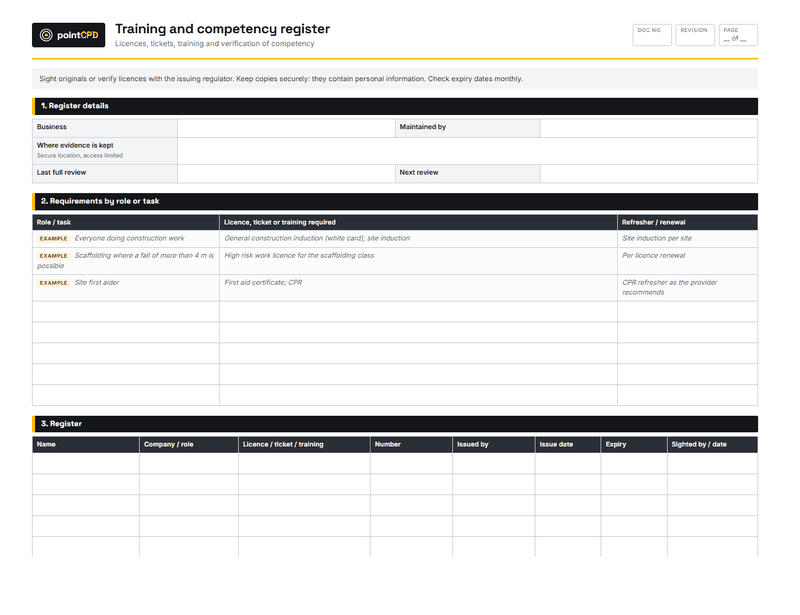
The elements that make a competency record useful are not complicated. They are the task, the date, the person assessing, the level of supervision assigned for that task, what was covered in the instruction, and the signatures. Add a review date so that the entry does not silently become stale. If the apprentice moves to a new task, you get a new entry rather than editing the old one.
Keep the record per person rather than per job. Apprentices move between sites and sometimes between employers, and a competency register that travels with them is more useful than a folder per project. It also makes the pattern visible: if you look at a register and see the same task assessed six months apart with no progression, that tells you something about the supervision the apprentice has actually been getting.
The mistake that costs the most. Leaving a first-year unsupervised on a task because the leading hand was called to another part of the site. The duty does not pause when the supervisor walks away, and an incident in that window will be examined as a failure of supervision, not as bad luck. If the supervisor has to leave, the work stops or a competent replacement takes over.
Our free training competency register template is set up to capture these entries per person, and it is a reasonable starting point if you do not already have a format. Whatever you use, the test is whether a regulator could read it in two years’ time and understand what supervision was in place on a given day.
High-risk tasks need a higher bar, and the SWMS is where it lives
For high-risk construction work, the WHS Regulation requires a safe work method statement, and the SWMS has to be followed. If an apprentice is doing high-risk work, they need to be working to the SWMS, and the supervision arrangements in the SWMS have to reflect their competence. An SWMS that assumes a competent tradesperson is not adequate for an apprentice on their first exposure to the task.
The practical fix is to write the supervision requirement into the SWMS itself, expressed in terms of the person doing the work rather than the task alone. Something like “direct supervision until competency is demonstrated, then general supervision” gives the supervisor a clear instruction and gives you a record of the decision. Our article on SWMS templates for residential builders in NSW covers the structure in more detail.
The same logic applies to heat. An apprentice who has not worked a full summer on site is at higher risk of heat illness than a tradesman who has, and the supervision arrangements need to account for that. The controls in our heat illness prevention article are relevant, but the supervision angle is that someone has to be checking on the apprentice through the day, not just at smoko.
Worked example: a first-year on a western Sydney project
A builder in western Sydney is running a two-storey project and has a first-year apprentice hosted from a group training organisation, working under a carpentry subcontractor. The apprentice has been on site for three weeks and has been doing general labouring and cleanup. The leading hand decides to put him on cutting fibre cement sheet for the eaves, because the sheeter is set up and the apprentice has watched it being done several times.
The leading hand sets the apprentice up, shows him the cut list, and goes to the other end of the site to deal with a delivery. The apprentice cuts for about twenty minutes. Nothing goes wrong, but the builder walks past, sees the apprentice working alone on the sheeter with the dust controls running but no supervisor in sight, and stops the work.
The builder’s response is the useful part. First, he confirms the controls are right — the sheeter is set up correctly, the water suppression is working, and the apprentice is wearing the right respiratory protection. That part is fine. Second, he checks the competency register and finds no entry for the apprentice on cutting fibre cement. The leading hand had assumed the watching counted as training. Third, he writes an entry that records the task, the level of supervision now assigned (direct until competency is demonstrated), and the instruction given. Fourth, he has a short conversation with the leading hand about what leaving the task unsupervised means, and records that too.
The cost of getting this wrong is not the twenty minutes of unsupervised cutting. It is what happens if the apprentice develops a silica-related condition years later, or if there is an incident on the sheeter in a similar window on a future job. At that point the question will be whether the builder had a system for assessing competency and assigning supervision, and whether it was followed. On this job, after the intervention, the answer is yes, and there is a record to prove it. Before the intervention, the answer was no, and the absence of a record would have been the problem.
Keeping the system alive across multiple sites and subbies
Most builders can get this right on one job with one apprentice. The failure mode is scale. Once you have three sites running and apprentices hosted from two different GTOs and employed by four different subcontractors, the informal approach collapses. The register stops being updated, the supervision levels stop being reviewed, and nobody can say with confidence who is supervising whom on any given day.
The fix is to make the register part of the site start-up routine rather than a separate administrative task. When a new worker arrives on site, the induction captures their competency for the tasks they will do, and the register is updated then. When the programme changes and a new task starts, the supervision level is reviewed as part of the pre-start. When an apprentice moves on, the register goes with them.
That last point matters more than it first appears. If you are hosting an apprentice, the GTO will want to see evidence of the supervision and competency development you provided, because it feeds into their assessment of the apprenticeship. A register that travels with the apprentice serves both purposes, and it means the next host does not start from zero. If you keep CPD records for yourself, this is the same principle: the record is only useful if it follows the person and stays current.
For builders who want to go deeper on the regulatory framework, the PointCPD guide to how NSW builder CPD works sets out the structure, and the course catalogue includes safety-focused content that covers supervision and competency. The home page at PointCPD is the starting point if you are new to the platform.
What to check before the apprentice starts on Monday
If you take nothing else from this article, take the checklist. It is short, and every item on it is something a regulator would ask about after an incident.
- Is there a named supervisor for every task the apprentice will do, and does that person hold the competency themselves?
- Has the risk of each task been assessed, and does the supervision level match the risk and the apprentice’s competence?
- Has the apprentice been given task-specific instruction, not just a site induction, and is it recorded?
- Does the competency register have a current entry for the tasks they are doing now, signed by both parties?
- Is there a rule about what happens when the supervisor has to leave, and does everyone on site know it?
- Are the high-risk tasks covered by a SWMS that accounts for the apprentice’s level of experience?
- Does the register travel with the apprentice when they move to another site or another host?
None of this is exotic. It is the ordinary discipline of knowing who is on your site, what they are doing, and what you have done to keep them safe. The reason it matters more with apprentices is that they are the workers least able to protect themselves, and the ones most likely to do what they are told without questioning it. The duty is yours, and the record is how you show you discharged it.
Questions builders ask
Who is responsible for supervising an apprentice on my site if they are employed by a subcontractor?
You are, as principal contractor, along with the employer. The duties overlap rather than replace each other. You control the site and the work, so the day-to-day supervision arrangements are yours to set and record. The subcontractor remains responsible for their own obligations as an employer, but that does not reduce yours.
Does an apprentice need direct supervision at all times?
No. The level of supervision has to be proportionate to the risk of the task and the competence of the person doing it. A low-risk task with an apprentice who has demonstrated competency can sit at general supervision. A high-risk task, or a first exposure to any task, generally needs direct supervision until competency is demonstrated.
What should a competency record for an apprentice actually contain?
At a minimum: the task, the date, the person who assessed it, the level of supervision assigned, what was covered in the instruction, and signatures from the supervisor and the apprentice. Add a review date so the entry does not become stale. The record needs to be created before the task starts, not reconstructed afterwards.
Can the leading hand supervise an apprentice on a task the leading hand has never done?
No, and this is a common gap. The supervisor has to hold the competency for the task themselves, because otherwise they cannot recognise when the apprentice is about to do something dangerous or correct it before harm occurs. If nobody on site holds the competency, the task needs a different supervisor or a different approach.
What happens if the supervisor has to leave the apprentice mid-task?
The work stops, or a competent replacement takes over. The duty does not pause when the supervisor walks away, and an incident in that window will be examined as a failure of supervision. Make the rule explicit on site so nobody has to make the call under time pressure.
How does the training contract with the GTO interact with my WHS duties?
The GTO is the employer and handles the formal training and pastoral side. You are the host and control the site, so the site-specific supervision, instruction and competency assessment are yours. Do not assume the GTO has covered the WHS side. Check what they have in place and record what you are doing on top of it.
Sources
- WHS duties for silica · Safe Work Australia
- Electrical safety · Safe Work Australia
- Key WHS statistics Australia · Safe Work Australia · 2025-10-01
- Pools and pool safety · NSW Government
Published 27 July 2026. General information for builders, not legal, financial or engineering advice for a specific job. Check current requirements with the relevant regulator or standard before relying on them.