Key takeaways
- Wet area waterproofing is governed by the NCC and the Australian Standard for waterproofing domestic wet areas, which set where waterproofing and water resistance are needed and how they are detailed.
- Membranes come as liquid-applied systems (acrylic, polyurethane, hybrid, cementitious) and preformed sheets. Each has strengths, and each must be compatible with the substrate, primer, adhesive and tiles.
- Most failures happen at junctions and penetrations: wall-floor junctions without bond breakers, poorly sealed wastes and taps, membrane not taken to the required extent, and shower screen fixings.
- Liquid membranes need the right number of coats at the right thickness and full cure before tiling. Rushing the cure is a common cause of failure.
- In NSW, wet area waterproofing is a critical stage inspection before it is covered. Photographs and the applicator’s certificate are essential records.
Leaking showers and bathrooms are among the most common defects in Australian homes and among the most expensive to fix, because the fix usually means removing tiles, replacing the membrane and repairing water damage in the surrounding structure. They are also among the most avoidable. The membranes themselves rarely fail on their own. What fails is the detail around them: junctions, penetrations, extents, falls, curing and compatibility.
This guide covers the main membrane types, how to choose and apply them, and the specific details where wet areas go wrong. For the standard itself, see our guide to AS 3740 waterproofing of domestic wet areas.
The rules
Wet area waterproofing for houses is governed by the NCC’s Housing Provisions and the Australian Standard for waterproofing of domestic wet areas, AS 3740. Together they set out which parts of a bathroom, laundry and other wet areas must be waterproof or water resistant, the extent of waterproofing around showers, baths and other fixtures, and how junctions, penetrations and falls must be detailed. The requirements were significantly revised with NCC 2022, so builders should work to the current edition that applies to their job rather than habits from older projects.
Products must also be installed as a system, following the manufacturer’s instructions, which usually specify the primer, membrane, reinforcement, number of coats and thickness, cure time, and compatible adhesives and grouts.
Membrane types
Membrane types compared
| Type | Strengths | Watch out for |
|---|---|---|
| Acrylic liquid | Easy to apply, water-based, common in residential wet areas | Must reach full thickness and cure; can re-emulsify if tiled too early |
| Polyurethane liquid | Flexible and tough | Surface preparation and priming; UV exposure; compatibility with adhesives |
| Hybrid liquid | Combines properties of different chemistries | Follow the specific system’s instructions exactly |
| Cementitious | Good on concrete and masonry; compatible with cement-based adhesives | Lower flexibility; not suited to substrates that move a lot |
| Sheet membranes | Factory-controlled thickness; quick to tile | Laps and seams, corners and penetrations need careful detailing |
Source: General characteristics. Always follow the manufacturer’s system instructions and the relevant standard.
Membranes are also classified by how much they can stretch without failing, known as extensibility. Higher-extensibility membranes are better able to bridge cracks and accommodate movement. The appropriate class depends on the substrate and the expected movement, particularly on timber floors and lightweight construction, which move more than concrete slabs. The system manufacturer’s literature and the standard guide the selection.
Where wet areas fail
Where wet areas fail
- Wall-floor junctions without a bond breaker, so the membrane tears when the building moves.
- Floor wastes without a properly sealed puddle flange or waste connection.
- Tap and mixer penetrations not sealed through the membrane.
- Membrane stopped short of the required extent on walls, floors or around the shower.
- Insufficient falls, so water ponds on the membrane and floor.
- Shower screen and fixture screws penetrating the membrane without sealing.
- Membrane applied too thin or tiled before it fully cured.
- Incompatible products: membrane, primer, adhesive or grout from different systems.
Junctions and bond breakers
The junction between wall and floor is where movement concentrates. Buildings move with temperature, moisture and loading. If the membrane is bonded tightly into the corner, movement concentrates stress in a tiny strip and the membrane tears. A bond breaker at the junction, such as a flexible sealant bead or bond breaker tape as the system specifies, lets the membrane stretch over a wider width. It is a small step that prevents many leaks.
Penetrations
Every hole through the membrane is a potential leak: the floor waste, taps and mixers, shower roses, shower screen fixings, and grab rails. Floor wastes need a puddle flange or equivalent connection that bonds to the membrane so water on the membrane drains into the waste rather than around it. Tap and mixer penetrations need sealing collars or the system’s penetration treatment. Screws for shower screens and accessories need to be sealed where they pass through.
Extent
Waterproofing must extend as far as the rules require on floors, walls and around fixtures. A membrane that stops short of the required height on the shower walls, or does not cover the required area of floor, is a defect even if it never leaks. It is also one of the easiest things for an inspector to see.
Falls
Floors in showers and other wet areas must fall to the waste as required. Where falls are inadequate, water ponds on the tiles and sits on the membrane for longer, increasing the chance of failure and causing staining and mould in grout. Level-entry showers and hobless designs are popular, and they depend on getting falls, set-downs and linear drains right.
Thickness and curing
Liquid membranes need to be applied at the specified thickness, usually in more than one coat, and allowed to cure fully before tiling. A membrane applied thinly, or tiled over before it has cured, may not perform. Water-based membranes can soften if exposed to water before full cure. Cold, humid weather slows curing. The manufacturer’s cure times are minimums, not suggestions.
Compatibility
Using a membrane from one system, an adhesive from another and a primer from a third is a common cause of failure. Some adhesives do not bond well to some membranes; some solvents attack some membranes. Use a system with compatible products, or confirm compatibility in writing with the manufacturers.
Don’t let the programme cure the membrane. Tiling over an uncured membrane to keep the job moving is one of the most common causes of wet area failures. Build the cure time into the programme, especially in winter.
A reliable sequence
A reliable wet area sequence
- 1Substrate and fallsSound, clean, dry substrate with falls to the waste as designed.
- 2Penetrations and flangesPuddle flanges and penetration seals installed as part of the system.
- 3Bond breakers and reinforcementAt junctions and corners as the system requires.
- 4MembraneApplied to the full extent, number of coats and thickness specified; cured fully.
- 5Inspect and recordFlood test where appropriate, photograph, certificate, critical stage inspection.
- 6Tile with compatible productsAdhesive and grout from the same or approved compatible system.
Flood testing
Some builders and waterproofers flood test shower bases and wet area floors before tiling: sealing the waste, flooding the area with water for a period, and checking for leaks below. It is not always required, but it is a good practice on higher-risk areas, such as upstairs bathrooms over living spaces and level-entry showers. A flood test that passes, photographed and recorded, is strong evidence of a sound membrane.
Inspection and records
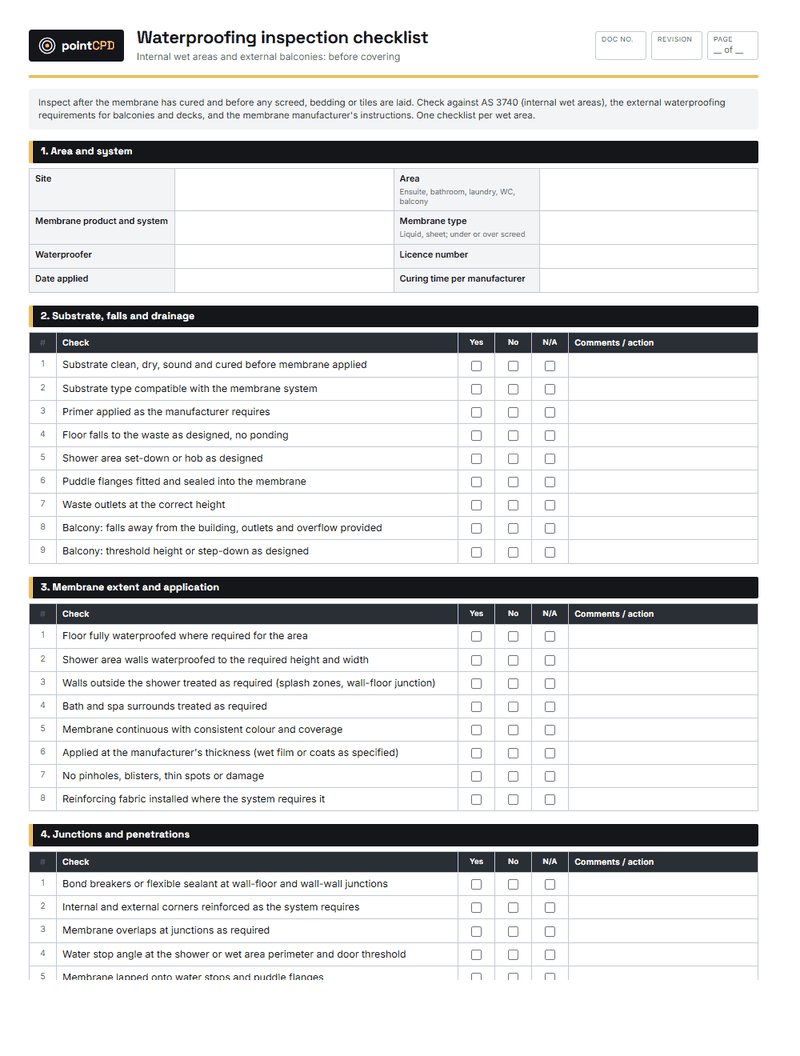
In NSW, waterproofing in wet areas is one of the critical stages that must be inspected before it is covered. The certifier will typically want to see the membrane before tiling and may require the applicator’s certificate. Builders should also photograph every wet area: the membrane, upturns, penetrations, bond breakers and falls, with a tape measure in shot to show heights.
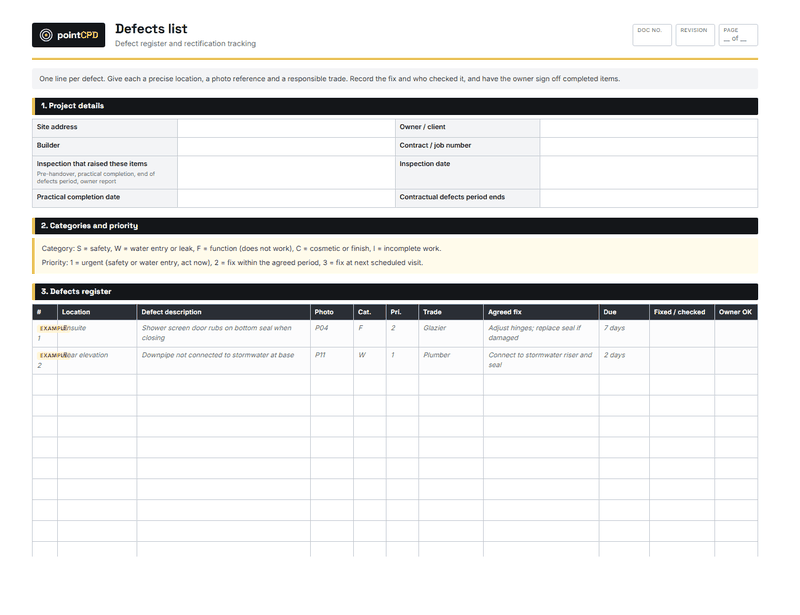
Those records matter years later. A leak three or four years after handover will be investigated, and the first question will be whether the membrane was installed correctly. Dated photos and a certificate are the builder’s best evidence.
Timber floors and upper storeys
Wet areas on timber floors and upper storeys carry higher risk. Timber moves more than concrete, so membranes need to accommodate that movement, and substrates such as compressed fibre cement or other suitable boards need to be installed as the system requires. A leak in an upstairs bathroom damages ceilings and rooms below, so the consequences are greater. Many builders apply extra care, such as flood testing and higher-extensibility membranes, to upstairs wet areas.
Renovations
Bathroom renovations carry their own risks: existing substrates of unknown condition, old membranes (or none), asbestos in older linings, and pressure from clients to minimise cost and time. Removing old tiles and membrane down to a sound substrate, checking framing and floor structure for water damage, and building a new, complete waterproofing system is the reliable approach. Tiling over old tiles and hoping is how renovation leaks start.
Laundries, kitchens and other wet areas
Showers get the attention, but laundries, toilets, and areas around baths and basins also have waterproofing or water resistance requirements under the rules. Laundry floors, where a washing machine can flood, and the junctions around freestanding baths are frequent sources of problems. Treat every wet area as a system and check the required extents for each one, not just the shower.
Choosing and managing the waterproofer
Waterproofing is specialist work. Use a competent, appropriately licensed waterproofer who follows the manufacturer’s system and the standard, and who provides a certificate for each wet area. Schedule the waterproofer with enough time for the membrane to cure before the tiler arrives, and make sure the plumber has installed wastes and penetrations in a way the waterproofer can seal properly. Many wet area failures come from poor sequencing between plumber, waterproofer and tiler.
A worked example: the upstairs ensuite
A builder is completing a two-storey home with an ensuite above the living room. The plan is a level-entry shower with a linear drain. At design stage, the builder confirms the set-down in the floor, the substrate and the falls with the engineer and designer. The plumber installs the linear drain at the right height with its flange. The waterproofer applies a higher-extensibility liquid membrane in two coats over a primed substrate, with bond breakers at the junctions, and seals the drain flange, tap penetrations and shower screen positions.
The builder photographs everything with a tape measure in shot, arranges a flood test of the shower area, and books the certifier’s wet area inspection before tiling. The tiler uses the adhesive and grout specified by the membrane system. Three years later, there has not been a single call about the ensuite. That is the unremarkable outcome good waterproofing is meant to produce.
The bottom line
Membranes rarely fail on their own. Wet areas fail at junctions without bond breakers, at poorly sealed penetrations, where membranes stop short, where falls are wrong, where membranes are too thin or tiled too soon, and where products are mixed. Choose a system, follow it exactly, sequence the trades properly, allow full cure, inspect and photograph before tiling, and keep the certificate. It is far cheaper than a new bathroom and a damaged ceiling.
Questions builders ask
What standard covers wet area waterproofing in houses?
The NCC Housing Provisions and AS 3740, the Australian Standard for waterproofing of domestic wet areas. Work to the edition that applies to your job.
Why do showers leak?
Usually because of details around the membrane: junctions without bond breakers, poorly sealed wastes and penetrations, membrane not taken to the required extent, poor falls, thin or uncured membranes, or incompatible products.
How long should a membrane cure before tiling?
As long as the manufacturer specifies for the conditions. Cure times are minimums, and cold or humid weather slows curing. Tiling too early is a common cause of failure.
Should I flood test a shower?
It is good practice for higher-risk areas such as upstairs bathrooms and level-entry showers. A recorded, passed flood test is strong evidence of a sound membrane.
Is wet area waterproofing inspected in NSW?
Yes. Waterproofing in wet areas is a critical stage inspection that must occur before it is covered.
Sources
- NCC Housing Provisions: wet areas · Australian Building Codes Board
- Environmental Planning and Assessment (Development Certification and Fire Safety) Regulation 2021 (critical stage inspections) · NSW Legislation
Published 24 August 2026. General information for builders, not legal, financial or engineering advice for a specific job. Check current requirements with the relevant regulator or standard before relying on them.