Skip to content
  • NSW-first CPD, built by a practising builder
  • Instant PDF certificates
  • Unlimited assessment attempts
  • 12 points a year, sorted
  • 15% off your first order — get your code
  • Content aligned to the NCC 2022

Free template Safety and WHS

Free JSA template (job safety analysis) for construction

Break any task into steps, identify the hazards in each, rate the risk and set controls before work starts. Built for everyday site tasks that are not on the SWMS list.

The short version

A job safety analysis breaks a task into steps, names the hazards in each step, rates the risk and sets controls before the work starts. It is not itself a legal requirement, but it is one of the simplest ways to show you have managed a task's risks so far as is reasonably practicable. For work on the high-risk construction work list, you need a SWMS as well.

  • No sign-up
  • Free for commercial use
  • Add your own logo
  • Updated 14 Sep 2026

Reviewed by Daniel Betros, Licensed Building Practitioner

Animated walkthrough · 7 steps

How to complete a JSA

Seven steps. Do it with the people who will do the job, ideally at the work area, not in the site shed.

1 / 7
  1. Name the task in plain words ("install gutter to rear elevation"), the location on site, and who is doing it. One JSA per task keeps it short enough to be read.

  2. Look at the actual conditions: ground, weather, overhead services, other trades working nearby, access and egress. Tick what applies. These are the hazards a desk-written JSA misses.

  3. Write the job as the crew will do it, from setting up to cleaning up. Five to ten steps is typical. If a step hides several actions, split it.

  4. For each step, ask what could hurt someone and how badly. Use the matrix to rate the risk before controls, so you can see where the real effort has to go.

  5. Remove the hazard if you can, then engineer or isolate it, then use procedures and PPE. Write each control so a worker knows exactly what to do, and put a name against it.

  6. Tick the protective equipment the task needs and agree what would make the crew stop and reassess: rain, a change in method, a new trade in the area.

  7. Everyone doing the task signs to say they were part of it and understand it. If conditions change mid-task, stop, update the JSA and re-brief.

A job safety analysis is the everyday workhorse of site safety paperwork. It takes one task, breaks it into the steps the crew will actually do, and forces the question that prevents most injuries: what could go wrong at this step, and what are we doing about it? This template is built to be filled in at the work area in ten minutes, not in the office.

What a JSA is for

A JSA sits between the quick personal check of a Take 5 and the formal SWMS. It is task-specific and crew-owned. The people doing the work list the steps, name the hazards, rate the risk and agree the controls, and in doing so they get a shared picture of the job before anyone picks up a tool.

Some businesses call the same document a JHA (job hazard analysis), a task risk assessment, or a safe work procedure. The name matters less than the method: steps, hazards, risk, controls, people.

Is a JSA required by law?

No Australian WHS law requires a document called a JSA. The law requires every business to eliminate risks so far as is reasonably practicable, and if that is not possible, to minimise them using the hierarchy of control. A JSA is simply one of the most practical ways to do that, and to show afterwards that you did.

The one document the law does name for construction is the safe work method statement, required before any of the high-risk construction work activities listed in the WHS Regulations. If a task involves, say, work where someone could fall more than 2 metres, or a trench deeper than 1.5 metres, a JSA does not replace the SWMS. Many builders use both: the SWMS for the high-risk work, and JSAs for the tasks around it.

JSA, SWMS or Take 5: which one?

DocumentUse it forLegally required?
Take 5A personal pre-task check by each worker, every time they start or change a taskNo, industry practice
JSAAny task the crew plans together, especially non-routine or multi-step tasksNo, but it evidences the risk management duty
SWMSHigh-risk construction work on the regulation’s listYes, before the work starts

How to write steps that reveal the hazards

The quality of a JSA is decided in the steps column. Too broad (“install roof”) and every hazard hides inside it. Too fine and nobody reads it. A good step is one action, in the order it happens, described with a verb: carry, lift, cut, fix, climb, pack down.

Include the parts people forget: getting the materials to the work area, setting up access, and cleaning up. A surprising share of site injuries happen during setup, manual handling and pack-down rather than during the main task.

Rating risk without overthinking it

The matrix on the template rates each step on likelihood and consequence. The point is not precision. It is to make the crew agree which steps are serious enough to need real controls, and to show that the controls brought the risk down. A step that is still rated high after controls is a signal to change the method, not to add more PPE.

Controls a crew can actually follow

Work down the hierarchy: eliminate, substitute, isolate, engineer, then administrative controls and PPE. Then check each control passes one test: could a new worker follow it without asking what it means? “Be careful with the saw” fails. “Blade guard fitted and checked, cut on the saw stool, no one within the cutting zone” passes.

Put a name in the “who” column. A control that belongs to everyone belongs to no one.

Keeping JSAs useful rather than filed

  1. Write it at the work area. The conditions checklist exists because desk-written JSAs miss the ground, the weather and the other trades.
  2. Keep it short. One task, one page of steps. Long JSAs are skimmed and signed.
  3. Update it when things change. Rain on clay, a different lift, a new sub in the area: stop, update, re-brief.
  4. Use the sign-on honestly. A signature means the worker took part or was briefed, not that they were handed a clipboard.
  5. Feed it back. Near misses and changes recorded on the JSA are the raw material for the next toolbox talk.

Where JSAs fit in your WHS system

Keep completed JSAs with the job records. They are evidence of consultation with workers, of risk assessment, and of supervision, all of which matter if a regulator or a court ever asks how a task was planned. For a full view of risks across a project, roll the recurring hazards into a risk register.

A worked example: installing a boundary fence

A JSA does not have to be long to be useful. Here is how a two-person crew might break down installing a colorbond boundary fence on a sloping residential block:

StepHazardsControls
Locate services along the fence lineStriking gas, water, power or telecommunications when digging post holesBefore You Dig Australia plans checked; line scanned with a locator; first 300 mm of each hole dug by hand near marked services
Dig post holes with a post-hole borerKick-back from the auger; noise; manual handling of the machineTwo-person borer with torque arm; hearing protection; rest breaks every hour on hard ground
Mix and pour concreteCement burns to skin and eyes; bag handlingGloves, long sleeves and eye protection; bags lifted from waist height off the ute tray
Fit rails and sheetsCuts from sheet edges; wind catching sheetsCut-resistant gloves; no sheeting in strong wind; one sheet at a time
Clean upOffcuts left on neighbour’s side; trip hazardsOffcuts collected into the bin as work progresses; site walked before leaving

None of that is complicated, but writing it down forces the service check before the first hole, which is the step most fence jobs skip. The same pattern works for any task: set-up, access, the work, clean-up.

Going digital without losing the point

Many builders now run JSAs in an app or a shared form on a phone, which makes them easy to complete at the work area, attach photos to, and store. That is a good change, as long as the method stays the same: the crew still discusses the steps together, the controls are still specific, and the sign-on still means people took part rather than tapped a button. A JSA template copied forward from the last job without a conversation is no better on a screen than on paper.

Whatever the format, keep completed JSAs with the job records and review them when planning similar work. The best source of a good JSA for next week’s task is last week’s, improved by what the crew found on the day.

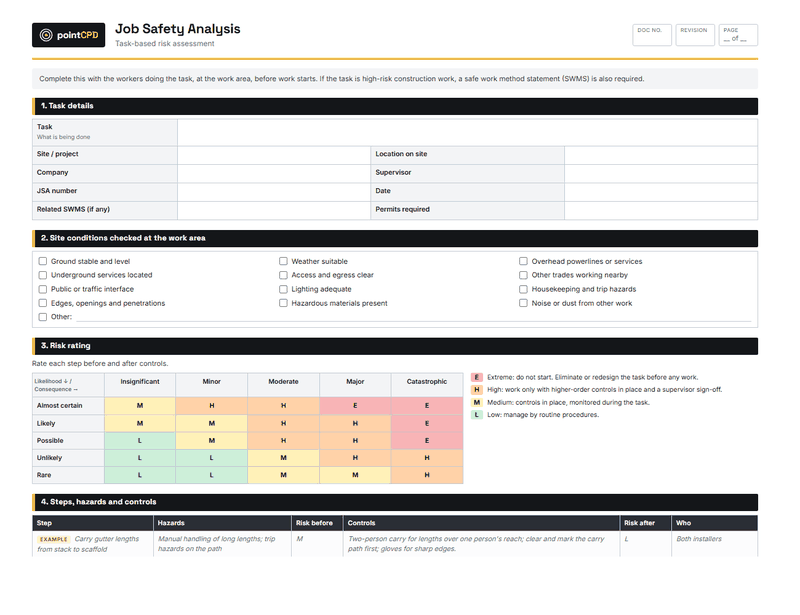
Preview the full Job Safety Analysis (JSA) template

Every section, field and check in the download, exactly as it prints. Edit the Word version to add your logo, delete what does not apply and add your own site-specific items.

pointCPD

Job Safety Analysis

Task-based risk assessment

Doc no.
Revision
Page
__ of __

Complete this with the workers doing the task, at the work area, before work starts. If the task is high-risk construction work, a safe work method statement (SWMS) is also required.

1. Task details

TaskWhat is being done
Site / projectLocation on site
CompanySupervisor
JSA numberDate
Related SWMS (if any)Permits required

2. Site conditions checked at the work area

  • Ground stable and level
  • Weather suitable
  • Overhead powerlines or services
  • Underground services located
  • Access and egress clear
  • Other trades working nearby
  • Public or traffic interface
  • Lighting adequate
  • Housekeeping and trip hazards
  • Edges, openings and penetrations
  • Hazardous materials present
  • Noise or dust from other work
  • Other:

3. Risk rating

Rate each step before and after controls.

Likelihood ↓ / Consequence →InsignificantMinorModerateMajorCatastrophic
Almost certainMHHEE
LikelyMMHHE
PossibleLMHHE
UnlikelyLLMHH
RareLLMMH
  • E Extreme: do not start. Eliminate or redesign the task before any work.
  • H High: work only with higher-order controls in place and a supervisor sign-off.
  • M Medium: controls in place, monitored during the task.
  • L Low: manage by routine procedures.

4. Steps, hazards and controls

StepHazardsRisk beforeControlsRisk afterWho
ExampleCarry gutter lengths from stack to scaffoldManual handling of long lengths; trip hazards on the pathMTwo-person carry for lengths over one person's reach; clear and mark the carry path first; gloves for sharp edges.LBoth installers
ExampleFix gutter brackets from the scaffoldFall from height; dropped tools onto path belowHScaffold with full edge protection and tag current; tool lanyards; exclusion zone below with barrier.MLeading hand

5. Protective equipment for this task

  • Hard hat
  • Safety glasses
  • Hi-vis
  • Safety boots
  • Gloves
  • Hearing protection
  • Respirator
  • Harness
  • Face shield
  • Sun protection
  • Knee pads
  • Long clothing
  • Other:

6. Stop-work triggers

Stop and reassess if: the weather changes, the method or equipment changes, another trade starts work in the area, a control cannot be put in place, or anyone feels unsafe. Update this JSA and re-brief before restarting.

7. Crew sign-on

I helped prepare or was briefed on this JSA, I understand it and I will follow it.

NameCompanyRoleSignatureDate

8. Supervisor review

Reviewed byDate
Changes made during the task
Template by PointCPD · pointcpd.com.au/resources/templates/jsa-template/Free to use, copy and adapt, including commercially (CC BY 4.0). Keep this credit line.v1.0

Download Word Download PDF

Questions builders ask

What is a JSA in construction?

A job safety analysis is a short, step-by-step risk assessment for one task. The crew lists the steps, names the hazards in each, rates the risk and agrees controls before starting. Some businesses call it a JHA (job hazard analysis) or a task risk assessment.

Is a JSA a legal requirement in Australia?

No specific law requires a document called a JSA. WHS laws require you to manage risks so far as is reasonably practicable, and a JSA is a common, practical way to show you did. For high-risk construction work, the law requires a SWMS.

What is the difference between a JSA and a SWMS?

A SWMS is the legally required document for the high-risk construction work activities in the WHS Regulations. A JSA can be used for any task. Many builders use JSAs for everyday work and a SWMS whenever work is on the high-risk list. See the SWMS template.

Who should fill in a JSA?

The workers doing the task, led by the supervisor or leading hand. People who do the work know where it goes wrong; a JSA written by someone off site tends to miss the hazards that matter.

How long should a JSA be?

As short as it can be while covering each step. One page of steps is typical. If it runs to many pages, split it into separate tasks.

When should a JSA be reviewed?

Whenever the task, the conditions or the crew change, after a near miss or incident, and if a control is not working. Write the change on the JSA and re-brief the crew.

Free to use, adapt and share, including commercially

This template is licensed under Creative Commons Attribution 4.0. Copy it, rebrand it, edit it for your jobs, hand it to clients and subcontractors, or republish it. The one condition: keep the small PointCPD credit line on the document. If you publish it online, credit it like this:

<a href="https://pointcpd.com.au/resources/templates/jsa-template/">Job Safety Analysis (JSA) template</a> by PointCPD, CC BY 4.0

Last reviewed 14 September 2026. A template is a starting point: it becomes a compliant document only once it is completed for the actual job by people who understand the work, and kept current as the work changes. General information, not legal advice. Check the requirements of your state regulator and your contract.

Sources: Safe Work Australia, Safe work method statement for high risk construction work: information sheet (on the difference between a SWMS and a JSA) and the model Code of Practice: How to manage work health and safety risks. Model Work Health and Safety Act and Regulations.