Skip to content
  • NSW-first CPD, built by a practising builder
  • Instant PDF certificates
  • Unlimited assessment attempts
  • 12 points a year, sorted
  • 15% off your first order — get your code
  • Content aligned to the NCC 2022

Free template Safety and WHS

Free toolbox talk template and attendance record

Plan a short safety talk, record what was discussed and what the crew raised, assign actions, and capture the attendance sheet, all on one form.

The short version

A toolbox talk is a short, informal safety meeting at the start of a shift or task, usually 10 to 15 minutes, on one topic. Record the topic, the key points, what workers raised, the actions agreed and who attended. It is one of the most practical ways to meet the WHS duty to consult workers, and the record is your evidence that you did.

  • No sign-up
  • Free for commercial use
  • Add your own logo
  • Updated 14 Sep 2026

Reviewed by Daniel Betros, Licensed Building Practitioner

Animated walkthrough · 6 steps

How to run and record a toolbox talk

Six steps. Keep it short, make it about this site, and let the crew do at least half the talking.

1 / 6
  1. Choose a topic tied to the work coming up or something that happened: a near miss, a new stage, the weather. One topic done well beats five skimmed.

  2. Write down the few things every person should leave knowing. Bring the SWMS, a photo, or the actual equipment if it helps.

  3. Ask the crew what could go wrong and what they have seen. Record what they raise in their words. This is the consultation part, and it is where the useful information comes from.

  4. Anything raised that needs fixing becomes an action with an owner and a due date. Tell the crew when it is done at the next talk.

  5. Everyone present signs. Note anyone absent who needs the information later, and brief them before they start.

  6. The supervisor signs off. Keep the record with the job WHS records, and close out the actions before the next talk.

Toolbox talks are where site safety is either real or theatre. Done well, they are ten minutes where the crew hears what is coming up, says what worries them, and leaves with a plan. Done badly, they are a clipboard passed around the lunch room. This template is built for the first kind: one topic, a record of what workers actually said, actions with names, and the attendance sheet.

What a toolbox talk is for

A toolbox talk is a short safety meeting on site, usually at the start of a shift or before a task. It has two jobs. The first is to tell the crew something they need to know about the work ahead: a new hazard, a change in method, a lesson from a near miss. The second, and the one most often skipped, is to listen. The people doing the work see the hazards first, and the talk is the easiest place for them to say so.

WHS laws require businesses to consult, so far as is reasonably practicable, with workers who are or are likely to be directly affected by a health and safety matter. That includes when identifying hazards, assessing risks, deciding on controls and proposing changes. Consultation means sharing information, giving workers a reasonable chance to express their views, and taking those views into account.

No law says “hold a toolbox talk”, but a regular, recorded talk where workers are asked for their views is one of the clearest ways to meet the consultation duty. That is why section 4 of the template records issues in the workers’ own words, and section 5 records what was done about them.

How to run one that people listen to

  1. One topic. Pick the thing most relevant to this week’s work.
  2. Make it about this site. “Ladders” is generic. “The ladder access to the first floor until the stairs go in on Thursday” is not.
  3. Show, do not tell. Bring the harness, the scaffold tag, the photo of the near miss.
  4. Ask questions. What could go wrong? Has anyone seen this go wrong before? What would make it easier to do safely?
  5. Close with actions. Anything raised gets an owner and a date, and the next talk starts with what was fixed.

Twenty toolbox talk topics for building sites

AreaTopics
HeightLadder use and set-up; scaffold tags and who may alter a scaffold; edge protection and penetrations; working from elevating work platforms
HealthSilica dust from cutting fibre cement, masonry and stone; asbestos in older homes; noise and hearing protection; heat stress and hydration; sun protection
Plant and powerMobile plant exclusion zones and spotters; overhead powerlines near tippers and pumps; extension leads and test and tag; hand-held power tool guards
GroundExcavation and trench safety; locating underground services before digging
EverydayManual handling and team lifts; housekeeping and trip hazards; hazardous chemicals and safety data sheets; reporting near misses; fatigue and fitness for work

What to record, and why

The record does three things. It proves the talk happened and who was there. It shows workers were consulted and what they raised. And it holds the actions that make the next talk worth attending. A record with only a topic and signatures proves attendance and little else.

Note anyone absent who needs the information, and brief them before they start work. That is often the gap: the subcontractor who arrives at 10am after the talk has finished.

Frequency

Weekly is common on residential sites, with extra talks when a new stage starts (frame, roof, fit-out), before an unusual high-risk task, and after any incident or near miss. On a small job the talk might be the supervisor and two trades standing at the tailgate; it still counts, and it is still worth recording.

Turning talks into a system

Read back through the actions every month. The same issue appearing three times means a control is not working and the SWMS or JSA needs to change. Hazards that cannot be fixed on the day belong on a hazard report so they are tracked to completion.

A sample 10-minute toolbox talk: silica dust

Here is how a supervisor might run a short talk before the cladding crew starts cutting fibre cement:

  1. Why today (1 minute). “Cladding starts this morning. Fibre cement contains crystalline silica, and cutting it dry puts fine dust in the air that causes silicosis. It does not hurt today; it shows up years later.”
  2. Key points (3 minutes). Score-and-snap or shears for straight cuts; saws only at the cutting station with extraction to the H-class vacuum; nobody cuts inside the house or upwind of other trades; P2 respirator on while cutting, fit-checked at the start of the shift.
  3. Show it (2 minutes). Demonstrate the extraction set-up and a fit check with the respirator.
  4. Ask (3 minutes). “What makes this hard to do properly? Where would you normally cut? Anything you need that we do not have?”
  5. Actions (1 minute). Record anything raised, with a name and date.

The crew might say the cutting station is too far from the scaffold, so people will be tempted to cut on the platform. That is the useful part: moving the station closer becomes the action, and the control is more likely to be followed.

Subcontractors and toolbox talks

On most residential sites, the majority of people working are subcontractors. Invite them. Talks about shared hazards, such as scaffolding, plant movement, housekeeping and the emergency plan, are relevant to everyone on site, and the consultation duty extends to coordinating with other businesses whose workers are affected. Where a subcontractor runs their own talks, ask for a copy of the attendance record for the site file. Where someone misses a talk that affects their work, brief them before they start and note it on the record.
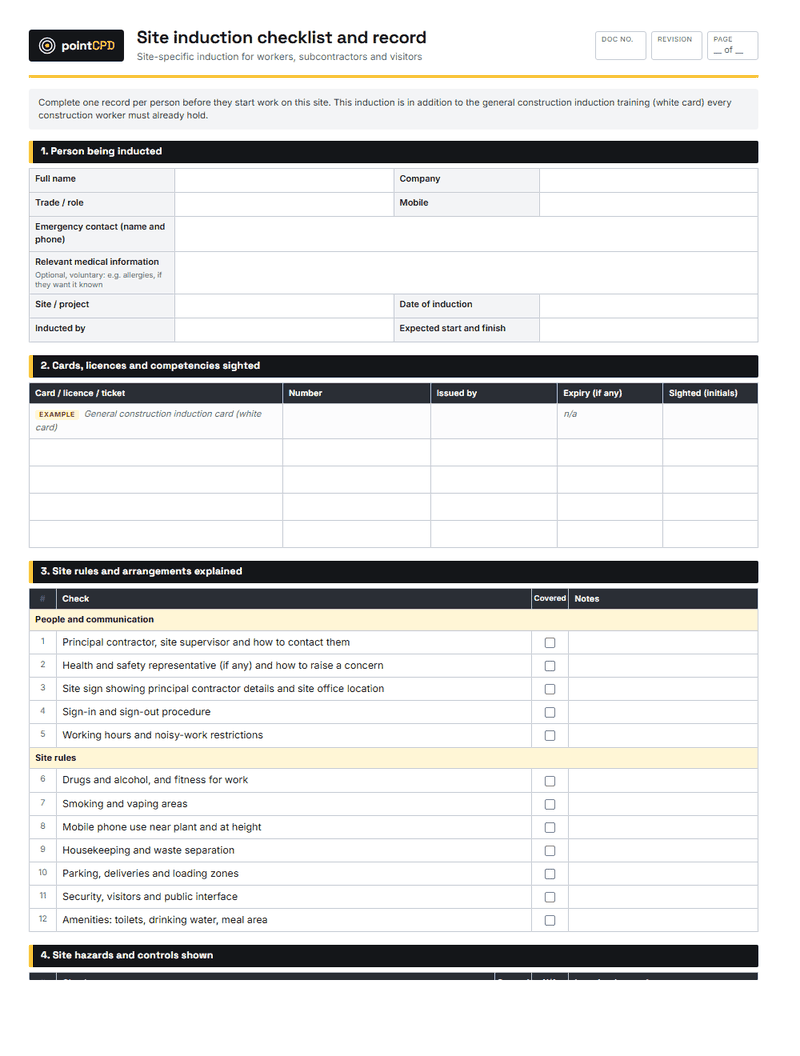
Preview the full Toolbox talk record template

Every section, field and check in the download, exactly as it prints. Edit the Word version to add your logo, delete what does not apply and add your own site-specific items.

pointCPD

Toolbox talk record

Safety discussion, actions and attendance

Doc no.
Revision
Page
__ of __

Keep talks short, on one topic, and specific to this site. Record what workers raise: it is evidence of consultation and the source of your best safety improvements.

1. Talk details

Site / projectDate and time
Presented byDuration
Topic
Reason for this topicUpcoming work, incident or near miss, new hazard, regular schedule

2. Key points covered

#Key point

3. Documents or materials referred to

  • SWMS
  • JSA
  • Safety data sheet
  • Incident or hazard report
  • Photos or diagrams
  • Equipment demonstration
  • Site rules
  • Code of practice or guidance
  • Manufacturer instructions
  • Other:

4. Issues and suggestions raised by workers

Raised byIssue or suggestion (in their words)

5. Actions agreed

ActionOwnerDueDone (date)
ExampleReplace damaged extension lead on level 1 and re-tag all leadsSite electricianTomorrow

6. Attendance

By signing I confirm I attended this talk and understood the key points.

NameCompanyTradeSignature

7. Supervisor sign-off

Workers absent who need briefing
SupervisorSignature and date
Template by PointCPD · pointcpd.com.au/resources/templates/toolbox-talk-template/Free to use, copy and adapt, including commercially (CC BY 4.0). Keep this credit line.v1.0

Download Word Download PDF

Questions builders ask

What is a toolbox talk?

A short, informal safety meeting held on site, usually at the start of a shift or before a particular task. It focuses on one topic and gives workers the chance to raise concerns.

Are toolbox talks a legal requirement?

No law names them, but WHS laws require businesses to consult workers on health and safety matters that affect them, including when identifying hazards and deciding on controls. Toolbox talks are one of the most common and practical ways of doing that, and the record evidences it.

How long should a toolbox talk be?

Usually 10 to 15 minutes. Long enough to cover one topic and hear from the crew; short enough that people stay engaged.

How often should toolbox talks be held?

Many sites hold them weekly, plus whenever a new stage or high-risk task starts, or after an incident or near miss. The right frequency is whatever keeps the crew informed as the job changes.

What are good toolbox talk topics for building sites?

Topics tied to the work in front of the crew: working at heights and ladders, scaffold tags, silica dust, manual handling, heat stress, electrical leads, excavation safety, mobile plant, housekeeping, hazardous chemicals, and lessons from recent near misses. The page lists twenty.

Do toolbox talk records need to be kept?

Keep them with the project WHS records. They show consultation happened, what workers were told, and what was done about the issues they raised.

Free to use, adapt and share, including commercially

This template is licensed under Creative Commons Attribution 4.0. Copy it, rebrand it, edit it for your jobs, hand it to clients and subcontractors, or republish it. The one condition: keep the small PointCPD credit line on the document. If you publish it online, credit it like this:

<a href="https://pointcpd.com.au/resources/templates/toolbox-talk-template/">Toolbox talk record template</a> by PointCPD, CC BY 4.0

Last reviewed 14 September 2026. A template is a starting point: it becomes a compliant document only once it is completed for the actual job by people who understand the work, and kept current as the work changes. General information, not legal advice. Check the requirements of your state regulator and your contract.

Sources: Model Work Health and Safety Act (duty to consult workers) and Safe Work Australia, Code of Practice: Work health and safety consultation, cooperation and coordination.