Skip to content
  • NSW-first CPD, built by a practising builder
  • Instant PDF certificates
  • Unlimited assessment attempts
  • 12 points a year, sorted
  • 15% off your first order — get your code
  • Content aligned to the NCC 2022

Free template Safety and WHS

Free incident report form for construction sites

Record what happened, who was involved, the injury or damage, whether it is notifiable to the regulator, what caused it and what will stop it happening again.

The short version

Record every incident, including near misses, as soon as the injured person is cared for and the area is safe. If it is a notifiable incident (a death, a serious injury or illness, or a dangerous incident), the business must notify the WHS regulator immediately and must not disturb the site until an inspector says so, except to help the injured, make it safe or assist police. The form walks you through that check.

  • No sign-up
  • Free for commercial use
  • Add your own logo
  • Updated 14 Sep 2026

Reviewed by Daniel Betros, Licensed Building Practitioner

Animated walkthrough · 7 steps

How to complete an incident report

Seven steps. People first, then the notifiable check, then the facts while they are fresh.

1 / 7
  1. First aid, call emergency services if needed, and make the area safe. Record what was done and when. Nothing else on the form matters until this is done.

  2. Work through the notifiable incident check. If it is notifiable, call the regulator straight away and preserve the site. Record who you spoke to and the reference number.

  3. When, where, who was involved and who saw it. Get witness names and numbers before people leave site.

  4. Write what happened before, during and after, as facts, not blame. Photos and a sketch help. Use the words of the people involved where you can.

  5. Nature and part of the body, treatment given, whether the person went to a doctor or hospital, and any plant, property or environmental damage.

  6. Ask why it happened until you reach something you can change: the method, the equipment, the supervision, the planning. Assign corrective actions with owners and dates.

  7. Supervisor and manager sign when the actions are complete. Keep notifiable incident records for the period the law requires, and update the SWMS or JSA if the controls changed.

An incident report does three things at once: it records the facts while they are fresh, it decides whether the regulator has to be told, and it turns a bad day into a fix that stops it happening again. This form is laid out in that order, because the order matters. People first, the notifiable check second, the paperwork after.

First, the people and the site

Nothing on the form comes before first aid and making the area safe. Section 1 records what was done, by whom and when, because the quality of the immediate response is often the first thing an inspector asks about.

Is it notifiable? The check that cannot wait

Under the WHS laws, a notifiable incident is a death, a serious injury or illness, or a dangerous incident arising from the business’s work. Serious injuries include those needing immediate treatment as a hospital in-patient, and immediate treatment for injuries such as amputations, serious head or eye injuries, serious burns, spinal injuries and serious lacerations. Dangerous incidents cover events that exposed people to a serious risk even if no one was hurt: the collapse of a structure or an excavation, a fall of materials from height, an electric shock, an uncontrolled fire, explosion or gas leak, and failures of licensed or registered plant.

For a builder, the dangerous-incident list is the one that catches people out. A trench wall that collapses overnight, a pallet of tiles dropped from a crane, a worker who gets a tingle from a lead: none may have hurt anyone, and all may be notifiable.

If it is notifiable, the business must notify the regulator immediately after becoming aware of it, by the fastest means available. If the regulator asks for written notice, it must be given within the period the Act sets. And the site must be preserved until an inspector arrives or says otherwise, with exceptions for helping the injured, removing a deceased person, making the site safe, and assisting police.

Getting the facts down

Record the facts before people leave site. Witness names and phone numbers are the most commonly missing detail in incident files, and the hardest to recover a week later. Describe what happened in order: what was being done, what changed, what happened, what was done next. Write facts, not conclusions. “The ladder moved” is a fact; “he was careless” is not, and it ends the investigation before it starts.

Photos taken before anything is moved, a quick sketch with distances, and the SWMS or JSA that covered the task all belong with the report.

Finding causes you can actually fix

Most incident reports stop at the immediate cause: someone slipped, a tool failed. Section 8 asks for contributing causes, found by asking “why?” until you reach something the business can change. Why did the ladder move? It was on soft ground. Why was a ladder used on soft ground? There was no platform available for side-setback work. Why? It was not in the plan. The fix is in the plan, not the worker.

Corrective actions should work down the hierarchy of control. “Retrain worker” on its own is rarely the right answer. Each action needs an owner and a date, and the report is not closed until they are done.

Near misses count

A near miss is an incident where luck did the work your controls should have done. Recording near misses is the cheapest safety information a business can get, and a crew that sees near-miss reports acted on will report more of them. Share the outcomes at the next toolbox talk.

After the report

  • Update the SWMS or JSA if the controls changed. A revised SWMS must be re-briefed to the workers and, on a construction project, given to the principal contractor.
  • Tell your insurer as your policy requires. Workers compensation claims are a separate process from the WHS report.
  • Keep the records. Notifiable incident records must be kept for the period the WHS Act sets, at least five years under the model laws, and a SWMS connected with a notifiable incident must be kept for at least two years.
  • Look for patterns. Three minor incidents with the same cause is a warning, not a coincidence.

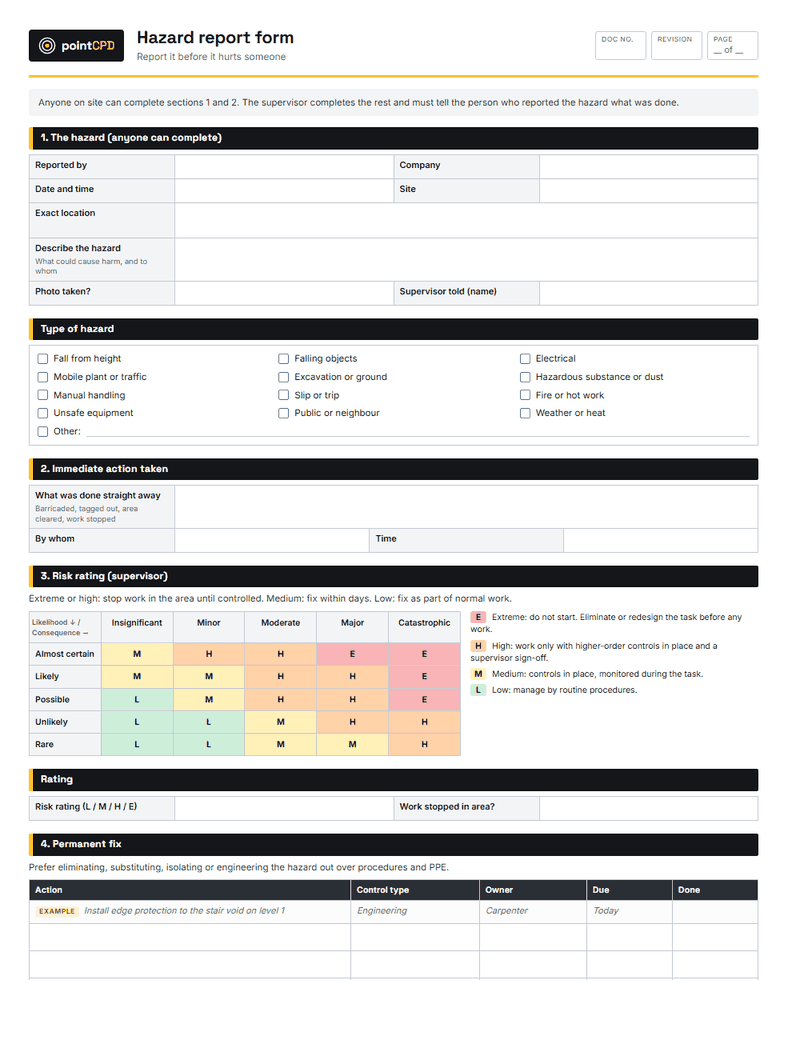
For hazards spotted before anything happens, use the hazard report form, and make sure the site emergency plan covers the incidents this form most often records.

A worked example

A labourer carrying a sheet of plasterboard trips on an offcut in the hallway and falls, injuring their wrist. The supervisor gives first aid and drives them to a medical centre, where an x-ray shows a fracture treated in the clinic, not as a hospital in-patient. Using the form:

  • Notifiable check: not a death, and not immediate in-patient hospital treatment or one of the listed serious injuries; not a dangerous incident. On those facts, likely not notifiable, but the supervisor records the reasoning and checks the regulator’s guidance if unsure.
  • What happened: hallway, level 1, 2.15pm; carrying a full sheet alone; offcuts from the morning’s cutting left on the floor.
  • Causes: offcuts not cleared as work progressed; full sheets carried by one person along a cluttered route; no designated cutting area.
  • Actions: a cutting area with a bin set up on each level; two-person carries for full sheets; housekeeping added to the daily supervisor check; the incident discussed at the next toolbox talk.

The report took twenty minutes. The actions will prevent the next one.

Talking to the injured worker and witnesses

People remember events differently, and quickly. Talk to the injured worker, once they are cared for, and to witnesses separately, as soon as practicable. Ask open questions: “Tell me what happened from when you picked up the sheet.” Write down what they say in their words and have them read it back. Avoid questions that suggest blame, which make people defensive and hide the real causes.

Look after the people involved, too. A serious incident affects the whole crew. Check on the injured worker during their recovery, plan their return to work with their doctor and your insurer, and make sure witnesses have support if they need it. How a business treats people after an incident shapes whether anyone reports the next one.
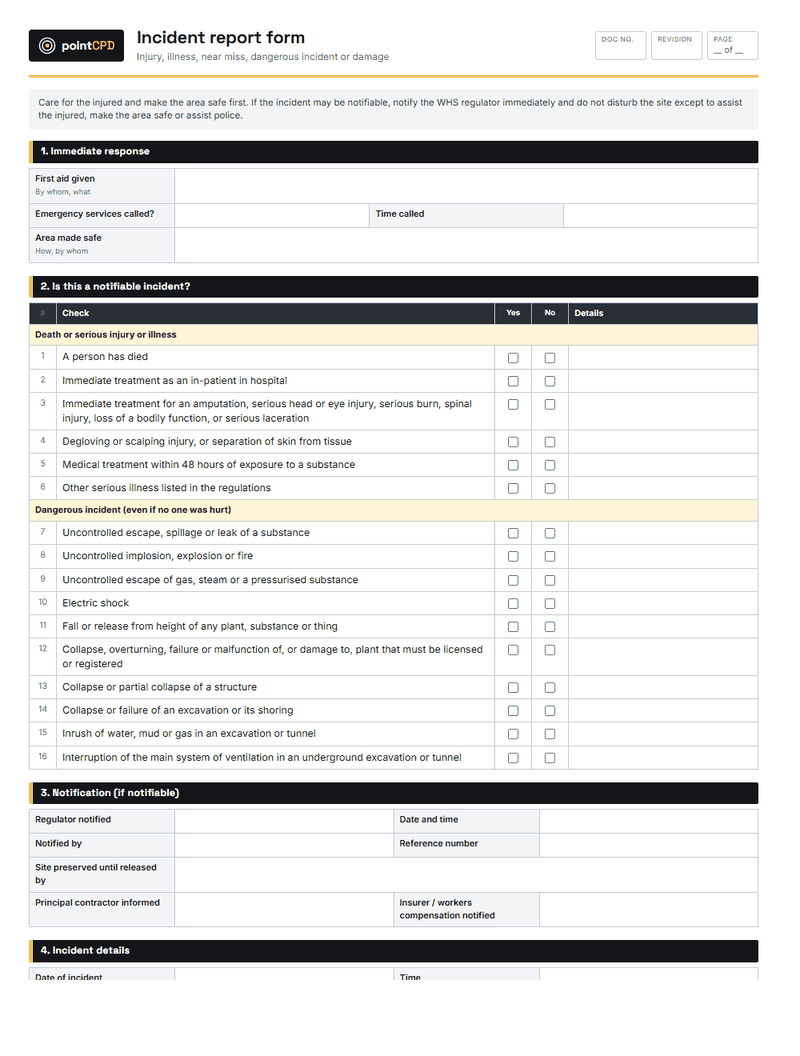
Preview the full Incident report form template

Every section, field and check in the download, exactly as it prints. Edit the Word version to add your logo, delete what does not apply and add your own site-specific items.

pointCPD

Incident report form

Injury, illness, near miss, dangerous incident or damage

Doc no.
Revision
Page
__ of __

Care for the injured and make the area safe first. If the incident may be notifiable, notify the WHS regulator immediately and do not disturb the site except to assist the injured, make the area safe or assist police.

1. Immediate response

First aid givenBy whom, what
Emergency services called?Time called
Area made safeHow, by whom

2. Is this a notifiable incident?

#CheckYesNoDetails
Death or serious injury or illness
1A person has died
2Immediate treatment as an in-patient in hospital
3Immediate treatment for an amputation, serious head or eye injury, serious burn, spinal injury, loss of a bodily function, or serious laceration
4Degloving or scalping injury, or separation of skin from tissue
5Medical treatment within 48 hours of exposure to a substance
6Other serious illness listed in the regulations
Dangerous incident (even if no one was hurt)
7Uncontrolled escape, spillage or leak of a substance
8Uncontrolled implosion, explosion or fire
9Uncontrolled escape of gas, steam or a pressurised substance
10Electric shock
11Fall or release from height of any plant, substance or thing
12Collapse, overturning, failure or malfunction of, or damage to, plant that must be licensed or registered
13Collapse or partial collapse of a structure
14Collapse or failure of an excavation or its shoring
15Inrush of water, mud or gas in an excavation or tunnel
16Interruption of the main system of ventilation in an underground excavation or tunnel

3. Notification (if notifiable)

Regulator notifiedDate and time
Notified byReference number
Site preserved until released by
Principal contractor informedInsurer / workers compensation notified

4. Incident details

Date of incidentTime
Site / projectExact location
Person(s) involvedName, company, role
WitnessesName and phone
Task being done at the time
SWMS / JSA in place?Supervisor on site

5. Type of incident

  • Injury
  • Illness
  • Near miss
  • Dangerous incident
  • Plant or equipment damage
  • Property damage
  • Environmental
  • Public or neighbour
  • Security or theft
  • Other:

6. What happened

Describe the events before, during and immediately after the incident, in order, as facts. Attach photos, a sketch and witness statements. Use additional pages if needed.

7. Injury, illness or damage

Nature of injury or illnesse.g. laceration, fracture, burn, strainPart of body
Treatment givenReferred to doctor / hospital?
Time off work expected?Returned to work (date)
Plant, property or environmental damage

8. Causes and corrective actions

Keep asking why until you reach a cause you can change. Controls should work down the hierarchy: eliminate, substitute, isolate, engineer, then procedures and PPE.

Contributing causeCorrective actionOwnerDueCompleted
ExampleLadder used on uneven, unconsolidated ground at the side setbackMobile scaffold or platform ladder on a levelled base for side-setback work; ladder use reviewed at next toolbox talkSupervisor3 days

9. Review and sign-off

Report completed byDate
Reviewed by (supervisor)Date
SWMS / JSA updated?Crew briefed on outcome?
Closed out by (manager)Date
Template by PointCPD · pointcpd.com.au/resources/templates/incident-report-form/Free to use, copy and adapt, including commercially (CC BY 4.0). Keep this credit line.v1.0

Download Word Download PDF

Questions builders ask

What is a notifiable incident?

Under the WHS laws, a notifiable incident is the death of a person, a serious injury or illness, or a dangerous incident arising out of the conduct of a business. The regulations and the Act list what counts as serious and dangerous; the checklist on the form sets them out in plain words.

How quickly must a notifiable incident be reported?

Immediately after the business becomes aware of it, by the fastest possible means (usually phone). If the regulator asks for written notice, it must be given within the time the Act sets, which under the model laws is 48 hours.

Can I clean up after an incident?

Not if it is notifiable. The site must be preserved until an inspector arrives or directs otherwise, except to assist an injured person, remove a deceased person, make the site safe or minimise the risk of a further incident, or help police.

Should near misses be reported?

Yes. A near miss is an incident where no one was hurt this time. Recording them is the cheapest way to find and fix hazards before they injure someone, and some near misses are dangerous incidents that must be notified.

How long must incident records be kept?

Records of notifiable incidents must be kept for the period the WHS Act requires, which under the model laws is at least five years from the date of notification. Keep all incident records with the project and business WHS records.

Is an incident report the same as a workers compensation claim?

No. The incident report is your internal and WHS record. A workers compensation claim is a separate process through your insurer, with its own forms and deadlines. Notify your insurer as your policy requires.

Free to use, adapt and share, including commercially

This template is licensed under Creative Commons Attribution 4.0. Copy it, rebrand it, edit it for your jobs, hand it to clients and subcontractors, or republish it. The one condition: keep the small PointCPD credit line on the document. If you publish it online, credit it like this:

<a href="https://pointcpd.com.au/resources/templates/incident-report-form/">Incident report form template</a> by PointCPD, CC BY 4.0

Last reviewed 14 September 2026. A template is a starting point: it becomes a compliant document only once it is completed for the actual job by people who understand the work, and kept current as the work changes. General information, not legal advice. Check the requirements of your state regulator and your contract.

Sources: Model Work Health and Safety Act (notifiable incidents, preservation of sites, record keeping) and Regulations. Safe Work Australia, Incident notification information sheet. Check your state or territory regulator for how to notify.