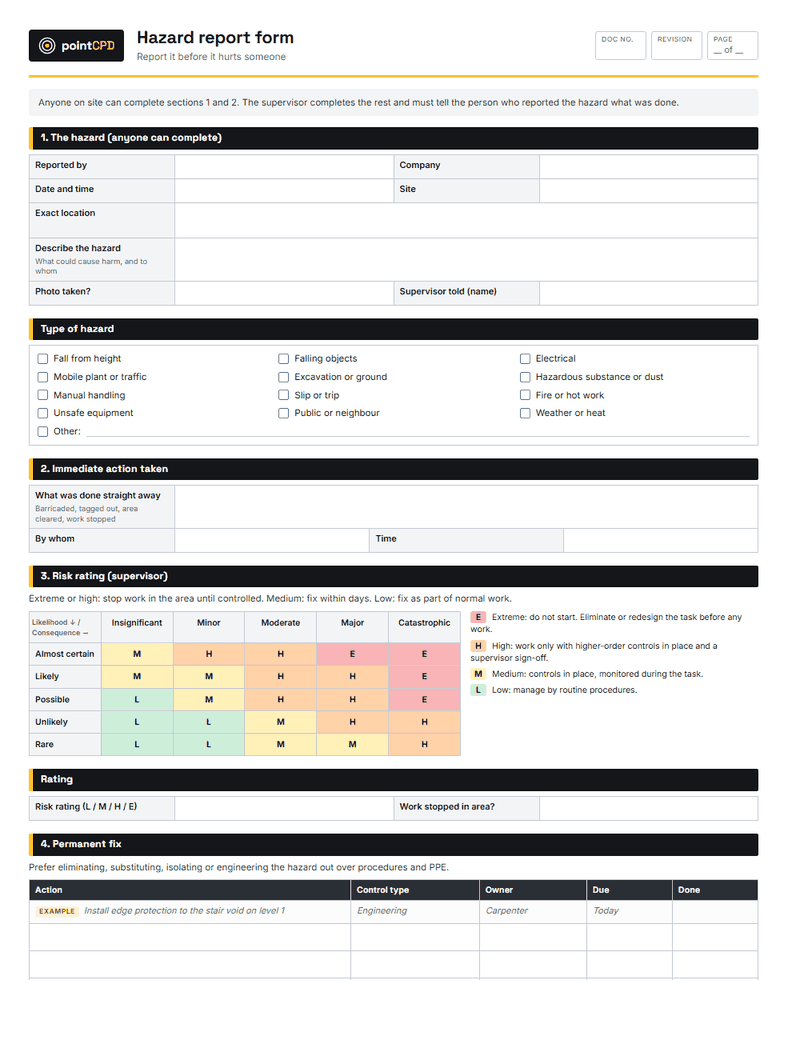
Every serious site injury is preceded by a hazard someone noticed and did not report, or reported and saw nothing happen. A hazard report form fixes both halves of that problem: it makes reporting quick enough that people do it, and it tracks the hazard until someone has fixed it and told the reporter. This template does both on one page.
Hazards, incidents and near misses
A hazard is anything that could cause harm: a missing guardrail, a frayed lead, a pallet stacked too high, a trench with no batter. An incident is an event where harm happened or nearly happened. The hazard report sits before the incident. Its whole value is in catching the problem while the cost of fixing it is a few minutes’ work rather than an injury, an investigation and a stopped site.
The legal basis: identify, assess, control
WHS laws require businesses to identify reasonably foreseeable hazards, eliminate the risks they create so far as is reasonably practicable, and otherwise minimise them using the hierarchy of control. Workers have a duty to take reasonable care and to cooperate with reasonable safety instructions. A hazard reporting system connects the two: workers identify, supervisors control.
Make reporting easy, and make it safe to report
Sections 1 and 2 of the template are deliberately short, so anyone can complete them in a couple of minutes. The most important parts are the exact location, a one-line description and a photo. The biggest barrier to reporting is not the form; it is whether people think they will be blamed or ignored. Two habits change that:
- Thank people for reporting, publicly at the toolbox talk where appropriate.
- Close the loop. Tell the reporter what was done. It is the last line of the close-out checklist for a reason.
Rating: how fast does it need fixing?
The supervisor rates the risk on the matrix. The rating sets the response. An extreme or high risk means work in that area stops until it is controlled; there is no “fix it later” for an open stair void on a site with trades working. A medium risk gets a fix within days, a low risk as part of normal work. Whatever the rating, the fix gets an owner and a date.
Fixes that last: use the hierarchy
| Hazard | Weak response | Real fix |
|---|---|---|
| Open stair void | “Danger” sign and a verbal warning | Edge protection or a secured cover installed before work continues |
| Damaged extension lead | Tape over the damage | Lead removed from service, tagged out, replaced; leads inspected |
| Cutting fibre cement in the open | Tell people to stay away | Score-and-snap tools, or saw with extraction and a set cutting area |
| Materials stacked on a slab edge | Remind the delivery driver | Designated set-down area agreed and marked; supplier told |
Close-out is where most systems fail
A hazard register full of open items is worse than useless: it proves the business knew and did nothing. Section 5 makes close-out explicit. Check the fix works. Ask whether the SWMS, JSA or site rules need to change so it does not recur. Tell the crew. Tell the reporter. Only then sign it off.
From individual reports to a pattern
Review hazard reports every few weeks. The same hazard appearing repeatedly, the same trade, the same stage of the job: those patterns tell you where the system is weak. Feed them into the project risk register and your weekly site inspection, so the next job starts with the fix built in.
What a good hazard report looks like
Compare two reports about the same problem:
| Weak report | Useful report |
|---|---|
| “Scaffold dodgy” | “North scaffold, second lift, near the corner downpipe: two planks lifted and not refixed, gap of about 400 mm. Photo attached. Taped off the bay; told the supervisor at 9.40am.” |
| “Leads everywhere” | “Level 1 hallway: three extension leads run through water pooling at the base of the stairs. Tags on two are out of date. Photo attached.” |
The useful reports say exactly where, exactly what, what was done immediately and who was told. They can be acted on in minutes. Show examples like these at the induction so people know what a good report looks like.
Building a reporting culture on a small site
On a residential job with five or six trades, formal systems can feel like overkill. The principles still work at that scale:
- Make it easy: a pad of forms in the site box, or a photo and a text message to the supervisor that the supervisor then records.
- Act visibly: when a hazard is fixed, say so at the next toolbox talk and name who reported it, if they are comfortable with that.
- Never punish the reporter: even when the hazard was theirs. The first time someone is blamed for reporting, reporting stops.
- Include subcontractors: they see hazards created by other trades that your own people never walk past.
Over a year, a steady trickle of hazard reports on small jobs is a sign of a healthy site. Silence usually is not.