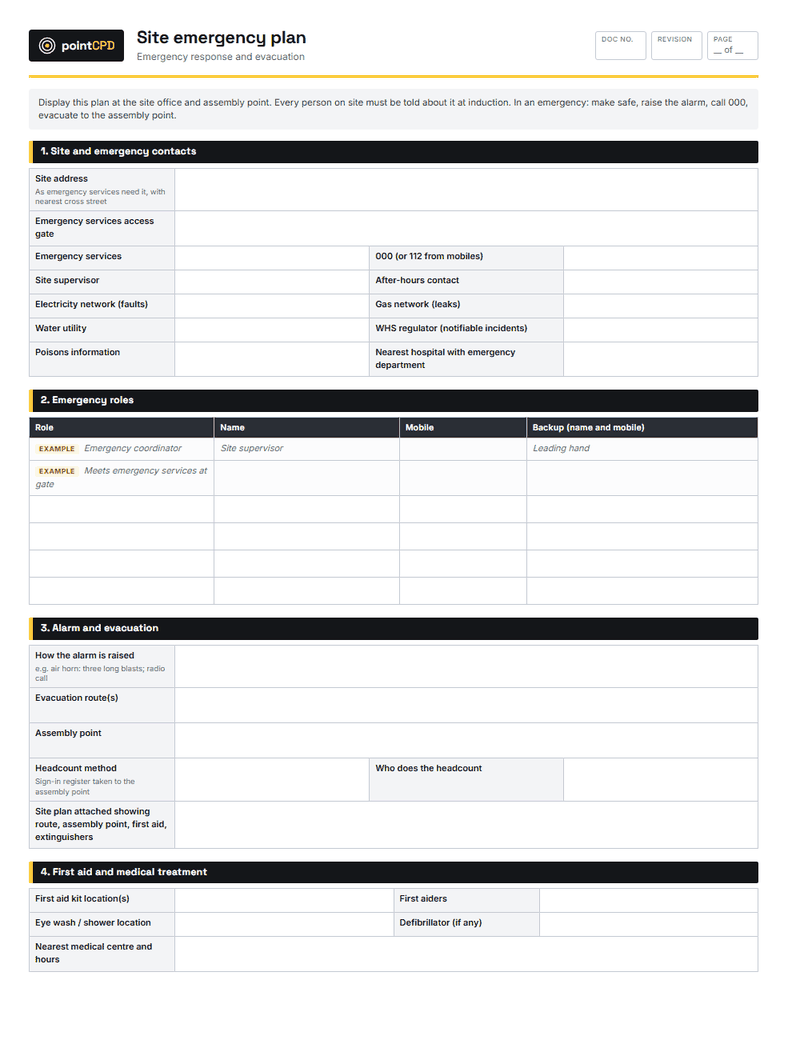
Most building sites have an emergency plan that nobody has read: a laminated sheet in the site shed with a phone number on it. When something actually happens, what matters is whether people know how the alarm sounds, where to go, who is in charge, and how a worker hanging in a harness is going to be brought down. This template covers all of it on a few pages, written for one site.
What the law requires
WHS laws require every workplace to have an emergency plan, and a building site is a workplace. The plan must provide for:
- an effective response to an emergency;
- evacuation procedures;
- notifying emergency services at the earliest opportunity;
- medical treatment and assistance;
- effective communication between the person authorised to coordinate the response and everyone at the workplace; and
- testing of the procedures, including how often.
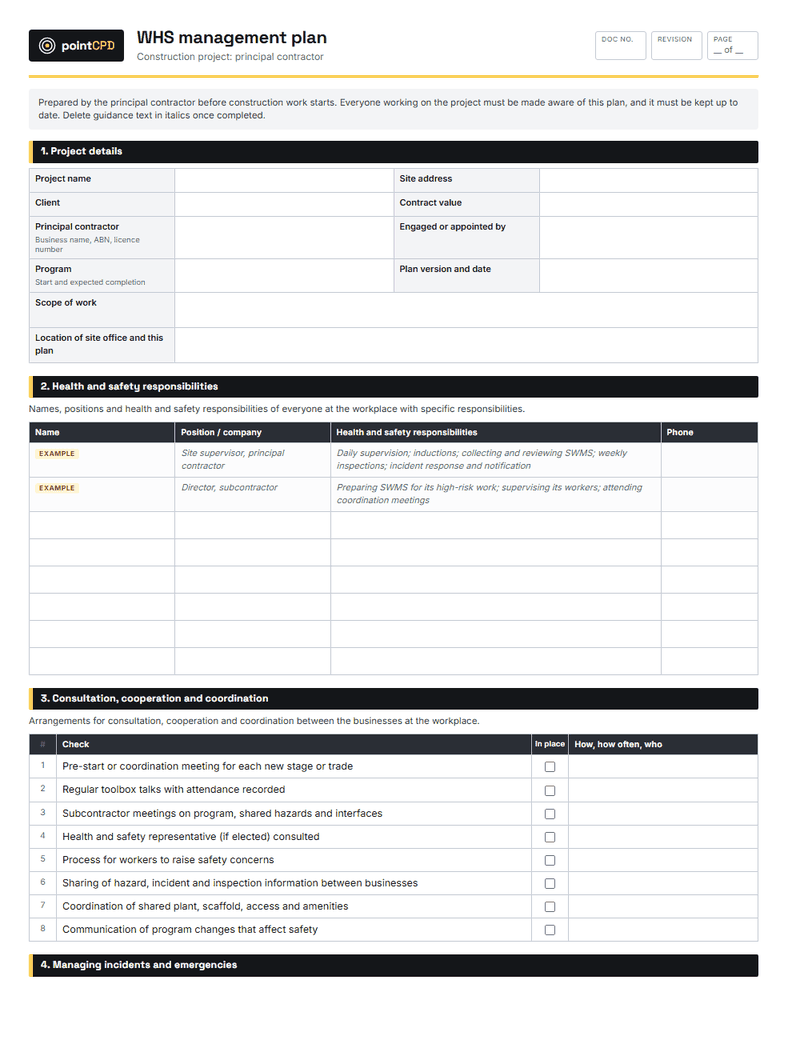
Workers must also be given information, training and instruction about the plan. On a construction project the principal contractor’s WHS management plan must set out arrangements for managing incidents, and the emergency plan is where the detail lives.
Write it so emergency services can find you
Section 1 starts with the address as an ambulance driver would need it: street number, nearest cross street, and which gate to use. On new estates without street numbers, or long rural driveways, this is the difference between minutes and a search. Name the person who will meet emergency services at the gate.
Raising the alarm without a fire panel
Commercial buildings have alarm systems; building sites usually do not. Agree a signal, commonly an air horn or whistle, and make sure it can be heard across the whole site over machinery. Back it up with radio or a group phone message. Explain it at induction and use it in the drill, so people recognise it.
Rescue: the gap in most construction plans
Some emergencies cannot wait for emergency services. A worker suspended in a harness after a fall arrest can be seriously harmed by suspension itself, so rescue needs to be fast. A worker trapped in a collapsed trench must not be approached by untrained people who may trigger a second collapse. A person collapsed in a confined space is the classic scenario where would-be rescuers become victims.
Section 5 makes you plan each relevant rescue before the work starts: the method, the equipment and who is trained to use it. If the plan relies on a piece of plant, such as an elevating work platform to reach a suspended worker, it has to be on site and available whenever that work is happening.
Specific procedures, kept short
Section 6 lists the emergencies most likely on a residential or light commercial site. Keep each procedure to the first few actions: what to do in the first minute. Long procedures are not read in an emergency. Include the ones that matter for your site’s location, such as bushfire, flood or proximity to a gas main.
Test it
A drill is the only way to find out that the air horn cannot be heard from the back of the block, that the assembly point is where the concrete truck parks, or that nobody took the sign-in register to the headcount. Record each drill in section 8: how long it took to account for everyone, what went wrong, and what was changed. Re-test when the site changes significantly, such as when scaffold goes up or the access route changes.
Keeping it in front of people
- Display it at the site office and the assembly point, with a site plan.
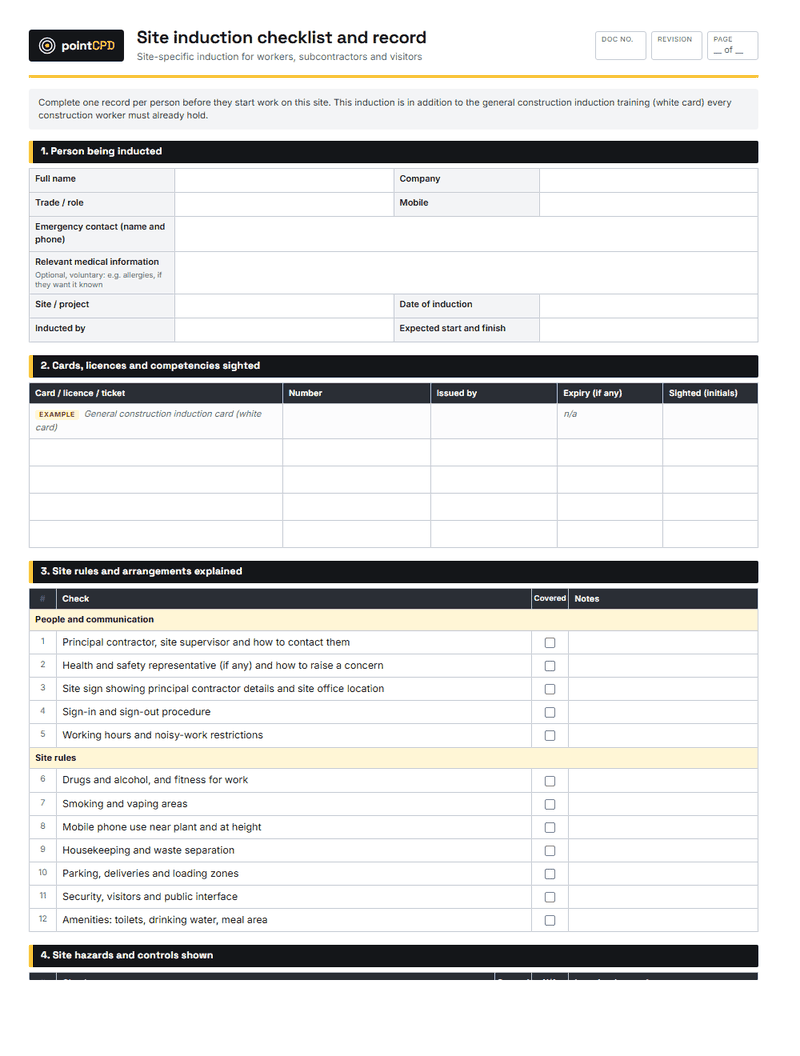
- Cover it at induction, walking the evacuation route where you can. The induction checklist has it built in.
- Update contacts whenever the supervisor or first aider changes.
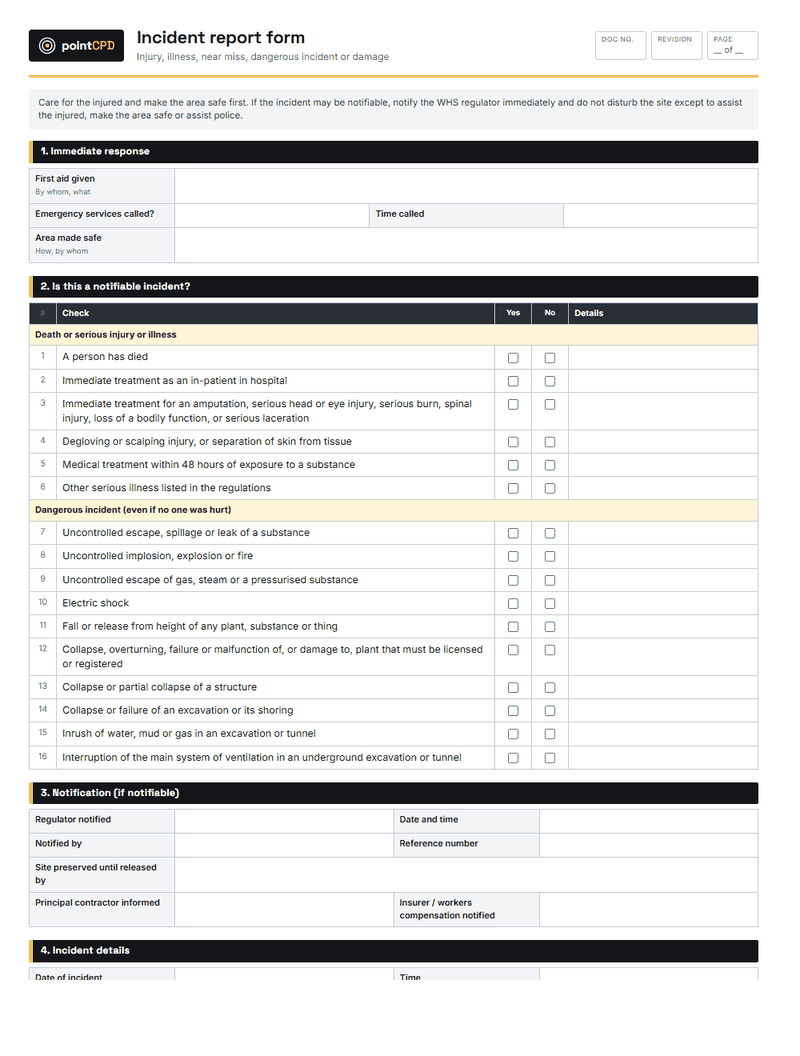
- Review it after any incident, using what the incident report found.
Emergency planning on small residential sites
A single house site with a supervisor and a few trades does not need a thick emergency manual. It needs a one-page plan that answers the questions people will actually have in the first minute:
- Where are we? The address and access gate, written for the ambulance.
- Who is in charge? The supervisor, and who takes over when they are not on site.
- How do we raise the alarm? The agreed signal.
- Where do we go? The assembly point, usually the footpath or the neighbour’s driveway with permission.
- Where is the first aid kit? And who is the first aider today.
- What if someone is stuck? The rescue arrangements for the work actually happening.
The template’s other sections add detail as the site grows, but those six answers are the core.
Working alone and after hours
Residential sites often have one trade working alone, early, late or on weekends. An emergency plan that relies on a supervisor raising the alarm does not help a lone worker who has fallen from a ladder. Arrangements for lone work might include a check-in call at set times, a rule that high-risk tasks such as work at height are never done alone, and making sure the lone worker has a charged phone and knows the site address. Record the arrangements in the plan and cover them at induction. For after-hours site security issues, make sure the after-hours contact on the site sign reaches someone who will answer.