Key takeaways
- The manufacture, supply, processing and installation of engineered stone benchtops, panels and slabs has been prohibited in Australia since 1 July 2024. Importing it has been prohibited since 1 January 2025.
- Removal, repair, minor modification and disposal of engineered stone already installed is still allowed, but only with strict silica controls.
- Since 1 September 2024, model WHS Regulations cover all crystalline silica substances, meaning products with more than 1% crystalline silica by weight. That includes concrete, bricks, tiles, pavers and natural stone.
- Where processing a crystalline silica substance is high risk, the business must put controls in place and document them. Dry cutting and dry sweeping have no place on a modern site.
- Builders are exposed through what they specify, what clients ask for, and what their own trades cut every day.
Engineered stone was the default kitchen benchtop in Australia for a generation. It was cheap, consistent and easy to sell. It was also, for the stonemasons who cut and polished it, one of the most dangerous materials in the building industry. Engineered stone typically contains very high levels of crystalline silica, and cutting it releases respirable dust that can cause silicosis, an incurable and often fatal lung disease.
Australia became the first country to ban it. Since 1 July 2024, the manufacture, supply, processing and installation of engineered stone benchtops, panels and slabs has been prohibited. But the ban is only the headline. The silica rules that came with it reach every builder who cuts concrete, brick, tile or stone, which is to say every builder.
How the ban and the silica rules arrived
- 1 July 2024Engineered stone prohibitedManufacture, supply, processing and installation of engineered stone benchtops, panels and slabs banned under WHS laws.
- 1 September 2024Silica regulationsModel WHS Regulations for crystalline silica substances (more than 1% crystalline silica by weight) start.
- 1 January 2025Import banImporting engineered stone benchtops, panels and slabs prohibited.
Source: Safe Work Australia, engineered stone ban. Dates can differ slightly by jurisdiction; check your state regulator.
Why the ban happened
Through the 2010s, doctors and regulators began seeing a wave of silicosis among young stonemasons who fabricated and installed engineered stone benchtops. Unlike the slow-developing silicosis historically seen in miners and quarry workers, many of these cases were accelerated: serious disease after a relatively short working life, in workers in their twenties and thirties. Screening programs in several states found significant numbers of affected workers.
Regulators first tried tighter controls: lower exposure limits, bans on uncontrolled dry cutting, and codes of practice. The evidence that followed suggested controls alone were not protecting workers in a sector made up largely of small fabrication shops. Safe Work Australia recommended a prohibition, and in December 2023 Commonwealth, state and territory WHS ministers agreed to ban engineered stone, with the prohibition taking effect from 1 July 2024.
The lesson for builders is that the rules on silica tightened because the problem was real and the controls on the ground were not working. Regulators are not going to relax them.
What the engineered stone ban covers
The prohibition applies to engineered stone benchtops, panels and slabs. Under the WHS laws, businesses cannot manufacture, supply, process or install them. Importing them has been prohibited since 1 January 2025.
“Engineered stone” in this context means an artificial product that contains crystalline silica and is made by combining natural stone materials with other constituents, such as resins, that then harden. The definition deliberately excludes a range of common building products, including concrete and cement-based products, bricks, pavers, ceramic and porcelain tiles and sintered stone. Those products are not banned. As explained below, they are still covered by the silica rules.
What you can still do with engineered stone already installed
Millions of Australian homes already have engineered stone benchtops. The ban does not require them to be removed. Removal, repair, minor modification and disposal of installed engineered stone are still permitted, but only with strict controls on dust. Some jurisdictions also require the work to be notified to the regulator. That matters for renovation builders, kitchen installers and plumbers who cut holes for new taps or cooktops in existing tops.
Replacing an existing engineered stone benchtop
- 1Identify itTreat any stone-look benchtop of unknown origin as engineered stone until confirmed otherwise.
- 2Use a competent tradeRemoval and minor modification are allowed with controls. Engage a trade who knows the rules and any notification your state requires.
- 3Minimise cuttingRemove whole where possible. Any cut must be wet or with on-tool extraction and suitable respiratory protection.
- 4Control the dustIsolate the area, protect other trades and the household, clean with an H-class vacuum.
- 5Dispose properlyWrap or wet the waste to stop dust and follow local disposal requirements.
The silica rules reach much further than benchtops
From 1 September 2024, the model WHS Regulations introduced requirements for all crystalline silica substances. A crystalline silica substance is any material that contains more than 1% crystalline silica by weight. That covers a huge range of everyday construction materials: concrete, mortar, render, bricks, blocks, pavers, many tiles and most natural stone.
Two figures that define silica risk
Source: Safe Work Australia.
The regulations focus on processing, meaning cutting, grinding, drilling, chasing, polishing, sanding and similar work that can generate respirable dust. Where processing a crystalline silica substance is high risk, the business doing the work must control the risk and document how. That includes identifying the risk before work starts, putting controls in place, training workers, and providing health monitoring where the regulations require it.
The workplace exposure standard for respirable crystalline silica is 0.05 mg/m³ averaged over an eight-hour shift. That is a very small amount of dust. Dry cutting a single paver with a masonry blade can generate far more than that in the immediate breathing zone, which is why controls at the source matter so much.
The dust you cannot see is the dangerous dust. Respirable crystalline silica particles are far smaller than the visible cloud from a saw. A site can look clean and still carry harmful levels in the air. Rely on controls at the source, not on what you can see.
Where builders are exposed
A builder does not need to run a stone workshop to be caught by these rules. The exposure comes from three directions.
What you specify and supply
If your standard inclusions, display homes or quotes still list engineered stone, that needs to change. You cannot supply or install new engineered stone benchtops, panels or slabs. Check your specifications, supplier agreements and client selection documents.
What clients ask for
Clients still ask for engineered stone by brand name, particularly when matching an existing kitchen or copying a design they saw a few years ago. You need to explain that you cannot install it and offer alternatives. It helps to have a short, clear explanation ready and a set of alternative products the client can see and touch.
What your trades cut every day
The largest exposure for most builders is ordinary work. Concreters cutting control joints, bricklayers cutting bricks, tilers cutting porcelain, electricians and plumbers chasing masonry walls, landscapers cutting pavers and demolition crews breaking up slabs. All of it processes crystalline silica substances. As the person with management or control of the site, the builder has duties to make sure that work is done safely, and the trades doing it have their own duties too.
What the ban covers, and what it does not
| Product | Engineered stone ban? | Silica rules still apply? |
|---|---|---|
| Engineered stone benchtops, panels, slabs | Yes: no new supply, installation or processing | Yes, for removal, repair and disposal of existing stone |
| Concrete, cement products, mortar, render | No | Yes, where they contain more than 1% crystalline silica |
| Bricks, blocks and pavers | No | Yes |
| Ceramic and porcelain tiles, sintered stone | No | Yes, where they contain crystalline silica |
| Natural stone such as granite, sandstone, quartzite | No | Yes; silica content varies widely by stone |
Source: Safe Work Australia. Check each product’s safety data sheet for its crystalline silica content.
What good silica control looks like on a building site
The controls follow the hierarchy that applies to every WHS hazard: eliminate where possible, then reduce the risk at the source, then protect the worker.
- Design it out. Pre-cut or factory-cut components, correctly sized pavers and panels, and planning that avoids unnecessary cutting on site all reduce exposure.
- Wet it. Water suppression on saws and grinders keeps dust from becoming airborne. It needs enough water, applied at the blade, and a way to manage the slurry.
- Extract it. On-tool extraction connected to a suitable vacuum captures dust at the blade. The vacuum matters: standard vacuums can blow fine silica straight back into the air.
- Separate it. Do cutting outdoors or in a designated area away from other trades, and never in an enclosed room with others working.
- Clean it properly. H-class vacuums or wet methods for clean-up. Dry sweeping and blowing dust with compressed air put silica back into the air.
- Protect the worker. Respiratory protection appropriate to the task, fit tested to the worker and worn for the whole task, as a last line of defence rather than the main control.
Silica controls every builder should expect on site
- Wet cutting or on-tool dust extraction on every saw, grinder and chaser cutting concrete, brick, tile or stone.
- H-class vacuums for clean-up. No dry sweeping and no compressed air to blow dust off.
- Cutting done in the open or in a set area away from other trades, never in a closed room.
- Respiratory protection suited to the task, fit tested, and worn for the whole task.
- A documented control plan where the processing is high risk, and workers trained in it.
- Health monitoring for workers where the regulations require it.
- Safety data sheets on hand for tiles, stone and cement products, checked for crystalline silica content.
Paperwork that stands up
Several standard site documents carry the silica controls:
- Safe work method statements. Much of the cutting and demolition work on a building site falls within high-risk construction work categories, and the SWMS for that work should describe the silica controls specifically, not just list “dust mask”.
- Risk assessments for processing that is not otherwise covered.
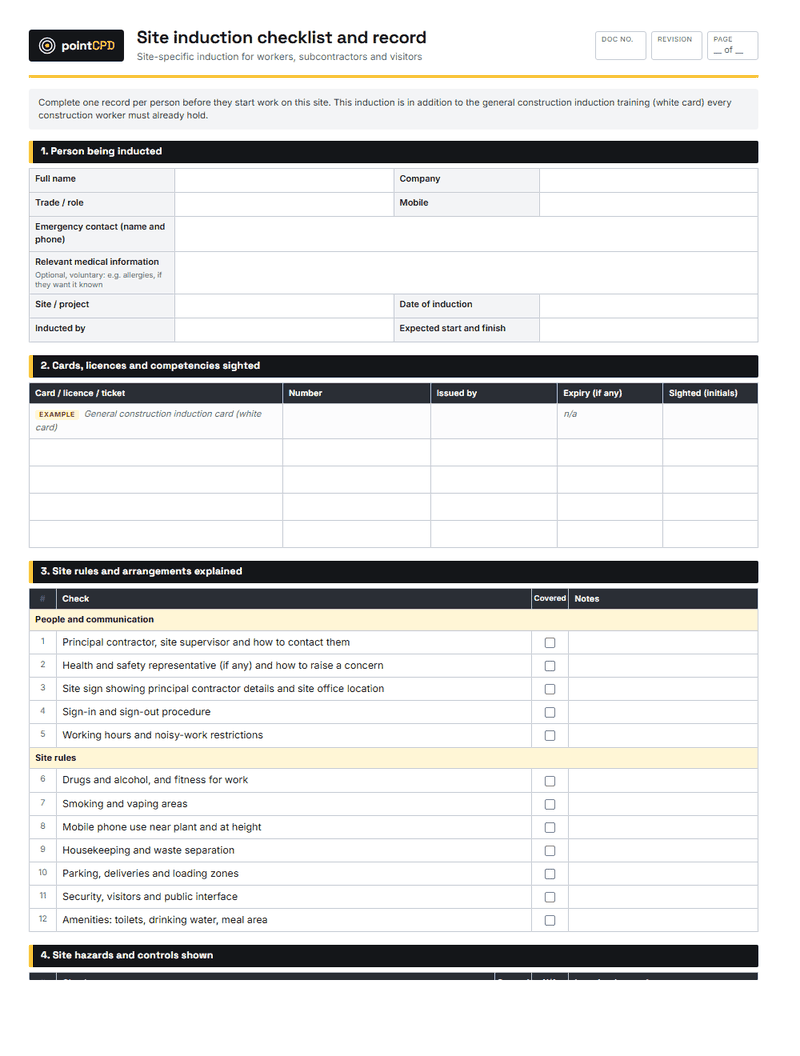
- Site inductions that explain silica rules to everyone on site, including the ban on dry sweeping.
- Toolbox talks that refresh the message when a new cutting-heavy stage starts, such as paving, tiling or slab cutting.
- Subcontractor requirements that make on-tool extraction and wet cutting a condition of working on your sites.
A worked example: one bathroom, four trades, four silica tasks
It helps to picture how often silica work happens on an ordinary job. Take a single bathroom renovation in an older brick home.
The demolition crew removes the old tiles and screed with a breaker, generating dust from mortar, tile and concrete. The plumber chases the brick wall for new pipework with a wall chaser. The electrician cuts a few boxes into masonry for new power points. The tiler cuts porcelain tiles, including notches around the waste and niches in the shower wall.
Each of those four tasks processes a crystalline silica substance. Each of them can generate respirable silica dust, indoors, in a small room, often in a house where people are living. Done badly, with dry cutting, no extraction and a broom at the end of the day, the room is thick with dust that settles through the house. Done properly, with a chaser connected to an extraction vacuum, water on the tile saw, cutting set up outside where possible, the doorway sealed and an H-class vacuum for clean-up, most of that dust never becomes airborne.
The builder’s role is to make sure the second version is the one that happens: in the SWMS for the demolition, in the conditions of engagement for the trades, in the induction, and in what the supervisor accepts on site.
Questions to ask your trades
- What cutting, grinding or chasing will you do on this job, and in which materials?
- How will you control the dust at the source: water, on-tool extraction, or both?
- What vacuum do you use for extraction and clean-up, and is it rated for fine dust?
- What respiratory protection do your workers use, and have they been fit tested?
- Where the work is high risk, do you have the documented controls the regulations require, and are your workers trained in them?
- Are your workers in health monitoring where the rules require it?
A trade who answers those questions confidently is a trade you can put on site with other workers nearby. A trade who shrugs is a risk to everyone on the job, including you.
Health monitoring, briefly
Health monitoring is a formal program of medical checks for workers exposed to a hazard, designed to catch early signs of harm. The silica regulations require it in certain circumstances, and it must be arranged by the business employing the workers. For builders, the practical point is that trades who process silica substances regularly should be part of a monitoring program run by their employer. Asking about it is part of choosing competent trades, and it signals that your sites take silica seriously.
Talking to clients about alternatives
The ban has pushed kitchens towards a range of other benchtop materials: porcelain and sintered stone, natural stone, solid surface materials, laminate, timber and stainless steel. Each has its own look, cost, durability and fabrication requirements. Some, such as porcelain, sintered stone and many natural stones, still contain crystalline silica and must be fabricated and installed under the silica rules, even though they are not banned.
For builders, the useful thing is to have a simple comparison for clients: what each material looks like, how it performs with heat, stains and knocks, what it costs relative to the others, and whether it needs specialist fabrication. Clients are more willing to move on from a product they wanted when they can see that the alternatives are good.
Renovations: the hidden exposure
Renovation builders face silica in places new-build builders do not. Removing old engineered stone benchtops, breaking up old concrete, chasing old brick walls for new services, and grinding back old tiles all generate silica dust, often indoors, in a home where people are living. The same controls apply, and the need to protect the household adds another layer: isolate the work area, control dust at the source, and clean up with the right equipment before the client comes back in.
Why it matters
Silicosis has a long latency. The damage done by dust today may not show for years, and by the time symptoms appear the disease is usually advanced and irreversible. The engineered stone ban dealt with the most extreme source of exposure, but the silica in everyday building materials remains. A builder who takes silica seriously protects their workers, their trades, their clients, and their own business from the claims that follow a diagnosis.
Questions builders ask
Is engineered stone banned in Australia?
Yes. Since 1 July 2024, the manufacture, supply, processing and installation of engineered stone benchtops, panels and slabs has been prohibited. Importing them has been prohibited since 1 January 2025.
Can I remove or modify an existing engineered stone benchtop?
Removal, repair, minor modification and disposal of installed engineered stone are still permitted, but only with strict silica controls. Some jurisdictions also require notification. Check your state regulator’s requirements.
Are porcelain and sintered stone banned?
No. They are excluded from the engineered stone definition. But where they contain more than 1% crystalline silica, they are crystalline silica substances and the silica rules apply to cutting and processing them.
What is a crystalline silica substance?
Under the model WHS Regulations, a material containing more than 1% crystalline silica by weight. Concrete, bricks, pavers, many tiles and most natural stone fall within the definition.
What is the exposure standard for crystalline silica?
The workplace exposure standard for respirable crystalline silica is 0.05 mg/m³ as an eight-hour time-weighted average.
Sources
- Engineered stone ban · Safe Work Australia
- Crystalline silica and silicosis · Safe Work Australia
Published 3 August 2026. General information for builders, not legal, financial or engineering advice for a specific job. Check current requirements with the relevant regulator or standard before relying on them.