Key takeaways
- The daily pre-start walk is the one check that looks at the site as it is this morning, which the induction record and the toolbox talk cannot do.
- Start the walk at the gate and work inward, so the entry route and the public-facing hazards are judged before the crew reaches the work.
- Judge every excavation after overnight weather, and confirm that the service markings are still visible and match the plan the crew is about to use.
- Treat temporary power, plant and dust as the hazards that change fastest, and check their controls on the day rather than relying on last week sign-off.
- Record each walk on the day with the findings and the action taken, because a short and specific record is the evidence that the look was actually made.
Every site has paperwork that says it is safe to start. The induction record confirms who has been inducted. The toolbox talk records what was covered with the crew. Both matter, and neither tells you what the site looks like at six in the morning, after the concreter has left a pump line across the path, the neighbour has dumped a skip against the fence and overnight rain has undercut the edge of a trench. The daily pre-start walk is the check that looks at the place where the work will actually happen, before anyone is asked to work in it.
This article is about that walk as a supervisor’s routine. It is not a guide to induction content or to running a toolbox talk, both of which sit alongside it. The walk has a narrow purpose: to find the hazards that have changed since the last time anyone looked, to deal with them before the crew arrives, and to leave a short record that shows the look was actually made. A builder who runs it well will find that most mornings it takes a short time and turns up something worth fixing.
The walk is also a commercial control. A site incident that began with a hazard visible at the morning walk becomes a question about the supervisor, the business and the principal contractor’s systems. Finding the hazard early, and fixing it while the crew is still in the ute, costs far less than explaining later why nobody looked.
What the walk is for, and what it is not
The induction establishes that a person knows the site rules. The toolbox talk establishes that the crew has been told about the day’s risks. The pre-start walk establishes that the risks the crew is about to meet are the ones they were told about. That difference matters. Induction and toolbox talks are about people. The walk is about the environment, which changes every day with the weather, the deliveries, the subcontractors who came back late and the things that were left in the wrong place the previous afternoon.
A useful way to keep the three apart is to ask what each one can see. An induction cannot see the trench. A toolbox talk cannot see the extension lead that was run across the stairwell overnight. Only the walk, done in person with the eyes and the feet, can see both. If the walk is replaced by a signature on yesterday’s sheet, the site has paperwork and no check at all.
Start at the gate, not at the work
Begin where the site begins. Walk in through the entry the crew will use, and look at the gate, the signage, the sign-in point and the access route as a person arriving for the first time would see them. Check that the entry is clear, that the pedestrian path is separate from vehicle movements, and that the fence is still intact and locked where it needs to be. Look for anything that has moved overnight, because the gate is the first place the public and the neighbours meet the site.
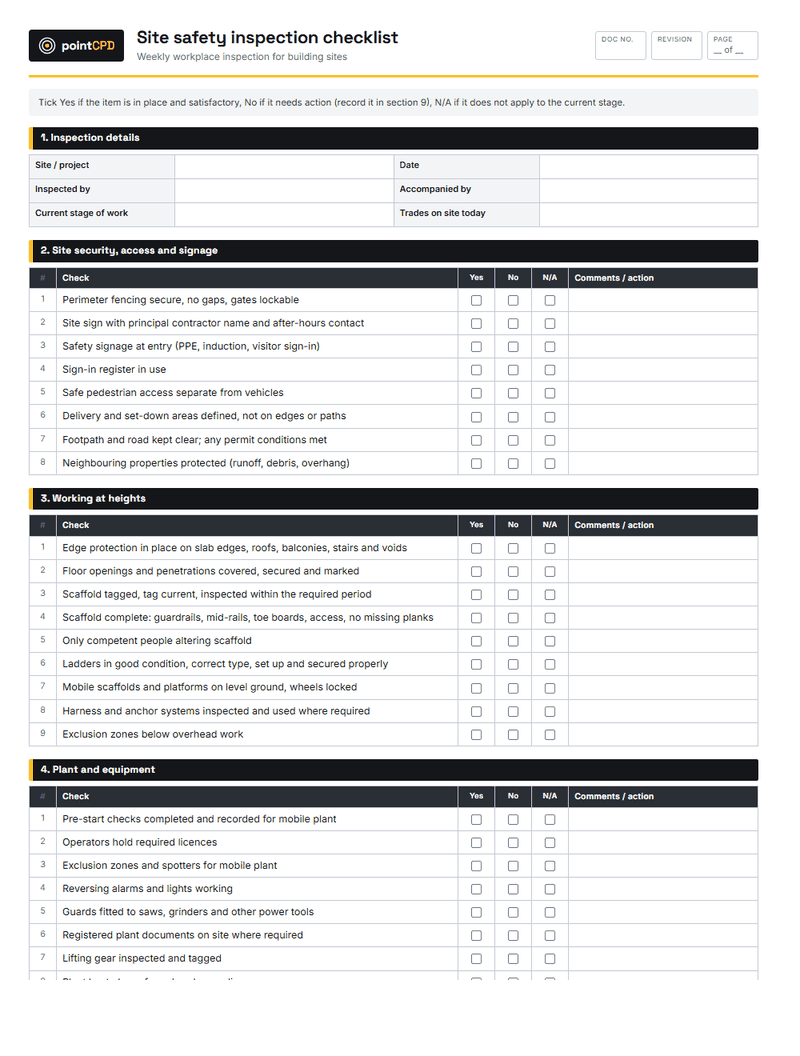
Then check the amenities, the first aid kit, the fire extinguisher and the emergency contact sheet. These are simple things, and they are often the first things that go missing when a site is busy. A supervisor who notices an empty first aid kit on the morning walk has saved a crew a bad afternoon.
Excavations, services and the ground underfoot
Excavations are where the walk earns its keep. Look at every open trench, footing and service cut. Check the edges for slumping, check any spoil heaped too close to the edge, and check that the barriers and access ladders are still in place. A trench that was safe on Friday afternoon can be a different hazard after a night of rain, so the walk should judge the ground as it is this morning, not as it was when the crew left.
Service locations are the same story. Before anyone digs, the proper locating must be in hand, and Before You Dig Australia is the national place to start that process. On the walk, check that the markings are still visible, that nobody has trampled or washed away the paint, and that the locations match the plan the crew is about to dig to. A set of markings that has faded over a week is not a locating process, however good the original search was.
Electrical safety and the temporary power setup
Temporary power is the hazard that changes most quickly. Leads are moved, boards are relocated, generators are refuelled and tools are swapped between trades. The walk should look at the leads and boards for damage, check that the protection in the supply is in place and working, and make sure no lead is lying in water, running across a walkway or wrapped around a bundle of reinforcement. Safe Work Australia’s guidance on electrical safety sets out the controls that should be in place, and the supervisor’s job on the walk is to confirm that they still are.
Check the tools as well. A damaged cord, a cracked casing or a tool left out in the weather is the sort of defect a crew will use without a second thought unless someone makes the call. Any tool that fails the check should be tagged out and removed before the crew starts. Tagging is a small step that prevents a large argument later.
Plant, vehicles and the people beyond the fence
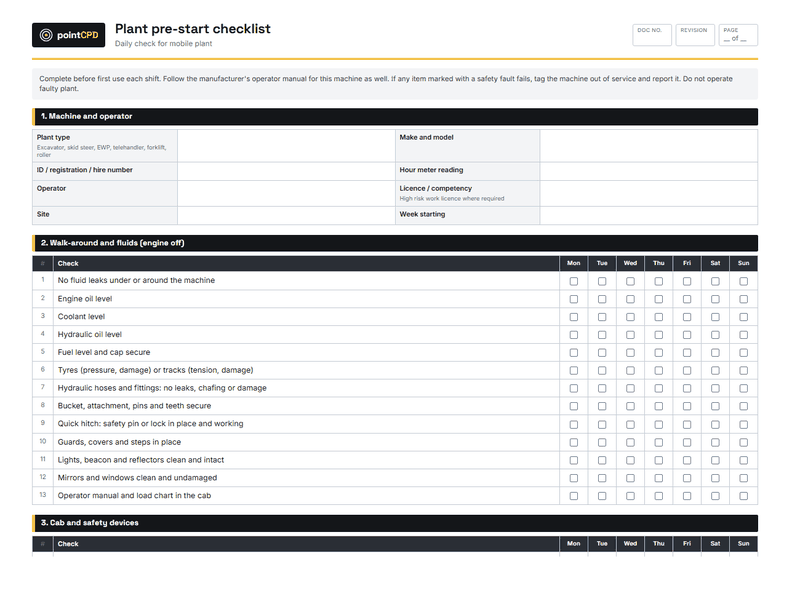
Plant is the next priority. Check where the excavator, the crane, the skip and the concrete pump are parked, and whether their swing or reach zones cross a path the crew or the public will use. Check that the ground under the plant is firm enough for the load, and that any operator who has arrived holds the tickets the job requires. The plant pre-start checklist is a useful companion for the operator’s own check, and the supervisor’s walk confirms that the site around the machine is ready for it.
Look past the fence line as well. Pedestrians, neighbours and children walk past many sites, and the walk should check what the public can reach. Unsecured materials, open pits near the boundary and a ladder left against a fence are hazards that have nothing to do with the crew. A site that is safe for its own workers but dangerous to passers-by is still a site with a problem.
Where a pool is on the site or next door, check the barrier and the fencing, because a gap in temporary fencing around a pool is a serious and avoidable risk. The NSW Government’s guidance on pools and pool safety is the reference to check when a pool is involved, and the supervisor should read it, not only the person who installed the fence.
Housekeeping is part of the walk
Housekeeping looks like the least important part of the walk, and it is a common source of minor injuries on residential sites. Offcuts left at the foot of a stair, bundles of tie wire across a path and a pallet of tiles partly blocking a doorway are not dramatic hazards, but they are the ones that trip a person carrying a load. The walk should treat the clear path as a safety feature, and the supervisor should ask whether a route through the site would still be clear if the crew were carrying a full sheet of plasterboard. The detailed approach to clean and clear routes is covered in the article on slips and trips on house sites, and the walk is where that standard is checked each morning.
Put housekeeping on the walk sheet as a line of its own, so it is not treated as an afterthought. A short note that the stair was cleared, the materials were moved off the path and the walkway to the rear was made safe is a finding in its own right. It shows the supervisor was looking at the places people actually walk, not only at the hazards that make the news.
Where the walk meets the subcontractors
Each subcontractor is responsible for the safety of their own work, and each one should be doing their own pre-start check before they start. The supervisor walk does not take that responsibility away. It is a separate check of the shared site, and its value lies in the hazards that sit between the trades: the scaffold that the framer uses but the bricklayer has leaned a ladder against, the lead left by the electrician that crosses the concreter’s barrow route, or the excavation that the plumber opened and the drainer assumed was covered.
Before the walk starts, it helps to know which subcontractors are on site that day and what they are doing. A supervisor who has checked the subcontractor’s own safety documentation before the first day is in a better position to see when the work in front of them does not match it. The article on verifying subcontractor WHS before they start covers that front-end check, and the pre-start walk is the daily follow-up to it. A verified contractor who then turns up with a different crew or a different method has changed the risk, and the walk is where that change is first seen.
Dust, silica and the work that creates it
Dust is invisible on the walk unless the supervisor looks for its sources. Look at where cutting, grinding, drilling and sweeping are planned for the day, and check that the controls are on site before the crew needs them. Wet methods, extraction and suitable respiratory protection are the controls the silica guidance points to most often, and the walk is the moment to confirm they are present and working, rather than discovering the gap when the saw is already running.
Look at the neighbours too. Dust that drifts across a boundary, or a cutting job that starts before the neighbours’ working hours, creates complaints and sometimes enforcement, even where the crew is fully compliant on site. The supervisor who walks the boundary before work starts is the one who can say the site was considered.
Recording the walk so it can be proved
The record of the walk does not need to be long. It needs to show the date, the time, the person who walked, what was checked, what was found and what was done about it. A simple sheet or a tick-based app will do, provided the record is made on the day, in the same place each time and kept with the job file. A walk recorded only in the supervisor’s memory is a walk that did not happen, as far as anyone else is concerned.
Make the record specific. A line that says the site was checked adds nothing. A line that says the trench at the north boundary was checked, the edge was found to have slumped, the barrier was extended and access was closed until the ground was reviewed, shows judgement. It is also the record a principal contractor or a regulator will want to see after an incident.
The most expensive shortcut. Signing the pre-start sheet from the office, or copying yesterday’s entry, means nobody has looked at the site this morning. The overnight change is the one that hurts someone, and it is exactly the one a paper signature cannot catch.
The walk, item by item
- Entry, gate, sign-in point and pedestrian route are clear, secure and free of overnight changes.
- Every open excavation has its edges, barriers and access checked after overnight weather.
- Service markings are still visible and match the plan the crew is about to use.
- Leads, boards and generators are undamaged, protected and clear of water and walkways.
- Plant is parked clear of crew and public paths, on firm ground, with the operator checks done.
- Dust controls for the day cutting and grinding are on site and working, and the boundary has been walked.
- Pool barriers and public-facing hazards are checked, and the findings and action taken are recorded on the day.
A worked example: a supervisor on a townhouse site in western Sydney
A supervisor on a townhouse site in western Sydney had a routine walk at six in the morning. On the day in question, the overnight rain had softened the edge of a service trench at the rear boundary, and a pallet of blocks had been stacked on the spoil heap beside it. The trench was marked for a plumber’s connection due later that morning. The supervisor stopped the plumber’s access, moved the pallet, put a barrier along the trench and asked the excavator operator to review the edge before anyone entered.
The crew arrived to a clear message and a barrier, and the plumber’s start was pushed back by a little under half the morning. The supervisor recorded the finding on the walk sheet, with the time, a photograph of the trench edge and the decision to hold access until the edge had been reviewed. The record was short, and it was the reason the business could later show that the hazard had been identified before anyone was exposed to it.
The walk, in order
- 1Start at the gateEnter the way the crew will, and look at the entry, the signage and the route as a stranger would.
- 2Check the ground and the open workJudge every excavation and edge as it is this morning, not as it was when the crew left.
- 3Check the services and the powerConfirm the locating marks, leads, boards and tools are safe to use today.
- 4Check the plant and the people beyond the fenceConfirm the machines have clear zones and the public cannot reach an open hazard.
- 5Check the dust before the saw startsConfirm the controls for the day cutting are present and working before the crew needs them.
- 6Act, then recordStop, fix or exclude each hazard on the spot, then record the finding, the time and the action taken.
Keeping the walk a routine, not a ritual
The walk fails when it becomes a ritual, which tends to happen after a few weeks of uneventful mornings. A supervisor who ticks the same boxes in the same order will start to miss the thing that is new. Vary the route occasionally, add a different check each week and make a point of looking up as well as down. The walk should feel like a real look at the site, because that is what it is.
Make sure the crew knows the walk is happening and what it found. Crews who see a hazard closed off within minutes learn that reporting a problem gets a response, and they start raising things themselves. That is the most valuable outcome a pre-start walk can produce, and it costs little beyond the time it takes. For the wider picture of how a site keeps its people safe from one day to the next, the PointCPD guide to how NSW builder CPD works sets out the supervision standards that a licensed builder is expected to meet.
Questions builders ask
What is a pre-start site walk?
It is a supervisor routine walk of the site before the crew arrives, looking at the hazards that have changed since the last check. It differs from an induction, which records that people know the site rules, and from a toolbox talk, which covers the day work with the crew. The walk checks the place where the work will happen.
How long should a pre-start walk take?
It should be short enough to do every morning without rushing, and thorough enough to look properly at each area. A walk that is always done in a hurry will miss the thing that changed overnight. Build a fixed route around the site so it can be covered in one pass.
Who should do the pre-start walk?
The site supervisor or the person responsible for the day work, not a labourer and not someone who has only arrived to sign the sheet. The person doing the walk needs the authority to stop work, because a walk that cannot close an excavation is only a report.
Does the walk replace the subcontractors own checks?
No. Each subcontractor remains responsible for the safety of their own work and for their own pre-start checks. The supervisor walk is a separate check of the shared site, and it catches the hazards that sit between the trades, which no single trade may see.
What should I do about a hazard I cannot fix straight away?
Stop the work that is exposed to it, keep people away with a barrier or clear marking, and arrange the fix before the area is opened again. Record the hazard, the action and who was told. Closing an area until it is safe is always the better decision than letting the crew work around it.
Is a pre-start walk needed on a small residential job?
Yes, although it can be quicker. A small site has the same underground services, temporary power and neighbours as a large one, and the risk often rises when a small crew is rushing to finish. A short walk with a written record is a sensible routine on any residential site.
Sources
- Electrical safety · Safe Work Australia
- Before You Dig Australia · BYDA
Published 23 October 2026. General information for builders, not legal, financial or engineering advice for a specific job. Check current requirements with the relevant regulator or standard before relying on them.