Key takeaways
- Most of concrete’s embodied carbon comes from making cement, specifically the clinker. Replacing part of the cement with other materials is the main way to cut it.
- Supplementary cementitious materials such as ground granulated blast furnace slag and fly ash are established in Australian concrete. Geopolymer concretes go further but are less common in housing.
- Low-carbon mixes can gain strength more slowly, especially in cold weather, so curing, finishing times and stripping or loading times may change.
- The engineer specifies the concrete. Builders influence the outcome by asking suppliers for low-carbon options and environmental product declarations, and by curing properly.
- Using less concrete through efficient slab design and not over-specifying strength can cut carbon as much as changing the mix.
If you want to cut the embodied carbon in a house, start with the concrete. The slab and footings of a typical Australian home contain more embodied carbon than any other element, and almost all of it comes from one ingredient: cement. As governments begin to measure embodied carbon, including through the BASIX materials index in NSW, and as clients and developers ask about it, low-carbon concrete is moving from specialist projects into everyday residential work.
This guide explains where concrete’s carbon comes from, the main low-carbon options, what they change on site, and how builders can get them onto their jobs without compromising the slab.
Where the carbon in concrete comes from
Concrete is mostly aggregate, sand and water, held together by cement. Cement makes up a relatively small share of the mix by weight, but it carries most of the carbon. That is because making cement clinker involves heating limestone to very high temperatures in a kiln. The heat comes from burning fuel, and the chemical reaction that turns limestone into clinker releases carbon dioxide directly. Both sources are large.
So the most effective way to reduce concrete’s carbon is to use less clinker: either by replacing part of the cement with other materials, or by using less concrete overall.
The main low-carbon options
Ways to lower the carbon in concrete
| Approach | How it works | What to watch |
|---|---|---|
| Blended cement with slag | Ground granulated blast furnace slag, a steel industry by-product, replaces part of the cement | Slower early strength in cold weather; finishing times; colour |
| Fly ash | A by-product of coal-fired power replaces part of the cement | Supply is shrinking as coal plants close; early strength |
| Other SCMs | Materials such as silica fume or ground glass pozzolan, used in specific mixes | Availability; supplier experience |
| Geopolymer concrete | Binder made from alkali-activated slag or fly ash, little or no cement | Specialist mixes, curing and approvals; less common in housing |
| Less concrete | Efficient slab and footing design, right strength class | An engineering decision; do not reduce without the engineer |
| Recycled aggregates | Crushed concrete replaces some virgin aggregate | Smaller carbon benefit; used within standard limits |
Supplementary cementitious materials
Supplementary cementitious materials, or SCMs, are materials that can replace part of the cement and contribute to the concrete’s strength. The most common in Australia are:
- Ground granulated blast furnace slag, a by-product of iron and steel making, ground into a fine powder.
- Fly ash, the fine ash collected from coal-fired power stations.
- Silica fume and other materials used in specific high-performance mixes.
Blended cements containing slag or fly ash have been used in Australian concrete for decades. They are covered by Australian Standards and are routinely supplied by concrete plants. What is changing is how much of the cement is replaced and how deliberately builders and designers ask for it.
Fly ash has a particular problem: it comes from coal-fired power stations, and as those close, supply will shrink. Slag supply depends on steel making. Suppliers are developing alternative SCMs, such as ground glass and calcined clays, but availability varies by region.
Geopolymer concrete
Geopolymer concretes use a binder made by activating materials such as slag or fly ash with alkaline chemicals, with little or no conventional cement. They can have much lower embodied carbon. They are used on some infrastructure and commercial projects, but they are less common in housing, often need specialist mixes and curing, and may need additional approvals. For most residential builders, blended cement mixes are the practical option today.
Using less concrete
The lowest-carbon concrete is the concrete you do not pour. Efficient slab systems, such as waffle pod slabs on suitable sites, use less concrete than a thick raft. Specifying the right strength class, rather than a higher strength than the design needs, uses less cement. These are engineering decisions and must stay with the engineer, but builders can ask the question: is there a more efficient design that meets the requirements?
What changes on site
Low-carbon mixes are still concrete, and they perform well when handled properly. But they can behave differently in the first days and weeks, and site practices need to account for that.
Strength gain
Mixes with a high proportion of slag or fly ash can gain strength more slowly at early ages, especially in cold weather. They often reach or exceed the strength of a conventional mix over time, but the early strength matters for decisions such as when to strip formwork, when to load a slab with frames and materials, and when to post-tension or cut joints. Those timings may need to change, and the engineer’s advice governs.
Setting and finishing
Setting times can be longer, which affects when finishers can start trowelling and how long they are on site. In winter, a slow-setting mix can keep a finishing crew waiting well into the evening. Planning the pour time, briefing the crew, and considering accelerating admixtures where the supplier and engineer agree all help.
Curing
All concrete needs proper curing to reach its potential strength and durability, and blended mixes can be more sensitive to poor curing. Keeping the surface moist, or using a curing compound, for the specified period is essential. A low-carbon slab that dries out early may not develop the surface durability it should.
Colour
Slag blends can give the concrete a slightly different colour, sometimes with a blue-green tint that fades over time. For exposed or polished slabs, that is worth discussing with the client and the supplier before the pour.
Site practices that make low-carbon concrete perform
- Cure for the full period specified, keeping the surface moist or sealed with a curing compound.
- Protect the pour from cold, wind and drying in winter; strength gain slows in the cold.
- Allow for longer setting and finishing times; brief the finishers before the truck arrives.
- Do not strip formwork or load the slab early without the engineer’s agreement.
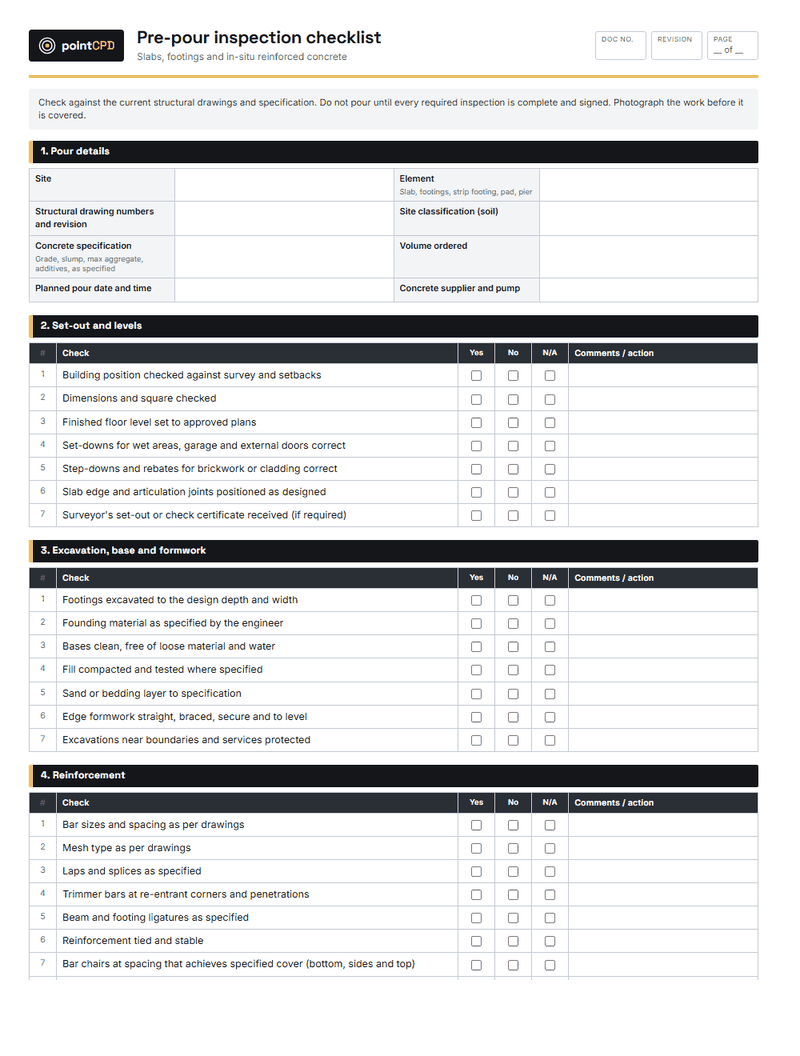
- Record the mix, delivery dockets, weather and curing on the day.
- Test cylinders or samples as specified, and check results before loading.
The engineer specifies the concrete. A builder should never substitute a different mix, however low its carbon, without the engineer’s agreement. Strength, durability class, exposure conditions and early-age properties are all part of the design. Ask for low-carbon options; do not swap them in.
How to specify and buy low-carbon concrete
Getting a low-carbon mix onto your next slab
- 1Ask earlyRaise it with the engineer at design, not with the plant the week of the pour.
- 2Ask the supplierWhat low-carbon mixes do they supply for residential slabs and footings, and what is the lead time?
- 3Get the dataRequest an environmental product declaration or carbon figure for the mix.
- 4Confirm the specificationThe engineer confirms the mix meets the design requirements for strength and durability.
- 5Plan the pourAdjust finishing crews, curing and loading times for the mix and the weather.
Most concrete suppliers now offer lower-carbon mixes for residential work, marketed under various names. The useful questions are not about the brand but about the substance: what has been replaced, by how much, what the carbon figure is, and what it means for strength gain, finishing and curing. An environmental product declaration, which reports the environmental impacts of a product in a standard format, is the most reliable source of the carbon figure.
Price varies. In some markets, blended mixes cost about the same as conventional ones; in others, low-carbon mixes carry a premium. Slower strength gain can also affect the programme. Builders should price those effects into the job rather than assuming a like-for-like swap.
Why it matters now
Measurement
NSW’s BASIX has, since October 2023, required new homes to calculate and record the embodied emissions of their main materials, though without a target. Commercial rating tools increasingly count embodied carbon. Government and institutional clients are starting to ask for it in tenders. Once carbon is measured, it becomes something clients compare, and eventually something regulators may set limits on.
Clients and developers
Some clients choose builders partly on sustainability credentials, and developers of larger projects are under pressure from investors and tenants to report embodied carbon. Being able to offer a lower-carbon slab, with the data to back it up, is a differentiator.
Cost pressure on cement
Energy costs, carbon policies and the phase-out of some SCM sources all affect the price of cement and concrete over time. Understanding the alternatives now puts builders in a better position as the market shifts.
A worked example: a winter slab
A builder is pouring a waffle pod slab for a single-storey home in July in a cool inland area. The engineer has approved a blended mix with a significant slag content, offered by the supplier as its lower-carbon residential product.
The builder books the pour for mid-morning rather than early, so the concrete is placed as the day warms. The finishing crew is told to expect a longer wait before power floating. A curing compound is sprayed as soon as finishing allows, and the slab is covered overnight when frost is forecast. The frame delivery, originally planned for four days after the pour, is moved back after the builder checks with the engineer about loading the slab in cold conditions.
The result is a slab that meets its design strength and has a good surface, poured with a mix carrying less embodied carbon than the conventional alternative. The only real changes were timing and curing, planned in advance. The builder who pours the same mix at dawn in winter, finishes it in the dark and leaves it uncured is the one who ends up with a dusty, weak surface and blames the mix.
Beyond the slab
Concrete is not the only material with embodied carbon, but in most houses it is the biggest single item. After the slab and footings, the next largest contributors are usually masonry, steel, aluminium windows and some insulation and cladding products. The same approach applies to each: use less where the design allows, choose products with lower embodied carbon where they perform equally, and ask suppliers for environmental product declarations so you can compare like with like.
Builders who get into the habit of asking for that data now will be well placed if embodied carbon targets follow the measurement that has already started.
Common questions from clients
Is low-carbon concrete as strong? When specified by the engineer and cured properly, it meets the same design strength and durability requirements. It may gain strength more slowly early on.
Will it crack more? Cracking in slabs depends mainly on design, site conditions, joints, curing and loading, not on whether the mix is blended. Poor curing is the bigger risk.
Does it cost more? Sometimes a little, sometimes not. Ask for a quote from the supplier for the specific mix.
Records to keep
Keep the delivery dockets showing the mix supplied, the engineer’s approval of the mix, test results, and a note of the weather and curing on the day. If a client or future owner ever asks about the slab, or if embodied carbon reporting becomes a requirement, those records answer the question.
The bottom line
Low-carbon concrete is not exotic. Blended cements with slag and fly ash are long-established in Australia, and most suppliers can provide lower-carbon mixes for residential slabs and footings. The builder’s job is to ask for them early, let the engineer specify them, and adjust the site practices, particularly finishing and curing, so the concrete performs as designed. Combine that with efficient slab design, and the biggest source of embodied carbon in a house can be cut without cutting corners.
Questions builders ask
What is low-carbon concrete?
Concrete in which part of the cement, the main source of carbon, is replaced with supplementary materials such as slag or fly ash, or which uses an alternative binder such as a geopolymer.
Is low-carbon concrete suitable for house slabs?
Yes, when the engineer specifies it for the design and it is cured properly. Blended cement mixes are widely available for residential slabs and footings.
Does low-carbon concrete take longer to cure?
Mixes with a high proportion of slag or fly ash can gain strength more slowly at early ages, especially in cold weather, which can affect finishing times, stripping and loading. Follow the engineer’s and supplier’s advice.
Can I swap to a low-carbon mix without asking the engineer?
No. Strength, durability and early-age properties are part of the design. Ask for low-carbon options, and let the engineer confirm the mix.
How do I know how much carbon a concrete mix has?
Ask the supplier for an environmental product declaration (EPD) or a carbon figure for the specific mix.
Sources
- BASIX materials index help notes · NSW Planning Portal
- EPD Australasia · EPD Australasia
Published 14 August 2026. General information for builders, not legal, financial or engineering advice for a specific job. Check current requirements with the relevant regulator or standard before relying on them.