Key takeaways
- NSW does not use the NCC’s residential energy efficiency provisions for new homes. It applies its own scheme, BASIX, which sets thermal, energy and water targets.
- Since 1 October 2023, BASIX requires thermal performance equivalent to 7 NatHERS stars for most new homes, with exceptions including the North Coast climate zone and apartments in buildings of up to five storeys.
- The energy target was also raised in 2023, and embodied emissions in the main building materials must now be calculated and recorded, although there is no target for them yet.
- The BASIX certificate is a list of commitments. Every listed item, from insulation R-values to window performance and the hot water system, must be installed as listed.
- The most common builder problem is substitution: a cheaper window, a different hot water unit or a missed insulation zone that no longer matches the certificate and holds up the occupation certificate.
“Seven-star homes” became the national headline when the 2022 National Construction Code raised the minimum energy performance of new houses. In NSW, the story is different. NSW does not apply the NCC’s residential energy efficiency provisions to new homes. It uses its own scheme, the Building Sustainability Index, better known as BASIX, and it made its own 7-star move on 1 October 2023.
For builders, the difference matters. The rules you are building to in NSW sit in a BASIX certificate, not in the energy efficiency part of the NCC, and the most common problems on site come from treating that certificate as paperwork rather than as a specification.
What BASIX is
BASIX is a NSW planning requirement that has applied to new homes since July 2004. Every new dwelling needs a BASIX certificate, as do renovations of $50,000 or more and swimming pools or spas of more than 40,000 litres. The certificate is generated through the BASIX online tool and shows that the design meets targets for:
- Thermal performance: how well the building fabric keeps heat in during winter and out during summer, which drives how much heating and cooling it needs.
- Energy: the greenhouse emissions from running the home, including hot water, heating and cooling, lighting and appliances.
- Water: how much drinking-quality water the home is expected to use.
The targets vary with location and building type. A house in the western suburbs of Sydney faces different settings from one on the South Coast, because climate, water supply and energy use differ. That is why this article does not quote a single target figure: the correct target is the one the tool applies to your specific site.
BASIX in brief
- July 2004BASIX startsThe Building Sustainability Index begins for new homes in Sydney, then rolls out across NSW.
- 2022NCC goes to 7 starsThe NCC 2022 sets 7 NatHERS stars and a whole-of-home energy budget nationally. NSW keeps BASIX as its mechanism.
- 1 October 2023The big upliftThermal performance raised to the equivalent of 7 NatHERS stars for most new homes; energy target raised; embodied emissions recorded.
- NowCertificate at every stageA BASIX certificate is lodged with the development application or complying development certificate, and commitments are checked before occupation.
Source: NSW Department of Planning, Housing and Infrastructure, BASIX.
What changed on 1 October 2023
The 2023 update was the biggest change to BASIX since it began. It brought NSW broadly into line with the performance levels the NCC 2022 set for other states, while keeping the BASIX approach.
Thermal performance: the 7-star equivalent
For most new homes, the thermal performance standard was raised to the equivalent of a 7-star rating under the Nationwide House Energy Rating Scheme (NatHERS). There are exceptions. Homes in the North Coast climate zone, and apartments in buildings of up to five storeys, were not subject to the same uplift. Your assessor will know which settings apply.
In practice, meeting a 7-star equivalent usually means some combination of higher insulation values, better-performing windows, attention to orientation and shading, and fewer uncontrolled air leaks. The specific combination is a design decision, and it is fixed once the certificate is issued.
Energy target
The energy target was also raised. The energy section credits efficient hot water systems, heating and cooling, lighting and on-site solar. An all-electric home with a heat pump hot water system and rooftop solar generally finds the energy target easier to meet than a home relying on gas. That is one reason builders are seeing more heat pumps and solar specified on BASIX certificates than a few years ago.
Embodied emissions
The update added a materials index. The embodied emissions in the main building materials, meaning the greenhouse emissions from manufacturing them, are now calculated and recorded for new homes. There is currently no target, so this does not change what you build today. It does signal the direction of policy: once the data exists, targets can follow. Builders who understand which materials drive embodied emissions will be ready if and when that happens.
The parts of a BASIX assessment and what they mean on site
| Part | What it measures | What the builder installs |
|---|---|---|
| Thermal performance | How much heating and cooling the building fabric needs | Insulation, glazing, sealing, shading and materials exactly as modelled |
| Energy | Greenhouse emissions from running the home | Hot water system, heating and cooling, lighting, any solar listed |
| Water | Potable water use | Fixtures and fittings ratings, rainwater tank and connections |
| Materials (embodied emissions) | Emissions from making the main building materials | Nothing extra yet: it is calculated and recorded, with no target |
How BASIX relates to the NCC’s 7 stars
The NCC 2022 introduced two headline residential energy changes: a minimum thermal performance of 7 NatHERS stars, and a whole-of-home energy budget covering the home’s major appliances. Most states adopted those provisions through the NCC. NSW kept BASIX as its mechanism instead, applying its own thermal and energy targets through the certificate.
The practical outcome for a builder working across state lines is that the performance level is broadly similar, but the paperwork and the checks are different. In NSW, the certificate is the reference document. If you build interstate as well, do not assume a detail that satisfied an NCC energy assessment in another state automatically satisfies a NSW BASIX certificate, or the reverse.
How NatHERS ratings work
Where the thermal section of BASIX is assessed using the NatHERS pathway, an accredited assessor models the home in NatHERS-accredited software. The software simulates the home’s heating and cooling needs across a typical year in its climate zone, and converts that into a star rating from zero to ten. More stars means less energy needed to stay comfortable.
The model is only as good as its inputs, and the inputs are your building: the wall construction, insulation values, window sizes and performance, roof colour, floor type, shading and orientation. When the building changes, the rating can change too. That is the heart of most BASIX problems on site.
The BASIX certificate is a specification
A BASIX certificate is a list of commitments. It records exactly what the home must include to achieve the targets: the insulation R-value in each part of the building, the performance of the windows and glazed doors, the type of hot water system, the ratings of fixtures, the size and connection of any rainwater tank, and more.
Those commitments carry through the whole approval chain:
From design to occupation certificate
- 1Design and modelThe designer or assessor models the home and sets the specification that meets the targets.
- 2Certificate issuedThe BASIX certificate lists every commitment and is lodged with the DA or CDC.
- 3Construction certificatePlans and specifications must show the BASIX commitments.
- 4Build to the listOrder windows, insulation and systems to the certificate. Any change means checking the certificate first.
- 5Occupation certificateThe certifier must be satisfied the commitments have been fulfilled before the occupation certificate is issued.
At the end, the certifier must be satisfied that the BASIX commitments have been fulfilled before issuing the occupation certificate. If what was installed does not match what was committed, the certifier can refuse the occupation certificate until the building matches, or until a revised certificate is obtained that matches what was built.
The site mistakes that break a BASIX certificate
Nearly every BASIX problem on site comes from the same place: something was changed between the certificate and the build, and nobody checked the certificate.
Window substitutions
A window supplier offers a cheaper or faster alternative. It is the same size and looks the same. But the glazing performance, its U-value and solar heat gain, is different from what the assessor modelled. The certificate may no longer be met. Windows are often the single biggest lever in a thermal assessment, so this is the substitution most likely to matter.
Insulation gaps and wrong products
Insulation is installed at a lower R-value than listed, or it is missing from walls that were modelled as insulated, such as garage walls adjoining living areas, or it is compressed and gapped around services. Even where the right product is used, poor installation reduces its real performance. Photographing every insulated area before lining is the cheapest protection a builder has.
Hot water and appliance swaps
The client changes their mind about the hot water system, or a supplier cannot deliver the listed unit. A different system, particularly a switch from heat pump to gas or electric storage, can move the energy score significantly.
Design changes without a new certificate
A window is enlarged, a skylight added, the orientation shifts on a redesign, or an alfresco area is enclosed. Each can change the assessment. If the design changes, the certificate needs to be checked and, where necessary, revised before the change is built.
Substitution is a compliance decision, not a purchasing one. Before approving any change to windows, insulation, hot water or heating and cooling, check the BASIX certificate. If the replacement is not equivalent or better on every listed value, talk to the assessor first. It is far cheaper to revise a certificate before ordering than to argue with a certifier at occupation.
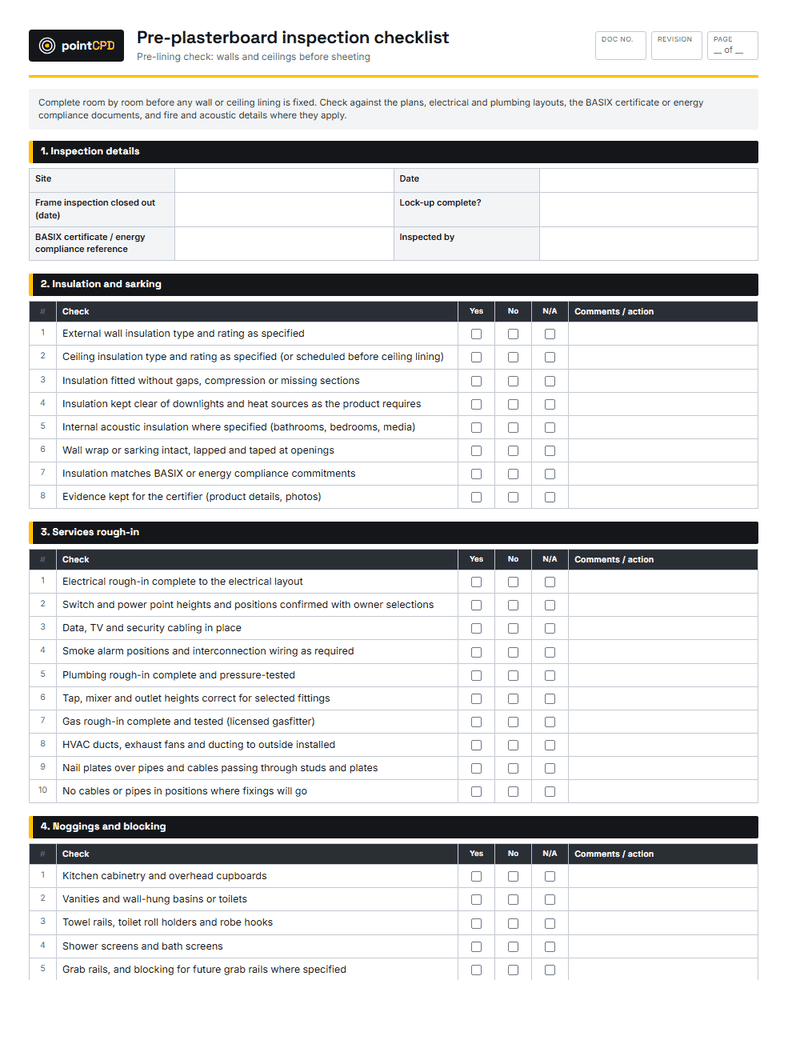
BASIX checks before the plasterboard goes on
- Insulation in every zone the certificate lists: ceiling, walls and any floor, at the stated R-value.
- No gaps at corners, around windows, behind services or at the top plate.
- Downlights and exhaust fans compatible with the insulation, with any required clearances or covers.
- Windows and doors delivered with labels matching the certificate’s performance values, not just the size.
- Wall wrap and sarking in place and taped where the design relies on them.
- Hot water, heating and cooling units ordered to the listed type and rating.
- Photos of every insulated area, filed to the job, before any lining goes on.
Glazing values in plain words
Because windows cause so many BASIX problems, it is worth being fluent in the two numbers that describe their thermal performance.
U-value measures how easily heat passes through the whole window, frame and glass together. A lower U-value means less heat lost in winter and less gained through conduction in summer. Double glazing, low-emissivity coatings and thermally broken or timber frames all lower the U-value.
Solar heat gain coefficient (SHGC) measures how much of the sun’s heat striking the window ends up inside. A higher SHGC lets in more solar heat, which can be useful on a north-facing window in a cool climate and a problem on a west-facing window in summer. That is why the assessor may specify different glazing for different elevations of the same house.
Both values are for the whole window system as tested, not the glass alone. When checking a delivery against the certificate, compare the labelled values for each window, and do not assume a window with the same glass type meets the same values in a different frame.
Alterations, additions and knockdown rebuilds
BASIX is not only for new houses on greenfield estates. Knockdown rebuilds are new dwellings and need a full certificate. Renovations of $50,000 or more also need a BASIX certificate, although the assessment for alterations focuses on the new work rather than the whole existing house. Pools and spas of more than 40,000 litres carry BASIX requirements too.
For renovation builders, the same rule applies: the certificate lists commitments for the new work, and those commitments must be installed. A renovation certificate might specify insulation for new external walls, the performance of new windows, or the rating of new fixtures. It is easy to overlook on a small job, and just as able to hold up the final certificate.
The evidence pack that makes occupation easy
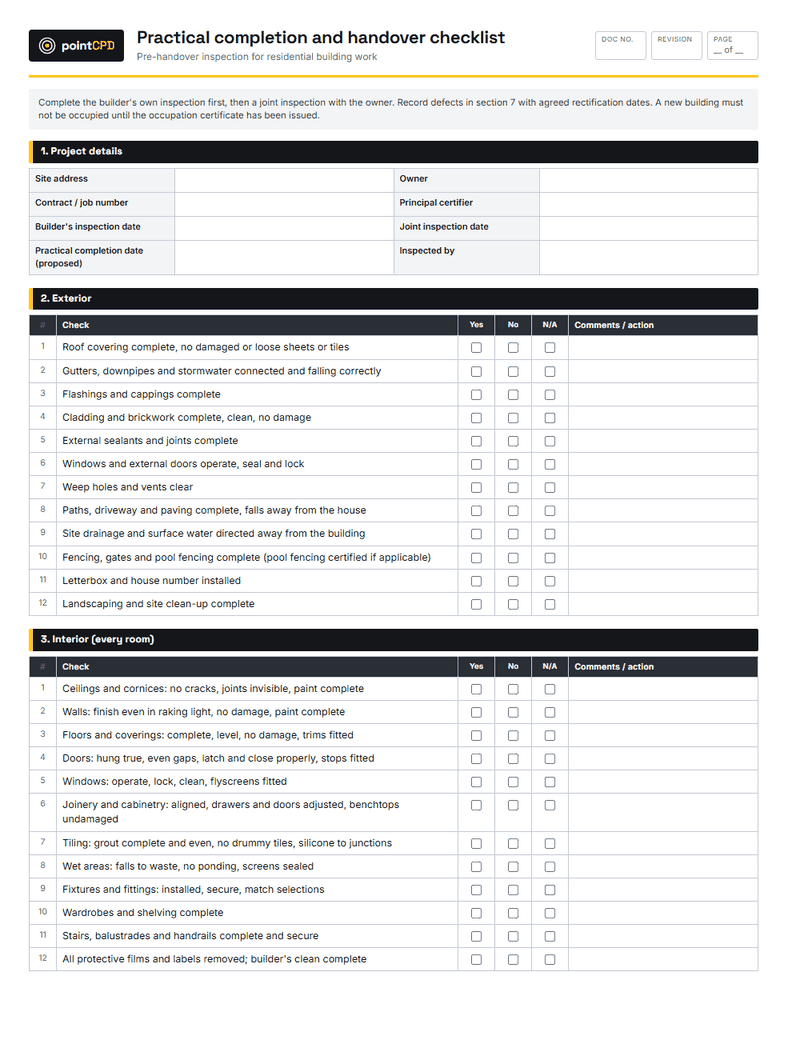
The certifier needs to be satisfied that the commitments have been fulfilled. Builders who make that easy tend to assemble a simple evidence pack as the job progresses:
- Window and door schedules with the manufacturer’s performance labels or certificates matching the BASIX values.
- Insulation delivery dockets showing product and R-value, plus dated photos of every insulated area before lining.
- Hot water, heating and cooling system model numbers matching the certificate.
- Fixture and tapware ratings where the certificate lists them.
- Rainwater tank size and a photo or plumber’s confirmation of the connections the certificate requires, such as toilets or laundry.
- Any solar system details the certificate relies on.
Filed to the job as it happens, this takes a few minutes per stage. Reconstructed at the end, after the plasterboard is up and the dockets are lost, it can take days and still leave gaps.
What it costs, and how to price it
The cost of meeting a 7-star equivalent depends heavily on the design. A well-oriented home with sensible glazing can meet it with modest upgrades. A home with large west-facing glass, a dark roof and limited shading may need expensive high-performance windows to compensate. The time to control cost is at design, when orientation, window size and shading are still flexible.
For builders pricing from someone else’s design, the BASIX certificate should be read alongside the plans before quoting. The window performance values, insulation schedule and systems listed there are cost items, and they are easy to underprice if you assume a standard specification.
Talking to clients about BASIX
Clients often see BASIX as red tape. It helps to explain it in terms they care about: a home that is cheaper to heat and cool, more comfortable in heatwaves, and quieter because it is better sealed. It also helps to explain, early, that the certificate locks in certain choices. A client who wants to swap the heat pump for a different system, or upsize a window during the build, needs to understand that it may mean a revised certificate and a cost.
The bottom line for NSW builders
BASIX is not complicated, but it is unforgiving of casual substitutions. Treat the certificate as part of the specification, check it before any change, photograph what you install, and brief the trades whose work determines the result, especially window suppliers and insulation installers. Do that and the occupation certificate is a formality rather than a fight.
Questions builders ask
Does NSW require 7-star homes?
NSW applies its own scheme, BASIX, rather than the NCC’s residential energy provisions. Since 1 October 2023, BASIX requires thermal performance equivalent to 7 NatHERS stars for most new homes, with exceptions including the North Coast climate zone and apartments in buildings of up to five storeys.
What is a BASIX certificate?
A certificate generated through the NSW BASIX tool showing that a home’s design meets targets for thermal performance, energy and water. It lists specific commitments, such as insulation values, window performance and the hot water system, which must be built as listed.
Can I change the windows on a BASIX job?
Only if the replacement meets or exceeds the performance values in the certificate, not just the size. If it does not, the certificate may need to be revised by the assessor before the change is made.
Who checks BASIX commitments?
The certifier must be satisfied that the BASIX commitments have been fulfilled before issuing the occupation certificate.
Is there a target for embodied emissions in BASIX?
Not currently. Since October 2023, embodied emissions in the main building materials are calculated and recorded, but there is no target to meet.
Sources
- BASIX · NSW Planning Portal
- Nationwide House Energy Rating Scheme (NatHERS) · Australian Government
Published 1 August 2026. General information for builders, not legal, financial or engineering advice for a specific job. Check current requirements with the relevant regulator or standard before relying on them.