Key takeaways
- Retention is a contractual mechanism that holds part of the contract sum back as security, while the defects liability period is the window in which the principal can require defects to be rectified at the builder’s cost.
- The defects liability period runs from completion of the work rather than from the date the contract was signed, so the retention release date and the defect notification deadline must be tracked separately.
- When a builder is working as a subcontractor under a head contractor, retention money is held under rules that sit alongside the security of payment regime, and the head contract terms govern when it is released.
- The statutory warranties that apply to residential building work operate independently of retention and of the contractual defects liability period, so a defect can still be pursued after the defect period has ended.
- The cheapest defects process is the one designed before the job starts: clear drafting of the retention percentage, the release triggers and the notice requirements saves more than any argument run after handover.
Retention and the defects liability period are the two mechanisms that decide what happens to the money and the responsibility after the last trade leaves site. They are often spoken about as if they are one thing, but they are separate: retention is money held back from progress payments as security, and the defects liability period is the window in which the principal can require defects to be rectified at the builder’s cost. Neither of them replaces the statutory warranties that apply to residential building work in NSW, and neither of them is optional just because the contract is silent.
On a home job, the practical stakes are high. If retention is drafted badly, a builder can have a large part of the contract sum locked up for longer than the cash flow can tolerate. If the defects liability period is drafted badly, the builder can be called back to site for items that are not defects at all, or find that a genuine defect claim arrives after everyone assumed the file was closed. The fix is almost always in the contract wording and in the administration, not in the argument after handover.
This article deals with the money held back and the post-completion defect process. Statutory warranties and what counts as practical completion are covered separately, because they operate on different timelines and different rules. If you want the wider picture of how CPD obligations fit around this work, the PointCPD guide to how NSW builder CPD works sets out the framework.
What retention actually is, and why principals hold it
Retention is a percentage of the contract sum withheld from progress payments and held by the principal as security. The purpose is simple: if the builder fails to complete the work, fails to rectify a defect, or leaves site with incomplete items, the principal has a pool of money to draw on without going to court. From the builder’s side, retention is a cost of doing business that has to be priced into the tender and managed through the programme.
The amount held is a matter of contract. On residential work in NSW, the contract must set out the retention arrangement clearly, including the percentage held, the maximum amount that can be held, and the events that trigger release. The NSW Government guidance on contracts for home building work makes the point that the contract is the document that governs the arrangement, so vague wording is not a neutral outcome — it is a risk that sits with whoever has to enforce or challenge it later.
Where a builder is working as a subcontractor under a head contractor, the retention arrangement is governed by the head contract and sits alongside the security of payment regime. The NSW Government’s guidance on retention money held by head contractors is written for subcontractors who are trying to understand what is being held and when it should come back. The key point for a builder running a home job as the head contractor is that the same logic flows downhill: your subcontractors will be asking you the same questions your principal is asking you, and inconsistency between the two sets of terms is where disputes start.
Retention is not a penalty and it is not a bonus for the principal. It is security, and it is meant to be released when the events in the contract occur. If the contract does not say when release happens, the builder has no mechanism to force it, and the money can sit there long after the defect period has ended.
How retention money moves through a home building job
- 1Contract sets the retentionThe contract states the percentage held back from each progress payment and the maximum amount that can be held.
- 2Retention accrues on claimsEach progress claim is paid net of the retention amount, so the held money builds as the job proceeds.
- 3Practical completion triggers part releaseThe contract usually allows the first portion of the retention to be released once practical completion is reached and certified.
- 4Defects liability period runsThe balance stays held while defects notified during the defect period are rectified by the builder.
- 5Final release at the end of the periodThe remaining retention is released once the defects liability period expires and any notified defects are closed out.
How the defects liability period fits around completion
The defects liability period is a period of time that starts when the work reaches completion — usually practical completion — and during which the principal can notify defects and require the builder to return and rectify them. It is a contractual right, not a statutory one. The statutory warranties that apply to residential building work in NSW operate separately and continue for their own periods regardless of what the contract says about defects liability.
That separation matters because it is easy to assume that the end of the defect period ends the builder’s exposure. It does not. The NSW Government guidance on defects and warranties for new work makes clear that the warranties survive handover and continue to apply. The defect liability period is the window in which the principal can use the retention as leverage; the warranties are the window in which a claim can still be brought even if the retention has long been released.
In practice, the defect period is usually written as a defined number of months from practical completion, but the article will not quote a figure because the correct period depends on the contract and the project. What matters is that the start date, the length, and the notification method are all specified. If the contract says the period starts on “completion” without defining completion, the parties can spend months disagreeing about when the clock started.
There is also a difference between a defect and incomplete work. Incomplete work is work that was never finished; it should be identified at practical completion and dealt with before the defects liability period even starts. A defect is work that was done but does not meet the contract, the standards, or the performance requirements. Confusing the two is the most common administrative error on a home job, and it is the one that most often leads to a dispute about retention release.
Writing retention and defect terms into the contract
The contract is the only place where the retention and defect arrangements can be made enforceable. The NSW Government guidance on contracts for home building work sets out what a home building contract needs to cover, and retention and defects are part of that. A builder who signs a contract with a one-line retention clause is accepting whatever interpretation the principal or the certifier applies later.
The clauses that need to be specific are:
- Retention percentage and cap. The percentage held from each progress payment, and the maximum amount that can be held. Without a cap, retention can grow to a point where it distorts the builder’s cash flow on a long job.
- Release triggers. The events that release part or all of the retention. Typically this is practical completion for the first portion, and the end of the defects liability period for the balance.
- Defect period start date. Defined by reference to practical completion, not to a date that can drift.
- Defect period length. A defined period, expressed in the contract so there is no argument later.
- Notification method. How the principal must notify a defect — in writing, to a named address, with a description of the item and its location. A notification clause that allows verbal complaints creates disputes about what was said.
- Rectification timeframe. How long the builder has to respond and to rectify, and what happens if the builder does not.
- What happens on failure to rectify. The principal’s right to engage others and recover the cost from the retention, and the requirement to account for any balance.
These clauses do not need to be long, but they do need to be consistent. A contract that says retention is released at practical completion in one clause and at the end of the defect period in another is a contract that will be argued about. The same applies to the interaction between the head contract and the subcontracts: if the head contract holds retention for a defined period, the subcontract should not hold retention for a longer one, because the builder will be carrying the gap.
Retention and the defects liability period are not the same thing
| Retention | Defects liability period |
|---|---|
| Money held back from progress payments as security. | A period of time after completion during which defects must be rectified. |
| Governed by the contract terms and, in subcontract settings, by security of payment rules. | Governed by the contract, and it runs from completion of the work. |
| Released in stages, usually at practical completion and at the end of the defect period. | Ends on a date, whether or not any defects have been notified. |
| Can be called on by the principal if the builder fails to rectify. | Gives the principal the right to require rectification before the period ends. |
| Affects cash flow during the job. | Affects cost and programme after handover. |
Administering retention through the job
Retention is only as good as the paperwork that tracks it. On a home job, the builder is usually the one holding retention from subcontractors while also having retention held by the principal, so there are two sets of records to keep. The first is the running total of retention held from each progress claim. The second is the retention held from each subcontractor, by trade, with the release date for each.
Progress claims are where retention is actually deducted. Each claim should show the gross value of work, the retention deducted, and the net amount payable. If the claim does not show the retention line, the principal can later argue that no retention was intended, or that it was already released. The article on progress claims and security of payment in NSW covers the claim mechanics in more detail, but the retention line is the part that matters here.
On the subcontractor side, the builder needs to be able to show each subbie what is being held and when it will be released. That is not just good manners; it is the same information the head contractor is expected to provide under the retention money guidance. A simple register that lists the subcontractor, the trade, the amount held, the date of practical completion for that trade, and the release date will prevent most of the arguments that arise at the end of a job.
The release itself should be documented. When practical completion is reached and the first portion of retention is due, the builder should issue a release notice or a final progress claim that shows the release and the balance still held. When the defect period expires and the balance is due, the same again. Retention that is released without a written record is retention that can be claimed twice.
Running the defects liability period without losing money
The defect period is not a passive waiting game. It is an active period during which the builder should be managing the risk of claims, and closing out items early where possible. A defect that is rectified in the first month of the period costs less than the same defect rectified at the end, because the builder still has trades on site or nearby and the access is easier.
The process should be:
- Log every notice. Date received, the person who notified it, the exact item described, and the location. If the notice is verbal, confirm it in writing the same day.
- Inspect before accepting. Not every notified item is a defect. Some are incomplete work, some are owner damage, some are maintenance items. The inspection is where that is established.
- Classify the item. Defect under the contract, incomplete work, or not a defect. The classification determines who pays and when it is dealt with.
- Rectify within the period. If it is a defect, the builder has the right to rectify it. Doing so promptly preserves the retention and avoids the principal engaging someone else.
- Document the repair. Photographs, materials, method, and sign-off. This is the evidence that closes the item.
- Close in writing. A written close-out notice prevents the same item being raised again at the end of the period.
Where the defect is a waterproofing or water ingress issue, the stakes are higher. Waterproofing problems could be classified as a major defect, which changes the warranty period and the way the claim is handled. The Building Commission NSW Building Defects Library is a useful reference for understanding how common defects are classified and what the expected rectification approach is. It is not a substitute for the contract or the standards, but it is a practical starting point when a defect notice arrives and the builder needs to work out whether the item is serious.
Managing a notified defect without losing control of the job
- Log the notice the day it arrives, note the date and the exact wording of the defect described.
- Inspect the alleged defect with the person who notified it, and photograph or record the condition before any work starts.
- Decide whether the item is a defect under the contract, incomplete work, or a maintenance or wear issue, and say so in writing.
- If it is a defect, schedule the rectification inside the defect liability period and confirm the date in writing.
- Keep evidence of the repair, including materials used, method, and sign-off from the owner where they are present.
- Close the item by written notice, and keep the file until the retention has been released and the warranties have run their course.
Worked example: a home job in western Sydney
A builder in western Sydney is contracted to build a new home for an owner-occupier. The contract provides for retention to be held from each progress payment, with a portion released at practical completion and the balance at the end of the defects liability period. The builder has also held retention from the waterproofing subcontractor on similar terms.
Practical completion is reached and certified. The first portion of retention is released to the builder, and the builder releases the matching portion to the waterproofing subcontractor. The defect period starts. Three months in, the owner notifies a defect: a shower recess is leaking into the adjoining wall. The notification is in writing, as the contract requires.
The builder inspects with the owner and the waterproofing subcontractor. The inspection shows that the leak is at the junction between the floor waste and the membrane, and that the membrane was installed by the subcontractor. The builder classifies the item as a defect and notifies the subcontractor in writing, requiring rectification within the defect period. The subcontractor returns, removes the tiles, repairs the membrane, and re-tiles. The builder photographs each stage, keeps the material receipts, and obtains a written sign-off from the owner.
The defect is closed before the end of the defect period. When the period expires, the builder releases the balance of retention to the subcontractor, and the principal releases the balance of retention to the builder. The file is closed with a written record of the defect, the rectification, and the release.
Now consider the same job with a weaker contract. The retention clause does not define when the defect period starts, the notification clause allows verbal complaints, and there is no requirement for the principal to account for the retention on release. The owner notifies the same leak verbally, months later, after the retention has been released. The builder has no written notice, no clear defect period, and no leverage over the subcontractor, who has been paid in full. The builder is now funding the repair from its own margin, and the argument about whether the defect is the builder’s responsibility or the subcontractor’s is being run after the money has gone.
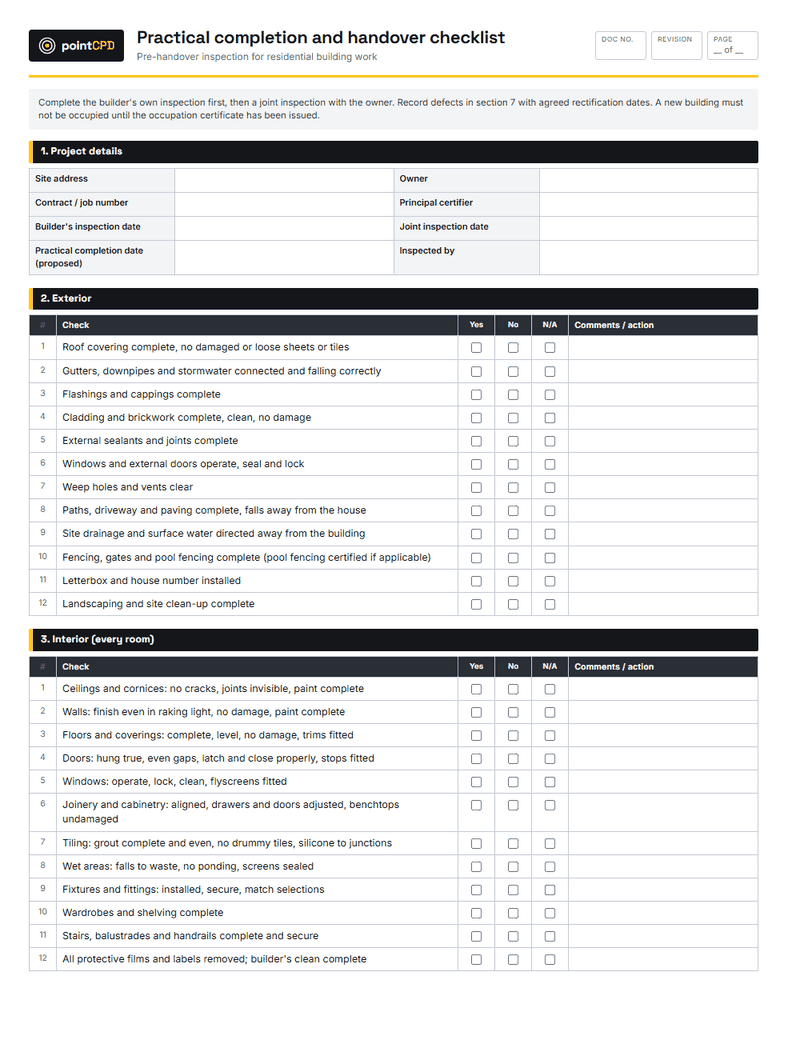
The difference between the two outcomes is not the quality of the work. It is the quality of the contract and the administration. The practical completion checklist template is a starting point for making sure the handover stage captures the information the defect period will need.
Where retention sits against statutory warranties and HBCF
Retention and the defects liability period are contractual. The statutory warranties are not. They apply to residential building work in NSW and they continue for their own periods, regardless of what the contract says. A defect that is notified after the defect period has ended can still be pursued under the warranties, and the fact that retention has been released does not extinguish the claim.
That is why the release of retention should never be treated as a full and final settlement of all claims. If the contract includes a clause that says release of retention discharges all defects, that clause needs to be read carefully against the statutory warranties, because the warranties cannot be contracted out of. The practical effect is that a builder can be called back to rectify a defect after the retention has been released, and the cost of that work has to be carried by the business.
The Home Building Compensation Fund sits alongside the warranties, not alongside retention. HBCF cover is a separate regime that responds to certain losses where the builder has not completed the work or has failed to rectify. It is not a substitute for retention, and retention is not a substitute for HBCF. The article on HBCF claims in NSW explains how that regime operates.
The practical implication is that the builder should keep defect records for longer than the defect period. If a claim is made under the warranties after the retention has been released, the builder’s file is the evidence of what was done, when, and to what standard. A file that is closed at the end of the defect period is a file that cannot answer a warranty claim that arrives later.
Common mistakes and what they cost
The mistakes that cost the most are rarely about the building work itself. They are about the paperwork and the timing.
- No retention cap. Retention grows with each progress payment, and on a long job the amount held can exceed the builder’s available working capital.
- Defect period start date not defined. The parties disagree about when the clock started, and the release date becomes a negotiation rather than a calculation.
- Verbal defect notices. Without a written notice, the builder cannot prove what was notified or when, and the defect period can be extended by argument.
- Mismatch between head contract and subcontract. The builder holds retention from a subcontractor for a shorter period than the principal holds it from the builder, leaving the builder carrying the gap.
- Release without a written record. Retention released without documentation can be claimed again, and the builder has no evidence of payment.
- Treating release as final. Releasing retention does not end the statutory warranties, and a builder who assumes it does will be unprepared for a later claim.
The mistake that costs the most. Releasing retention without a written release notice and without a documented defect close-out leaves the builder with no evidence that the defect process was completed, and the same items can be raised again under the statutory warranties after the money has gone.
The commercial reality is that retention and defects are cash flow issues before they are legal issues. A builder who tracks retention carefully and administers the defect period actively will collect the balance on time and close the file with evidence. A builder who treats the defect period as a formality will fund the repairs from margin and spend the next job arguing about the last one.
If you want to build the contract and defect management side of your practice, the PointCPD course catalogue includes modules on contracts, progress claims and defects, and the PointCPD home page is the starting point for NSW builder CPD courses.
Questions builders ask
What is the difference between retention and a defects liability period?
Retention is money held back from progress payments as security for completion and defect rectification. The defects liability period is the time after completion during which the principal can require the builder to return and fix defects. Retention is the leverage; the defect period is the window in which that leverage can be used.
When is retention released on a home building job?
The contract sets the release triggers, which are usually practical completion for the first portion and the end of the defects liability period for the balance. If the contract does not say when release happens, the builder has no clear mechanism to force it, so the release terms need to be specific.
Does the defects liability period replace the statutory warranties?
No. The statutory warranties apply to residential building work in NSW and continue for their own periods regardless of the contract. A defect can still be pursued under the warranties after the defects liability period has ended and the retention has been released.
Can a principal refuse to release retention because of a defect?
The contract governs this. If a defect has been notified within the defect period and has not been rectified, the principal will usually be entitled to hold the retention or to use it to fund the rectification. The contract should set out the process for that, including how any balance is accounted for.
What should a builder do when a defect notice arrives?
Log the notice with the date and the exact wording, inspect the item with the person who notified it, and classify it as a defect, incomplete work, or neither. If it is a defect, rectify it within the defect period and document the repair and the close-out in writing.
How does retention work when the builder is a subcontractor?
The head contract governs the retention held by the head contractor, and the security of payment regime sits alongside it. The subcontractor should be able to see what is being held and when it will be released, and the head contract terms should be consistent with what the builder passes down to its own subcontractors.
Sources
- Retention money held by head contractors · NSW Government
- Ensure your new work remains trouble-free (defects and warranties) · NSW Government
- Contracts for home building work · NSW Government · 2026-04-29
- Building Defects Library · Building Commission NSW · 2025-06-25
Published 11 September 2026. General information for builders, not legal, financial or engineering advice for a specific job. Check current requirements with the relevant regulator or standard before relying on them.