Key takeaways
- The principal contractor role is a WHS function that attaches to one person or business on a construction project, and it is separate from the commercial head contract.
- The core duty is coordination: the principal contractor must manage WHS matters across the whole site and between overlapping trades, not just police its own employees.
- Consultation with workers and subcontractors is a legal duty, not a courtesy, and it must happen before decisions are made rather than after a problem appears.
- Subcontractor control depends on what the principal contractor knows before a trade starts, including the hazards that trade brings and how those hazards interact with others on site.
- Records created during the job, not after an incident, are what demonstrate the duties were discharged when a regulator or insurer asks questions.
On a residential project, the principal contractor is the person or business that carries the WHS duties for the construction work as a whole. That is a different thing from being the head contractor commercially. The head contract tells you who gets paid and who carries the risk under the building contract. The principal contractor role tells you who is responsible for managing work health and safety across the site, including the work of every subcontractor who sets foot on it.
Builders get caught out because the two roles usually sit with the same business on a house or duplex, so the distinction never gets tested until something goes wrong. When a subcontractor is injured, or a regulator attends after a complaint, the first question is not who signed the contract. It is who was coordinating the site, what did they know about the hazards, and what did they do about them.
This article covers the coordination side of the role: how the duty is established, what it requires between trades, how consultation works in practice, and what records you need. If you want the mechanics of safe work method statements and high risk construction work, those are covered separately.
How the principal contractor role is established on a residential project
The role attaches to a project. Once a person conducting a business or undertaking has been appointed as principal contractor for construction work, the WHS duties that come with that role apply to them for the duration of the work. On a residential job this is normally confirmed in the head contract or in a separate written appointment before work starts.
The practical problem on small residential sites is that the role is often assumed rather than stated. The builder thinks it is obvious. The subcontractors assume the builder is running the site. The owner assumes the same. That works until a trade brings its own plant, or two trades are working in the same area, and nobody has actually set the rules for how those activities interact.
If you are the principal contractor, that appointment should be visible in the site documentation. Subcontractors should be able to find it, and so should anyone attending the site on official business. A written appointment also clarifies the boundary: which parts of the work you are coordinating, and which activities sit outside the construction project entirely.
How the principal contractor role is established and held
- 1Confirm the roleEstablish who holds the principal contractor role for the project before any construction work starts on site.
- 2Appoint in writingRecord the appointment so subcontractors, suppliers and the certifier know who carries the WHS coordination duty.
- 3Set the site rulesIssue site-specific WHS arrangements covering access, inductions, amenities, first aid and emergency procedures.
- 4Coordinate overlapping tradesManage how trades interact, including sequencing, shared plant and shared access routes.
- 5Monitor and reviewCheck that arrangements are being followed, and revise them when the scope or the trades change.
What the coordination duty actually requires between trades
The central obligation is to manage WHS matters across the site, which in practice means managing the interfaces. A tiler working alone in an empty house is a low-complexity problem. The same tiler working below a roofer, with a scaffold partially dismantled and a sparky running cable through the same ceiling space, is a coordination problem that the principal contractor owns.
This is where residential sites differ from larger commercial work. On a big project there is usually a site manager whose entire job is that interface. On a house or a small townhouse development, the builder or supervisor is doing it between quoting, ordering and dealing with the client. The duty does not shrink because the project is small.
Coordination means at least three things. First, knowing what work is planned and when. Second, identifying where activities will overlap and what hazards that creates. Third, deciding how those hazards will be controlled before the overlap happens, and telling the people involved. That third step is the one most often skipped, because it requires a conversation that costs time and does not produce anything visible.
The commercial reality is that interface hazards are where residential injuries cluster. A fall from a partially sheeted roof, a strike from plant moving through a shared access route, an electric shock from a cable run through a wall another trade is about to cut. These are not failures of one trade’s work method. They are failures of site coordination, and the principal contractor carries them.
Identifying hazards before the trades arrive, not after
Hazard identification on a residential site is mostly sequencing work. You know the order the trades will follow. You know which stages put people in the same space at the same time. The job is to think through those overlaps before the programme puts them together, and to decide whether the overlap is acceptable or whether the sequence needs to change.
Some hazards are inherent to the site rather than the trade. A sloping block creates access and traffic issues that persist through the whole build. A site with limited street frontage creates delivery and unloading hazards that repeat every week. A site in a flood-affected area brings its own set of considerations, and the NSW flood risk management manual is the reference point for how flood risk is treated in planning and development decisions, which feeds into what you need to allow for on site.
Other hazards come with the trade. Silica is the obvious current example. Safe Work Australia’s guidance on WHS duties for silica sets out how the duties sit across the parties, and for a principal contractor the practical question is whether the controls being used on your site actually match the task. Cutting engineered stone or concrete with a dry saw in an enclosed room is a different proposition from the same cut outdoors with water suppression. You do not need to be the expert in every trade’s controls, but you do need to know enough to recognise when the control on site does not match the task.
Hazard identification is not a one-off exercise at the start of the job. It happens again every time the scope changes, the sequence changes, or a new trade arrives. A variation that adds a retaining wall or a pool changes the site hazards, and the coordination arrangements need to follow.
Site coordination checks before a new trade starts
- The trade has been inducted into this site’s WHS arrangements, not just a generic induction.
- The hazards that trade brings have been identified and matched against work already underway.
- Shared plant, access routes and temporary services have been discussed with every affected trade.
- The trade knows who to report incidents, near misses and hazards to on this site.
- Emergency and first aid arrangements have been explained, including the site address for emergency services.
- Any high risk construction work has been identified before the work starts, not after.
- The trade knows what records it must provide and when.
Consultation with workers and subcontractors
Consultation is a duty, not a management style. It requires that workers who are affected by a WHS matter have a reasonable opportunity to be involved in decisions about it, and that their views are taken into account. On a residential site this is usually informal in form but still required in substance.
What it looks like in practice is a conversation before the decision, not an announcement after it. If you are changing the sequence so that two trades work simultaneously in a confined area, the people doing that work should be part of the discussion about how it will be controlled. They often know the practical problem better than you do, and the control they suggest is more likely to be followed than one imposed from the office.
Consultation also covers the subcontractors themselves. Each subcontractor is a person conducting a business or undertaking with its own WHS duties, and those duties overlap with yours rather than replace them. The principal contractor coordinates; the subcontractor manages its own work. Neither party can delegate the whole thing to the other.
Where consultation breaks down is when it is treated as documentation. A toolbox talk where everyone signs a sheet and nobody discusses the actual hazard is not consultation. The signature proves attendance. It does not prove that anyone engaged with the risk.
Subcontractor management without micromanaging the trade
There is a spectrum between ignoring subcontractors and trying to run their work for them. Neither end works. The principal contractor needs enough control to coordinate the site, and enough distance to let each trade apply its own competence.
The practical lever is what you require before a trade starts. That includes evidence that the trade is competent for the work, that its workers are inducted into this site, and that any high risk construction work it will perform has been identified and covered by a safe work method statement. The information sheet on safe work method statements for high risk construction work sets out what those documents need to contain and how they are meant to be used on site.
What you should not do is collect a SWMS and file it. The document is only useful if the people doing the work have it on site, have been briefed on it, and are following it. Part of the coordination duty is checking that what was submitted is what is actually happening, and stopping the work when it is not. That is an uncomfortable conversation on a residential site when the trade is a long-standing subbie and the programme is tight, but it is the conversation that the duty requires.
The other lever is exclusion. A trade that will not follow the site arrangements is a coordination risk you carry for the rest of the job. The cost of removing them mid-programme is real, but so is the cost of an incident on a site you are responsible for coordinating.
Records that show the duty was discharged
After an incident, the question is always the same: what did the principal contractor know, and what did they do. Records answer that question. Without them, the answer defaults to whatever the regulator or the insurer can infer from the site conditions at the time.
The records that matter are the ones created during the job. Site inductions for every worker who attended. The WHS arrangements for the site, issued to every trade. Consultation records that show what was discussed and when. Hazard identification for the stages of the work. Evidence that subcontractors were checked before they started. Records of any incidents, near misses and the actions taken in response.
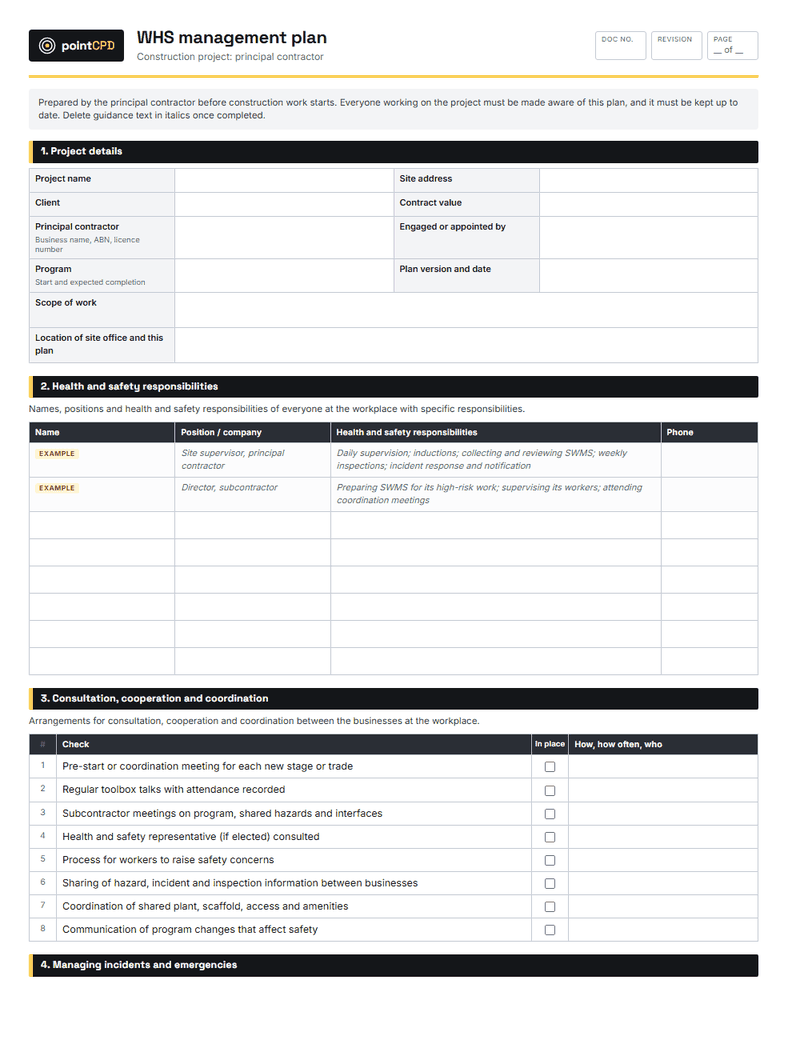
None of this needs to be elaborate. A folder, whether physical or digital, with the current versions of everything and a date on each entry is enough. What does not work is a set of documents assembled after the fact, because the dates will not line up and the gaps will be obvious. Our free WHS management plan template is a starting point for the site-level documentation, and it is easier to adapt it to a residential job than to build the record from scratch when a regulator asks.
Keep the records for the period the legislation requires, and keep them in a form you can produce quickly. If you cannot find the induction record for a worker who was injured, the practical position is that the induction did not happen, regardless of what you remember.
What the role is not
The principal contractor role does not make you responsible for everything that happens on site, and it does not remove the duties of anyone else. Each subcontractor still manages its own work and its own workers. Each worker still has duties to take reasonable care and to follow reasonable instructions. Designers, manufacturers and suppliers carry their own duties upstream.
It also does not make you the supervisor of every trade. You are not directing how a plumber makes a connection or how a carpenter frames a wall. You are coordinating the site so that those activities can happen without creating risk for each other. The distinction matters because builders sometimes swing between doing nothing and trying to control everything, and both responses misread the duty.
The role does, however, carry the consequences. If the coordination fails and someone is injured, the principal contractor is the party the regulator looks at first, and the party whose insurer will be asking what records exist. That is why the ladder safety on site are worth understanding properly rather than treating as a signature on a contract. If you are working through how this fits with your broader obligations, our guide to how NSW builder CPD works explains the categories and what counts toward your hours, and the PointCPD course catalogue lists the compliance units that cover this material in more depth.
Worked example: a duplex in western Sydney
A builder in western Sydney is running a two-lot duplex. The frame is up on lot one, the roof is being sheeted, and the builder has scheduled the electrician to start rough-in on the same day. The scaffold is in place but the roofers need part of it moved to reach the far pitch.
On paper, the programme looks fine. Each trade has its own scope, its own subbie, and its own work method. What has not been thought through is the overlap. The roofers are working above the electrician. The electrician is running cable through the same ceiling space the roofers are accessing. The scaffold is being modified while both trades are on site.
The principal contractor duty requires the builder to identify this overlap before the day it happens, decide how it will be controlled, and communicate that to both trades. The control might be resequencing so the roof is sheeted before the electrician starts. It might be separating the work areas and confirming the scaffold modification is complete and inspected before anyone else accesses it. Either way, the decision is the builder’s to make and to communicate.
If the builder does nothing and an electrician is struck by a falling sheet, the investigation will not focus on whether the roofer was competent. It will focus on whether the principal contractor identified the interface, whether the trades were consulted, and what record exists of the decision. That is the practical test of the role, and it is applied retrospectively, which is why the records need to exist before the incident rather than after it.
The most expensive mistake is treating coordination as paperwork. A site folder full of inductions and SWMS that nobody has acted on does not discharge the duty; what counts is whether the overlaps were identified and controlled before the trades arrived.
Where builders most often get it wrong
The failures are consistent. Assuming the role without confirming it in writing. Letting the programme drive the sequence without checking what overlaps it creates. Collecting subcontractor documents and filing them without checking that the controls on site match what was submitted. Treating consultation as a signature sheet. Relying on memory and verbal instructions instead of a record.
Each of these is cheap to fix before the work starts and expensive to fix afterwards. The records take time on a residential job where the builder is already stretched, but they are the only thing that stands between a coordination failure and a finding against the business.
The other consistent failure is letting the role drift. On a long job, the principal contractor arrangements set up at the start stop matching the site. New trades arrive without induction. The sequence changes without the hazard identification being revisited. The arrangements need to be reviewed as the job progresses, not just issued once and left.
Building the role into how you run the job
The principal contractor duties are not a separate compliance exercise bolted onto the build. They are the coordination function that a well-run residential site already performs, written down and made explicit. If you are already sequencing trades sensibly, checking that subbies know the site rules, and dealing with problems before they escalate, you are doing most of the work. What is usually missing is the record.
Start with the appointment, then the site arrangements, then the checks before each trade starts, then the consultation record, then the review as the job moves. That sequence matches how the work actually happens, which makes it easier to keep current than a document written once at the start.
If you want to work through the detail for your own projects, the related article on NSW builder supervision duties covers the supervision side of the same role, and the material on SWMS and high risk construction work covers the documentation that sits underneath it. Together they cover the ground a principal contractor on a residential site needs to hold.
Questions builders ask
What is the difference between the head contractor and the principal contractor on a NSW residential site?
The head contractor is a commercial role defined by the building contract. The principal contractor is a WHS role that attaches to the construction project and carries the duty to coordinate work health and safety across the site. On most residential jobs the same business holds both, but they are separate obligations and the WHS one does not disappear if the commercial arrangement changes.
Do I need to be appointed in writing as principal contractor?
The role is established by appointment, and on a residential project it is normally confirmed in the head contract or in a separate written appointment before work starts. Putting it in writing removes the assumption that it is obvious, and it gives subcontractors and anyone attending the site a clear point of reference for who coordinates WHS matters.
Am I responsible for a subcontractor’s workers if they get injured on my site?
Each subcontractor is a person conducting a business or undertaking with its own WHS duties for its own workers. Your duty as principal contractor is to coordinate WHS matters across the site, including the interfaces between trades. If a coordination failure contributed to the injury, that is where your exposure sits, which is why the records of what you identified and communicated matter.
How do I coordinate trades that are working in the same area at the same time?
Identify the overlap before it happens, decide how it will be controlled, and communicate the decision to both trades. The control might be resequencing so the activities do not overlap at all, or separating the work areas and confirming shared access and plant are safe. What matters is that the decision is made before the day, not worked out on site.
What records should a principal contractor keep on a residential job?
Site inductions for every worker who attended, the WHS arrangements issued to each trade, records of consultation, hazard identification for the stages of work, evidence that subcontractors were checked before starting, and records of incidents and near misses with the actions taken. Keep them current and in a form you can produce quickly, because after an incident the dates and gaps will be examined.
Does the principal contractor role change if the project is a small renovation rather than a new build?
The duty is the same in substance, but the coordination burden scales with the number of trades and the complexity of the overlaps. A small renovation may have fewer interfaces, but if high risk construction work is involved, or if multiple trades are working in the same space, the same coordination and consultation obligations apply.
Sources
- WHS duties for silica · Safe Work Australia
- Safe work method statement for high risk construction work · Safe Work Australia
- Flood risk management manual · NSW Government
- Key WHS statistics Australia · Safe Work Australia · 2025-10-01
Published 15 September 2026. General information for builders, not legal, financial or engineering advice for a specific job. Check current requirements with the relevant regulator or standard before relying on them.