Key takeaways
- A safe work method statement (SWMS) is required before any of the 18 categories of high-risk construction work in the model WHS Regulations is carried out. The ACT adds a further category for silica processing.
- A SWMS must identify the high-risk work, the hazards and risks, the control measures, and how they will be implemented, monitored and reviewed.
- It must be prepared in consultation with the workers doing the work, be kept available on site, and be reviewed when the work or the controls change.
- The principal contractor must take reasonable steps to obtain a SWMS before high-risk work starts on site.
- A SWMS that describes the actual site, the actual task and the actual controls is a safety tool. A generic one is paperwork that regulators criticise.
Every builder knows the acronym. Safe work method statements are required for high-risk construction work, and most building sites have a folder full of them. The problem is that many of those documents are generic templates that describe no particular job, name no particular hazard and change nothing about how the work is done. Regulators have criticised this for years, and in an incident investigation, a generic SWMS is often worse than useless.
This guide explains when a SWMS is required, the 18 categories of high-risk construction work, what the law says a SWMS must contain, and how to write one that actually works on site.
When a SWMS is required
Under the model WHS Regulations, which apply in NSW and most other jurisdictions, a person conducting a business or undertaking must prepare a SWMS before high-risk construction work starts, and the work must then be carried out in accordance with it. High-risk construction work is defined by a list of categories. If any part of the work falls into one of them, a SWMS is required, regardless of the size of the job.
The 18 categories of high-risk construction work
- Risk of a person falling more than 2 metres.
- Work on a telecommunication tower.
- Demolition of an element of a structure that is load-bearing or related to its physical integrity.
- Work likely to involve disturbing asbestos.
- Structural alterations or repairs that require temporary support to prevent collapse.
- Work in or near a confined space.
- Work in or near a shaft or trench deeper than 1.5 metres, or a tunnel.
- Use of explosives.
- Work on or near pressurised gas distribution mains or piping.
- Work on or near chemical, fuel or refrigerant lines.
- Work on or near energised electrical installations or services.
- Work in an area that may have a contaminated or flammable atmosphere.
- Tilt-up or precast concrete elements.
- Work on, in or next to a road, railway or other traffic corridor in use by traffic other than pedestrians.
- Work in an area where there is movement of powered mobile plant.
- Work in areas with artificial extremes of temperature.
- Work in or near water or other liquid involving a risk of drowning.
- Diving work.
Source: Model WHS Regulations. The ACT adds a category for processing crystalline silica substances. Check your jurisdiction.
On a typical residential building site, several categories are almost always present: work at height where a fall of more than 2 metres is possible, work where powered mobile plant moves, work near energised electrical services, trenching deeper than 1.5 metres for services and footings, work next to a road, and, on renovations, work likely to disturb asbestos or involving structural alterations that need temporary support.
What a SWMS must contain
The regulations require a SWMS to identify the high-risk construction work involved, specify the hazards relating to that work and the risks to health and safety, describe the control measures to be implemented, and describe how those measures will be implemented, monitored and reviewed. It must be set out and expressed in a way that is readily accessible and understandable to the people who use it.
What a SWMS must cover
- 1The high-risk workWhich category or categories of high-risk construction work are involved.
- 2Hazards and risksThe specific hazards of this task on this site.
- 3Control measuresThe controls to be used, following the hierarchy of controls.
- 4ImplementationHow the controls will be put in place, monitored and reviewed.
- 5Consultation and sign-onPrepared with the workers, understood by them, and kept on site.
The controls should follow the hierarchy of controls: eliminate the risk where possible, then use substitution, isolation and engineering controls, then administrative controls and personal protective equipment. A SWMS that relies mainly on “be careful” and “wear PPE” for a hazard that could be controlled with edge protection or a barrier is not following the hierarchy.
Who prepares it, and who checks it
The business carrying out the high-risk work, usually the subcontractor, prepares the SWMS for its work, in consultation with its workers. The principal contractor, usually the builder on a residential site, must take reasonable steps to obtain the SWMS before the high-risk work starts. In practice, that means asking for it, reading it, checking that it matches the site and the controls the builder is providing, and raising any gaps before the work begins.
The SWMS must be kept and be available for inspection while the work is being done, and it must be reviewed and, if necessary, revised when the work or the controls change, or when there is reason to believe the controls are not working.
Read the SWMS you are given. Filing a subcontractor’s SWMS without reading it does not meet the principal contractor’s obligation to take reasonable steps. Check it describes this site, these tasks and the controls that will actually be used, and ask for changes if it does not.
How a SWMS fits with the other safety documents
A SWMS is one document in a set, and confusing them causes gaps. The model WHS Regulations require the principal contractor for a construction project, which the regulations define as construction work costing $250,000 or more, to prepare a WHS management plan for the whole site. That plan sets out the site rules, the arrangements for consultation and incident management, and how the principal contractor will collect and check SWMS from the businesses doing high-risk work.
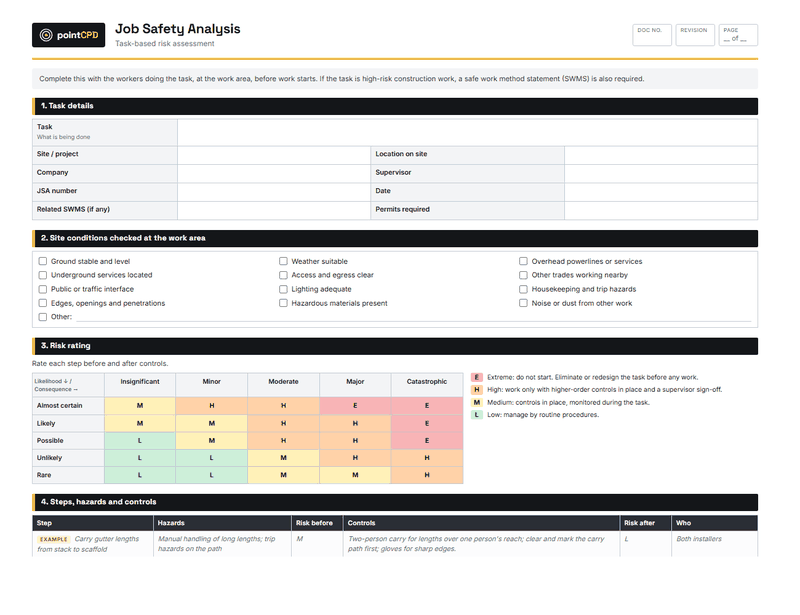
A job safety analysis, or JSA, is a task-level risk assessment often used for work that is not high-risk construction work, or to break a complex task into steps. A risk assessment may be used for a specific hazard, such as a hazardous chemical or a manual handling task. A toolbox talk is how the content of these documents reaches the people on the tools. None of them replaces a SWMS where one is required, but together they give a consistent picture of how the site manages risk.
Keeping SWMS records
A SWMS must be kept until the high-risk construction work it covers is complete. If a notifiable incident occurs during that work, the SWMS must be kept for at least two years after the incident. In practice, most builders keep SWMS with the project records for much longer, because they are also evidence of how the work was planned if a claim, an investigation or a dispute arises years later. Digital sign-on systems make this easier, recording who read which version and when.
Generic versus useful
Generic SWMS versus useful SWMS
| Generic | Useful |
|---|---|
| “Use harness where required” | “Perimeter scaffold installed and tagged before any roof work; no work at the gable until the gable edge protection is fitted” |
| “Beware of power lines” | “Service line crosses the front of the site; no crane lift within the marked zone; spotter for all boom movements” |
| “Wear dust mask” | “Wet cutting and on-tool extraction for all brick and paver cuts; fitted respirators for chasing; H-class vacuum clean-up” |
| 40 pages covering every possible task | A few pages covering the tasks actually being done on this site |
The difference between a useful SWMS and a generic one is specificity. A useful SWMS names the site features that create the risk: the height of the eaves, the location of the service line, the depth of the trench, the tight access for plant. It describes the controls in terms a worker can check: edge protection installed and tagged before roof work, trench shoring or battering to a specified design, a spotter for reversing. And it is short enough that the people doing the work read it.
Consultation and sign-on
A SWMS must be prepared in consultation with the workers who will do the work. Their knowledge of how the task is really done, and where the risks really are, is what makes the document accurate. Workers should sign on to confirm they have read and understood it, and the SWMS should be explained to anyone who joins the task later. Where workers have limited English, the SWMS should be explained in a way they understand.
Reviewing a SWMS
A SWMS is not a set-and-forget document. It should be reviewed when:
- the work method changes, such as a different access method or plant;
- the site conditions change, such as weather, ground conditions or new hazards;
- a control measure is found not to be working;
- there is an incident or near miss;
- workers or supervisors raise concerns.
Common SWMS failures
- Generic templates with no site-specific information.
- Controls that do not match the site, such as a SWMS referring to scaffold that was never installed.
- Too long to use, covering every conceivable task rather than the ones being done.
- Not on site or not accessible to the workers.
- Not followed: the work is done differently from what the SWMS describes.
- Never reviewed, even after conditions changed.
A worked example: the roof on a two-storey home
A roofing subcontractor sends the builder a 30-page SWMS for “roof installation” before starting on a two-storey home. The builder reads it. It refers generally to harnesses and ladders, but says nothing about the site: the house is on a slope, one side has a drop well over the height of a single storey to a lower yard, and a power service line crosses the front of the property.
The builder and the roofer meet on site. The revised SWMS is four pages long. It states that perimeter scaffold with guardrails is installed on all sides, including the high side over the lower yard, and tagged before roof work starts; that no roof sheets are lifted near the service line without a spotter; that sheets are delivered by crane to a set-down area away from the line; and that work stops in winds above the limit for handling sheets. The roofing crew signs on after a short briefing. The work goes ahead exactly as the SWMS describes.
Using a template well
Templates are useful as a starting structure, and PointCPD’s free SWMS template is designed to be adapted, not filed unchanged. The value is in the site-specific information you add: the actual hazards, the actual controls, and the actual people. A template that prompts those details, and a builder who insists on them, turns a compliance document into a safety tool.
The bottom line
A SWMS is required before any high-risk construction work, and on a house site that means most of the major trades. The law asks for a document that identifies the work, the hazards and the controls, prepared with the workers, kept on site and reviewed when things change. The builder’s job is to obtain it, read it, check it matches the site, and make sure the work follows it. Specific beats generic every time.
Questions builders ask
When is a SWMS required?
Before high-risk construction work starts. High-risk construction work is defined by 18 categories in the model WHS Regulations, including work with a risk of falling more than 2 metres, trenching deeper than 1.5 metres, work near energised electrical services and work where powered mobile plant moves.
Who has to prepare the SWMS?
The business carrying out the high-risk work, in consultation with its workers. The principal contractor must take reasonable steps to obtain it before the work starts.
What must a SWMS include?
The high-risk construction work involved, the hazards and risks, the control measures, and how the controls will be implemented, monitored and reviewed, in a form the workers can understand.
How many high-risk construction work categories are there?
Eighteen under the model WHS Regulations. The ACT adds a category for processing crystalline silica substances.
When should a SWMS be reviewed?
When the work or site conditions change, when a control is not working, after an incident or near miss, or when workers raise concerns.
Sources
- Safe work method statement for high risk construction work · Safe Work Australia
- Construction work: code of practice · Safe Work Australia
Published 5 September 2026. General information for builders, not legal, financial or engineering advice for a specific job. Check current requirements with the relevant regulator or standard before relying on them.