Key takeaways
- Safe Work Australia reported 37 construction worker fatalities in 2024, about one in five of all worker fatalities that year. Falls from height are one of the leading causes of death in construction.
- The duty to manage the risk of a fall applies at any height. Work involving a risk of a person falling more than 2 metres is high-risk construction work that needs a safe work method statement.
- The WHS Regulations set a hierarchy: do the work on the ground where possible, then use fall prevention such as scaffolds and edge protection, then work positioning, then fall arrest, with ladders and admin controls last.
- On houses, the main fall hazards are roof edges, brittle roofing and skylights, open floor frames, stair voids, trusses during installation, and ladders.
- Perimeter scaffolding or roof edge protection installed before roof work starts is the most effective single control on a residential job.
Every year, building workers die in falls: from roofs, frames, scaffolds, ladders and through openings in floors. Most of them were doing ordinary work on ordinary jobs. Many of the falls happened from heights that do not sound dangerous, a single storey or a few rungs up a ladder. And almost all of them could have been prevented with controls that are well known, affordable and standard on good sites.
This guide covers why falls remain such a problem, what the work health and safety rules require, and the practical controls that work on residential jobs.
Construction deaths in Australia, 2024
Source: Safe Work Australia, Key WHS Statistics Australia 2025
The scale of the problem
Safe Work Australia reported that 37 construction workers were killed at work in 2024, about 20% of all worker fatalities in Australia. Construction is consistently among the industries with the highest number of work-related deaths, and falls from height are one of the leading causes. Falls also cause a very large number of serious injuries: broken backs, head injuries and fractures that end careers.
The pattern behind the numbers is consistent. Falls happen when edge protection has not yet been installed or has been removed, when someone steps onto a fragile surface, when a ladder is used for a job it was not suited to, or when a void is left uncovered. They happen at the edges of time pressure: the last hour of the day, the “quick job” before the scaffold arrives.
What the law requires
Under the model WHS laws, which apply in NSW and most other jurisdictions, a person conducting a business or undertaking must manage the risk of falls. That duty applies at any height where a fall could cause injury, not only above a particular height. On a building site, the builder as principal contractor, and each subcontractor for their own work, carry duties.
The WHS Regulations set out a hierarchy for controlling fall risks:
The hierarchy of controls for falls
- 1Work on the groundPrefabricate, assemble trusses and panels at ground level, use extendable tools.
- 2Fall preventionScaffolds, edge protection, guardrails, covers over voids, elevating work platforms.
- 3Work positioningA restraint system that stops a worker reaching the edge in the first place.
- 4Fall arrestHarness and anchor, safety mesh or catch platforms that stop a fall once it starts.
- 5Ladders and adminOnly for short, low-risk tasks, with procedures, training and supervision.
Source: Model WHS Regulations; Safe Work Australia codes of practice on falls.
The hierarchy matters. A harness is not a first choice. It only works if it is worn correctly, attached to a suitable anchor, and followed by a rescue plan, because a worker suspended in a harness needs to be rescued quickly. Scaffolds and edge protection work passively: they protect everyone on the roof or floor without relying on each person doing the right thing every time.
Safe work method statements
Work that involves a risk of a person falling more than 2 metres is high-risk construction work under the WHS Regulations. It must not be carried out until a safe work method statement (SWMS) has been prepared for it, and it must be done in accordance with the SWMS. The SWMS must describe the actual fall hazards on the job and the actual controls, and it should be reviewed if the work or the controls change.
A generic SWMS that says “use harness where required” is not a plan. A useful SWMS says, for example, that perimeter scaffold with guardrails will be installed at eaves height before trusses are delivered, that internal fall protection will be installed in the stair void, and that no one will work on the roof until the scaffold has been inspected and tagged.
Codes of practice
Safe Work Australia’s codes of practice on managing the risk of falls, including the code for housing construction, set out practical ways to meet the duties. Codes of practice can be used as evidence of what is known about a hazard and how to control it, so a builder who departs from them needs a good reason and an equally effective alternative.
Fall hazards on a house, stage by stage
Fall hazards on a house, and the control that fits
| Stage | Hazard | First-choice control |
|---|---|---|
| Frame | Open edges of upper floor, unprotected stair void | Perimeter scaffold or edge protection; void covers or guardrails |
| Trusses | Working on top plates and trusses during installation | Scaffold at eaves height plus internal platforms or mesh; lift trusses by crane |
| Roof | Roof edges and gable ends | Perimeter scaffold or roof edge protection before roofers start |
| Roof | Skylights, brittle or fragile sheeting | Covers or mesh under fragile areas; mark and exclude |
| Fit-out | Ladders for ceilings, high windows, stairwells | Mobile scaffold or platform ladder; stair void protection kept in place |
| External | Gutters, fascia, cladding at height | Scaffold or elevating work platform rather than ladders |
Frame stage
On a two-storey house, the upper floor frame creates open edges around the perimeter and at the stair void. Carpenters working on the upper floor, and anyone else who goes up, are exposed until edge protection is in place. Perimeter scaffolding or temporary edge protection, plus a cover or guardrail on the stair void, removes the hazard.
Trusses
Truss installation is one of the highest-risk tasks on a house. Workers stand on top plates and walk trusses into place, often at the full height of the building. Good practice is to have perimeter scaffold at eaves height before trusses arrive, to lift trusses into place by crane where possible, and to use internal platforms or other fall protection so that workers do not balance on top plates.
Roof
Roof edges, gable ends and fragile areas such as skylights and translucent sheeting are the classic roof fall hazards. Perimeter scaffold or roof edge protection should be installed and inspected before roofers start. Skylight openings and fragile sheeting need covers, mesh or exclusion. Weather changes the risk quickly: wet or frosty roofing is far more slippery, and wind can make handling sheets dangerous.
Fit-out and external work
Once the roof is on, the fall hazards shift to ladders, stairwells and high internal work such as ceilings, high windows and voids. Ladders are involved in a large share of falls, often from low heights. A mobile scaffold or platform ladder is usually a better option for work that takes more than a few minutes. External work on gutters, fascias and cladding is safer from scaffold or an elevating work platform than from a ladder.
The removed guardrail. A common way edge protection fails is a trade removing a section to get materials in or out, intending to put it back. Make it a site rule that edge protection is only altered by the person responsible for it, and check it at the start of every day.
Ladders: the everyday risk
Because ladders are cheap and convenient, they are used for far more than they should be. A ladder is appropriate for short, light tasks where the worker can maintain three points of contact, or as a means of access. It is not a good working platform for heavy or prolonged work, or where the worker needs to use both hands.
Good ladder practice includes using the right type and rating of ladder, setting it on firm, level ground at the correct angle, securing it at the top or footing it, extending it well above the landing point when used for access, and never standing on the top rungs. Platform ladders and small mobile scaffolds are safer for most internal fit-out work.
Scaffolds: installed, inspected, unaltered
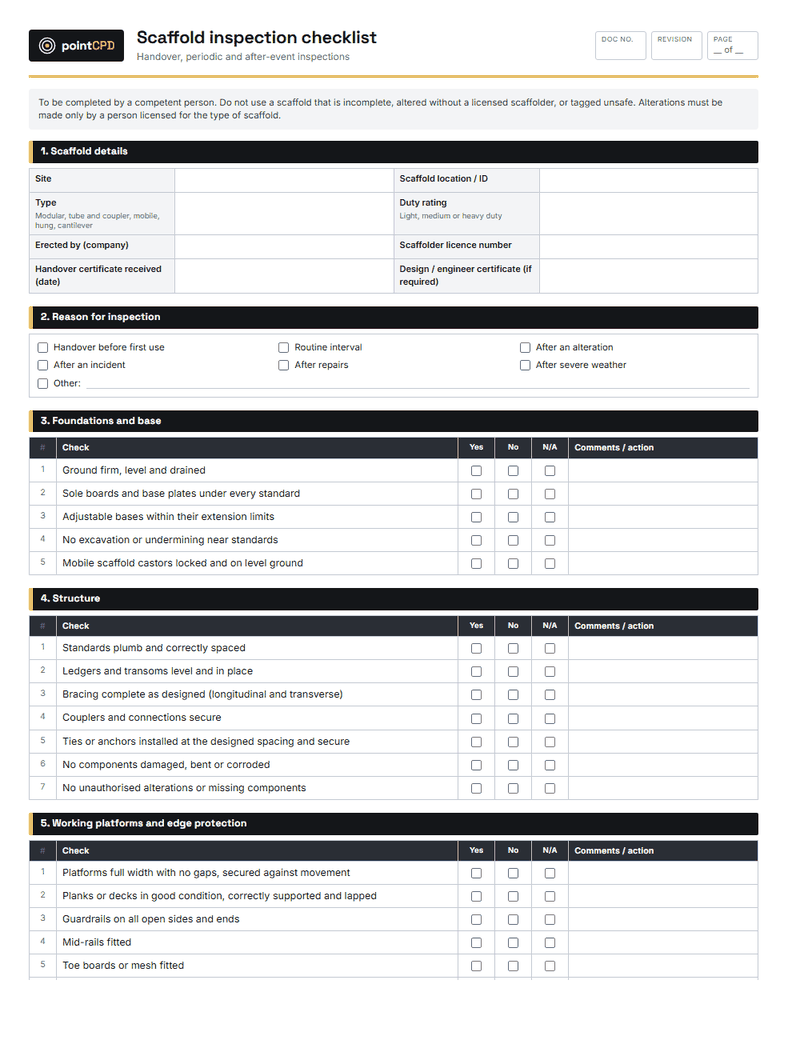
Perimeter scaffolds on houses are installed by licensed scaffolders where the work requires a licence, and they must be inspected before use, after alterations, after events such as storms, and at regular intervals. A scaffold tag showing the last inspection is the simplest check a supervisor can make. Unauthorised alterations, such as removing planks, braces or guardrails, are one of the main causes of scaffold failures.
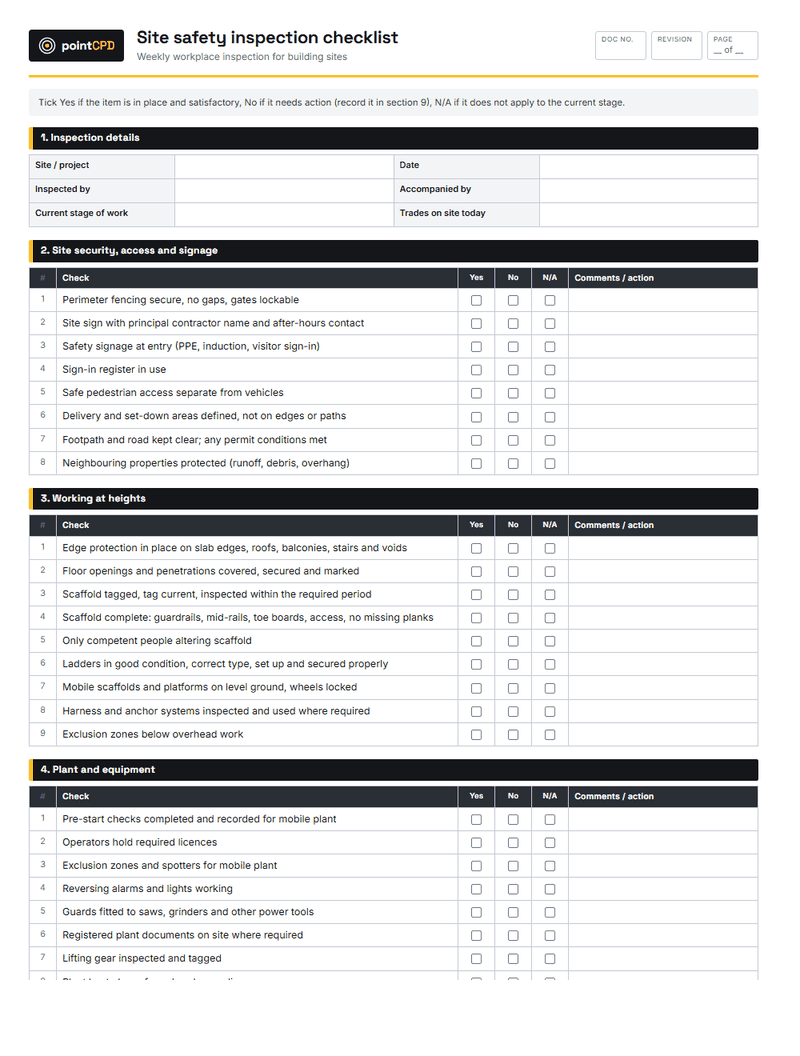
A daily fall-protection walk
- Scaffold tagged and inspected, with no missing planks, guardrails or toe boards.
- Edge protection complete and unaltered: nobody has removed a rail “just for a minute”.
- Stair and floor voids covered or guarded.
- Ladders footed, secured, extended above landing points, and in good condition.
- Skylight openings and fragile roofing covered or marked.
- Harness users trained, anchors rated, and a rescue plan in place.
- Weather checked: wind and wet surfaces change the risk on roofs.
Renovations and re-roofing: the hidden fall risks
Renovation work brings fall hazards that new builds do not. Old roofs may have fragile sheeting, rotten battens, or asbestos cement sheeting that cannot bear a person’s weight. Existing skylights may be brittle with age. Ceiling spaces in older homes may have gaps where a foot can go straight through the plaster. Second-storey additions put workers at height over an occupied house, often without room for full perimeter scaffold.
The controls are the same in principle, but they need more planning. Treat any roof of unknown condition as fragile until assessed. Use scaffold, mesh or crawl boards rather than walking on old sheeting. Where space is tight, consider elevating work platforms or a scaffold design that suits the site. And remember that if the old roof contains asbestos, the fall risk sits alongside an asbestos risk that needs its own controls.
Power lines
Overhead power lines near a house site create a combined fall and electrocution risk for anyone working on a roof, a scaffold or with long materials such as downpipes, roof sheets and ladders. The electricity network operator’s rules set approach distances, and some work near lines needs a permit or the line to be de-energised or insulated. Identify overhead lines before the scaffold goes up, not when a roofer is carrying a 6 metre sheet towards them.
Rescue: the part most plans forget
If fall arrest equipment is used, the plan must include how a worker who falls and is suspended in a harness will be rescued, quickly. A person hanging in a harness can suffer serious harm within a short time, and waiting for emergency services may be too slow. A rescue plan names who will do the rescue, with what equipment, and how. If a builder cannot write a realistic rescue plan for a task, that is a strong sign that a higher-order control, such as scaffold or an elevating work platform, is needed instead.
Planning falls out at the start
The most effective fall prevention is planned before the job starts, not improvised on the day. That means:
- Pricing scaffolding and edge protection into the job. If it is not in the price, it is tempting to skip it.
- Programming it. Scaffold ordered and installed before frame or trusses, not after the first trade is already at height.
- Designing for safety. Where the builder has influence, choose details that reduce work at height: prefabricated components, trusses lifted by crane, gutters installed from scaffold.
- Coordinating trades. Make sure each trade’s SWMS matches the controls on site, and that trades know who is responsible for edge protection.
- Inducting everyone. A site induction that explains the fall controls, the no-alteration rule and who to tell if something is wrong.
What happens after a fall
A serious fall triggers obligations as well as grief. Serious injuries and dangerous incidents must be notified to the regulator, and the site must be preserved until the regulator says otherwise. Regulators investigate falls closely, and prosecutions for fall-related incidents are common. The questions asked are predictable: what was the fall hazard, what did the SWMS say, what controls were in place, were they adequate under the hierarchy, and who was responsible for them?
Builders who can answer those questions with a specific SWMS, inspection records, induction records and a history of enforcing controls are in a very different position from builders who cannot.
Toolbox talks that change behaviour
Falls are a good subject for regular toolbox talks because the hazards change as the job moves from frame to roof to fit-out. A short talk at the start of each stage, covering the specific fall hazards and controls for that stage, the no-alteration rule for edge protection, and what to do if something is missing, keeps the message current. Record who attended, and invite workers to raise concerns. The people working at height often see the problems first.
The cost argument, honestly
Perimeter scaffold on a house costs money, and on a tight job it can feel like a cost that competitors avoid. But the comparison is not scaffold versus no scaffold. It is scaffold versus the cost of a serious fall: the injury, the investigation, the stop-work, the penalties, the insurance consequences, and the effect on everyone who works on the site. Scaffold also makes trades faster and more productive at height, which recovers part of its cost.
The bottom line
Falls are predictable, and the controls are known. Plan edge protection into the job and the programme, install it before anyone works at height, inspect it daily, never let it be altered casually, and use ladders only for what they are good for. On a house, that is the difference between a routine job and a fatality.
Questions builders ask
At what height do you need fall protection on a building site?
The duty to manage fall risks applies at any height where a fall could cause injury. Work involving a risk of falling more than 2 metres is also high-risk construction work that requires a safe work method statement.
Is a harness enough for roof work?
A harness is fall arrest, which sits below fall prevention in the hierarchy of controls. Scaffolds and edge protection should be the first choice. Where harnesses are used, workers need training, rated anchors and a rescue plan.
How many construction workers die at work in Australia?
Safe Work Australia reported 37 construction worker fatalities in 2024, about 20% of all worker fatalities in Australia that year.
Do I need a SWMS for working on a single-storey roof?
If the work involves a risk of a person falling more than 2 metres, it is high-risk construction work and requires a SWMS. Many single-storey roofs exceed that height at the edges and gables.
Can I use a ladder for fit-out work?
For short, light tasks with three points of contact, yes. For longer work, heavier work or work needing both hands, a mobile scaffold or platform ladder is safer.
Sources
- Key WHS statistics Australia · Safe Work Australia · 2025-10-01
- Managing the risk of falls in housing construction: code of practice · Safe Work Australia
- Safe work method statement for high risk construction work · Safe Work Australia
Published 9 August 2026. General information for builders, not legal, financial or engineering advice for a specific job. Check current requirements with the relevant regulator or standard before relying on them.