Key takeaways
- In NSW, the completion date matters because it starts the statutory warranty periods and the Home Building Compensation Fund cover periods.
- Work is complete when it matches the contract’s definition. If the contract does not define it, the NSW Government explains how completion is determined, including the handover date, the last day of work, or the occupation certificate.
- Define practical completion clearly in the contract, give written notice when you reach it, and inspect with the owner against a list.
- A complete handover pack should include certificates, warranties, manuals, as-built information, maintenance guidance and the insurance certificate.
- The defects liability period, usually 13 weeks for new homes, is a contractual process. It does not shorten the six-year and two-year statutory warranties.
The last weeks of a residential job are often the most rushed. Trades are finishing, the client is keen to move in, the final payment is waiting, and the next job has already started. It is also the stage where many disputes begin: a disagreement over whether the work is finished, a list of minor defects that turns into an argument, missing certificates that delay the occupation certificate, or a handover so hurried that the owner feels the builder has walked away.
This guide explains what practical completion means in NSW, why the completion date matters so much, and how to run a handover that protects both the builder and the owner. It is general information; your contract governs the detail.
Why the completion date matters
Completion is not just the moment the job ends. Under the Home Building Act, the NSW Government explains, completion marks the start of the time periods for the statutory warranties and for insurance under the Home Building Compensation Fund. The statutory warranties run for six years for major defects and two years for all other defects, from the date the work was completed. The completion date also often triggers the final payment, the start of the defects liability period, the release of retention and the end of the builder’s responsibility for insuring the works.
So a clear, documented completion date is in everyone’s interest. Uncertainty about when the job was completed becomes uncertainty about when warranties expire and whether a claim is in time.
What completion means
When is work “complete” in NSW?
| Situation | Completion is |
|---|---|
| The contract defines completion | When the work matches the contract’s requirements |
| No contract, or completion not defined | When the work can be used for its intended purpose and is free of major defects |
| Determining the date | The earliest of handover, the last day of work (other than minor defects), or the occupation certificate |
| Strata schemes | The date of the occupation certificate for the whole building |
Source: NSW Government, contracts for residential building work. Owner-builder rules differ.
The NSW Government explains that residential building work is complete when it matches the requirements of the contract. If there is no contract, or the contract does not define completion, the work is regarded as complete when it can be used for its intended purpose and is free of major defects, and the earliest of certain events can be used to determine when that occurs: the date the builder handed the project over to the owner, the date the contractor last carried out work other than remedying minor defects, or the date an occupation certificate was issued. For strata buildings, the date of the occupation certificate for the whole building is the completion date.
Most residential contracts define practical completion, typically as the stage when the work is complete except for minor defects or omissions that do not prevent the home being used for its intended purpose, and when the documents the contract requires have been provided. Read your contract’s definition carefully, because it governs when you can claim completion and final payment.
Before practical completion: the pre-handover inspection
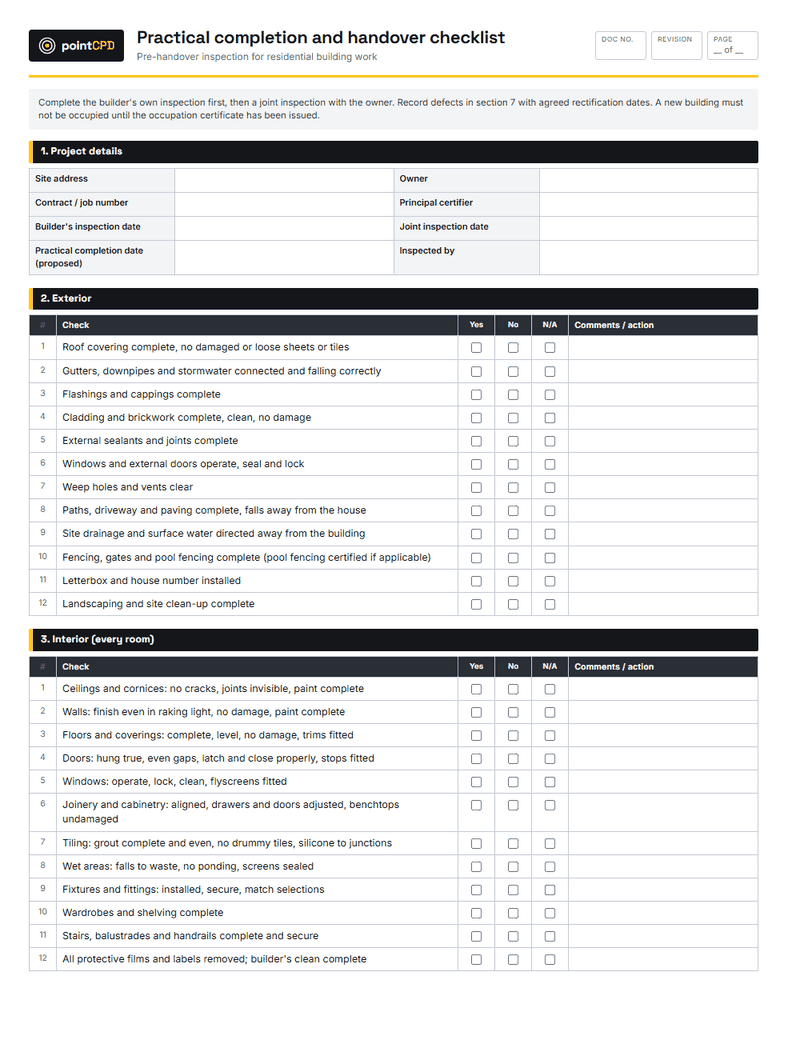
About a week before you expect to reach practical completion, walk the job yourself as if you were the owner and the certifier together. Check the work against the plans, the specification, the variations and the selections schedule. Test everything that moves or runs: doors, windows, locks, taps, drains, appliances, lights, power points, smoke alarms, the hot water system and air conditioning. Look for damage by trades, missing items, paint touch-ups and cleaning. Fix what you find before the owner sees it.
This is also the time to check the certificates. The occupation certificate, where one is required, depends on a complete set of certificates from the trades and consultants. See our guide to occupation certificates for the pack a certifier expects.
First impressions last. An owner who walks into a clean, finished house with everything working, and is handed an organised pack, starts the relationship on trust. An owner who finds paint on the windows and a missing handle starts it on suspicion, and every later issue is seen through that lens.
Notice and the joint inspection
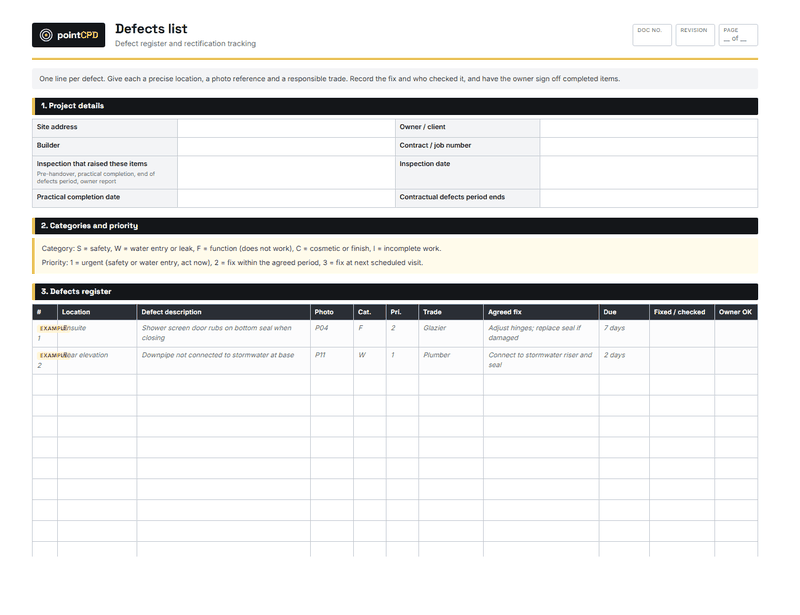
When the work reaches practical completion, give the owner written notice as your contract requires, with the date and any documents the contract says must accompany it. Then inspect the work together. Walk every room with the owner, explain how things work, and record any agreed minor defects or omissions on a list that both parties sign or acknowledge, with a timeframe for fixing them.
If the owner disputes that the work has reached practical completion, the contract usually sets out a process. Follow it, keep the discussion in writing, and focus on the specific items in dispute. A clear definition in the contract and a thorough pre-handover inspection make these disputes rare.
From practical completion to the end of the defects period
- 1Pre-handover inspectionWalk the job yourself a week out, against the plans, the specification and a checklist.
- 2Notice of practical completionGive written notice as the contract requires, with the date and supporting documents.
- 3Joint inspectionInspect with the owner and list any agreed minor defects and omissions.
- 4Final payment and handoverKeys, the handover pack and the final claim, as the contract sets out.
- 5Defects liability periodOwner lists defects in writing; builder returns to fix them.
- 6Close-outFinal defects visit, retention released, records archived.
The handover pack
The NSW Government encourages owners to keep a detailed set of records: the contract and variations, plans and specifications, proof of payments, the Home Building Compensation Fund certificate where the work costs more than $20,000 including GST, warranties from the builder and manufacturers, termite protection warranties and instructions, documents identifying the main materials used, reports, care and maintenance manuals, and correspondence. Much of that comes from the builder. Providing it in one organised pack, printed or digital, is a sign of a professional builder and saves you answering the same questions for years.
The handover pack
- Copy of the contract, variations, plans and specifications.
- Home Building Compensation Fund certificate, where required.
- Occupation certificate, where required, and other approvals.
- Certificates: waterproofing, termite management, glazing, electrical, plumbing and others required.
- Manufacturer warranties and care instructions for appliances, fixtures, roofing, cladding and finishes.
- Product schedule: brands, colours and suppliers of the main materials.
- As-built information: service locations, photos before cover-up, meter and isolation points.
- Maintenance guidance: gutters, drainage, sealants, doors and windows, termite inspections.
- Key contacts and the process for reporting defects.
The defects liability period
Most new home contracts include a defects liability period, usually 13 weeks for new homes according to the NSW Government, during which the owner can list defects in writing and the builder returns to fix them. Explain the process at handover: how to report defects, what is normal settling, such as minor cracking as materials dry out in the first year, and when you will return.
Be clear that the defects liability period is a contractual process and does not shorten the statutory warranties. Owners have the benefit of the two-year and six-year warranties whatever the contract says. See our guide to statutory warranties in NSW.
Explaining maintenance
Many defect complaints are really maintenance issues: blocked gutters overflowing into eaves, garden beds built against walls over the termite barrier or weep holes, sealants that need renewing, sliding door tracks full of grit. The NSW Government’s guidance to owners covers maintenance of brickwork, doors and windows, wet areas, gutters and drains, and landscaping. A short, practical maintenance guide in the handover pack, and a few minutes explaining it on site, prevents problems and gives you a record that the owner was told.
Final payment
The contract sets out when the final payment is due and what must be provided before it. Issue the final claim in the form the contract requires, with the supporting documents. If the owner withholds payment because of alleged defects, respond to the specific items in writing, offer to inspect, and follow the contract’s dispute process. Keep the conversation professional. A builder who handles a final-payment dispute calmly and in writing is in a much stronger position than one who stops returning calls.
A worked example: the rushed handover
A builder, under pressure to start the next job, hands over the keys to a new house on a Friday afternoon without a joint inspection. Over the weekend the owners find a scratched benchtop, a door that will not latch and a missing towel rail, and email a list with photos. The owners also cannot find the appliance warranties. The relationship sours, the final payment is withheld, and the builder spends several visits and many emails resolving items that a one-hour inspection would have dealt with.
On the next job, the builder books a pre-handover inspection a week out, fixes what it finds, then holds a joint inspection with the owners and a printed handover pack. Three minor items are listed, signed and fixed within a week. The final payment arrives on time, and the owners refer a friend.
Handover on renovations
Renovations need the same discipline, with a twist: the owners are often living in the house, and the boundary between new and existing work can blur. Be clear in the handover about which parts of the house were in the scope, what was retained, and what the warranties cover. Hand over certificates for the new work, especially waterproofing and electrical, and point out where new work meets old, such as floor level changes and junctions in roofs and walls, so the owners know what to watch. If an occupation certificate is needed for the new work, make sure the owners understand that the new areas should not be occupied until it is issued.
Close-out
At the end of the defects liability period, carry out a final visit, fix any listed defects, release retention to subcontractors as their contracts allow, and archive the job records. Keep them for longer than the six-year warranty period, because claims can arrive late and later owners inherit the warranties. The photos before cover-up, certificates and correspondence in that archive are your best evidence if a claim ever arrives.
The bottom line
The completion date starts the warranty clock, triggers the final payment and shapes the owner’s view of the whole job. Define it clearly, inspect before the owner does, give proper notice, inspect together, and hand over a complete pack. Explain the defects period and maintenance, and keep the records long after the job is closed.
Questions builders ask
What is practical completion in residential building?
Usually the stage when the work is complete except for minor defects or omissions that do not prevent the home being used for its intended purpose, as defined in the contract. The contract’s definition governs.
When does the statutory warranty start in NSW?
From the date the work was completed. The NSW Government explains that completion starts the time periods for the statutory warranties and Home Building Compensation Fund cover.
How is the completion date worked out if the contract does not define it?
The work is complete when it can be used for its intended purpose and is free of major defects, and the earliest of handover, the last day of work other than fixing minor defects, or the occupation certificate can be used to determine the date.
How long is the defects liability period for a new home?
The NSW Government says it is usually 13 weeks for new homes, but it depends on the contract. It does not shorten the statutory warranties.
What should a builder give the owner at handover?
A handover pack with the contract and variations, insurance certificate, occupation certificate where required, trade certificates, manufacturer warranties and manuals, a product schedule, as-built information, maintenance guidance and contacts for reporting defects.
Sources
- Contracts for residential building work · NSW Government
- How to make sure your new building work remains trouble-free · NSW Government
Published 13 September 2026. General information for builders, not legal, financial or engineering advice for a specific job. Check current requirements with the relevant regulator or standard before relying on them.