Key takeaways
- Work in an area where powered mobile plant is moving, and work on or next to a road used by traffic, are both high-risk construction work that requires a safe work method statement.
- The most effective control is separation: keep people and plant apart with physical barriers, exclusion zones and planned routes.
- Residential sites have particular risks: reversing delivery trucks, excavators and skid steers on tight blocks, concrete pumps and crane trucks, and the public walking past.
- Overhead power lines are a major hazard for anything with a boom or tipper. Know where they are and follow the network operator’s rules for working near them.
- Work on a road or footpath may need council approval and a traffic control plan implemented by trained traffic controllers.
Most builders think of traffic management as something for road projects. But a residential building site is full of moving plant: concrete trucks and pumps, tippers, excavators, skid steers, crane trucks, telehandlers and delivery vehicles, often on a tight block with a driveway, a footpath and a busy street. Add workers on foot, neighbours, and children walking to school, and the risk is obvious.
Vehicle and mobile plant incidents are consistently among the causes of serious injuries and deaths at work in Australia. On building sites, the classic scenarios are well known: a worker struck by a reversing truck, someone crushed between an excavator and a wall, a boom touching an overhead power line, a pedestrian hit on the footpath by a delivery. This guide covers the rules and the practical controls for residential sites.
What the rules require
Under the model WHS Regulations, several categories of high-risk construction work relate to plant and traffic, including:
- work in an area at a workplace where there is movement of powered mobile plant;
- work on or next to a road or other traffic corridor that is in use by traffic other than pedestrians;
- work near energised electrical installations or services, including overhead power lines.
High-risk construction work requires a safe work method statement before it starts. Beyond that, the general duty applies: the principal contractor and each business on site must manage the risks of plant and traffic so far as is reasonably practicable. Plant must be maintained and inspected, and operators of certain types of plant need a high risk work licence.
The hazards, stage by stage
Plant hazards on a house site, and the controls that fit
| Activity | Hazard | Controls |
|---|---|---|
| Deliveries | Trucks reversing onto site or down driveways; pedestrians on the footpath | Planned delivery times and route, spotter, footpath managed, reversing alarms |
| Excavation | Excavator swing and tracking on a tight block; workers in the swing radius | Exclusion zone, one person directing, no one in the swing radius |
| Concrete pour | Pump boom, agitator trucks, hoses under pressure, crowded site | Pour plan, boom set-up away from power lines, clear roles |
| Crane truck lifts | Load swing, boom near power lines, outrigger ground conditions | Lift plan, qualified operator and dogman, exclusion zone, ground check |
| Skid steers and telehandlers | Poor visibility, reversing, uneven ground | Designated routes, spotters, operators trained for the plant |
| Work near the road | Passing traffic; plant entering and leaving | Council approval where needed, traffic control plan, trained controllers |
Deliveries
Deliveries are where the public and the site meet. A truck reversing across a footpath, or down a sloping driveway into a tight site, can hit a pedestrian, a worker or a neighbour’s car. Schedule deliveries at quieter times, plan the route and set-down area, use a spotter for reversing, and manage the footpath while the truck is crossing it. On busy streets, school zones and main roads, a road occupancy or footpath approval from council and a traffic control plan may be required.
Excavators and skid steers
On small residential sites, excavators and skid steers work in tight spaces close to people, walls and fences. The swing radius of an excavator is a crush zone. Set up exclusion zones, have one person directing the plant, and keep everyone else out of the swing radius and travel path. Skid steers have poor rear visibility and are frequently involved in reversing incidents.
Concrete pours
A slab pour brings several hazards together: agitator trucks arriving and leaving, a pump with a boom, hoses under pressure, and a crowded site with finishers, the builder, the plumber checking penetrations and sometimes the client watching. A pour plan that sets the truck route, the pump position, clearances from power lines and who is in charge makes a chaotic morning safer.
Crane trucks and lifts
Crane trucks lifting frames, trusses and materials are common on house sites. The risks are load swing, the boom contacting power lines, and outriggers sinking into soft ground or the edge of a trench. Lifts need a plan, a competent operator and dogman where required, a check of ground conditions, and an exclusion zone under the load.
Overhead power lines
Overhead power lines deserve special attention because contact is so often fatal. Crane booms, concrete pump booms, tipper trays, excavator arms, elevating work platforms, scaffolds, and long materials such as downpipes and roof sheets can all contact lines. The electricity network operator’s rules and the relevant codes set approach distances and when a permit, supervision, or de-energising or insulating the line is required.
Before plant arrives, identify all overhead lines on and next to the site, including the service line to the house, and mark them. Brief every operator. Where work must happen near lines, contact the network operator early; arrangements can take time.
Look up before every lift. A boom that touches a power line can kill the operator and anyone touching the truck. Mark the lines, keep the approach distances, and use a spotter whenever plant with a boom or tipper works anywhere near them.
The hierarchy of controls
Controls for plant and people, most effective first
- 1SeparatePhysical barriers and fencing that keep pedestrians away from plant routes.
- 2Plan the flowOne entry, one exit, delivery times scheduled, turning and set-down areas marked.
- 3Engineer the plantReversing cameras, proximity alarms, beacons and good maintenance.
- 4DirectSpotters and traffic controllers with clear signals and radios.
- 5InformInductions, signage and high-visibility clothing.
Separation is the most effective control because it does not depend on anyone paying attention at the right moment. Fencing that keeps pedestrians on a protected path, a designated plant route that workers do not use, and set-down areas away from where people work do most of the work. Spotters and signage support separation; they do not replace it.
The public interface
Residential sites sit in neighbourhoods. The site fence, gates, footpath and street are where the public meets the job. Keep the footpath clear and safe, or provide a safe alternative with approval where needed. Keep gates closed when not in use, so children cannot wander in. Clean up mud and debris tracked onto the road. And tell neighbours about big days, such as a pour or a crane lift, so they can avoid the area.
Planning traffic on a small site
A traffic management plan for a house site does not need to be long. A site plan marked with the entry and exit, the plant route, set-down and turning areas, pedestrian routes, the site office and amenities, overhead lines and exclusion zones, plus a few rules about deliveries and reversing, covers most of it. Update it as the site changes: the plan for excavation is different from the plan for frame and roof.
Before any plant moves on site
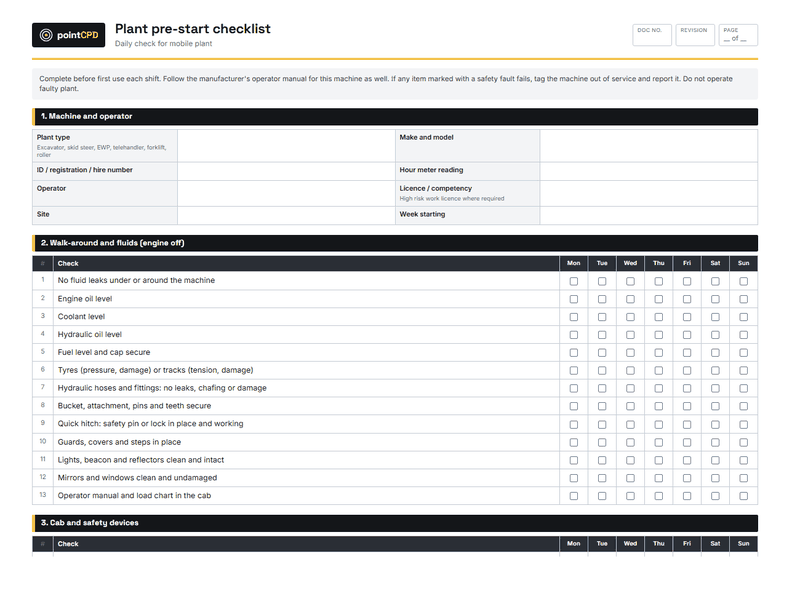
- Pre-start check completed on each item of plant, with faults reported and fixed.
- Operator holds the licence or training the plant requires.
- Overhead power lines identified and marked; approach distances known.
- Exclusion zones set up and understood by everyone on site.
- Spotter assigned for reversing and tight manoeuvres.
- Footpath and road interface managed; approvals and traffic plan in place if needed.
- Ground conditions checked for outriggers, trenches and soft areas.
A worked example: pour day on a sloping block
A builder is pouring the slab for a two-storey home on a sloping block on a busy suburban street, next to a primary school. The pour needs a concrete pump with a boom, three or four agitator trucks in sequence, a finishing crew, the plumber to check penetrations and the builder’s supervisor.
The week before, the supervisor walks the site with the pump operator. They agree the pump will set up on the road, which needs council approval for a road occupancy and a traffic control plan. The service line to the house runs across the front of the block, so the boom will be positioned and swung to keep well clear of it, with a spotter watching. The pour is booked to start after the school morning drop-off and finish before pick-up.
On the day, trained traffic controllers manage the lane and the footpath. Agitator trucks wait around the corner and are called in one at a time. Only the pump operator, the concrete crew and the supervisor are allowed within the fenced pour area; the plumber checks penetrations before the first truck arrives and then leaves. The neighbours were told two days earlier.
Nothing dramatic happens, which is the point. The same pour, done without a plan, is how a truck reverses over a footpath at school drop-off, or a boom swings into a service line.
Noise, dust and neighbours
Plant also brings noise, dust and vibration, which affect neighbours and are often controlled by development consent conditions, such as permitted working hours. Keeping plant within approved hours, controlling dust on dry days, and managing mud on the road all reduce complaints and keep the site on good terms with the community and council.
Operators and competency
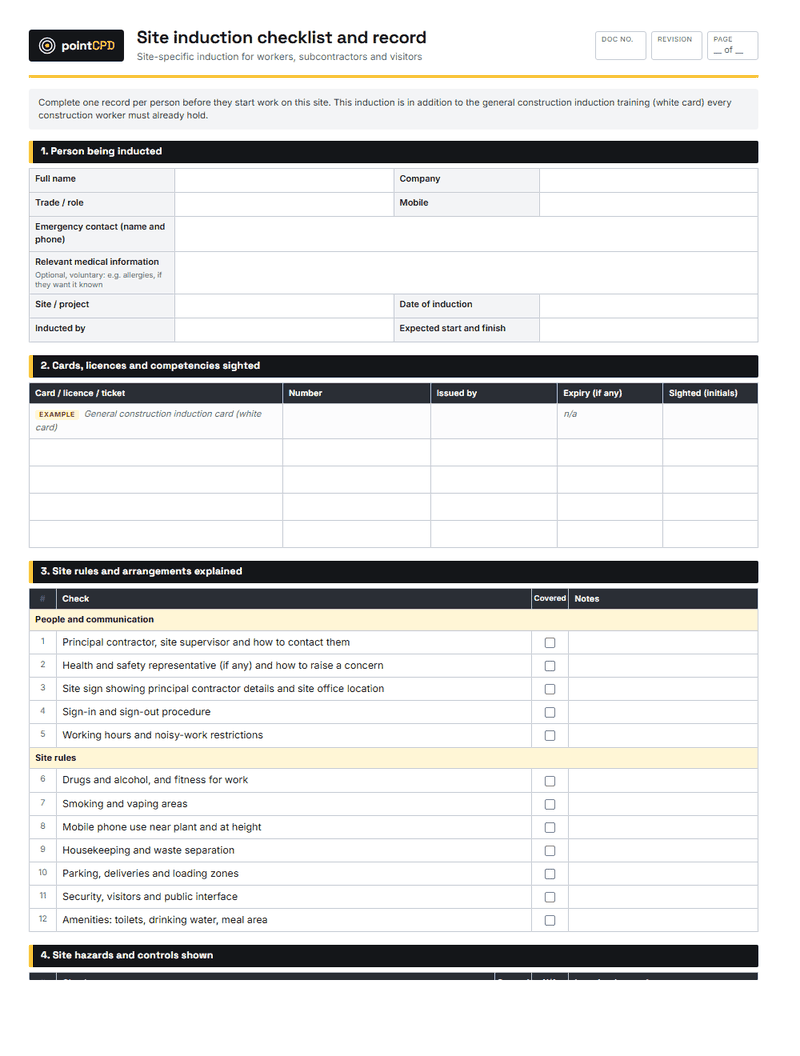
Anyone operating plant on your site must be competent to do so, and some plant requires a high risk work licence. Check licences and competency before plant operators start, and include plant-specific rules in the site induction. Hired plant should arrive with evidence of maintenance and inspection, and daily pre-start checks should be done and recorded.
Hired plant and subcontractors’ plant
Much of the plant on a residential site belongs to someone else: the excavation contractor, the concrete pump company, the crane truck operator, the scaffold supplier. That does not remove the principal contractor’s duty to coordinate. Ask each plant supplier for their SWMS and evidence of maintenance, confirm the operator’s licence or training, and make sure their plans fit your site traffic plan. Where two plant items will work at once, such as a pump and an agitator, or an excavator and a tipper, agree who directs the movements.
Records
Keep the traffic management plan, SWMS, plant pre-start checks, operator licences, lift plans, council approvals, traffic control plans and records of toolbox talks on plant safety with the job. If an incident happens, those records show what was planned and what was done.
The bottom line
On a residential site, big or small, plant and people share a small space, and the consequences of a mistake are severe. Plan the flow of vehicles and plant, separate people from plant wherever you can, identify overhead power lines before anything with a boom arrives, use spotters for reversing and tight moves, manage the footpath and the street, and make sure every operator is competent. Traffic management on a house site is not paperwork; it is how everyone goes home.
Questions builders ask
Do I need a SWMS for mobile plant on a house site?
Yes, work in an area where powered mobile plant is moving is high-risk construction work, and it requires a safe work method statement.
What is the best way to control plant hazards on site?
Separation: physical barriers, exclusion zones and planned routes that keep people away from moving plant. Spotters, alarms and signage support separation but do not replace it.
What should I do about overhead power lines near my site?
Identify and mark them before plant arrives, brief operators, follow the network operator’s approach distances and rules, and contact the network operator early if work must be done near them.
Do I need council approval to use the footpath or road?
Often, yes. Occupying or working on a road or footpath commonly needs council approval, and a traffic control plan implemented by trained traffic controllers may be required.
What checks should be done on plant each day?
A pre-start check by the operator, confirmation the operator is licensed or trained for the plant, and a check of ground conditions, exclusion zones and overhead hazards.
Sources
- Safe work method statement for high risk construction work · Safe Work Australia
- Cranes · Safe Work Australia
- Concrete pumping · Safe Work Australia
- Excavation · Safe Work Australia
Published 20 August 2026. General information for builders, not legal, financial or engineering advice for a specific job. Check current requirements with the relevant regulator or standard before relying on them.