Skip to content
  • NSW-first CPD, built by a practising builder
  • Instant PDF certificates
  • Unlimited assessment attempts
  • 12 points a year, sorted
  • 15% off your first order — get your code
  • Content aligned to the NCC 2022

Free template Safety and WHS

Free plant pre-start checklist for excavators, EWPs and loaders

A daily pre-start for mobile plant: walk-around, fluids, cab and controls, safety devices and a function test, with a fault record and a seven-day log on one page.

The short version

Before the first use each shift, the operator walks around the machine, checks fluids, tyres or tracks, attachments and guards, then checks the cab, controls and safety devices and runs a function test. Any fault that affects safe operation means the machine is tagged out and not used until it is fixed. Always follow the manufacturer's own pre-start list for that model; this template adds the site checks around it.

  • No sign-up
  • Free for commercial use
  • Add your own logo
  • Updated 14 Sep 2026

Reviewed by Daniel Betros, Licensed Building Practitioner

Animated walkthrough · 6 steps

How to do a plant pre-start check

Six steps, done by the operator before first use each shift, with the machine off and secured.

1 / 6
  1. Plant type, ID or registration, hour meter, operator name and licence. Check the operator holds any high risk work licence the machine needs and is familiar with this model.

  2. Leaks, damage, tyres or tracks, attachments and quick hitch, hydraulic hoses, guards, lights and mirrors. Look under the machine too.

  3. Engine oil, coolant, hydraulic oil, fuel and battery. Top up only as the manufacturer specifies.

  4. Seat belt, ROPS or FOPS, mirrors and camera, horn, reversing alarm, beacon, fire extinguisher, emergency stop and, for EWPs, the harness anchor and emergency lowering.

  5. Start up, check gauges and warning lights, then test brakes, steering, every hydraulic function and the quick hitch locking, in a clear area.

  6. Record the result and any faults. If a fault affects safety, tag the machine out and report it. Do not operate until it is repaired.

A pre-start check takes a few minutes and catches the faults that turn plant into a hazard: a leaking hydraulic hose, a reversing alarm that has stopped working, a quick hitch pin that is missing. This template covers the checks common to excavators, skid steers, elevating work platforms, telehandlers and forklifts, with a seven-day grid so one sheet covers a week.

Why plant gets checked every shift

WHS laws require plant to be kept safe: maintained, inspected and used according to the manufacturer’s information. On a building site that means a daily check by the operator before first use, because conditions are hard on machines and faults develop between services. Hire companies and principal contractors almost always require it, and it is one of the first documents asked for after a plant incident.

Manufacturer first

Every machine has an operator manual with its own pre-start list. That comes first. This template covers the checks common to most mobile plant and adds the site record around them: operator, licence, faults and sign-off. Use the Word version to add any model-specific items.

The three parts of a pre-start

PartWhat you are checking
Walk-around (engine off)Leaks, fluids, tyres or tracks, hoses, attachments and quick hitch, guards, lights and mirrors
Cab and safety devicesSeat belt, rollover and falling-object protection, horn, reversing alarm, camera, extinguisher, emergency stop, EWP-specific devices
Function testGauges and warning lights, brakes, steering, every hydraulic function, quick hitch locking, isolation

Quick hitches deserve special attention

Buckets and attachments detaching from excavator quick hitches have killed and seriously injured workers on Australian sites. The locking pin or mechanism must be engaged and tested by the operator every time an attachment is changed: curl the attachment and apply pressure against the ground to confirm it is locked. It is on the pre-start, and it belongs in every excavator operator’s routine.

Licences and competency

Some plant needs a high risk work licence to operate, including forklifts, certain boom-type elevating work platforms and cranes. Other plant needs an operator who is trained and competent for that type and, ideally, familiarised on that model. Record the licence or competency at the top of the sheet and on the training and competency register.

When a fault is found

  1. Safety fault: brakes, steering, quick hitch, seat belt, alarms, ROPS damage, major leaks. Tag the machine out of service, report it, do not operate.
  2. Non-safety fault: record it, report it, and get a repair date.
  3. Record the repair in section 6 before the machine goes back into use.

The site around the machine

A perfect machine can still hurt someone. The pre-start sits alongside site controls: exclusion zones, spotters, traffic management, overhead powerline clearances and ground conditions. For digging work, the excavation permit covers services and ground support, and plant movement near people is high-risk construction work that needs a SWMS.

Hired plant: what the hire company does, and does not do

Much of the plant on residential sites is hired, often with an operator. The hire company is responsible for supplying plant that is safe and maintained, with its manuals, service records and any registration documents. That does not remove the site’s responsibility for daily checks, for how the plant is used, and for the people around it. When plant arrives:

  • check it matches what was ordered, with the attachments and safety devices expected;
  • ask for the service log and, for registered plant, the registration documents;
  • confirm the operator’s licence and familiarity with that model;
  • do the first pre-start together with the operator and record it.

Report faults to the hire company straight away and tag the plant out. Hire companies would rather replace a machine than have it operated with a known fault.

Elevating work platforms: extra checks

Scissor lifts and boom lifts are common on two-storey builds for fascias, gutters, cladding and eaves. On top of the general checks, an EWP pre-start should confirm the platform gate closes and latches, the guardrails are secure, the tilt alarm and load limits work, the emergency lowering system works from the ground, and, for boom types, the harness anchor point is undamaged. Check the ground too: EWPs overturn on soft ground, slopes and near excavations far more often than from mechanical faults. Plan rescue for a worker stranded or suspended at height before the work starts, and record it in the site emergency plan.
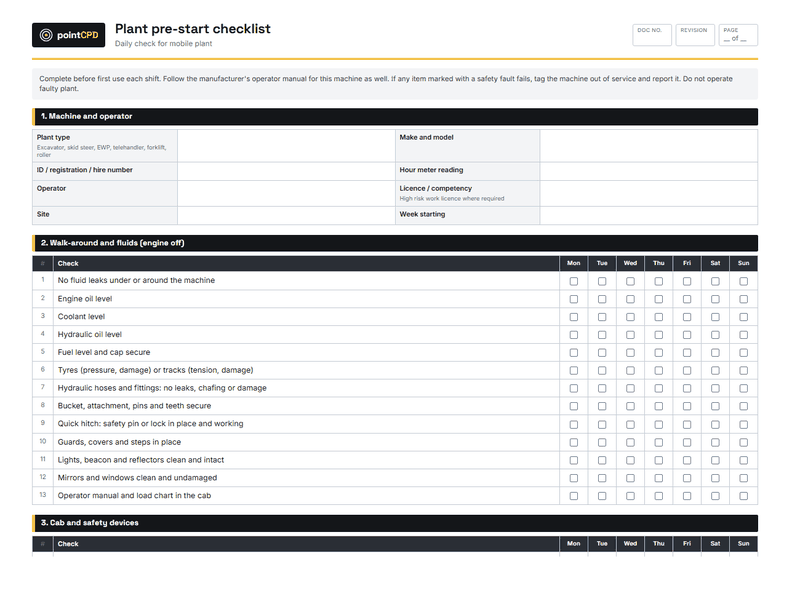
Preview the full Plant pre-start checklist template

Every section, field and check in the download, exactly as it prints. Edit the Word version to add your logo, delete what does not apply and add your own site-specific items.

pointCPD

Plant pre-start checklist

Daily check for mobile plant

Doc no.
Revision
Page
__ of __

Complete before first use each shift. Follow the manufacturer's operator manual for this machine as well. If any item marked with a safety fault fails, tag the machine out of service and report it. Do not operate faulty plant.

1. Machine and operator

Plant typeExcavator, skid steer, EWP, telehandler, forklift, rollerMake and model
ID / registration / hire numberHour meter reading
OperatorLicence / competencyHigh risk work licence where required
SiteWeek starting

2. Walk-around and fluids (engine off)

#CheckMonTueWedThuFriSatSun
1No fluid leaks under or around the machine
2Engine oil level
3Coolant level
4Hydraulic oil level
5Fuel level and cap secure
6Tyres (pressure, damage) or tracks (tension, damage)
7Hydraulic hoses and fittings: no leaks, chafing or damage
8Bucket, attachment, pins and teeth secure
9Quick hitch: safety pin or lock in place and working
10Guards, covers and steps in place
11Lights, beacon and reflectors clean and intact
12Mirrors and windows clean and undamaged
13Operator manual and load chart in the cab

3. Cab and safety devices

#CheckMonTueWedThuFriSatSun
1Seat and seat belt in good condition and working
2ROPS / FOPS structure undamaged
3Horn working
4Reversing alarm working
5Camera or proximity system working (if fitted)
6Fire extinguisher present and in date
7Emergency stop working
8EWP: harness anchor, gate, emergency lowering and tilt alarm working
9Forklift or telehandler: forks, chains and load backrest in good condition

4. Start-up and function test (in a clear area)

#CheckMonTueWedThuFriSatSun
1No warning lights or abnormal gauge readings
2Service and park brakes working
3Steering working correctly
4All hydraulic functions smooth and responsive
5Quick hitch locks correctly under test
6Slew, travel and boom functions working (as applicable)
7Isolation or lock-out working
8No unusual noises, smoke or vibration

5. Daily sign-off

DayResultOperator signatureSupervisor sighted
ExampleMonOK to operate

6. Faults and repairs

DateFaultSafety fault? (tagged out)Reported toRepaired by / date
Template by PointCPD · pointcpd.com.au/resources/templates/plant-pre-start-checklist/Free to use, copy and adapt, including commercially (CC BY 4.0). Keep this credit line.v1.0

Download Word Download PDF

Questions builders ask

Is a pre-start check a legal requirement?

WHS laws require plant to be maintained and inspected so it is safe, and require businesses to follow the manufacturer's information. A daily pre-start check is the standard way operators meet that for mobile plant, and principal contractors and hire companies usually require it.

Who should do the pre-start check?

The operator, before first use each shift. They know the machine and are the ones relying on it. Supervisors should sight the checklists regularly.

What happens if a fault is found?

If it affects safe operation, such as brakes, steering, the quick hitch, the seat belt or an alarm, the machine is tagged out and not used until it is repaired. Minor faults are recorded and reported for repair.

Does this replace the manufacturer's checklist?

No. The manufacturer's operator manual sets the checks for that model and comes first. This template covers the common checks and adds the site record around them; add any model-specific items to the Word version.

Which plant needs a high risk work licence to operate?

Some plant, including forklifts, certain boom-type elevating work platforms and cranes, needs a high risk work licence. Other plant needs a competent, trained operator. Check the licence classes with your regulator.

Why is the quick hitch on the checklist?

Because buckets detaching from quick hitches have killed workers on Australian sites. The locking pin or mechanism must be engaged and tested every time an attachment is changed, not just at pre-start.

Free to use, adapt and share, including commercially

This template is licensed under Creative Commons Attribution 4.0. Copy it, rebrand it, edit it for your jobs, hand it to clients and subcontractors, or republish it. The one condition: keep the small PointCPD credit line on the document. If you publish it online, credit it like this:

<a href="https://pointcpd.com.au/resources/templates/plant-pre-start-checklist/">Plant pre-start checklist template</a> by PointCPD, CC BY 4.0

Last reviewed 14 September 2026. A template is a starting point: it becomes a compliant document only once it is completed for the actual job by people who understand the work, and kept current as the work changes. General information, not legal advice. Check the requirements of your state regulator and your contract.

Sources: Model Work Health and Safety Regulations (plant and high risk work licences). Safe Work Australia, Code of Practice: Managing risks of plant in the workplace and guidance on quick hitches for excavators. Manufacturer operator manuals.