Key takeaways
- Subcontractors are usually unsecured creditors when a builder collapses, so the best protection is getting paid on time before it happens.
- In NSW, security of payment laws give you a right to progress payments, set maximum payment times and let you go to adjudication quickly when a claim is not paid.
- Watch the warning signs: late or part payments, new excuses, disputes over routine claims, trades leaving the job and suppliers putting the builder on stop credit.
- If you are not paid by the due date, you can give notice and suspend work, and in some cases ask the principal to withhold money owed to the builder.
- Once a builder is in administration or liquidation, stop, document what is owed, get advice and deal with the administrator. Do not remove fixed work.
Builder and developer collapses are some of the hardest events a subcontractor faces. By the time a company enters administration or liquidation, the subbies on its jobs have usually done weeks of work, bought materials and paid their own workers, and they find themselves as unsecured creditors, near the back of the queue. The recent administration of a large Sydney developer and builder, covered in our news section, is a reminder of how quickly it can happen.
This guide explains how subcontractors can reduce their exposure before a collapse, use NSW’s security of payment laws to get paid on time, and what to do if the worst happens. It is general information, not legal advice; if a builder you work for is in trouble, get advice specific to your situation.
Why subcontractors are exposed
In a typical residential chain, the owner or developer pays the builder, and the builder pays the subcontractors. If the builder becomes insolvent, money paid to the builder does not flow down, and money not yet paid to the builder may be tied up in the administration. Subcontractors are generally unsecured creditors, which means they rank behind secured lenders and certain priority claims, and often receive only a fraction of what they are owed, if anything.
Once materials are fixed into a building, they generally become part of the land. That limits what a subcontractor can recover by retrieving goods, and removing fixed work can create legal problems of its own. The practical conclusion is that the most effective protection is being paid promptly for work as it is done, so the amount at risk at any time is small.
Before you start: choose and contract carefully
- Check the builder. Confirm their licence on the NSW register, look for disciplinary history, and ask other trades how they pay.
- Get a written subcontract. Know the payment terms, the reference dates for claims, retention and variation procedures. Payment terms cannot be later than the Act allows.
- Price the risk. Very large retentions or long payment terms increase your exposure.
- Do not over-commit. Having most of your work with one builder means one collapse can take your business with it.
- Be careful with materials. Suppliers who deliver on credit often use retention of title clauses and register security interests. If you supply materials, get advice on whether you should do the same for unfixed goods.
Security of payment: your strongest tool
NSW’s Building and Construction Industry Security of Payment Act gives anyone who carries out construction work or supplies related goods and services under a construction contract a right to progress payments. That right applies whether the contract is written, verbal or silent on payments, and even if the contract tries to exclude progress payments. The Act also applies to residential work, including owner-occupier construction contracts, following recent changes.
The Act sets maximum payment times where the contract does not set shorter ones. A head contractor must pay a subcontractor within 20 business days after a claim is made, or 10 business days for a subcontractor doing related exempt residential work. If the builder does not intend to pay the full amount, it must give a payment schedule within 10 business days of the claim, stating what it will pay and why. If it does not give a schedule in time, it becomes liable for the whole claim.
Head contractors must also give the principal a supporting statement with each payment claim, declaring that they have paid their subcontractors. Knowingly giving a false statement is a serious offence. For subbies, this is a useful pressure point: a builder cannot honestly claim from the owner while leaving subcontractors unpaid.
Make your claims count
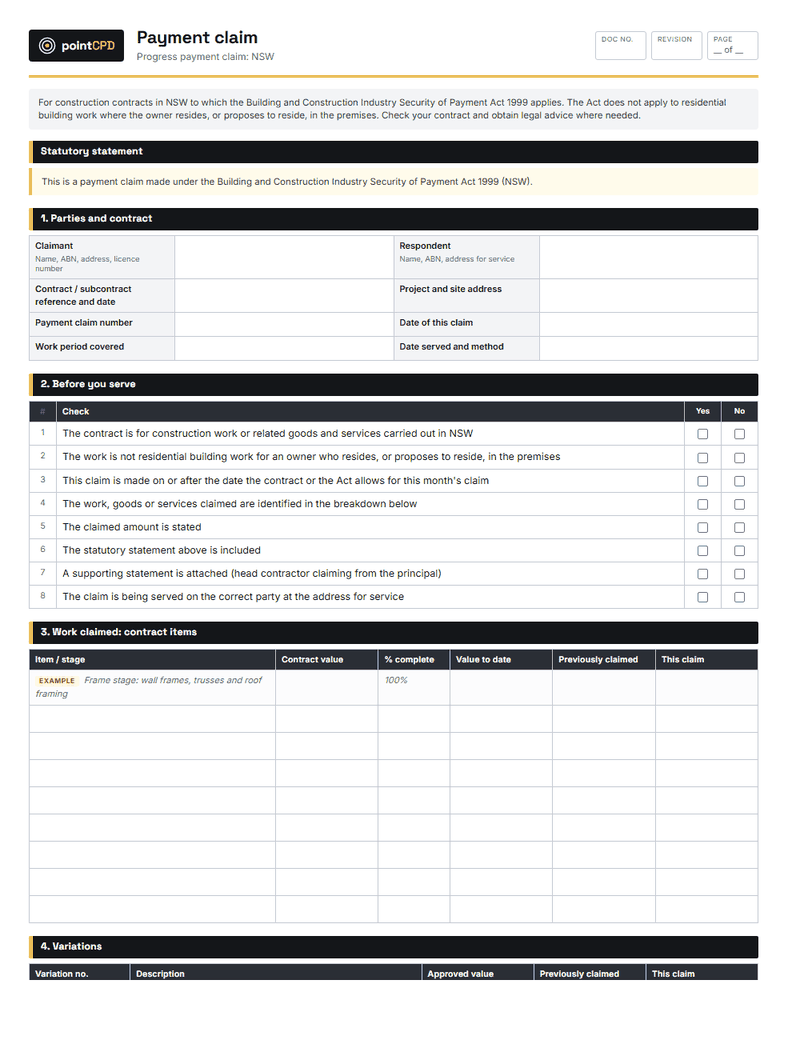
A payment claim must be in writing, state the amount claimed and describe the work, goods or services it covers, and be served in a way the Act or contract allows. If you are a subcontractor on a job connected with a residential construction contract, the claim must include the statement that it is a payment claim made under the Act. Record when the builder received it. Only one claim can be made for each reference date, which is the date in the contract or, if none, the last day of the month. Unpaid amounts from earlier claims can be included in the next one.
Claim every month, on time. Subbies who let claims slide, or who wait to “sort it out at the end”, are the ones left with large unpaid balances when a builder fails. A steady rhythm of properly served claims keeps your exposure small and your rights alive.
If you are not paid
If you are not being paid
- 1Serve a proper payment claimIn writing, describing the work and the amount, with the statement the Act requires where it applies.
- 2Watch the clockNo payment schedule within 10 business days means the whole claim is payable.
- 3AdjudicationApply within the time limits if the claim is disputed or unpaid.
- 4SuspendAfter the due date, give written notice and you may suspend work two business days later.
- 5Withholding requestOnce you have applied for adjudication, ask the principal to hold back money owed to the builder.
Source: NSW Government security of payment guidance.
If the builder gives a payment schedule for less than you claimed, you can apply for adjudication within 10 business days of receiving it. If no schedule arrives and the due date passes, you can give notice of your intention to apply for adjudication, and the builder then has a further five business days to give a schedule. If the builder agrees with the claim but does not pay, you have 20 business days after the due date to apply. Adjudication is fast and relatively inexpensive compared with court, and a determination can be enforced as a judgment debt.
You can also suspend work. If you are not paid by the due date, you can serve a written notice of your intention to suspend, stating it is given under the Act, and suspend work two business days later. The builder cannot claim damages for the suspension. And once you have applied for adjudication, you can serve a payment withholding request on the principal above the builder in the contract chain, directing it to hold back money owed to the builder so there is enough to cover your claim.
Separately, the Contractors Debts Act gives unpaid subcontractors a way to seek payment from the principal of money owed to the head contractor, once the debt has been established. It is worth asking a lawyer whether it applies to your situation.
Retention money
Retention is money held back from each payment as security for defects. On larger projects, NSW’s retention money trust scheme requires head contractors to hold subcontractors’ retention in a separate trust account with an authorised deposit-taking institution. The scheme applies to head contractors and their direct subcontractors on projects worth $20 million or more, so most residential subcontracts are not covered. For everyone else, retention is simply money the builder holds, and it is at risk if the builder fails. Negotiate the amount down, set clear release dates, and chase release as soon as it is due.
Warning signs a builder may be in trouble
- Payments arriving later each month, or in part, without a dispute.
- New reasons to reject routine claims, or requests to hold invoices.
- Pressure to keep working without a signed variation or a paid claim.
- Other trades leaving the job, or chatter about unpaid subbies.
- Suppliers putting the builder on cash-only or stop credit.
- The builder taking on work at prices that look too low.
- Staff leaving, or the builder becoming hard to reach.
If the builder enters administration or liquidation
When a company enters voluntary administration, a moratorium generally stops creditors from starting or continuing most enforcement action without the administrator’s consent or the court’s permission. Liquidation brings its own restrictions. The practical steps are:
- Stop and get advice before taking any action, including removing materials or equipment.
- Document everything owed: claims, invoices, variations, retention, and the dates work was done.
- Lodge a proof of debt with the administrator or liquidator, and attend creditors’ meetings.
- Check your contract and any registered security interests over unfixed goods.
- Talk to the owner or developer, carefully. They may want the job finished and may engage you directly, but make sure any new arrangement is in writing and does not confuse what the old builder owes you.
- Do not remove fixed work. It generally belongs to the land, and removing it can expose you to claims.
A worked example: the tiler and the slow payer
A tiling subcontractor notices that a builder’s payments have gone from 20 business days to 30, then to part payments with vague reasons. Instead of continuing to work and hoping, the tiler serves each month’s claim properly, with the required statement, and records delivery. When the next claim goes unpaid past the due date with no payment schedule, the tiler gives notice of intention to apply for adjudication and a notice of intention to suspend work, and stops starting new bathrooms for that builder.
The builder pays most of the outstanding amount within a week. Two months later, it enters administration. The tiler is still owed one claim and some retention, but not the three months of work they would have lost by carrying on without claiming.
The bottom line
Subcontractors are rarely protected well once a builder has collapsed. The protection is in the months before: a written subcontract, disciplined monthly payment claims, prompt use of security of payment rights when payments slip, a spread of builders, and the willingness to stop work when warning signs appear. Keep the amount at risk small, and a collapse becomes a loss you can survive.
Questions builders ask
How long does a builder have to pay a subcontractor in NSW?
Unless the contract sets an earlier date, 20 business days after the payment claim is made, or 10 business days for a subcontractor doing related exempt residential work.
What happens if a builder does not respond to a payment claim?
If the builder does not give a payment schedule within 10 business days, it becomes liable for the whole claimed amount, and the subcontractor can take court action or apply for adjudication.
Can a subcontractor stop work if not paid?
Yes. Under the NSW security of payment laws, if you are not paid by the due date you can serve written notice of intention to suspend work under the Act and suspend two business days later.
Is my retention money safe if the builder goes broke?
Only on projects covered by the NSW retention money trust scheme, which applies to head contractors and direct subcontractors on projects of $20 million or more. Otherwise retention is at risk in an insolvency.
What should a subcontractor do when a builder enters administration?
Stop and get advice, document what is owed, lodge a proof of debt, check contracts and security interests, deal with the administrator, and do not remove fixed work.
Sources
- Making a payment claim under Security of Payment laws · NSW Government
- About Security of Payment for construction contractors · NSW Government
- Retention money held by head contractors · NSW Government
Published 9 September 2026. General information for builders, not legal, financial or engineering advice for a specific job. Check current requirements with the relevant regulator or standard before relying on them.