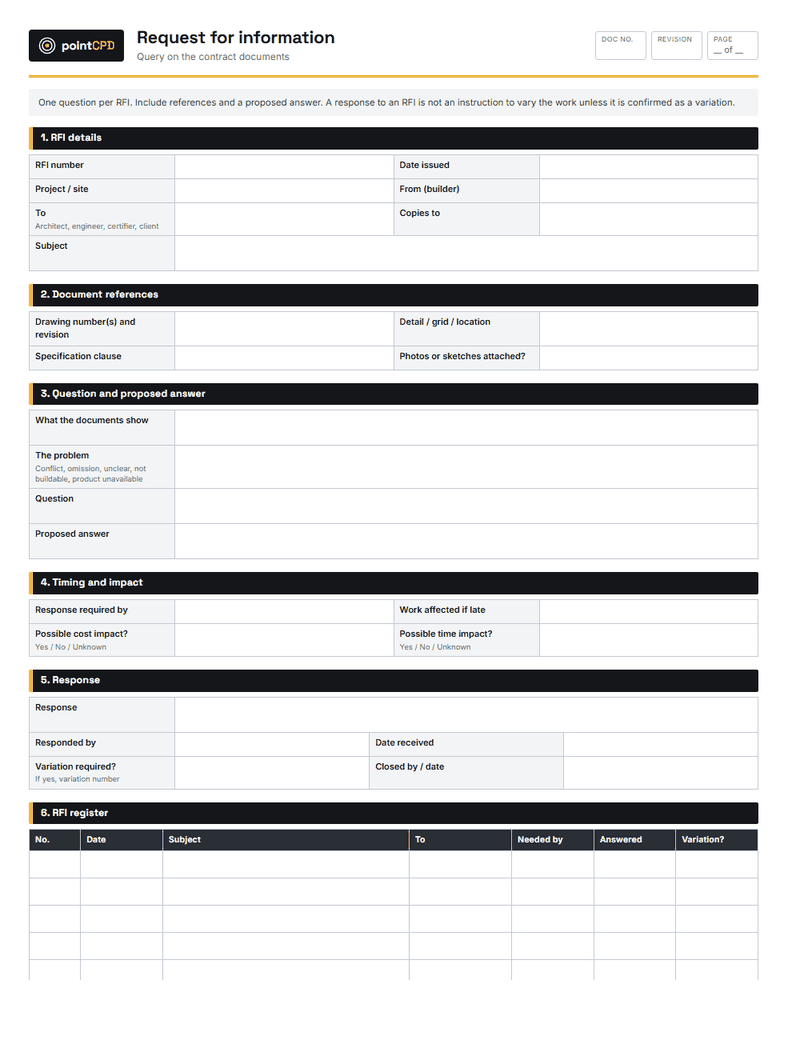
Every set of drawings has gaps: a detail that does not work at a corner, a dimension that does not add up, a product that is no longer made. The builder who asks about them early, in writing, avoids rework and keeps the right to be paid for the answer. The builder who guesses, or asks on the phone, often ends up paying for the difference. This RFI template turns the question into a record.
What an RFI is for
A request for information is a formal question from the builder to whoever controls the design: the architect, the engineer, the certifier or the client. Use it when the contract documents are:
- conflicting, such as the architectural and structural drawings showing different beam sizes;
- incomplete, such as a junction or finish not detailed;
- unclear, such as a note that could be read two ways;
- not buildable, such as a detail that does not work on site; or
- overtaken, such as a specified product that is discontinued.
Anatomy of an RFI that gets answered quickly
| Part | Why |
|---|---|
| Number | So it can be tracked and referred to in variations and claims |
| Exact reference | Drawing, revision, grid, detail, clause: the responder should not have to search |
| One question | Multiple questions produce partial answers and confusion |
| Proposed answer | Often the designer simply confirms it, which is the fastest response of all |
| Date needed | Ties the response time to your program and any delay |
| Impact flag | Records early that the answer may affect cost or time |
RFIs and variations
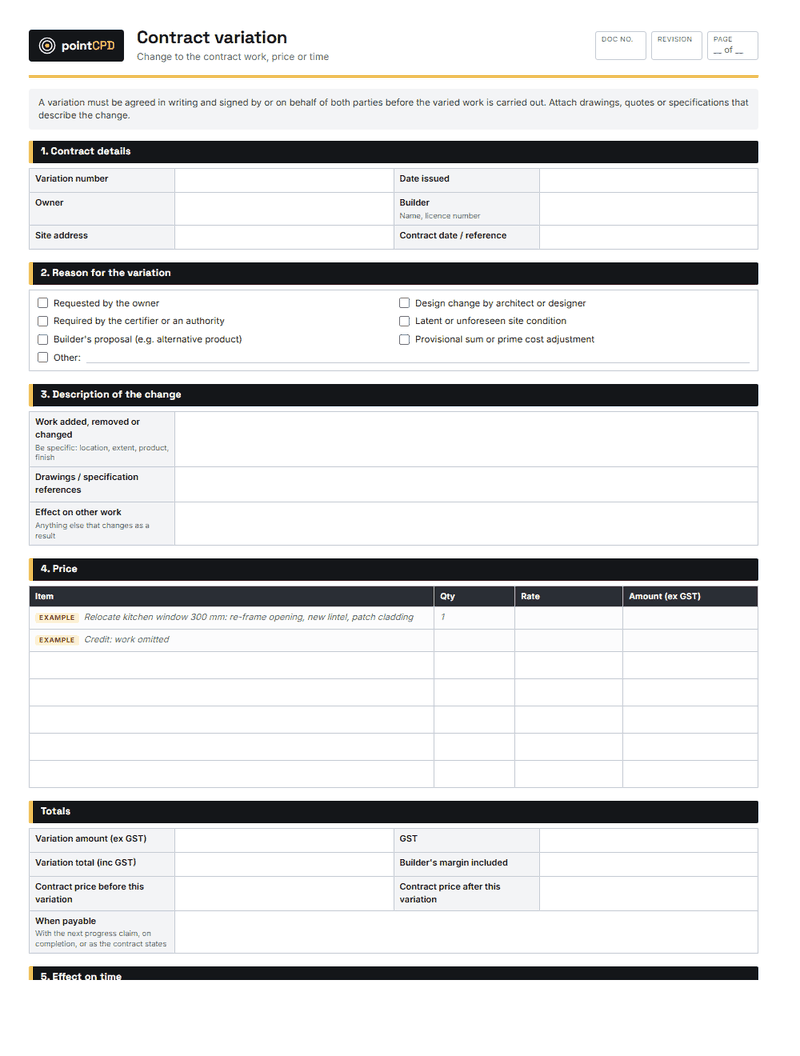
An RFI response is not automatically a variation. If the answer changes the work, the price or the time, confirm it with a signed variation. The template says that a response is not an instruction to vary unless it is confirmed, which protects both sides from treating a clarification as a change. In NSW residential work, variations need to be in writing and signed by both parties, so the RFI is often the first step on the way to one.
RFIs and delays
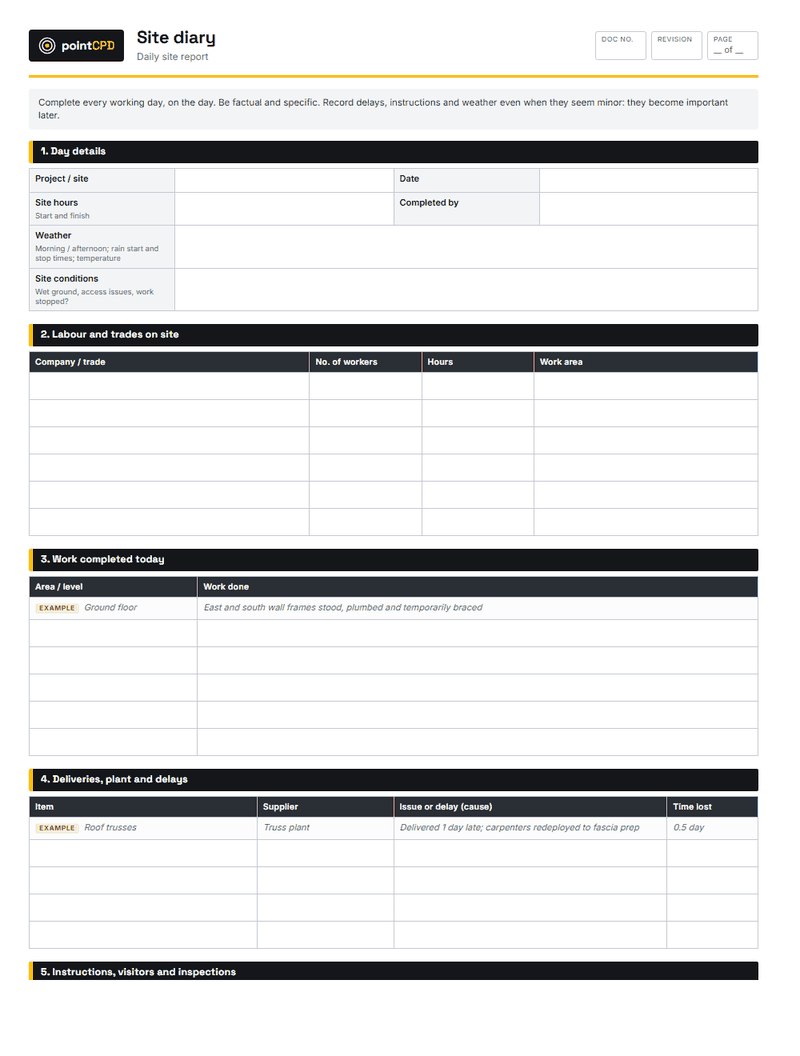
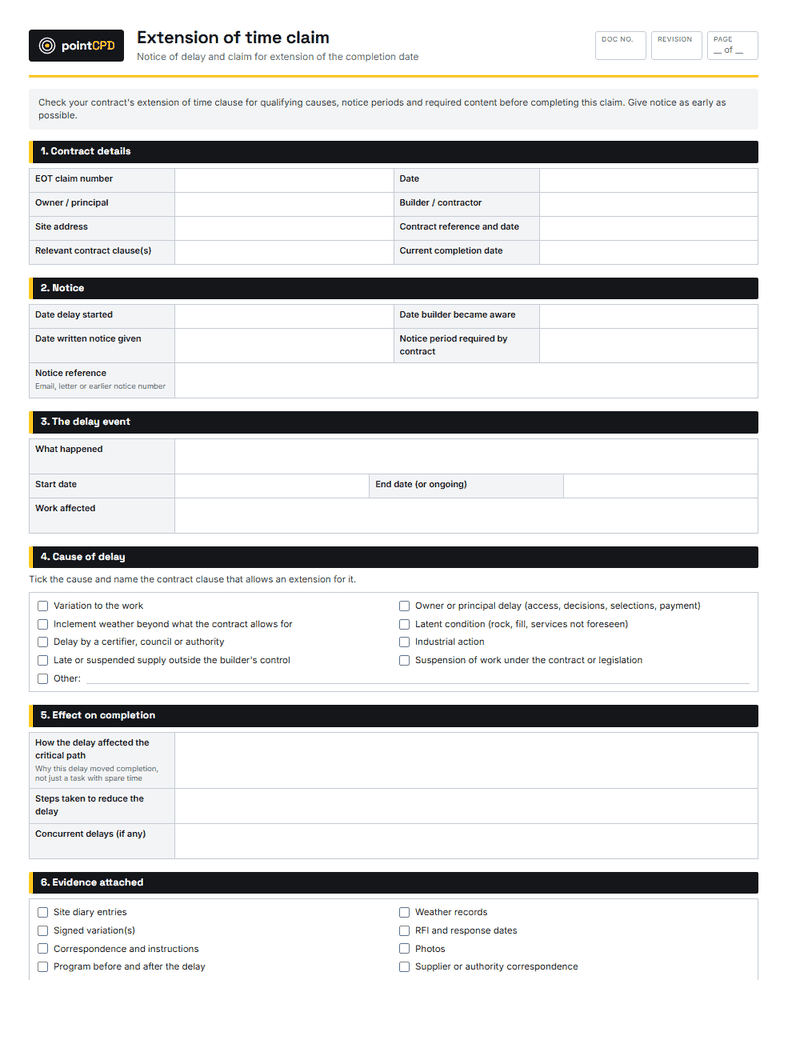
If work is waiting on an answer, the delay may entitle you to an extension of time, depending on the contract. The RFI shows when the question was asked and when the answer was needed; the site diary shows the work that could not proceed. Together they are the evidence an extension of time claim needs. Check your contract for notice requirements: many require notice of a delay within a set period, whether or not the RFI has been answered.
Keep a register
Section 6 is a simple register: number, date, subject, recipient, date needed, date answered, and whether it became a variation. It shows at a glance what is outstanding and who you are waiting on. Review it at every site meeting and chase overdue RFIs in writing.
Informal is fine, unrecorded is not
On a small residential job, an RFI can be an email with a number, a clear question, a drawing reference and a date. What matters is not the format but that the question and answer are written, dated and kept. The phone call that settled a detail is worthless in a dispute; the email that confirmed it is not.
Examples of well-written RFIs
| Weak | Clear |
|---|---|
| “Beam size?” | “Architectural A-201 rev C shows a 290 mm deep beam over the family room opening; structural S-102 rev B shows 360 mm. Which applies? Proposed: structural S-102. Needed by 12 March for the frame order.” |
| “Tiles not available” | “Specified floor tile (spec clause 9.2) is discontinued by the supplier. Proposed alternative attached with sample and data sheet; same size and slip rating. Please confirm acceptance or nominate another by 20 March to hold the tiling program.” |
The clear versions give the reference, the problem, a proposed answer and the date that matters. They are answered faster, and they leave a record that explains any later cost or delay.
RFIs on design and construct jobs
On design and construct contracts, where the builder is responsible for completing the design, many questions are the builder’s to answer rather than the client’s. RFIs are still useful internally, between the builder and its designers and engineers, to record decisions. Questions that go to the client, such as selections, performance requirements or changes to the brief, should still be written, numbered and dated, because they are the ones most likely to become variations or delays.