Skip to content
  • NSW-first CPD, built by a practising builder
  • Instant PDF certificates
  • Unlimited assessment attempts
  • 12 points a year, sorted
  • 15% off your first order — get your code
  • Content aligned to the NCC 2022

Free template Safety and WHS

Free construction site safety inspection checklist

A weekly walk-through checklist for building sites covering 58 checks: site security, working at heights, scaffold, plant, electrical, excavations, hazardous materials and amenities.

The short version

Walk the whole site at least weekly, and whenever a new stage starts, checking access and security, working at heights, scaffold, plant, electrical, excavations, hazardous materials, housekeeping, first aid and amenities. Record every item that fails, fix the serious ones on the spot, and give the rest an owner and a date. The value is in the follow-up, not the ticks.

  • No sign-up
  • Free for commercial use
  • Add your own logo
  • Updated 14 Sep 2026

Reviewed by Daniel Betros, Licensed Building Practitioner

Animated walkthrough · 6 steps

How to do a site safety inspection

Six steps. Walk it in the same order every week so nothing gets skipped.

1 / 6
  1. Site, date, who is inspecting, the current stage of work and the trades on site. Invite the HSR or a leading hand to walk with you.

  2. Check fencing, signage, access, traffic and deliveries, and the public interface. This is where the public and the site meet, and where the most avoidable incidents happen.

  3. Check edges, openings, scaffold tags, ladders and platforms. Look at what is actually installed today, not what was installed last week.

  4. Plant exclusion zones and pre-start records, leads and RCDs, test tags, excavation protection and underground services. Note every failed item.

  5. Dust control, chemicals and safety data sheets, noise, heat, access paths, waste, toilets, water, first aid and emergency equipment.

  6. Fix high risks immediately. Give every other failed item an owner and due date, and start next week's inspection by checking they were closed.

A weekly site inspection is the supervisor’s best defence against the slow drift that turns a safe site into an unsafe one: a guardrail removed for a delivery and never replaced, a lead that has been run through water all week, a trench that has been sitting open since the rain. This checklist walks the site in a fixed order, from the gate to the amenities, so nothing is skipped.

Why a recorded inspection matters

WHS laws require businesses not only to put controls in place but to maintain them and review them when they are not working. Controls on a building site degrade daily: people move barriers, trades change, weather undoes last week’s work. A regular inspection, written down, is how a business shows it is monitoring its controls rather than assuming they are still there.

How to walk a site

  1. Same order every time. The checklist starts at the gate and works inwards. Habit is what stops you skipping a section on a busy day.
  2. Look at what is there today. Not what was there last week, and not what the SWMS says should be there.
  3. Bring someone. The HSR or a leading hand sees things you do not, and it counts as consultation.
  4. Photograph failed items. It helps the fix and it is evidence of what you found.
  5. Stop work where you need to. An open void with trades working is not a note for next week.

What the checklist covers

SectionWhat you are looking for
Security and accessFencing, signage, pedestrian routes, deliveries, the public and neighbours
Working at heightsEdge protection, voids and penetrations, scaffold tags and completeness, ladders and platforms
PlantPre-starts, licences, exclusion zones, guards, lifting gear, powerlines
ElectricalSwitchboard, RCDs, test tags, lead management, services
ExcavationsServices located, shoring or batters, spoil, barriers, access
Health and housekeepingDust, asbestos, chemicals, noise, heat, clear paths, sharp edges, waste, stacking
First aid and amenitiesKit, first aider, emergency plan, extinguishers, toilets, water, SWMS and inductions

The items that fail most often on residential sites

In practice, the same few items account for most failures: edge protection removed and not replaced, stair voids left open between trades, extension leads on the ground in wet areas, test tags out of date, fibre cement or masonry cut dry in the open, and materials dropped on the slab edge by delivery drivers. If your inspections keep finding the same item, the control is wrong, not just the behaviour. Change the system: a designated set-down area, a lead stand, a cutting station with extraction.

Actions: the part that makes it worthwhile

A checklist full of ticks with no actions either means a perfect site or an inspection that was not really done. Section 9 records every failed item with an action, a risk rating, an owner and a date. The sign-off asks whether last week’s actions were closed, so each inspection starts by checking the previous one. Hazards that need more than a quick fix go on a hazard report.

Items with their own inspection rules

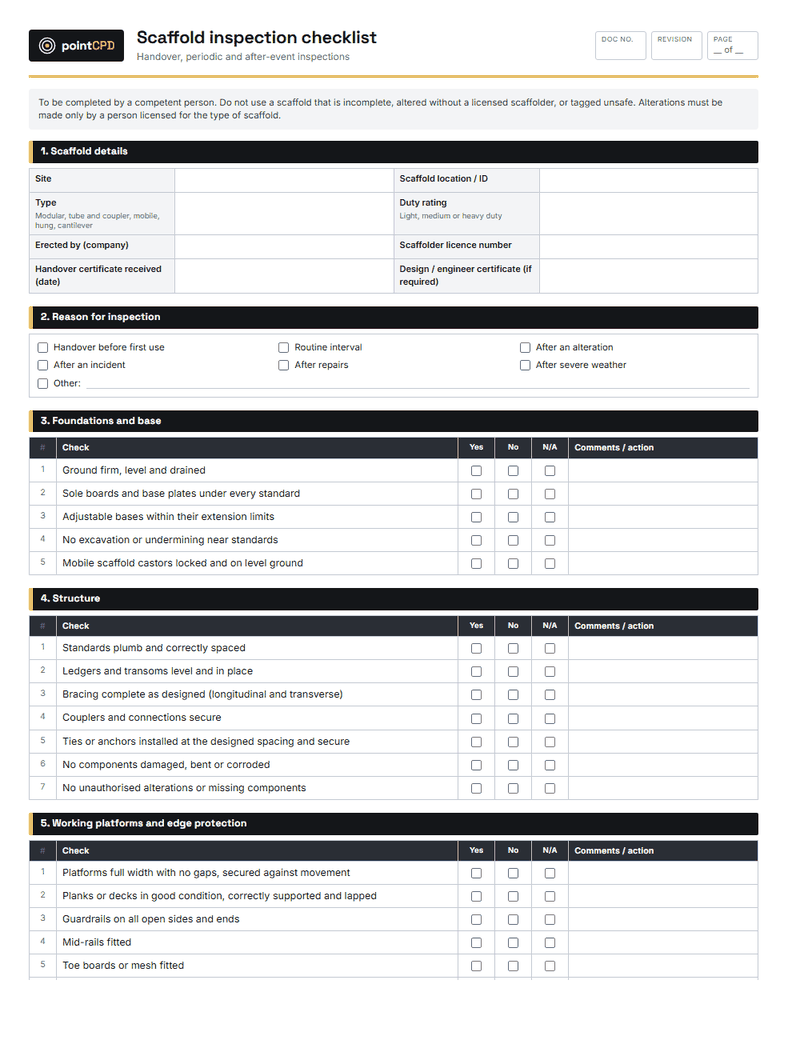
Some things need more than a weekly walk-past. Scaffold must be inspected by a competent person at set intervals and after events that could affect it; use the scaffold inspection checklist for that. Mobile plant needs a pre-start check each shift; use the plant pre-start checklist. The weekly inspection checks those records exist and are current.

Daily checks and weekly inspections

A weekly recorded inspection does not replace the supervisor’s daily look around. The two do different jobs:

Daily walk-aroundWeekly inspection
PurposeCatch today’s changes: removed barriers, new trades, weather damageSystematic check of every control, with a record and actions
TimeTen minutes at start of dayThirty to sixty minutes, with a colleague
RecordSite diary note; issues fixed on the spotThis checklist, with the actions register

The daily check is where most problems are fixed. The weekly inspection is where patterns are found and where the business can show it is monitoring controls over time.

Preparing for a regulator visit

Inspectors from the state WHS regulator visit residential sites, sometimes as part of targeted campaigns on falls, silica or electrical safety. A site that runs regular inspections is usually in good shape when they arrive, because the things they look at are the same things on this checklist: edge protection and scaffold, electrical leads and switchboards, dust control, amenities, and whether SWMS exist for high-risk work and match what is happening. They will also ask for records. Being able to show the last few weekly inspections, with actions closed, demonstrates that safety is managed rather than improvised on the day of the visit.

If an inspector issues a notice, comply with it, fix the issue and record what was done. Use the inspection checklist to check the same issue does not reappear on other sites.
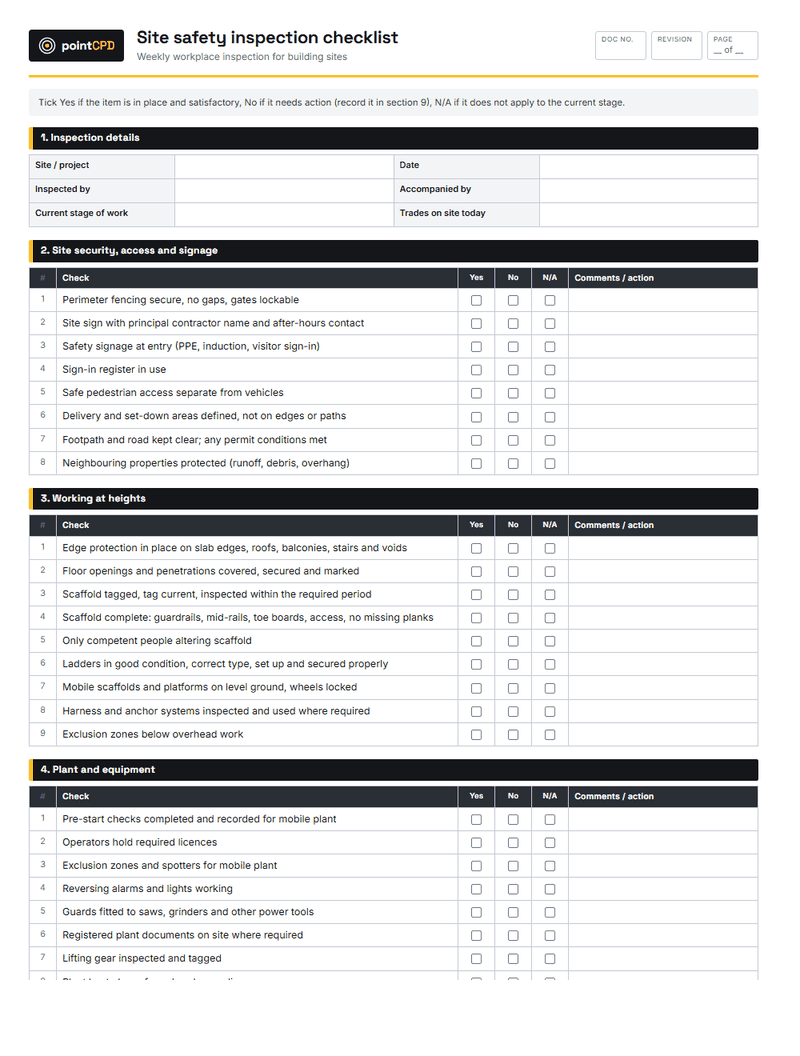
Preview the full Site safety inspection checklist template

Every section, field and check in the download, exactly as it prints. Edit the Word version to add your logo, delete what does not apply and add your own site-specific items.

pointCPD

Site safety inspection checklist

Weekly workplace inspection for building sites

Doc no.
Revision
Page
__ of __

Tick Yes if the item is in place and satisfactory, No if it needs action (record it in section 9), N/A if it does not apply to the current stage.

1. Inspection details

Site / projectDate
Inspected byAccompanied by
Current stage of workTrades on site today

2. Site security, access and signage

#CheckYesNoN/AComments / action
1Perimeter fencing secure, no gaps, gates lockable
2Site sign with principal contractor name and after-hours contact
3Safety signage at entry (PPE, induction, visitor sign-in)
4Sign-in register in use
5Safe pedestrian access separate from vehicles
6Delivery and set-down areas defined, not on edges or paths
7Footpath and road kept clear; any permit conditions met
8Neighbouring properties protected (runoff, debris, overhang)

3. Working at heights

#CheckYesNoN/AComments / action
1Edge protection in place on slab edges, roofs, balconies, stairs and voids
2Floor openings and penetrations covered, secured and marked
3Scaffold tagged, tag current, inspected within the required period
4Scaffold complete: guardrails, mid-rails, toe boards, access, no missing planks
5Only competent people altering scaffold
6Ladders in good condition, correct type, set up and secured properly
7Mobile scaffolds and platforms on level ground, wheels locked
8Harness and anchor systems inspected and used where required
9Exclusion zones below overhead work

4. Plant and equipment

#CheckYesNoN/AComments / action
1Pre-start checks completed and recorded for mobile plant
2Operators hold required licences
3Exclusion zones and spotters for mobile plant
4Reversing alarms and lights working
5Guards fitted to saws, grinders and other power tools
6Registered plant documents on site where required
7Lifting gear inspected and tagged
8Plant kept clear of overhead powerlines

5. Electrical

#CheckYesNoN/AComments / action
1Temporary switchboard secured, weatherproof and labelled
2Residual current devices in use and tested
3Leads and tools tested and tagged, tags current
4Leads elevated off the ground and out of water and traffic
5No damaged leads, plugs or double adaptors
6Overhead and underground services identified and marked

6. Excavations and ground

#CheckYesNoN/AComments / action
1Underground services located before digging (Before You Dig Australia)
2Excavations protected: shoring, benching or battering as designed
3Spoil and materials kept back from edges
4Barriers and signage around excavations
5Safe access and egress from trenches
6Excavations inspected after rain or ground movement

7. Health, hazardous materials and housekeeping

#CheckYesNoN/AComments / action
1Dust controlled at the source when cutting (extraction, water, score-and-snap)
2Respiratory protection available and worn where required
3Asbestos register sighted for existing buildings; suspect material left alone
4Hazardous chemicals stored correctly with current safety data sheets
5Hearing protection used for noisy work
6Heat and sun: shade, water and rest breaks available
7Walkways and work areas clear of rubbish and offcuts
8Nails, reo and sharp edges capped or removed
9Waste bins not overfull; waste separated
10Materials stacked stably and within safe heights
11Adequate lighting for work areas and access

8. First aid, emergency and amenities

#CheckYesNoN/AComments / action
1First aid kit stocked and accessible
2Trained first aider identified
3Emergency plan and contact numbers displayed
4Fire extinguishers in date and accessible, especially near hot work
5Assembly point signed
6Toilets clean and serviced
7Drinking water available
8Meal area and hand-washing available
9SWMS on site for all current high-risk work
10Induction records current for everyone on site

9. Actions required

Item #Issue foundActionRiskOwnerDueClosed

10. Sign-off

Inspector signatureDate
Actions from last inspection closed?Next inspection due
Template by PointCPD · pointcpd.com.au/resources/templates/site-safety-inspection-checklist/Free to use, copy and adapt, including commercially (CC BY 4.0). Keep this credit line.v1.0

Download Word Download PDF

Questions builders ask

How often should a construction site be inspected?

Weekly is a common minimum for a general walk-through, with daily informal checks by the supervisor, extra inspections when a new stage starts, and inspections after storms or incidents. Some items, such as scaffold and certain plant, have their own inspection requirements.

Who should carry out a site safety inspection?

A person who knows the site and the hazards, usually the site supervisor or safety officer. Walking with the health and safety representative or a leading hand improves the inspection and helps meet the duty to consult.

Is a site inspection checklist legally required?

No law prescribes this form, but businesses must monitor their controls and review them when they are not working. A regular recorded inspection is the most practical way to show you do that.

What should happen when an item fails?

Fix high risks immediately, stopping work in the area if necessary. Record every failed item with an action, owner and due date, and check they were closed at the next inspection.

Can I add my own items?

Yes. The Word version is fully editable. Add items specific to your type of work, and remove sections that never apply so the checklist stays quick to use.

How long should inspection records be kept?

Keep them with the project WHS records. They show hazards were being monitored, and the actions column shows what was done about them.

Free to use, adapt and share, including commercially

This template is licensed under Creative Commons Attribution 4.0. Copy it, rebrand it, edit it for your jobs, hand it to clients and subcontractors, or republish it. The one condition: keep the small PointCPD credit line on the document. If you publish it online, credit it like this:

<a href="https://pointcpd.com.au/resources/templates/site-safety-inspection-checklist/">Site safety inspection checklist template</a> by PointCPD, CC BY 4.0

Last reviewed 14 September 2026. A template is a starting point: it becomes a compliant document only once it is completed for the actual job by people who understand the work, and kept current as the work changes. General information, not legal advice. Check the requirements of your state regulator and your contract.

Sources: Model Work Health and Safety Act and Regulations (monitoring and review of controls). Safe Work Australia, Code of Practice: Construction work, Managing the risk of falls at workplaces and Excavation work.